How Could They Move On So Quickly?

move on ex

My ex-husband certainly wasted no time. He didn’t even bother filing for divorce before he married his second (I’m assuming here; there could have been others) wife.

Among all of the myriad thoughts that crashed around my mind in the aftermath of the discovery, one kept popping back up to the surface,

“How could he move on so quickly?”

I just couldn’t understand how he could go from sixteen years with the same person to seemingly head-over-heels within weeks of meeting this new woman. Here he was celebrating his newfound love while I was still struggling to sleep through the night.

Of course, it was apples to oranges trying to equate my mental state at the time with his. For so many reasons, we were at different places when it came to our readiness for moving on.

The following are some of the reasons that your ex may have moved on (or appeared to move on) soon after your breakup:


They have pre-grieved the breakup.

In some situations, one person has known (or at least suspected) that the relationship is over long before it is pronounced terminal. In these cases, the one with the prior knowledge often begins grieving the end of the relationship months or even years before it is truly over. They may begin to withdraw, they might start to expand their social circle and hobbies to fill anticipated gaps and they have time to process the loss. They will be ready to move on before you are because they have been attending to the breakup for a longer period of time.


They want you to think they’ve moved on.

Sometimes moving on is an illusion, a play put on social media or spread through mutual acquaintances in an attempt to make you jealous or regretful. The urge is understandable, although childlike. It can be driven by a, “I’ll show them that I am desirable” attitude. Others try to appear moved on soon after the end of the relationship because they don’t want to be seen as “weak” by appearing affected by the breakup. These people are motivated by a need to be seen as strong.


They are afraid of being alone.

Some people hop from relationship to relationship like life is a rocky river crossing. They cannot stomach the thought of being alone and so they waste no time in lining up the next partner as soon as a relationship implodes. This is less “moving on” and more “grasping on;” they’ll hold onto anyone like a life raft. Learn more about the underlying issues that lead to a fear of being alone.


They are able to compartmentalize your relationship and the new one.

For many us, we cannot enter into a new relationship before we have fully dissected and processed the previous one. Others are able to keep those two processes more separate. It may be that your ex seems to be moving quickly because they are doing the often- invisible internal work concurrent with reentry to the dating scene.


They are using dating as a distraction.

Let’s face it, divorce sucks. And while you’re going through it, you’d rather think about anything else. For some, this distraction comes in the form of dating. Although this can look like they’re moved on, they’re are really using others as a bandaid to temporarily stop the pain. Early dating can also be motivated by the blow to confidence that often accompanies divorce; it’s good to feel wanted.


They started seeing this person before your relationship ended.

If your ex seems to have moved on quickly, it may be that they were having an affair during your relationship and now that your partnership has ended, the love interest is brought to the surface. Of course, this revelation brings with it it’s own set of problems. Betrayal is a uniquely piercing pain with long-ranging repercussions.


They met somebody who is a good fit for them at this point in their lives.

And here’s the hard one – maybe they have met somebody that is a good match for them. I know that can be difficult to stomach when you still might be wishing/hoping/believing that you’re that person. It’s important here to remember that not being the right person for them does not mean that you’re a bad person and it certainly does not mean that you’re not the right person for someone else. It simply means that your ex found a better match for them and now you have an opportunity to look for somebody better for you.


In my ex’s case, he knew that the end was approaching and so had time to process the divorce long before it happened. He was having affairs and so his other wife was lined up and ready to go. And, from what I learned, she was a good fit for him at the time – trusting, nomadic and in possession of a decent credit score.

In time, I no longer questioned how he could move on so quickly. Instead, I got busy with moving on myself with a sense of gratitude that she helped to take him out of my life and far away.


 

Benefits of Traveling Outside Your Comfort Zone

comfort zone

images-33

I had two choices for my morning run today – the relative comfort of a treadmill in my dry and air-conditioned gym or the muddy trails of a nearby park in the rain and oppressive mugginess that blankets the east coast in the warm months.

I debated for a few moments, considered how miserable I would likely be on an outdoor run as I struggled to breathe in air that was more water than oxygen and how tempting it was to remain in the manufactured comfort of air-conditioned space.

After swallowing the last of my coffee, I went downstairs and selected my trail-running shoes, opting for the less comfortable option. At the beginning of the trail, I questioned my choice. The sweat was already soaking through my shirt, my lungs were threatening to wheeze and a strange guy on the relatively empty trail caused me to grip the mace I carry just a little tighter.

But then after the first mile, I began to find my stride. The moisture in the air became less noticeable, my breathing began to acclimate and the weird guy stayed weird, but also stayed back. And by the time I made it back to my car, looking like I had just completed a mud run complete with a culminating dunk in a body of water, I was happy that I chose the less comfortable route.

images-36


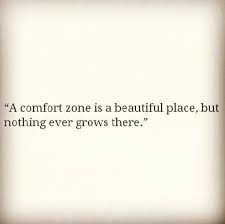
Which are you more likely to regret – the step that takes you out of your comfort zone or the inaction that keeps you there?


We all like to be comfortable. All of us fear the unknown and to some extent, shudder at the thought of potential failure. We shy away from experiencing any sensation that could be labeled as unpleasant. All of us have become experts at crafting and disseminating excuses that give us permission to maintain the status quo, telling ourselves stories to justify our inaction and our conclusions.

images-34

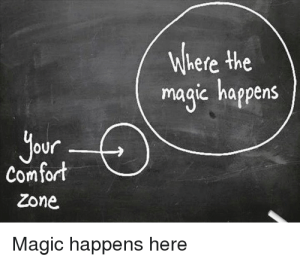
Life – real life – happens outside your comfort zone.


When we take steps outside our comfort zone, we are granted permission to fail.

Once you’ve been labeled “good” at something, you are expected to perform at a certain level every single time. In contrast, when something is brand new to you, any failure is somehow less personal and more situational. That makes it much easier to face.


When we take steps outside our comfort zone, we are allowed to be unsure.

I don’t know about you, but I always feel pressure to appear confident about my decisions and my actions. I feel like this is one of the great lies of adulting. When we were little, we assumed that adults knew what they were doing. Only now, we’re the grown ones and we’re just faking it. When you’re doing something new, you’re allowed to reveal that insecurity.


images-32

When we take steps outside our comfort zone, small achievements are recognized and celebrated.

When you were a baby, your every “first” was marked and even memorialized. That recognition of small successes often fades as we age. When you’re outside your comfort zone, you are far more aware of those “firsts” and mark them of signs of growth.


When we take steps outside our comfort zone, we have fewer expectations from ourselves or from others.

Expectations can be powerful limiters. Just look at those studies where teachers of completely average classes were either told that their children were brilliant or behind. The children performed not based on their ability, but according to their teacher’s expectations. And in our day-to-day lives, we are just as likely to limit ourselves with claims of, “I can’t.” When we take that step outside of our comfort zone, we are instead asking, “But what if I can…?”

our-comfort-zone-where-the-magic-happens-magic-happens-here-18784279


When we take steps outside our comfort zone, assumptions – and beliefs – are challenged and often adjusted.

WE often reach conclusions based on what we experience. So the more limited your experiences, the less-informed and potentially more biased your assumptions will be. When we meet new people and experience new ways of seeing the world, we are forced to re-examine and maybe even readjust our beliefs.


When we take steps outside our comfort zone, learning combats frustration born of stagnation.

Humans get bored. Just watch a modern queue and take notice of how many people are engaged in their phones to avoid a few minutes of idle and purposeless time. The same thing happens on a larger scale. We thrive on novelty, on challenge. When there is nothing left to learn, we become stagnant and then frustrated. The space outside a comfort zone offers unlimited opportunities for learning.

images-35


When we take steps outside our comfort zone, curiosity dominates and inspires wonder.

Have you ever watched a kid in a new environment? A place that is known to you suddenly becomes alive with possibility when seen through their eyes. Our brains have literally evolved to disregard that which is too ordinary. And when your life is spent entirely within a comfort zone, you risk having your brain ignore it all. Newness encourages our brains to wake up and pay attention, bringing with it a childish sense of exploration and wonder.


When we take steps outside our comfort zone, we allow space for authenticity and purpose.

We all-too-often become our labels – mother, father, caretaker, employee, etc. We forget who we really are and what really inspires us and drives us. When we leave our comfort zone, we often discard those labels for a period of time, allowing us the the opportunity to discover what is really important to us.


images-37


Common Challenges in Post-Divorce Relationships

relationships dating divorce

Post-divorce relationships are often where the fears of experiencing heartbreak again collide with the hope and heady infatuation of early attachment. These opposing emotional forces, along with any lingering unresolved divorce issues, present certain common challenges in relationships entered into after one or both parties experienced divorce.


You meet the right person at the wrong time.

Finding a good match is as much about the timing as it is the person. You may encounter somebody who radiates potential, but if either one of you is not yet ready for a relationship, that potential has to be put on hold. It can be tempting to try to push it; to discount the warning signs that there is still healing work to be done. It’s scary and disheartening to release the possibility of a connection when you have been feeling alone and afraid of finding somebody. Yet sometimes, accepting that the timing isn’t right is exactly what is needed so that you’re not pouring energy into a relationship that is built on unstable ground.


You carry over blame or suspicion meant for your ex to your new partner.

If your ex behaved badly, you may be primed to assume that your new partner is also up to something whenever your back is turned. Instead of coming from a place of innocent until proven guilty, you may be operating from a place of assumed guilt where you’re looking for evidence to support your beliefs. This is easy to do. If you’ve been fooled once by a liar or a cheater, you don’t want to ever experience that humiliation and betrayal again. However, there is a big difference between staying alert for bad behavior and assuming that bad behavior is occurring.


A fear of further heartbreak or relationship failure hinders – or prematurely ends – the relationship.

The pain that comes from the end of a relationship is brutal and it’s only natural that we act to avoid experiencing similar heartbreak again. A healthy approach to this is to address the factors that led to the divorce and to learn to accept that sometimes relationships serve their purpose and come to an end. Yet, more commonly, the fear of further pain prompts a person to leave before they’re left, making an exit before the attachment – and the predicted pain – becomes too strong.


You expect the new relationship to be as intimate and fulfilling as a marriage from the very beginning.

After divorce, the loneliness and isolation are gutting. So when you meet someone and feel those initial sparks fly, you become hopeful that the loneliness is over and that you again have someone that will truly see and appreciate you. Yet, this neglects to acknowledge that building a relationship and a shared history takes time. It’s not fair to expect that level of a connection in the beginning; you have to provide it with the opportunity to grow.


You are expecting the new relationship to heal you and to fill in the gaping void you’ve felt since divorce.

If you believe Hollywood, all you need is the right person to come into your life when you’re down and everything will be better. There’s a reason that these stories are presented as fiction; it doesn’t happen that way. There are certain post-divorce wounds that can only be healed within the context of a relationship (not necessarily a romantic one), but the work is still yours to do.


You are afraid of being open and vulnerable again, so you only let them in so much before the walls come up.

When we’re afraid, sometimes we fight, sometimes we flee, and sometimes we simply freeze. The latter is what happens when you feel too exposed in a new relationship and so you tuck yourself away behind carefully constructed barricades, built in an attempt to protect the heart from further assault. Although this strategy does limit risk, it also inhibits growth and fulfillment. It’s much like an attempt to learn to swim while refusing to get out of the shallow end of the pool.


You mistake the intensity of early attraction as the sign that you’ve found the “right one.”

In a long marriage, the intensity of the initial attraction inevitably fades over time. And so when you experience that jolt of biochemical desire again, it sends a powerful message. It’s easy to interpret this common biological response as a sign that this is the right person for you. By all means, enjoy the surge of passion and excitement, yet refrain from making any major decisions until you’ve given your body chemistry time to normalize.


You overreact to benign situations because it triggers memories from your marriage.

There will be times when you and your new partner are reading from different scripts. They may think that you’re arguing over something in the present while you’re whisked backwards in time and replaying a role from your marriage. These moments are challenging in a new relationship because the person who is triggered is flooded with emotion and if that continues unaddressed, it threatens to drown the new partnership as well.


You grasp onto a relationship that isn’t working because you want to avoid another ending.

Sometimes, we fall prey to the belief that someone is better than no-one. We will grasp onto a relationship not because we love the person, but because we fear being without a person. This is one of the main reasons for the advice to spend some time single before you enter into a new relationship. If you know that you’re okay alone, you’re much less likely to stay with somebody just for the sake of being coupled.


You attribute everything that was wrong in your marriage to your ex and expect everything to be instantly better with a new person.

Choosing the right person is certainly important. But it’s not everything. No matter what went wrong in your marriage, it is your responsibility to identify and address areas where you can do better. If you don’t, you may find that similar patterns continue to play out in future relationships, no matter who you choose to partner with.


Jealousy of former partners or relationships poisons the new connection.

It can be strange entering into a relationship with somebody that had an entirely other life – and love(s) – before you. It can be threatening to see evidence of this former life. Depending upon the situation, ex-spouses may even be a part of the new relationship. It takes a certain amount of maturity to recognize and accept that these early loves can coexist with your new one.


You compare your new partner to your ex.

It’s only natural to compare two different people who fill a similar role in your life. Yet comparison can be damaging if it impedes on your new partner’s ability to be accepted as their own person with their own inherent strengths and weaknesses. They will not be the same as your ex. In some facets, they will be a dramatic improvement and in others, they may be lacking. It’s up to you to select someone who has the characteristics that you deem critical and it’s up to you to not expect them to meet all of the positive traits that your ex possessed.


You experience an increased complexity in joining established lives.

If you married young, commingling two lives was probably relatively simple. That’s not the case in post-divorce relationships, with their higher bank accounts and debts, increased responsibilities and commitments and maybe even children or an ex that is still in the picture because of shared responsibilities. These external demands and restrictions are very real and can add a significant amount of challenge to a post-divorce relationship.


Common relationship challenges and transition points cause panic that the end is nearing.

Especially if the end of your marriage came as a surprise, you may find yourself panicking anytime your new relationship hits a rocky patch. This is tricky, because you want to take these signs seriously, yet if you overreact, you may end up sabotaging what you’re trying to save. It may take some practice to approach these issues with the right amount of energy and attention.


None of these common post-divorce challenges are insurmountable. Love after divorce is not only possible, you may even find that it’s better than before.


11 Tips to Make Friends As an Introverted Adult

make friends

I watch friendships form every day. I see the new kids slink through the halls and into the classrooms on their first day, both wanting to be invisible and also yearning for recognition and acceptance. Their first interactions with the other kids are often uncomfortable, but within the span of a week, most of the new students no longer stand out as different.

It’s easy to make friends in childhood. School provides both the structure and freedom needed for relationships to develop. Classes and lunch schedules allow for repeated exposure to the same people so that familiarity easily builds. The down time in the halls and the lunch room provides an easy opening for exploration and banter, often centered on the shared experience of school.

It’s not as easy to make friends as an adult.

Especially as an introverted one.

Introverts can easily underestimate the importance of friendships. After all, we don’t feel the same intense pull towards others that our more extroverted brethren experience. Our social groups are smaller, our interactions fewer. The need for time alone is often more pressing than the need for connection.

And yet, we need friends just as much as the gregarious. Loneliness and a lack of human connection has been associated with both lower mental and physical well-being. We introverted ones may treat friendships as a nicety, but they are really a necessity.

Introverts tend to be adept at maintaining already established friendships, especially with people that are understanding of their periodic need for hibernation. But when life circumstances remove those familiar relationships, introverts can stall in the quest to create – and build – new friendships.

So how can introverts make friends in adulthood?

Adult life doesn’t easily provide the nutrient-rich agar that friendships feed off of. We may encounter others sporadically or only with a task-oriented goal in mind. There are no teachers or counselors to intervene on our behalf, requesting that others extend a hand.

By the time we’re old enough to rent a car, we have become quite comfortable with the room within our own minds and, as independent beings, have the opportunity to curl up and stay there. This natural introversion can come across as cold or uncaring, leading to further isolation.

But with just a few tweaks and adjustments, even the most introverted can find and nurture new friendships.


Accept that you will be uncomfortable sometimes.

Like most introverts, I am comfortable in my own home. My own room. My own head.

But that’s not where potential friends reside. In order to meet people, you will have to leave your comfort zone. You will be in environments that may feel overwhelming. You will be asked to stretch beyond your unusual routine. Learn to distinguish between ordinary discomfort and your intuition telling you that something is amiss. Refuse to pander to the former and what was once unsettling will become easier to navigate.


1 – Seek out one-to-one or (very) small group interactions.

Play to your strengths. You likely find large groups of people draining and even isolating. While an extrovert may throw a party to meet new people, you’ll be better served by inviting an acquaintance to coffee.

Recognize the numerical tipping point where you go from. “I like this” to “This is too much” and strive to keep your social interactions within that limit. When you do find yourself in a big group, try to find or create a smaller, more intimate gathering within (or just beyond) the masses.


2 – Say yes.

I know your book is calling. I know that you crave the solitude of your bed after a crazy day. It’s easy to make excuses to those invites that find there way to you. To beg off those intrusions on your peace.

Make a promise to yourself to say “Yes” to a certain number of invitations every month. The gathering may not exactly be your cup of tea (again, you will be uncomfortable sometimes), but you’re opening the door to allowing someone in. And you never know, they just might become a friend.


3 – Plan for buffer zones.

If Maslow had written a hierarchy of needs for the introvert, alone time would certainly be on the lower rungs. In order to both maintain your sanity and to ensure that you’re at your best in social situations, plan for some down time both before and after any taxing interactions.

You may be surprised how minimal these need to be in order to be effective. Try wearing headphones to block out others on your daily commute or diving into a book for five minutes in the parking lot before you exit your car.


4 – Strive for repeated and frequent exposure.

Familiarity breeds friendships. You cannot make a friend in just one encounter. If you meet someone and they pique your interest, look for a way to see them again soon. If you’re trying to meet others, seek out environments where you encounter the same (manageable-sized) group on a frequent basis.

Repetition is especially important in the beginning of a friendship. You may need to have more contact than you usually prefer in the early stages in order to get the relationship off the ground.


5 – Practice extending invites.

I’m good about saying “Yes” to invites, but not as good at initiating them. And since I have a lot of introverted friends, we can easily go quite a long time without contact.

Look for opportunities to extend an invitation. Instead of falling to your default position of doing things alone, see if somebody wants to join. It may feel awkward at first to ask, but often that effort is needed to create the frequency of contact needed for friendship.


6 – Use technology wisely.

On the one hand, the internet and texting technology has been a boon for introverts. After all, we can now “talk” to others without ever leaving our home. On the other hand, it can easily provide an excuse to not have meaningful connections with others as we hide behind our screens.

Use technology as an assist, not an excuse. Send an invite through text. Find potential friends through an online interest group. And then put the phone down and talk to the person. In person.


7 – Find your niche.

If you find small talk awkward and annoying, you may find it easier to meet potential friends that already share an interest of yours.

Introverts often have passions and hobbies that are largely solo activities – writing, model-building, gaming, etc. Since you may not meet others simply by engaging in your interests, it will take some extra effort to find others that share your enthusiasm.


8 – Look outside your familiars.

When we’re in school, our friends largely mirror us. They tend to be of a similar age, background and social class. As adults, we are not limited by the factors that guide childhood friendships.

We find it easier to identify with and bond with those that are superficially like us, but sometimes the best friendships can be formed with apparent opposites.


9 – Identify and manage any social anxiety.

Introversion and social anxiety are no the same thing (the former deals with how you recharge your energy and the latter comes from a fear of “what ifs”), but they can go hand-in-hand.

Recognize if you have any signs of social anxiety that are making it more difficult for you to make friends. Anxiety can be managed and inaction often serves to only allow it to grow.


10 – Communicate your needs.

Your budding friends may not recognize you as an introvert or may be unfamiliar with the needs of the more introspective set. Be upfront with your need for alone time and be clear that it has nothing to do with your like – or dislike – of another.

People are going to respond much more favorably to an explanation of a need for solitude than to constant brush-offs or unanswered texts. Additionally, if you sometimes need a nudge to get you out of the house, let that be known as well.


11 – Maintain your intention.

As an introvert, you need your time alone. Yet you also need meaningful human connection. Once you determine how much you require of each in order to be happy and healthy, make maintaining that balance a priority.


Related –  An Open Letter to Extroverts: What the Introverts in Your Life Want You to Know


How to Survive “Transplant Shock” After Divorce

transplant shock

It was a gift, a full and beautiful French hydrangea, with it’s startling blue pom-poms of flowers perched above the simple white wrapping over the pot. I placed it on a counter, where it was out of the reach of the dogs, and for several weeks, I tended to it carefully with the enclosed fertilizer packet and a carefully metered watering schedule. In return, I was awarded with stunning and tenacious blooms for many days.

Then, so slowly that it was hard to notice at first, the plant began to languish. New buds were no longer forming and the ones that held tight were beginning to turn to parchment with age. The leaves, once a deep, leathery green, began to yellow, their pallor hinting at ill health.

At this point, I was a complete neophyte when it came to plant care. So, I turned to the wisdom held on the shelves of my public library combined with the practical advice delivered by a seasoned gardener who was volunteering at the library that day. I learned that the gifted shrub would only survive for a brief period in its small pot but that, luckily, it was suited to the climate found in Atlanta. I was instructed to purchase some planting soil, pick a suitable spot in my yard, and transfer the plant to its new home where, I was assured, it would thrive.

I followed the instructions as I understood them, holding visions of a huge hydrangea soon becoming the stunning focal point of my tired front yard.

Instead, I found myself pulling its skeletal remains from the earth a mere four weeks after planting. In my ignorance and haste, I had failed to adequately protect my charge against transplant shock, and it succumbed to the stress.

Years later, I again thought of that little plant. I, too, had gone from being in full-flower, content in my small world, to suddenly being ripped out and forced into a new – and harsher – environment. In the interim, I had become a competent gardener, successfully transplanting many plants. Now, it was necessary for me to apply that knowledge to myself so that I could survive the transplant shock after divorce.


Timing Matters

With plants, it’s best to move them during their more dormant season and when they will not face the additional stress of extreme weather conditions. When it comes to divorce, we may not have the option to make the move at a time when the rest of life is relatively inert, so we have to be mindful of the additional pressures the timing may entail. As much as possible, try to push the pause button on the non-essential demands for the short term, so that you can direct your energies to getting settled in your new space.


Be Mindful About Placement

One of the many mistakes I made with my first hydrangea was siting it where it received afternoon sun, a death sentence for this shrub in the south. I almost made a similar mistake with myself, placing myself in an environment – alone in a rental – where I would receive too little social connection. Instead, I resided with a dear friend, where I had the connection and sanctuary I needed. Don’t worry about what others say you’re “supposed” to do or the mental image you’ve held for this life stage, place yourself where you will thrive.


Add a Little Bit of the Old

When I moved my little shrub that day, I carefully brushed away as much of the old soil as I could, thinking that it was stale and barren and needed to be replaced with completely new earth. Except that new soil was a huge blow to the struggling roots, with nothing familiar to comfort them, they simply froze from the shock. We’re not that different. When everything is new, we have nothing to rely on as we begin our exploration. Keep some things constant as you move from your old life to the new.


Provide Plenty of Water

It turns out that stressed plants need more water. They’ve not yet acclimated to their site, so they’re not yet completely efficient and the growth of new roots requires plenty of moisture. We also have a tendency to need more of the things that sustain us during a period of translate shock. We require more attention, more sleep and more support.


Don’t Try to Grow Too Fast

I fell for the advertising. While purchasing the planting soil for my little shrub, I picked up a gardening magazine from the checkout line. A two-page advertisement showed a glorious hedge of hydrangeas with the tagline, “Brought to you by Miracle Grow.” So, of course, I added the fertilizer to my cart and liberally applied to over the next two weeks. It was a huge mistake. I was forcing the plant to put out new stems and leaves while the rootball beneath the soil was still too small to support the new growth. We can easily fall into the same trap after divorce. The deep work, the root work, that we need to do to thrive isn’t fun. It isn’t sexy or beautiful. It’s easy to try to spread out too far, too fast and ignore what anchors us. And, just like the plant, it cannot be supported long term.


Loosen the Barriers

I probably killed that plant in fifteen different ways. When I finally removed its remains, I saw evidence of some root growth. To a point. I had made the planting hole too small and the roots had stopped growing once they reached the barrier of the rock-hard Georgia red clay. Sometimes, after divorce, we can find ourselves in a pocket of compassion and intervention and then once the empathy and concern of others begins to fade, we feel as though we’re up against a rock wall of indifference. Strive to integrate those barriers so that support is slowly decreased as you gain your strength.


Patience

So many of my mistakes with my little shrub were made out of impatience. I wanted it to be fully grown. Like yesterday. But, as with anything, there are no shortcuts. Instead, it’s a process of trial and error, adaptation and setbacks, and learning from each mistake. Only then, and with time, will the blooms return in full.

bloom-1851481__480