Broken Windows

Broken windows theory
Broken windows theory (Photo credit: Roel Wijnants)

I need to fix my broken windows.

Not literal windows, luckily, since it’s been snowing for the past two days in Atlanta, but metaphorical windows. The types of fractured panes that, if you subscribe to the broken window theory, will lead to greater calamity if left unrepaired. Unlike the criminological perspective of the original theory, I am not concerned about increased vandalism or an uptick of violent crime in my actual or figurative home, but I am concerned about a cascade effect if I don’t make the minor repairs now.

Brock and I currently reside in a rental home. We selected the home because we love the location and the space and price suits our needs. However, the state of the house is a bit…rough. It’s been a rental for many years with no major updates or repairs. The floors are poorly laid. The nails and screws form connect-the-dots pictures on the walls. None of the interior doors lock and none of the fixtures match and none of them work particularly well, either. Apart from painting a few rooms upon moving in 16 months ago, we have not put much effort into the home, not wanting to waste time or money on a temporary stay. Even with those restrictions, we still settled in to some degree, hung pictures on the walls and curtains on the windows.

We plan to buy a house next winterish (for those of you unfamiliar with the season, it begins in October and continues until the last of the sweaters are put away). I’m ready. I’ve lived in temporary housing for the past 4 years after owning a home for the previous 10. I’m tired of feeling unmoored. I want to put down roots and put down new floors.

In my old life, my physical space was very important to me. My stress levels and ability to relax were directly tied in to my surroundings. My ex was helpful with this. He graciously helped me redo my office between work commitments when I was desperate for a change of scenery after completing my master’s degree. In my new life, I have had to learn to be content despite my surroundings. I’ve lived in a spare bedroom in a home with a young kid and lots of clutter. I moved into Brock’s space for a time and had to carve out my niche in a bachelor’s domain. And now, I am in this rental, with all its marks of tenants past.

It’s been 16 months. A picture has fallen off my office wall. It now sits in a corner awaiting a new nail that I have yet to hammer in. My cork wall tiles have been leaping off like lemmings and, now that I’ve tired of trying to convince them not to jump, rest stacked in a pile on my printer. I have a jacket that lives on the floor of the guest room closet because I never transferred any hangers to that room.

These are details. Unimportant in many ways. But they are also broken windows.

This is my home. It’s not permanent (is anything?) but it is home for now. If I ignore these minor fixes, I am allowing myself to not be present in my current environment. I am making do and making plans, rather than being in my surroundings. If I allow myself to agree that these details don’t matter, what will not matter next?

I’m not going to go Martha Stewart on my house (after all, I do see perfection in my chipped plates!), but I am going to take a few moments over spring break to restore the wall hangings and transfer a few hangers. Although I am looking forward to purchasing a home, I am not going to let myself live in the home of next winterish while I am still in the present season. So I will fix those broken windows and appreciate their view. Even through the torn screens:)
Ghosts of Christmas

Christmas can be such a polarizing season. Some people are enraptured by the sights and sounds, while others, lamenting what they have lost or never had, fall into despair. Why is it that a holiday can have so much power to drive our emotions? Why are some okay with their lives from January through November, but then feel despondent about their lot when the month clicks over to 12? Why do others allow stress to accumulate throughout the month, only releasing it with the ribbons on Christmas mornings? How is it that a holiday that emphasizes togetherness creates intense loneliness in so many?

It’s simple, really. There is no other time of the year as fraught with expectations as Christmas. And loneliness, stress, and disappointment hitch a ride on those expectations, sliding into our minds undetected. We can choose not to welcome them. We can use awareness to exorcise the ghosts of Christmas’s past and future, allowing ourselves to embrace the present and whatever gifts it brings.

Ghosts of Christmas Past

When I was young, I spent Christmas with both my parents. As with all families, we had rituals and traditions. I remember my mom making pineapple ham and my dad coming in from a bike ride, the smell of sweat blending with the scent of the pine needles on the tree. I remember the Christmas eve church services, with me squirming between them awaiting the tradition of opening one gift that night upon our return. I can picture our rides through town, viewing the lights in the trees and luminaries that lined the streets.

And then we were two. My parents divorced and my dad moved across the country. It took us some time to find our stride. Those first couple years felt empty; traditions carried out even though a critical member of the team was missing. We tried to keep it the same, fought against the inevitable change. It didn’t work. It never does.

Eventually, we created our own traditions, some carried through and some newly invented. We had a family friend join us for celebrations, her energy completing the triad. We took trips. We celebrated with other families. Sometimes we had money. Often we did not. But it didn’t matter. We let go of Christmases past and, in doing so, created wonderful Christmases in the present.

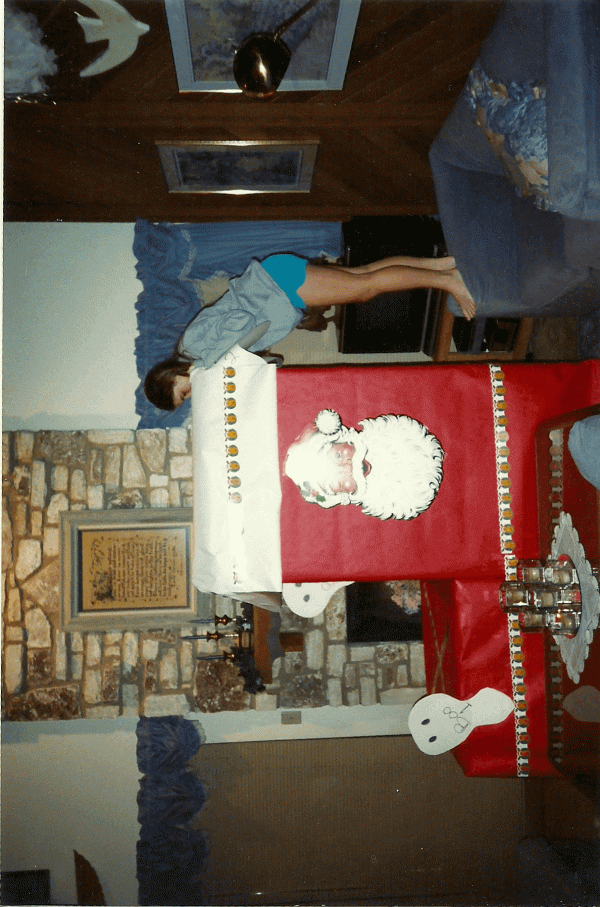
Scan 1

This was one of my favorite Christmases. My mom obtained and wrapped a refrigerator box and a washing machine box and assembled them to make a stocking. I was shocked when I woke up that morning and, at 16, it took a lot to impress me. Our family friend joined us and they both had fun laughing at me as I crawled through the endless “stuffing” that filled the stocking and surrounding wrapped gifts, many of which were inexpensive. This was a great example of how creativity and attitude matters more than money.

I’m thankful for those childhood experiences. They taught me to be flexible and to work within the present reality. As I entered into married life, my husband and I followed a similar model. We were lucky enough to be “adopted” by various families over the years. On some Christmases we traveled, and some we did not. Sometimes we saw family; more often we were devoid of blood relatives. Each year was different. And each year was wonderful in its own way.

Christmas
At my ex-in law’s on Christmas in 2001.

If you have children, realize that your attitude towards the holiday is more important than any traditions. If your family has changed, it is futile to try to recreate the Christmases of the past. But that doesn’t mean that your Christmas cannot still be wonderful.

Ghosts of Christmas Future

Not everyone is haunted by the past. Some people’s expectations are fixated on the future. It is easy to allow expectations to build. We expect Uncle Bobby to act differently than he usually does and we get stressed when his good behavior fails to manifest. We picture perfect children, gleaming and squealing in glee. We envision a table piled high with delectable goodies worthy of Martha Stewart’s kitchen. We allow our minds to ponder what glorious gifts might lie just beneath the wrappings. We watch movies filled with perfect families and see commercials pushing items, implying that they will make your life perfect as well.

christmas dinner at my mom's house

These daydreams may be pleasant, but they have a dark side. Unless you are visiting Martha, the spread will not be perfect. Your kids will inevitably allow grouchiness to overcome them by afternoon. You will probably not find the winning lottery ticket in you stocking. In other words, Christmas will be real. It is easy to become disappointed when we allow our expectations to grow well beyond our realities.

The ghost of Christmas future is often hardest on those who are or feel alone. The divorced parent who does not have custody over the holiday. The single person without family in town. At no time can you feel more alone than during a holiday that celebrates togetherness. But, you are only alone if you allow yourself to be. Let others know you do not have a family to celebrate with; the offers will likely come. Some of my best Christmases were spent with the families of friends or employers. If you’re willing to speak up and be vulnerable, you will find an open home and open hearts. They may not be family, but they are family for the day and sometimes that is enough.

Volunteers

If you prefer not to join another’s celebration, look for volunteer opportunities through church or Meetup.com. Helping others is a surefire way to get your mind off your own troubles. It may feel as though the whole world is paired up or celebrating with family, but that’s just the message, not the reality. You have choice in the matter. You can choose to suffer or you can choose to smile.

The Gift of Christmas Present

This year, my home will be full of family, yet none of them are related to my fiance or me. There is no tree in our  living room, nor lights on our house. I will be serving a vegetarian spread with nary a ham hock to be found. The kitchen will be messy and the plates will be mismatched (and chipped!). But there will be laughter and games. Friendship and smiles.

It won’t be like the Christmases of the past nor will it be a celebration in an imagined future. Rather, it will be the Christmas of now. Exactly as it should be. Let go of the ghosts lamenting the past and brush of those whispering of an imagined future and be with the Christmas of the present.

I wish you and your loved ones a happy (and real) holiday:)

I Can’t, I Won’t, I Don’t and I’ll Never

  I really did have a great marriage.  In retrospect, though, I’ve realized that he never really challenged me.  I am not saying that as a dig against him, or claiming that the responsibility was his, it is just how it was.  I could easily say “I can’t, I won’t, I don’t or I’ll never” and he never questioned it.  It was comfortable.  I developed a rather static view of myself, content to be what I was in many areas.  I did push myself, but only in areas where I was comfortable pushing (which are never the areas that need improvement, are they?).  Even though this was a lesson I didn’t want to learn, I  learned the value in pushing oneself in the areas that cause discomfort.  It just might surprise you (as it did me) how many of those, “I wont’s” become “I can’t wait to’s.”

Here are some  of the items that were on my “can’t” list that are now on my “bring it on” list:

-riding a motorcycle (sorry, mom!)

-running a race (warning – these are addictive)

-eating spicy foods (I now have to restock chili powder and Tabasco every couple weeks)

-enjoying sports (don’t mention last week’s playoffs…)

-learning to play chess (I’m still pretty crummy, but it’s progress)

-kissing another man (strange at first, but not too hard to get used to)

-cooking (see “I’m Not Martha Stewart…”

-having a dog again (you’ll hear more about this one later)

-trusting again

-loving again

It is not the responsibility of those in our life to push and challenge us; it is something we must take on ourselves.  As a teacher, I am fully aware that growth occurs when I keep the students slightly uncomfortable, just a little beyond where they want to go.  Likewise, we can grow when we take ourselves beyond what we think we can do.  What can you transfer from your “I can’t, I won’t, I don’t, and I’ll never” list?  How can you challenge yourself?