Facing Divorce? Here’s What You NEED to Know

need to know

Is divorce in your future? Here’s what you need to know!

  1. Your brain won’t work right for a while. You’ll fear that the affected thinking is permanent. It’s not. But invest in notepads in the meantime because you’ll need to write everything down. Your brain is sluggish because it is recovering from a TLI – Traumatic Life Injury. It will get better.
  2. When you see seemingly happy families or couples, you’ll experience jealousy like you’ve never imagined, your brain throwing toddler-like temper tantrums of, “It’s not fair.” Sometimes it’s easiest to give them a little distance until your envy fades. And in the meantime, watch or read about people that have it worse than you.IMG_4619
  3. Your body will change. You may gain or lose weight, depending upon your personal dietary response to stress. Wrinkles and gray hairs may suddenly appear or increase in number. You will catch every cold and digestion will be impaired. Protect your sleep, eat your veggies and buy a new belt.
  4. At some point, you will have a sexual dream or fantasy about your ex. And you will go from feeling both titillated and comfortable to being repulsed and unsure. You will wonder how you ever found him or her attractive. Take a lesson from preteens and develop safe crushes and fantasies on famous people. It helps to reassure you that you’re not dead while protecting you from fantasizing about your ex or encouraging you to get between the sheets with another before you’re ready. And the first time you do engage with a new partner? You’ll feel like you’re cheating. IMG_4610
  5. You will be memory slammed. And it will happen just when you feel as though you’ve made progress and when your mind is other places. And it will feel as though you’ve caught a bowling ball launched by Babe Ruth with your gut. Keep breathing. It will fade.
  6. The court process will be worse than you ever imagined. But at the same time, it will be much less important than you believe. You will give the paperwork and the process too much power over you. And you will only realize that misappropriation of significance after it’s over.IMG_4646
  7. Your brain will become your worst enemy, offering up, “What ifs” and rudely bringing up painful memories just as you’re trying to get your sh*t together. You don’t have to indulge its every whim. Try exhausting it or distracting it, much like you would with an unruly toddler.
  8. You will experience a false dawn, a period where you feel excited and “over it.” And you will be angry when others caution you that it’s too soon. As much as you want them to be wrong, you will soon learn that they are right, when you come crashing down again. Even though this respite is brief, let it fill you with hope.IMG_4623
  9. Over time, you will start to see the person you were before the divorce as a separate entity. A different person. A foreign person. You will speak of your life in two chapters – before and after. And as you move further into your new chapter, the pain of the old begins to fade.
  10. As the immediate emotions of fear and anger and despair begin to soften, frustration will move in. You will feel stuck and wonder why you can’t just be done with it already. You will feel embarrassed that you’re still struggling, believing that you should be done by now. Sometimes this is harder than the initial pain because your rational brain is being held hostage and is fighting against the restraints. Escape takes time. Stay with it.IMG_4616
  11. You will be okay. I promise:)IMG_4652

My First-Ever New Year’s Resolution

I’m generally not a fan of resolutions – they generally aim too high, lack staying power and lead to feelings of guilt and failure when they inevitably crash and burn.

But this year, I’m ignoring my own advice and I’m committing to a resolution for the New Year.

A resolution inspired by watching my husband over the past few days.

—–

The day after Christmas found us on a plane leaving warm and soggy Atlanta to travel to not-quite-as-warm-but-equally-soggy Baltimore for a few days of football (Go Ravens!), family (his) and crab cakes (all his!).

And my husband loves his crab cakes. On this visit, like every visit to Maryland, he consumed crab for breakfast, lunch, dinner and snack. Every bowl of soup was upended to reach every last drop. Each plate that held a precious crab cake was scraped or licked clean. Every last morsel was consumed with passion and purpose.

It was a beautiful thing.

In those moments, he was not concerned with the head-shaking that others may engage in when observing a soup bowl turned into a mug. He didn’t exercise restraint, metering out the bites like little crab crumbs left to mark a trail.

He ate with full-force gusto.

Which is also how he lives.

—–

My resolution for the New Year is to become a plate-licker. Probably not literally, because I rarely see the bottom of a plate, but in attitude. To worry less about restraint and instead, focus more on the pleasure in the moment. To celebrate hedonism in the small things without concern for what others think I should be doing.

And to realize that happiness and joy is not a finite resource that must be parceled out in order to last.

Happy New Year!

In 2015, I presented a challenge – to my readers and to myself – in place of a resolution. How did you do? I’m still working on mine:)

8 Positive Life Events That Can Stress Your Relationship

We often underestimate stress. Not the frenetic energy of the I-have-a-deadline-to-meet panic or the constant fear of how the bills are going to get paid this month.

But the other stress. The good stress. The stress that sneaks in alongside positive life events. The occurrences we hope for, pray for and plan for.

Only to be surprised when the desired event is served with an unwanted heaping side of stress.

And sometimes that stress can be even harder to bear than that which accompanies life’s rough times. It’s often a surprise, and so catches people unaware. It’s less likely to receive support and understanding from others than a corresponding negative event. Even worse, we often chastise ourselves for feeling stressed when life hands us a tall, cold glass of lemonade, believing that it is somehow wrong to feel that way when others are trying to juggle lemons.

But the reality is that stress accompanies any change. Even positive transformations. And a little prior knowledge, awareness and understanding can help to ensure that this stress – and its effects – are temporary.

Marriage

Wedding planning and execution is an effective distraction from the very real stresses that can accompany a new marriage. Although not as common as it once was, this may be the first time you’re learning how to live as roommates with your new spouse. And the reality of the commitment can be daunting as you realize that you’ve promised to sleep next to this person for the rest of your life.

Add to this the questions and expectations thrown at the new couple, with the peanut gallery pushing for home-buying and child-making before the honeymoon bags have even been unpacked.

This is a stress of transition and one the newness has passed, the stress will fade as well.

Promotion

When the celebratory dinner fades, the reality may begin to set in. The increase in position will most likely result in an increased workload, especially at first. This shift in work demands impacts the entire family, as others pick up the slack at home or act as a sounding board for the newly-promoted partner’s anxieties. A promotion also brings with it an increase in income, which requires new discussions around household finances and goals. There may be geographic constraints instituted  by the new position, requiring anything from remaining in the same area to a move across the world. All of these changes requires discussion, negotiation and perhaps compromise.

And perhaps most importantly, a promotion can come with a host of expectations, from the brand of work attire worn to the right neighborhood to live in. In a culture where we so often define ourselves by what we do, a change in work status can easily bleed into other areas.I saw this with my ex, as he moved from skilled manual labor to design and management positions. He became more concerned with appearances and projecting the image of someone who is successful.

It’s important to continue to remember and tell the story of the earlier days of struggle. To emphasize the team nature of the marriage, even as the roles may shift. If you’re the partner moving up in the work world, make sure to also expend energy to nurture your family; they’re the soil that anchors your roots. If you’re the spouse whose partner has been promoted, support them and also make sure you’re taking care of yourself.

Windfall

Whether it’s a lottery win or an unexpected inheritance from your great-aunt Gertrude, most of us dream of coming into a pile of money.

And most of us rarely entertain the downside of a sudden financial windfall.From the immediate, “What are we going to do with this money?” to the inevitable realization that no windfall is infinite in scope.

The sudden influx of cash can highlight any discrepancies in financial ideologies with the spender and the saver arguing over the best use of the funds. Sometimes the best decision is no decision, at least for a time. Let the money sit while you adjust to the idea of it and have time to engage in productive (rather than reactive) conversation with your partner.

New House

In most major cities, many couples struggle with the decision to buy a smaller, older home closer to the city and to work or to instead look to the far-flung suburbs with its large homes and equally generous commutes. Each has its potential stressors – the city home may be too small to comfortably fit the family and the schools may not be desirable. The suburban home entices with its low-priced perfection, but a lengthy commute can drain a person (and the family) in time.

I worry about families who decide to trade time for house size. We have neighbors who are making this move themselves in a few short weeks. And the husband will spend at least four hours on the road every day while his wife, who also works full-time, will essentially be solely responsible for their two young children. They are getting a great house and great schools. I just hope the price isn’t also great.

And even once the stress of the move is over, there is often the additional burden of being house-poor, especially in the beginning when everything seems to demand being purchased and updated at once. But at the end of the day, it’s just a house. And no structure is worth damaging a family over.

School

This one is so prevalent, I wrote an entire post about it.

Birth of a Baby

Although I’m not a parent, I’ve had the opportunity to witness this one first hand, with a couple who negotiated quite well through that first, stressful year.

The addition of a new family member – a crying, screaming, needy family member – is a huge stressor on a couple. Because the reality is hard, even when growing the family had always been a shared dream.

Celebrate your new status as a parent while ensuring that you don’t forget who you are apart from being a parent. And love on that baby while making sure that you don’t neglect to love on your spouse as well.

Empty Nest

“What do we even talk about now?” a friend confided in me after sending the youngest off to college. For most of her adult life, her marriage had been centered around child-rearing. And now with the children reared, the marriage was needing redefining. The stress of the transition caught her off guard, as she was eagerly looking forward to having more time and freedom.

Couples often come to rely on the energy and distraction of children to fill in the gaps in their own relationship. And when the children are gone, the fissures become clear and demand attention.

Retirement

Brock and I have annual practice at this one. It’s always a rough transition when the school year concludes and he has to adapt to me being around the house (where his office is located) all day long. We have to renegotiate alone time and boundaries while also taking advantage of the increased opportunities for connection. And, after a couple weeks, we usually have it all worked out. I really hope that our repeated practice pays off when we get to the real deal:)  Because from what I’ve heard from friends, it can be a doozy of a transition!

—–

Nothing in life is all-good or all-bad. It is an endless swirl of both joy and tragedy, celebration and strain. The only certainty we are promised is change. And the best way to find happiness is to learn to accept what life has in store while adapting to what comes your way. Peace is found not in being stationary, but in being fluid.


 

Is Living After An Unwanted Divorce Worth It?

unwanted divorce

“Is living after an unwanted divorce worth it?”

That particular search string has been leading people to my blog these past few weeks.

And every time I see it, I feel a pull to reach out to them and a twinge because I cannot.

But if I could somehow identify the struggling soul on the other side of the keyboard, this is what I would say:

Yes! 100%, unequivocably yes! Living after an unwanted divorce is absolutely worth it.

Now, I know you don’t feel that right now and I know you can’t see how, so please just try to keep an open mind right now and let those who have been through it strengthen your faith in your future.

I know you know the pain. The void. The never-ending loss of lives ripped apart.

So I’m not going to go there. You need no guide to the suffering.

Instead, I’m going to start at the beginning.

Because divorce is the end of one life

but the beginning of another.

Trying to compare where you are right now with where you were before the divorce is like trying to equate a lot cleared for a house with a personalized and well lived-in home.

They’re not the same thing.

And here’s the hard part, the part that took me some time to accept –

One is no better or worse than the other. Just different. And this one feels worse because it is new and foreign and unwanted.

It starts with accepting that you’re at a beginning. A blank slate, albeit a tear-stained one.

Your divorce was unwanted. Perhaps you had no say.

Now you do. You may be starting with nothing. From nothing.

But you’re still starting.

You may feel as though your ex has taken everything from you. So, get angry. And use that anger to fuel your conviction that you will not allow your ex to take away your future as well.

That’s your energy pushing you forward.

Now find something to pull you as well.

What do you have to live for? Who do you have to live for?

It’s there. It may be hidden under the cloak of the divorce, but it’s there.

Latch on.

I know the empty wasteland is overwhelming. So don’t look at it in its entirety. Instead, build a picture of what you want your life to look like. No, not what it was. I know that trick. But what you really, really want. Because every marriage, every life, no matter how good we thought it was left some desires unfed. There’s no reason to suppress them now.

Let that image of your desired life be your beacon.

While you simply focus on your next step.

And your next breath.

———-

I can still vividly recall the devastation and utter hopelessness I felt after my ex left me with no warning and no opportunity for discussion. I remember the hollowing, the agony, the blinding fear.

I recollect wondering if life after would be worth it. If I would ever be happy again.

And those feelings now are as far away as joy was then.

Because not only is life after an unwanted divorce worth living, it can be even better.

Accept where you’re beginning.

Summon your motivation.

See where you want to go.

And take one step. And then another.

You are worth it.

———-

I am generally a very independent and headstrong person. In the first few days, I refused any professional intervention. By week two, I learned that I could not do it alone and sought medical and psychiatric assistance. And I could not have done it without them.

If you are experiencing a persistent feeling of hopelessness or prolonged changed in eating or sleeping, please seek help. Remember, you’re at the end of one life and the beginning of another. And we ALL need help at the beginning and end of life.

“I’m Fine.” (But What Are You Really?)

I'm fine

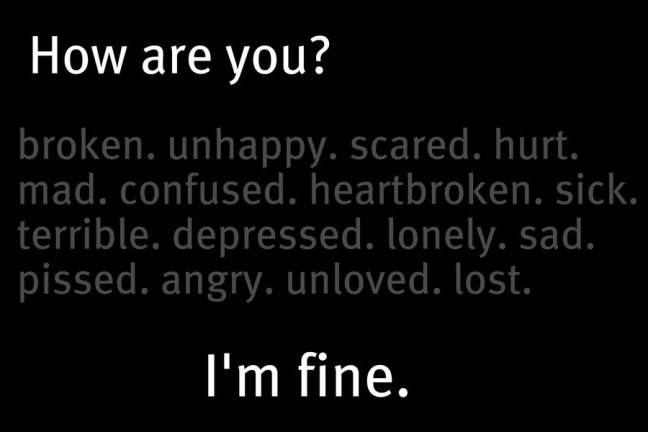
“I’m fine.”

How many times have you declared those words?

Hundreds?

Thousands?

Maybe more?

And how many times were those utterances accurate, describing your well-being as exceptional? Thriving? Or, in the more modern use of the term, simply satisfactory?

And how many times were they offered in reflex, in deflection or even as an outright lie?

__________

Here are some of the true feelings that can hide behind “I’m fine.” Do you relate to any of them?

“I’m afraid that if I start talking, I’ll start crying.”

My world is a mess right now and I’m trying to just get through. I may look okay, but I’m really just going through the motions.

“I’m trying very hard to pretend that I’m fine. Please don’t intrude on my delusion.”

If I really paid attention to my intuition, I would probably know that something is not right. But I’m not ready to face it yet so I’m going along with the idea that I’m fine.

“I’m not fine, but I don’t feel safe sharing that with you.”

Things are really hard right now and I wish I could talk about it but I’m afraid that you’ll ridicule me or somehow add to the pain. So I’d rather play it safe and keep my feelings tucked inside.

“I don’t know how I’m doing, to be quite honest with you. I don’t really give it much thought.”

I haven’t allowed myself to slow down enough to be aware of how I’m doing. I stay busy and pretend that as long as I’m doing, I am fine.

“I’m afraid that if I admit to not being fine, you’ll see me as weak.”

I know you see me as the strong one. The one that holds it all together. And I don’t want to be seen as weak or have you think that I can’t be counted on.

“I’m not fine and that’s my problem.”

I don’t want to burden you with my troubles. You have enough on your plate.

“I believe that I should be fine, so I play the part to the world.”

It’s been a long time since the event. I have so much going for me. I have nothing to complain about. I feel guilty for not feeling fine when so many others have it much worse.

“I don’t have the energy to explain my not-fineness to you.”

I’m tired. Defeated. And even just the thought of trying to explain how I feel is exhausting. So I give you the two syllables needed to stop you from probing further.

“I’m frustrated or upset with you, but I don’t want to rock the boat.”

I’m not fine, but I’m afraid that if I tell you how I feel, you’ll be angry or disappointed. And my fear of your reaction is greater than the pain of holding back. For now.

“I was taught that my feelings aren’t valid. So I suppress them.”

My parents taught me that feelings were stupid. I learned that nobody will listen or respect my emotions. So they stay hidden. Even from me.

“I want to be left alone.”

I really just want to crawl into bed and hide under the covers until this fades. Please don’t come in after me.

“I need time to process my feelings and put words to them.”

I want to open up, but I need to do it at my own pace once I wrap my brain around what I’m feeling.

“I need someone who will just listen. Not try to fix things.”

I’m not fine. But I’m also not helpless. I want to be able to share my feelings without you trying to step in and fix everything.

__________

I’m not suggesting that the next time the cashier at the grocery store asks you how you’re doing, you should respond with a truthful unloading of your current worries. Unless you want to be the one they all try to avoid when you walk through the door, that is.

After all, many of our daily interactions are superficial and that’s okay.

But not all of them are.

And when “I’m fine” becomes a habit, a reflex, that we apply to our friends, family, therapists, doctors and even ourselves?

We’re robbing ourselves and our relationships of the vulnerability and connection that comes from the courage to respond with authenticity.

So next time somebody asks how you’re doing, respond consciously.

Here are some words to choose from:

sad  nervous  excited  anxious  lonely  energized  confused  frazzled  aroused  irritated  content  elated  angry  lost  melancholy  fatigued  overwhelmed  engaged  hurt  fabulous  frightened  playful  relieved  embarrassed  awed  vulnerable  relaxed  jealous  unsure  apathetic  curious  grief-stricken  grateful       rough around the edges   better every day      making progress     happy to be here

Or even just fine.