Three Reasons NOT to Seek Closure

I was good at coming up with excuses.

I must send him another email (even though he didn’t respond to the first two) so that he knows the impact of what he’s done and it might prompt him to apologize.

I have to contact the police about his bigamy because it is a crime and he should face the legal consequences.

I need to look at his other wife’s blog so that I have an idea if he’s going to show up to court.

I read through scores of emails and stared at countless images of his face, all in the name of finding closure.

Yet with every message I sent his way, every piece of evidence collected for the court case, every glance at the other wife’s blog and every peak at his face or his words, what I was really doing was reopening the wound. Delaying healing all in the name of closure.
IMG_2873


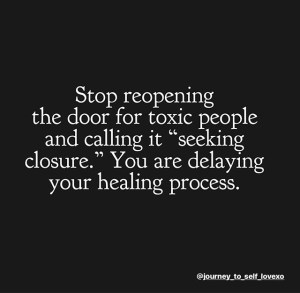
The concept of closure is a malleable one. Generally, people use the term to signify that they have harvested any lessons from the situation, found acceptance and are ready to move on. In that sense, closure is a respectable and desirable goal. The problem arises when the pursuit of closure is used as justification for detrimental behaviors.


Using Closure as an Excuse to Maintain Contact

It’s rarely easy limiting contact with your ex during a divorce. For some, they miss the companionship and reach out under the guise of “talking things out” in order to maintain the familiar friendship. Others bombard their ex with questions, convinced that they need these answers in order to understand the demise of the relationship. (Hint: You don’t actually need to understand in order to move on.) And then there are those like me that maintain “virtual” contact by following the ex’s actions online, with the pretense that the other person’s actions are somehow important to your own happiness (Spoiler alert – they’re not.).

There’s a reason that “no contact” with the ex is recommended whenever possible (and it’s possible in pretty much every case without children and can often be limited even when kids are in the picture). Whenever you have exposure to your ex during the healing process, the scab is ripped off and the wound reopened. Go back and look at the ultimate goals of closure – learning, acceptance and moving on. You’re not going to find any of those by seeing your ex smiling alongside some new hottie on their Instagram.


You’re Wanting Things to Be Different

Sometimes, closure really means, “I’m not happy with the reality and I’m going to keep poking at it until it matches my vision.” You can become convinced that if you ask the right questions or just dig deeply enough, you’ll discover that things aren’t as they appear.

In my case, I wanted evidence that he was remorseful for his actions. I convinced myself that I needed an apology (I didn’t) or at least some scrap of information that would demonstrate that he did love me and that he was heartbroken over the consequences of his choices.

This type of closure is in opposition to acceptance. Whenever you’re dictating what you want to find, you’re trying to make reality match your wishes. And that’s a losing battle.


When What You’re Looking for Doesn’t Exist

In seeking closure, many of us are looking for the neat and clean ending that wraps up most fictional stories. We want the lessons presented in an easy-to-understand format. We want the protagonist to find happiness and we want to see karma bite any bad guys in the tale. All of this makes for a great movie ending, but it doesn’t exist in the real world.

Life is messy. Any lessons that you can learn from your divorce won’t be found in a distilled moral to the story. Your happiness will be variable and karma may be stuck in traffic. Closure doesn’t mean that you will never again feel the pain and it doesn’t mean that you will forget. Closure simply means that you’re willing to let the past go.

And if you’re using closure as an excuse, maybe it’s time to let that go too.


And if you’re looking for healthy ways to create your own closure (that don’t require the participation of your ex), read this!


After Divorce: Is This Your New Normal?

In response to my video, The Three Things I Hated to Hear During Divorce, one reader shared her pet-peeve phrase about adjusting to life after a break up – “It’s your new normal.”

And even though that phrase didn’t make my hair stand on end, I could understand her ire. After all, nothing about life after the apocalypse of an unwanted divorce feels normal. And the last thing you want to do is to accept it as such.


New: not existing before; unfamiliar

Normal: typical, expected


Which makes a “new normal” a bit of an oxymoron.


Because of the particularly large blast radius of divorce, there is little left untouched. Not only are you dealing with the end of a relationship with your spouse, you are also navigating major changes with your children, your family, your friends and even the dry cleaner. Your living arrangements have been altered and you may even find yourself without a home to call your own. Items which once were sentimental or at least innocuous have become landmines of emotion, ready to detonate at a moment’s notice. Your emotions feel more out of control than they did during your teenage years; you never know when you’re going to be struck down by tears or irradiated with red-hot rage. This, alongside the sleep difficulties, means that tasks that once seemed simple now feel overwhelming and impossible.

On the surface, things may look normal. You manage to maintain your appearance, only the changes in your weight and the dark circles residing under your eyes belying the hidden pain. You go through the motions of life, taking the kids to school, clocking in at the office, even managing to fill your grocery cart with appropriate food items. Yet even though much of it is the same, it feels as though it has been rotated 90° from normal, like some dystopian world that only bears passing resemblance to our own. It’s an alien world and one which you received no training in how to navigate.

As you stumble through, your brain releases a steady drumbeat of protest –

“This isn’t fair.”

“This shouldn’t be happening.”

“This isn’t what I planned.”

“How could they do this to me/us?”

“Will I ever be okay again?”

And perhaps the scariest one of all…

“Is this it? Is THIS my new normal?”


Well, yes.

And no.

Some of the post-divorce changes may indeed be permanent. Your relationship with your ex-spouse will never return to the way it was. Likewise with your in-laws and with certain friends or friend groups. Your parenting role will be different and you will have to help your children negotiate life with divorced parents. Your financial well-being may be diminished for a time or even forever. And no matter what the future holds, this experience will always be a major chapter in your life story.

Yet these changes, even the difficult ones, will no longer be so foreign, so unfamiliar. Much like how you learn to navigate a darkened space once you’ve spent time in a home, you will no longer see this life as strange and foreboding. It just is.

The new has become the normal.


But that’s not the whole story.

You’ve adapted, become accustomed. You’ve accepted those things you cannot alter.

Now it’s time to modify what you can in order to create what you want.

Consider that darkened room. At first, it was a new space and all you could do was stumble through until you finally became adept at navigating through the furniture. There are some things about that room that are fixed, unchangeable. But within those walls, you have endless freedom to shape a space you love.

And at first, that will feel strange. You will stumble. Maybe even trip and fall. And then, over time, that will become your new normal. And a better one that you found yourself before.


New normal doesn’t mean that change cannot occur. It is not a place of settling or giving up. And it’s now a place you have to stay forever. New normal is a baseline, a platform where you can acclimate and adjust.

So, yes. Maybe this is your new normal. And maybe that’s okay.

Take some time and get used to the space.

And then think about how you can make it better.


The concept of a “new normal” can have a dark side. Learn more about that here.


How NOT to Be a Victim (No Matter What Life Throws at You!)

“Let me introduce you to the victim advocate,” offered the policeman who had arrested my husband the day before.


I stopped short. That was the first time that word – victim – had ever been applied to me. I certainly felt victimized. My partner of sixteen years had just abandoned me with a text message, stolen all of my money and then committed bigamy. Yet even though I was still in the acute phase of suffering, I startled at the application of the word “victim.”


Because even though I had been hurt, I did not want to see myself as a victim. Although it felt good for the pain and unfairness to be recognized, the term also made me feel minimized. That word embodied weakness in my mind and I wanted to feel powerful. It spoke of a lack of control and I wanted to be the one to drive my life.


I did not want to be a victim.


But for a time, I was.


In the beginning, I spoke about what was done to me. I looked for resolution and justice from outside sources, hoping for an apology from him and a conviction from the courts. I embraced my pain, feeling justified in holding on to it. Meanwhile, I demonized my ex, removing all semblance of humanity in my view of him.


There was a certain comfort in accepting a role as a victim. I garnered sympathy and commiseration from those around me. I had limited control and limited responsibility. But those same conditions that sheltered me also confined me.


As long as I saw myself as a victim, I would remain one. As long as I was limited by my past, I would remain a prisoner of what happened.


When the desired justice from the courts failed to appear and the hoped-for apology never came, I was left with a decision to make: I could either bemoan the circumstances or I could change my response.


I chose the latter.


I used the following ideas to help shed the guise of victim and make myself the hero of my own life:


Rewrite Your Story


When we are harmed, we often feel powerless, as though we are simply being led through someone else’s story. One of the first steps to renouncing victimhood is to take control of your story. Rewrite it. Reframe it. Narrate it. Change the perspective. Take yourself out of the role of victim (done to me) and put yourself in the role of hero (I did…). Write it or tell it until you believe it.


Pick up a pen and write your happy ending.


Create Purpose


Whatever happened, happened. There is no changing the past. But you can use the past to create something better in the future. Find some anger about what occurred and use that as fuel to drive you to create something better. Look around and see others suffering and use your experience to render aide. Use your rock bottom as a foundation for your life’s purpose.


You have the power to create something wonderful out of something terrible.


Make Changes


When unwanted change is thrust upon our lives, it’s easy to feel hopeless. Learn to recognize the potential hidden within and use the opportunity of uncertainty to create change of your choosing. There is no better time to release what no longer serves you and to embrace new beginnings.


When you’re rebuilding your life from the ground up, you have the power of choice and the wisdom of experience. That’s a powerful pair.


Find Gratitude


One of the powerful and difficult exercises that can empower the victimized is practicing radical gratitude. Face what has caused you the greatest pain, the most suffering, and write down why you are grateful for it. It is an amazing reminder of how much our thoughts rather than our circumstances are responsible for our happiness.


When gratitude is your wrapping paper, everything is a gift.


You are only a victim if you imprison yourself. Release yourself from the shackles of your past and let your spirit soar.


6 Unique Ways to Use Journaling For Divorce Recovery

recovery

The need for me was primal.

My mind was overfull of questioning and virulent thoughts. At first, I tried to hold them in, but their toxic and tenacious nature burned further holes into my heart. They weren’t meant for public consumption, yet I knew I had to find some way to purge them from my  mind and from my body.

The first journal entry was ugly. The hateful and hurting words screamed so loudly through the pen that they pierced several pages and imprinted through a dozen more. The pages were further marred by the endless tears that smeared the ink as soon as it was laid down. The resulting effect was as brutish and incomprehensible as the end of my marriage.

Finally spent, I allowed the pen to drop to the floor as I reassumed the familiar fetal position in the corner of my bed. In some ways, I felt a little better. It reminded me of the hole drilled into my childhood fingernail, crushed by a falling piece of lumber, to allow the pressure from the trapped fluid to release.

But much like that passage through the nail was only one part of the healing process, simply unleashing the ugly thoughts onto the paper was only part of the divorce recovery exercise.

If I was going to make it through, I was going to have to try something different. Here are six unique and innovative ways that you can use journaling as part of your divorce recovery process. I promise none of them require a drill.


And if you’re still unsure about journaling, here are twelve reasons that it’s awesome post-divorce.

And…here’s a peek into my post-divorce journal. It’s raw. And it’s real.

Why the Hard Work After a Breakup Is Worth It

“It’s not fair,” I remember thinking. He’s the one that had the affair, led a secret life and committed crimes and yet I was left having to manage the recovery from his actions. Part of me railed against putting in the emotional work to right myself again. After all, if he made the mess, shouldn’t he have to clean it up?

In the beginning, I did place the responsibility in his lap (and in the hands of the courts). I was convinced that I needed an apology. I was certain that I needed him to hear my victim impact statement. I was determined that I needed for him to return the swindled funds in order for me to move on.

Yet those things never happened. And so I could wait. Or I could try to navigate the road back to “okay” again on my own.

I chose the latter.

At times, I was angry when it seemed as though he was escaping consequence as easily as a cat navigates through a fence. I felt despair when the reality of where I was mentally  crashed rudely into my reality and getting better seemed like more mirage than realistic goal. I became frustrated when certain strategies or passed milestones failed to bring immediate relief, worried that my efforts were being wasted. And throughout, I was exhausted. Emotional work may not break a sweat, but it sure feels harder than any workout at the gym.

But then, as I kept slogging through the emotional wasteland, some strange things started to happen. Because although the work may be hard, the efforts are worth it.


Opportunities to Heal Earlier Traumas

While I wrestled with the pain and consequences of abandonment, the early childhood pain of my parent’s divorce and my dad’s subsequent move across the country resurfaced. I had long ago buried this sense of abandonment, convinced that it wasn’t worth the attention. Yet when my ex-husband left, I became acutely aware at how strong of a presence this fear was in my life.

The pros call it “trauma reenactment.” Others refer to it as baggage. No matter its label, the stuff that has happened to us tends to stay with us unless we do the work of processing it – absorbing the lessons and dispelling the waste. We often fail to do this work because it’s not fun and we can usually convince ourselves that it’s not necessary.

A breakup will often trigger earlier trauma that has not been resolved. It’s a spotlight on your past, pointing out areas that need attention. And if you do the work to resolve those early pains, it will help you find and create better relationships going forward.


Acceptance of Personal Power

I felt powerless after my marriage ended. I had no say in (or even knowledge of) of its eminent demise. I felt like I had few choices in how I handled the immediate aftermath and my basic needs. And no matter how much I tried, I couldn’t make him talk to me, much less offer an explanation or apology.

I started small. I pledged to finish an entire waffle for dinner. Or to walk twice a week. I accepted the offer of medications to calm the body and allow it to rest.

Then, I began to cook instead of just eat. My walks turned into runs, which led to crossing a finish line of a half marathon. The medications allowed me to experiment with other ways to calm my body, leading me to solid yoga and meditation practices.

Maybe I didn’t have a say in my marriage or my divorce, but I realized just how much of a say I still had in my life.

When you undertake the emotional work of recovering from a breakup, you’re learning to identify those things you can control. And even though your agency is limited to your sphere, it’s amazing how much of a difference just changing your attitude and perspective can make.


An Opening to Build Authentic Confidence

Breakups have a way of destroying our self-confidence. We feel rejected. Unloved. Unwanted. Even while smearing our ex’s character, we silently question if we are somehow broken and not worth loving.

Emotional recovery is a long and often arduous process, two steps forward followed by a long slide backward. It can difficult to see the progress along the way, because it is often nonlinear and even nonsensical.

Yet at some point, you’ll encounter a memory, or a bit of writing, or a picture that highlights just how far you’ve come. And you’ll shake your head in wonder even as you feel a little sense of pride blossoming within you – “I made it through that. Damn, I’m a badass!”

That newfound confidence, along with the insight and skills you have learned, will serve you well going forward as you approach subsequent life challenges.


An Invitation to Overcome Inertia

Okay, so maybe “invitation” isn’t quite the right word. It’s way more like being shoved out of a plane with a tangled parachute and having only part of the instructions for its use.

It certainly is a wake-up call.

In my former life, I had certain elements that I was discontent with and I had allowed myself to become content with that discontent. I rationalized my reasons for avoiding the efforts of change, but really it came down to being more comfortable with the status quo than uncomfortable with my life.

When my ex left, I no longer had the option to remain as I was. My life had been pulled out from under me and I was either going to have to make some changes or crash spectacularly into the ground. Those options certainly make the efforts required to do the emotional work a lot more compelling.

This is a magical moment. A break in the routine. A chance to try something different. You’re not settled, not anchored, not stuck. You can move, you can shift. You can even dance.


A Gift

So the wrapping is ugly. And at first glance, the contents seem rotten. Yet inside that mess are the seeds that you can plant and nurture and grow. And once you see the verdant and magnificent results, you realize that all the efforts were worth it.