
How We Handle Failure

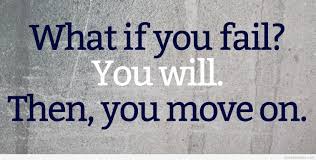
As I was reacquainting myself with my students last week (yes, we start school WAY too early in the south!), I reminded them of my belief that the math they will learn in my class is important. But the lessons in learning how to handle frustration and failure are even more important. Because, let’s face it, many of these kids may never have to solve a quadratic equation as an adult or explain why an exponential function has an asymptote, but they will certainly face failure. Probably many times.

images-53.jpeg

And I’ve to realize how important learning how to handle failure really is. In fact, I would go so far as to say that it is one of the primary forces that shapes who we become. The good news? Even if we have a had a subpar response to defeat in the past, with practice and the right mindset, we can learn to improve our relationship with failure.
images-52.jpeg

Five Negative Responses to Failure

Giving Up

I think all of us have released the words, “I give up!” in frustration when the fifteenth attempt at something still neglects to result in the desired outcome. It’s easy to become fatigued and weary, especially once the thinking brain has expended all of its energy and allows emotions to take the helm.

Internalizing the Message

“I suck,” we mutter to ourselves, confusing the line the action with the person, believing that we ARE a failure instead of a being that failed at something. This response is often ingrained in childhood when perfection (or at least the illusion of it) is expected of you from the adults in your life. You equate failure with rejection.

Avoiding Risk

If you don’t try, you cannot fail. Some respond to failure by refusing to take risk, preferring to practice the perfect and staying safely on known ground. This choice is rationalized as prudent, even wise. Yet the decision is made out of a fear of failure rather than a careful weighing of the potential risks and rewards.

Lashing Out

Some get angry when facing failure, attempting to cover the discomfort and vulnerability inherent in defeat with a veneer of hostility. “It’s not me, it’s you!” the response insists, hoping that by keeping people on the defensive, the failure will be overlooked.

Hiding the Evidence

This response is another that develops when failure is not accepted. When the inevitable happens, it is seen as shameful. And what do we do with that which shames us? We bury it.

images-8.png

Five Positive Responses to Failure

Accepting the Inevitability

Perfection is an illusion. There is no creature on this earth that succeeds in everything it tries. The newborn foal stumbles and falls before it learns how to walk on its shaky and spindly legs. The tree fails to root down deeply enough into the dense soil and almost topples during a storm.

And we are no different. Failure is as much a part of life as breathing. By accepting that, we can remove some of the emotion often associated with it. Rather than being shameful or a sign of weakness, failure is a sign of life.

Viewing Failure as Information

When I was preparing my classroom for the new school year, I had to adjust the legs on several of the student chairs. I glanced at the screws holding the legs together and estimated the proper size of screwdriver needed. On my first attempt, I managed to almost completely strip the screw while failing to loosen it enough to adjust the leg. That failure provided me with information – the screwdriver was the wrong size.

Once we have information, we are able to make adjustments and try a new approach. Without failure, we would never know what modifications are beneficial. Failure is a part of evolution; it steers us towards what works.

Taking Responsibility Within Locus of Control

Those that know how to use failure to their benefit are quick to own their failures, but only the ones within their control. There are two important facets to this response. The first is that once we claim responsibility for something, we give ourselves the power to change it. Secondly, by only accepting responsibility for things within our influence, we refrain from wasting energy trying to change things that we do not have dominion over.

It can be scary to admit that you failed. We don’t want others to see us as weak, as flawed. Yet by taking ownership, you remove the opportunity for others to use your failures against you. And the reality is that much of the time, people respect those that immediately and completely admit their failings as long as they are also making an honest attempt to learn from those defeats.

Reminder to be Open to Learning

Do professional athletes ever outgrow their need for a coach?

Nope.

Yet all too often, we become so comfortable (okay, cocky) within our own areas of expertise that we forget that we should still be learning.

And failure is happy to give us that reminder that there is always room for growth. For improvement. Failure equals humility and humility keeps us open and pliable.

See Failure as Opportunity

And this is what it comes down to.

Every failure is an opportunity.

A chance to try again.

Only now with more experience and knowledge of what doesn’t work.

Every failure is an opportunity.

A change to do better. To respond differently.

Without failure, there is no learning. No growing.

When we see failure as something to avoid, we are robbing ourselves of the opportunity to become the best version of ourselves.

And when we are able to become comfortable with failure, we are able to use it to take the next step. And then the next.

We will stumble. We will fall.

But as long as we get back up, learn from what didn’t work and keep trying?

Well, there’s no stopping us.

images-51.jpeg

Marriage is Not a Test

Marriage is not a test.
I lived.
I loved.
I lost.
But I didn’t fail.

Society makes assumptions about those who are divorced. Maybe we lack the fortitude to persist through difficulties. Perhaps we possess some great fatal flaw that makes us unable to sustain matrimony. Or, possibility we are flighty, given to jump in without thought and give up just as easily.
There is often shame inherent in admitting that one is divorced, like some scarlet letter “D” is forever branded upon your character if your “ever after” ended sooner than expected. It’s as though you failed at one of the biggest assessments you face as an adult.

In the strictest sense, my marriage did fail. After all, it ceased to exist upon the receipt of the horrific text: “I’m sorry to be such a coward leaving you this way but I’m leaving you and leaving the state.” Furthermore, my husband failed me through his betrayal and abandonment. I failed him by not seeing that he needed help and I failed myself by not being aware of his actions and the signs of a crumbling marriage. Yet, even with all that defeat, I refuse to look at my marriage as a failure. That label undermines our years together with all its shared memories and joys; the shared life and experiences are negated with that single word. Although I did feel as though I failed in some ways, I was adamant that I was not going to let my divorce define me as a failure.

Failure is an act, not a person. I’m divorced. Not defective.

As I grappled with the end of my marriage, I found comfort in the words of others. Others who had faced their own challenges and were determined to learn from and grow from their mistakes and unrealized goals.
There’s always failure. And there’s always disappointment. And there’s always loss. But the secret is learning from the loss, and realizing that none of those holes are vacuums. Michael J. Fox


When the marriage died, I felt like I expired right along with it. As though my respirator had been yanked from my face and I was struggling to find the strength and will to breathe on my own. I felt unanchored and unable to escape from the pull of the dying marriage. Failures are not vacuums; we can summon the strength to move beyond them. The realization that I could choose to redefine my divorce was powerful; it gave me the motivation and momentum to continue.
I’ve come to believe that all my past failure and frustration were actually laying the foundation for the understandings that have created the new level of living I now enjoy. Tony Robbins


I am often asked if I would have married him if I could turn back the years. I would. Yes, the divorce and associated suffering have been the most painful experience of my life. Yet, I could not imagine my life without having endured that pain. Without that failure, I would not have the perspective that allows so much gratitude and acceptance in my life today. Acceptance that extends to forgiveness for my ex and myself for the conditions that led to the end of the marriage.
It is impossible to live without failing at something, unless you live so cautiously that you might as well not have lived at all, in which case you have failed by default. J. K. Rowling


I used to be too fear adverse in my old life; I would engage it what I call “practicing the perfect,” which is a way to feed the ego at the expense of the soul. I would try things only if I believed that I had a good chance of success. Interestingly, the cataclysmic end of the marriage released me from that fear of failing. I learned that it’s rarely fatal and that security is only an illusion. You’ll never know what you can do unless you try.
A failure is not always a mistake, it may simply be the best one can do under the circumstances. The real mistake is to stop trying. B. F. Skinner


The tendency is to respond to failure in one of two ways — blame others or internalize the mistake. That’s the ego talking again. It’s helpful to realize that most people in most situations are doing the best they can. I used this to help soften towards my ex. I realized that he didn’t do these things to me; I was simply collateral damage in his decisions. I also let up on the self-flagellation for not recognizing any red flags.
Success is not a good teacher, failure makes you humble. Shahrukh Khan


Our egos are a bit like young meatheads in a gym. Flexing in the mirror, wanting to appear strong and capable amongst the others. This means that sometimes we will try to lift more than we can without asking for assistance. And, just like in the weight room, this can only lead to disaster. When we fail at something, we can either give up or ask for help. Allow yourself to be humble, ask for a spotter and you’ll not only gain the respect of those around you, but you will also be able to lift more than you ever thought possible.
I don’t believe in failure. It is not failure if you enjoyed the process. Oprah Winfrey


My biggest issue with labeling my marriage as a failure is that it focuses on the end and ignores the 16 years together. The 16 good years. Those still count. I still think back and smile. I may not love the man but I still love the memories. I think this thought is especially poignant for those with children from the union. It’s important for the kids not to think that you see the marriage that created them as a waste, a mistake. In some way and for some amount of time, it was successful.
Failure should be our teacher, not our undertaker. Failure is delay, not defeat. It is a temporary detour, not a dead end. Denis Waitley


Divorce is a powerful teacher if you listen to its lessons. Its methods may be harsh but its messages are life changing. A failed marriage does not make you a failure. The only true failure is failing to live and love, even if that means that sometimes you may lose.
Related:  What Makes a Marriage Successful (and Why Divorce Does Not Mean Failure)
test

Sacrifice

There’s a simple reason most diets ultimately fail.


Mindset at the outset.


Most diets possess at their core a sense of giving up something that you want. Relinquishing that which you desire.

A sacrifice.

But we don’t view sacrifice as simply releasing something from our lives.

We see it as a trade. A bargaining tool. A giving up of one thing with the promise of gaining (or, in the case of dieting, losing) something else.

The rational mind realizes that the short-term denial of dessert will lead to the longer-term goal of a smaller waistline.

But the rational mind isn’t always at the reins.

And the more emotional brain steps up to the podium to present its case:

I went to the gym today. I deserve a cookie.

I ate well at breakfast and lunch; dinner out won’t kill me.

And those statements are literally true. A single cookie won’t derail a diet. Indulging at a single meal won’t make much difference. But it rarely stops there.

The problem comes from our deeper psychology. Because when we feel deprived, panicked that we may lose something, we quickly go from scarcity to splurge.

So, before any diet books are purchased or points tallied, the successful “dieter” begins with the mindset. Shifts the thinking from a perspective of paucity to one of abundance, focusing on what is to be gained rather than the feared losses. When approached from this angle, it’s amazing that what once were viewed as sacrifices, simply become matter-of-fact. The martyr mindset is replaced with an appreciative one.

This sacrificial mindset doesn’t only derail diets.

It also derails relationships.

When someone approaches a deepening relationship or marriage focusing on what is being given up, it creates a sense of loss and lays the groundwork for future binges.

Yes, relationships require change.

But healthy ones demand compromise.

Not sacrifice.

You’re not giving up.

You’re growing.


I Didn’t Fail

Marriage is not a test.

I lived.

I loved.

I lost.

But I didn’t fail.

Society makes assumptions about those who are divorced. Maybe we lack the fortitude to persist through difficulties. Perhaps we possess some great fatal flaw that makes us unable to sustain matrimony. Or, possibility we are flighty, given to jump in without thought and give up just as easily.

There is often shame inherent in admitting that one is divorced, like some scarlet letter “D” is forever branded upon your character if your “ever after” ended sooner than expected. It’s as though you failed at one of the biggest assessments you face as an adult.

In the strictest sense, my marriage did fail. After all, it ceased to exist upon the receipt of the horrific text: “I’m sorry to be such a coward leaving you this way but I’m leaving you and leaving the state.” Furthermore, my husband failed me through his betrayal and abandonment. I failed him by not seeing that he needed help and I failed myself by not being aware of his actions and the signs of a crumbling marriage. Yet, even with all that defeat, I refuse to look at my marriage as a failure. That label undermines our years together with all its shared memories and joys; the shared life and experiences are negated with that single word. Although I did feel as though I failed in some ways, I was adamant that I was not going to let my divorce define me as a failure.

Failure is an act, not a person. I’m divorced. Not defective.

As I grappled with the end of my marriage, I found comfort in the words of others. Others who had faced their own challenges and were determined to learn from and grow from their mistakes and unrealized goals. Read the rest on The Huffington Post.

test

Marriage is Not a Test

test