
Unraveling Expectations: The Good, the Bad and the Ugly

Join me on a little thought experiment as we consider two different situations…

Situation 1 – You go on a blind date, knowing nothing at all about the person before you meet. The date went well, not great but also not terrible. You had some good conversation and you think they’re a quality person, but you doubt you’ll ever see them again.

Situation 2 – You meet somebody on an online dating site. Due to your schedules, you are unable to meet in person for several weeks. During that time, the two of you have been texting and messaging constantly. The texts are flirtatious and even begin to tiptoe into some deep territory. “Maybe they’re the one,” you think to yourself as you excitedly get ready for your first date. The date goes well, not great but also not terrible. You had some good conversation and you think they’re a quality person, but you’re just not feeling it.

Even though the dates themselves are identical, how would your feelings about them differ? I would expect that the first situation would be easily shrugged off, whereas the second situation may well knock you down a bit, possibly even prompting worries about being alone forever.

What is the difference between the two?


Expectations.


images-45


As anyone with a dog around dinnertime knows, expectations are a powerful force. Unless you live a life without any predictability or patterns, expectations are necessary to navigate efficiently in a complex world. We expect the sun at the beach to be intense, so we respond by bringing an umbrella and sunscreen. We expect a toddler to become irritable on a long car ride, so we stash snacks and toys in anticipation.

But expectations are not always so benign. They have a way of sneaking up on us, whispering temptations into our ears and then running away unrestrained. We follow, only to end up face-planted as we trip over our own predictions when they fail to materialize. Other times, past trauma has primed the pump for expecting the worst, even when the worst is no longer the reality.

We cannot eliminate expectations from our lives. They’re innate and needed. But we can also learn to understand them better and we can become better at managing them so that we don’t continually break our own hearts.

Expectations can be trip wires in all areas of life – relationships, work, health, etc. I’m going to focus on expectations in relationships, although much of this applies to expectations in other arenas as well.
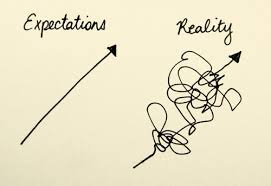
 

images-44

Expectations


The Good

Since we often face counsel to “let go of expectations,” we rarely take the time to reflect upon their benefits –

Opportunity to Gain Self-Awareness

We all develop our own personal narrative, stories that pass through our brains, spinning yarns and asserting beliefs. All too often, those personal narratives become tainted, as drops of fear or insecurity bleed throughout the story, altering and staining it without enough external influence to right the path. And expectations can come from those painful places. After all, a fear of abandonment is really an expectation of abandonment sparked from some prior experience.

We are not always aware of our internal narrative. It’s too close, too much a part of us. But disappointment is a handy way to recognize when our expectations are out of alignment. So let those times when you feel let down by someone become an opportunity to look within. What were you expecting? Where did that expectation come from? The answers to those two questions can give you some great insight into yourself.


Keeps Us From Settling For Less

Sometimes expectations act to inform us what we deserve. This is especially true when we come from a healthy and loving family and we anticipate others to treat us in the same way.

Expectations can act like a minimum fill line in a pool, alerting us to behaviors that fall below a certain threshold. In a relationship, it is perfectly appropriate to expect to feel safe, to feel loved much of the time and to have an atmosphere of honesty and respect.


Allows Relationships to Operate Efficiently

Expectations and habit allow us to shift some of our daily lives to autopilot. This isn’t always ideal, but in a busy world, it’s often necessary. When we have an idea what to expect from our partner, we can shift our own choices accordingly. For example, if you want an opportunity to reconnect with your spouse over a meal and you know they’re not a morning person, you propose a dinner date as opposed to brunch. Expectation and adaptation.

 

IMG_1276

The Bad

Of course, expectations have their downsides –

We Are Set Up for Disappointment

We recently received a widespread lesson in the danger of unchecked expectations. I don’t think any series finale has been so widely anticipated as that of Game of Thrones. After years of a wild – and emotional – ride, the expectations of fans were at an all-time high. And the disappointment after the ending was almost palpable.

No matter what happens in reality, it will never align perfectly with our expectations. So when we become too wedded to a particular outcome, we are guaranteeing our own disappointment.

Related: Are Expectations Dooming Marriage?


Other’s Actions Are Outside Our Locus of Control

Sometimes we act as though our internal narrative is script and others should be reading the lines and following the stage directions we have prepared for them.

But of course that’s not true.

We can have expectations all day long, but unless it’s something within ourselves, we have little influence on what actually happens.


We Confuse Boundaries and Expectations

Expectations say, “I’m assuming that you’re going to…”

Boundaries say, “If you do …, then I will…” 

Note the difference. The first isn’t giving the person a choice. It’s guilty until proven innocent. Whereas the latter gives the other permission to act and then provides information about the consequences.

Letting go of expectations is not the same as permitting others to treat you poorly. If they act badly, let them face the consequences. But also give them the opportunity to make that choice before you enact the repercussions.

IMG_1333

The Ugly

And then there’s this. Expectations can cause worse effects than disappointment. They can set us up for catastrophe –

When Expectations Are Too High, We Are Always Chasing Contentment

I have been outspoken in my disdain for the concept of a single soulmate. I mean, talk about a high expectation! I have to somehow manage to find the one, single person that is perfect for me. And then once I have them, everything will be easy because we are meant to be together. So then what happens when you first face discord in your relationship? Does that mean that they were the wrong person and you need to resume the search?

We are constantly bombarded with images of perfection. And so we can easily find ourselves lacking. When expectations are unrealistic, we will never be happy because the bar is set at infinity and we’re mere mortals.


Expectations Can Influence Reality For the Worse

I love the studies that have been done in schools where the teachers of two comparable classes were given different – and false – information about their students. One teacher was told that their students were exceptionally bright and they could expect great things from them. The other educator was informed that their students were slow learners and have never really shown much promise.

Same types of students. Different expectations. And VERY different results.

I bet you can guess which class did better.

People have a way of acting as we expect them to act. After all, even if we say nothing, our unconscious interactions will reveal some of our internal beliefs. This chicken-and-egg dance often happens with infidelity. We often assume that the cheating happens first, followed by the suspicions. Yet it is not rare for the distrust to enter first with the infidelity following behind.

When expectations are too rigid, we fail to give others the space to change. And if we’ve inadvertently set the bar too low, we may just find that it’s met.

When we lead with expectations, we are not truly seeing or hearing the other person. Instead, we’re interacting with the mental construct we have of them. We’re in an echo chamber, seeing and hearing only what we expect. Confirmation bias is a powerful force.


Toxic People Can Hide Behind Our Expectations

Sometimes our expectations of people are too high. We start from a belief that they are kind and operate with integrity and then we assume that their actions will be in accordance with those characteristics.

And if they’re not honest and kind? They very well may take advantage of those expectations, manipulating things behind the scenes like a magician’s assistant behind a screen.

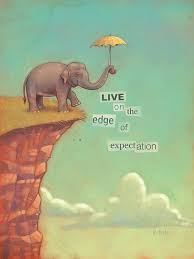
Expectations can blind us to truth as we confuse desire with belief. And that’s a dangerous road to travel.
 

images-46


Learn to Work With Your Expectations Instead of Fighting Against Them


First, let me state that I am by no means an expert when it comes to managing expectations. I struggle with it on a frequent basis. But I HAVE gotten better at keeping them in check. Here’s what has worked for me:


Awareness of Expectations

Expectations can become so ingrained, so knee-jerk, that we often take them for granted and hardly even notice them. In order to become more aware of my own expectations, I’ve committed to paying attention to my disappointments and where they are coming from.

It’s been an interesting and eye-opening exercise. I’ve learned that my expectations anchored in trauma have all-but-disappeared, yet I still struggle with plenty of other maladaptive expectations. And as I become aware of them, I’m better able to adjust them to the actual circumstances.


Shift Your Expectations Within Your Locus of Control

When I first started dating post-divorce, I did one smart thing in a great big tangle of not-so-smart things.

I decided that my expectation for every date was that I would learn something. Here’s the beauty of that expectation – it had a 100% chance of being met every single time because I was the one in control of it. I was even able to learn something on the times I was stood up:)

In contrast, if I had expected for every date to go well or every man to be attracted to me (or me to him), I was guaranteed to fall short.


Practice Being Flexible

Sometimes when my expectations aren’t met, I don’t become disappointed.

I become irritable.

This happens when I’m knee-deep in my planned tasks (thanks, anxiety!) and I’m having trouble shifting gears when my predictions go awry.

As with everything, practice makes better. So the more I practice being flexible and trusting that it will be okay even if it doesn’t go to plan, the easier it becomes.


Keep Your Expectations Realistic

I love to travel and I love to travel with my husband. However, he is not as enamored of trips as I am. So whenever he mentions a possible trip, I get excited.

I used to get too excited.

I would research, plan and dream. Then, I would present him with the information and he would be all, “Eh.” I took his rejection hard, feeling like my hopes had been machete-cut like a coconut on some tropical beach.

But here’s the bigger picture. My husband is an extrovert with ADD. That combination means that many of his thoughts are shared aloud, even the impulsive, not fully-matured ones. So he may want to go on a trip, but the casual mention doesn’t mean that he has fully thought through all of the time and financial repercussions. And that’s who he is, not something I can ask him to change.

As an analytical introvert, I fully think (okay, overthink) anything through before I speak it. And I was listening to him as though he was me. Which of course, he’s not.

So I’ve learned. Now, when he mentions a trip, before I do anything else I ask a few questions – What sort of timeline are you thinking of? Where are you with commitment to this on a scale of 1 to 10? And with just those questions and any needed follow-ups, I know where my expectations should be.

Result? I don’t get disappointed and I thoroughly enjoy the trips I do take – with or without – him.

The best bet is to keep your expectations high, but also realistic.


Communicate Your Expectations

If birthdays are important to you, you might get your hopes up as the first birthday approaches in a new relationship. After all, it’s easy to assume that what is important to you is also important to someone else. And then when the day comes, if their excitement isn’t on par with yours and they either fail to appreciate the celebration you created for them or didn’t meet your expectations for the recognition of your birthday, you feel dismissed and unimportant.

Yet it’s also not fair to expect others to meet our expectations if we don’t communicate them. Until Elon Musk develops some sort of implantable mind-reading device, we have to express both our expectations and the importance of them to others.

If we don’t say anything about the expectation, the resulting disappointment is on us.


Try to Replace Expectations With Curiosity

Some of my favorite yoga teachers are consistently good, yet I never know what to expect from them since every class is good in its own way. They have helped me shift my thinking before class from, “I hope we do some hip-opening today” to “I wonder what goodness we are going to do in class today.”

When we’re curious, we are not wed to any certain outcome. Instead of closing our minds and sealing the cracks with conclusions, we are throwing the doors wide open to see what might show up.


Give to Give, Not to Receive

It feels good to have your efforts recognized and affirmed. But if that’s the only (or at least, a major) reason you’re giving, you will be disappointed. Whether from a lack of awareness or a lack of caring, you will not always be validated for your efforts. Give because you want to give, not because you expect something in return.


Distinguish Between Needs and Expectations

Needs are requirements. Expectations are hopes.

Sometimes I confuse those, feeling as though not having my expectations met is a personal attack that causes great damage.

Yet I’ve survived every disappointment that has ever come my way.

We don’t always get what we want.

Yet sometimes as a result, we end up with exactly what we need.

Good Ol’ Gratitude to the Rescue Again

When I do feel disappointed because my expectations have not materialized, I like to pause for a moment to think about the good that has come from the situation. And usually, it’s surprisingly easy to find once I let go of the image of how things are supposed to be.


Ultimately, it comes down to this –

You have a right to your expectations. You have a right to feel disappointed. You have a right to not accept behaviors. But you don’t have a right to expect others to act the way that you want them to act. And the sooner you accept that, the more at peace you’ll be.



Divorce: Expectations vs. Reality

Was your divorce anything like you would have expected divorce to be like?

I know mine wasn’t.

Not. Even. Close.

Movies, books, billboards, magazine articles and my own parent’s divorce created certain expectations in my mind about what I could anticipate from divorce.

But the reality?

Something entirely different.


We think we know about divorce. We’ve watched untold examples of what happens after the end of a marriage unfold on film. Perhaps we’ve survived the separation of our parents or watched our friends’ marriages dissolve from the sidelines. We’ve read articles and listened to interviews about what causes divorce and how to navigate it if it appears at our doorstep.

We think we know about divorce.

Until it happens to us. And then we’re forced to accept that our expectations are often misguided and that the reality of divorce is something altogether different.


Expectation: Divorce won’t happen to me; my spouse and I will always be able to work things out.

Reality: Divorce is always a possibility. You may end up with a spouse that leaves or one that refuses to put in the effort. Or, you may find that you have changed and the marriage no longer makes sense for you. While there are plenty of not-so-good marriages that go the distance, no good marriage ends in divorce. If it’s over, something wasn’t working, even if you can’t identify the cracks yet.

Expectation: I wanted this divorce, so it won’t impact me that much emotionally.

Reality: Divorce is hard on everyone, whether you’re the one who initiated the split or not. Often, the one who started the ball rolling wrestles with the decision for some time and may even feel guilty about “giving up.” They may have wanted desperately for the marriage to work, but their partner isn’t willing to meet their efforts. Additionally, the partner who leaves the marriage is often blamed for the split and may not receive the same sympathy from friends and family.


Expectation: This divorce blindsided me and I won’t be able to get past it.

Reality: The shock is immense and the blast wave levels everything in sight. Your breath has stopped and it feels as though your world has too. At first, you feel completely powerless and utterly destroyed. However, in time, you’ll begin to regain your senses and your sense of autonomy over your life. You may not have asked for this change, but that doesn’t mean you can’t learn how to move through it.

Expectation: The courts will see how poorly my ex behaved and they will respond appropriately.

Reality: The courts don’t care about your feelings or about how much of a jerk your ex is. Don’t go in expecting sympathy or outrage; they’ve heard it all (and they also have learned to doubt one-sided stories). Additionally, the system is not designed to “punish” spouses who behaved badly; the court’s focus is simply on dissolving the legal ties of matrimony.

Expectation: Our situation is relatively straightforward, so the legal divorce should happen quickly.

Reality: Some states place a mandatory waiting period between the legal separation and divorce. Others have no such mandate, but the constant delays and rescheduling that plagues the court system effectively acts as a brake on the process. Sometimes, the divorce can be completed within a matter of weeks. But more often, it drags out for closer to a year.

Expectation: Both my ex and I are generally reasonable people, so we won’t let this divorce turn ugly.

Reality: You don’t really know a person until you divorce them. Divorce has a way of making even the most rational people act crazy, with its unfamiliar situations and very high stakes. It’s easy to become involved in a tit-for-tat war or to allow your emotions to drive your decisions. Furthermore, there is often a slippery slope of poor decisions, where the unthinkable slowly begins to feel perfectly normal.

Expectation: I’ve seen those billboards that advertise divorces for $200, so the expense can’t be that bad.

Reality: If you stick with mediation and generally agree with your ex on the terms of your divorce, you can make it through with minimal expense. However, as soon as the lawyers get involved, the financial impact can skyrocket quickly to the average of $15,000-$20,000 per person. And that’s not taking into account any major custody or property battles. In order to manage your expenses, be very clear about your long-term goals and make sure you don’t waste money on details that don’t align with these objectives.

Expectation: Once I have the decree in hand, everything will be okay.

Reality: In addition to legally dissolving your marriage, your decree may also spell out certain expectations for finances, custody or dividing property. It’s easy to believe that these mandates printed on an official, notarized document, will all be carried out according to the decree. However, your ex may refuse to follow the judge’s directions and, if that happens, it is up to you to take them back to court.

Expectation: After the divorce, I won’t have to deal with my ex again.

Reality: If you and your ex have children together, they will always be in your life to some extent (even once the children are adults). In addition to parenting demands, you may also have to deal with your ex about financial situations or when untangling other accounts. Regardless of their actual presence, you will probably find that they still have a strong emotional existence for you for some time.

Expectation: We’ve worked out the co-parenting agreement, so now it will be smooth sailing.

Reality: No matter how smooth, the co-parenting relationship will always be evolving and will always require a certain amount of diplomacy and trust. As the kids grow and change and new partners for you and/or your ex enter the scene, alterations will have to be made. You also may find that your agreement didn’t address certain issues or that your ex doesn’t always adhere to the terms. The sailing will get smoother, but storms will still have to be navigated at times.

Expectation: My ex was never really present, so I know what it’s like to be a single parent.

Reality: There’s a difference between having a partner that travels or one that doesn’t take an active role in the kid’s lives and being the only adult in the house at 2:00 a.m. when your toddler’s fever is well into the triple digits. The sense of responsibility is magnified and the potential for isolation grows. Don’t be afraid to ask for help.

Expectation: Divorce is so common now, so there really isn’t a stigma about it.

Reality: The divorced are no longer viewed as heathens, but you may still find that some people conclude that you give up too easily or that you fail to put in the effort required. More often, you may find that people are afraid to accept that divorce could happen to them, so they try to find a way that you’re somehow at fault so that they can believe that they are safe from it’s touch.

Expectation: Other than being single, not much else in my life will change.

Reality: Divorce has a way of impacting pretty much everything. Your friendships will change as some people exit your inner circle and you move others in. Work may be impacted by your need to free up more time for your children or your motivation to bring in more money. Time which used to be dedicated by default to family is now more amorphous, needing your direction. Some of these changes will be difficult and others will be welcomed, but it’s largely a given that widespread change will occur.

Expectation: I’ll take a few months to get my life sorted out and then I’ll be over the divorce.

Reality: The average person requires between one and two years to feel “moved on” from divorce. And that’s just the average. Many people, either because of the particular factors of their split or their backgrounds, require longer. You can expect improvement within the first few months, but you will most likely not yet be “over it.” And that’s okay.

How Do You Know When You’ve Moved On After Divorce?

Expectation: Healing will progress in a steady manner.

Reality: When emotional setbacks occur, it’s easy to become frustrated and disheartened, discounting the months of progress. This climb forward, slide backward pattern is extremely common and it not a sign that there is anything wrong with you or that you will never heal. There will be triggers that pull you back after several good weeks and anniversaries that welcome you like a sucker punch to the gut. You’ll get through them and, each time you do, they get a little easier.

Expectation: If I don’t give attention to my emotions, they will eventually fade.

Reality: It’s tempting to try to shove all of that divorce sadness, rejection and anger under the rug in an attempt to make it disappear. And for a time, it may seem to be an effective strategy. However, by ignoring those feelings, you are only giving them more power over you. The only way to allow the negative emotions to lose their grip over you is to confront them and become comfortable with their presence. Only then will they begin to fade.

Expectation: All of these issues are because of my ex and the marriage, so they’re all behind me now.

Reality: Surprisingly enough, some of the issues you had in your marriage probably stem from your childhood. Were you mirroring your parent’s relationship, looking for the parental approval you never had or replaying your script of rejection? This is an amazing opportunity to begin to delve into those childhood wounds so that you can heal those early – and internalized – pains.

Expectation: I’m SO over my ex. I don’t care what they do anymore.

Reality: Maybe it’s been months. Or even years. The early pining or animosity towards your ex has faded and has been replaced with a general sense of ambivalence. And then you receive the news – they are seeing someone else or even getting married again. You’re shocked. Hurt. Jealous and also sad. It’s very normal to have this reaction when you first learn of your ex moving on. Don’t worry, it’s not permanent nor is it fatal.

Expectation: I’m NEVER dating or getting married again!

Reality: The end of a relationship hurts and it’s natural to be inclined to avoid relationships – and the potential of pain – in its aftermath. Yet, in time, that early resolve may fade and you may decide that love (even with its inherent risks) is more valuable than the safe position of being alone. Luckily, it’s a decision that you can revisit whenever you wish. Remain open to possibility that you may change your mind.

Expectation: I’ll never get over the divorce.

Reality: You WILL make it through the divorce and its aftermath. In fact, upon reflection after some time has passed, many people are able to see their divorce as a turning point for the better in their lives.

Was Divorce What You Expected?

Six Reasons You’re Not Seeing the Results You Expected

This sign welcomed me at the gym today:


Not seeing the results you expected?

Visit the training desk to set up your personal training session now!


It prompted me to scan the mid-morning crowd with a curious eye, wondering how many of them were seeing the results in the gym that they anticipated when they first signed their contracts. I suspect that many of them, if asked, would express disappointment with their progress as measured against their initial expectations.

Pulling on my background with personal training and my own countless hours spent in the gym, I considered the most common reasons that people don’t see the fitness results that they expect when they first vow to get in shape. And then, like so often happens, I realized that these explanations are not limited to the gym.

These are the reasons that any of us fail to see the expected results in all areas of our lives – work, relationships, finances, education and yes, fitness:

pug-801826__480


You’re Not Working as Hard as You Think You Are

I often see the same people on the stationary bikes or the treadmills every time I enter the fitness center. They have the resistance and the speed set at some reasonable number and they dutifully put in their sixty minutes of daily exercise. I’m sure they feel like they’re working hard. The heart rates are elevated, the sweat is evident and there is probably some soreness the next day. The brutal truth is that this kind of steady-state cardio is beneficial for maintaining cardiovascular fitness and not much else.

It’s simply not hard enough.

We ALL have a natural tendency to stay within our comfort zones. When discomfort rises, we often respond by backing off. Which we then justify with our internal narrative –

“I’ll do more after this tough period of work is over.”

“This is all that I am capable of.”

“It feels difficult, so it must be my edge.”

“I need to play it safe so that I don’t get hurt.”


And by doing so, we’re robbing ourselves of the potential results.

There are some clues to indicate when you ARE working hard enough – You’ll have doubts in your ability to reach your stated goals. There will be times where you feel as though it’s impossible and it will rarely feel easy (and when it does, it’s swiftly followed by a humbling reminder that you still have a way to go). You will see progress and change; what was once difficult will begin to seem very doable. When you reach a goal or even when you put in the time, you will feel a sense of accomplishment or pride, knowing that you pushed yourself. There may be a sense of risk, since reward rarely travels alone. And finally, when you’re working hard enough, you will be uncomfortable.


dog-734689__480

You’re Working On the Wrong Thing

I’m frequently approached by women who want my advice on how to tone up. They are faithful to their Zumba classes or elliptical machines but have become frustrated with a plateau in their pants size. When I mention the addition of free weights or kettle bells, the response is often an immediate dismissal, “Oh, I don’t want to get too muscular.” And then they return to the efforts that are failing to deliver the desired results.

I see this dynamic often in those I work with following a divorce from a difficult person (I was also guilty of this myself!!). They are often frustrated with their ex’s lack of response to parenting responsibilities or inability to act like a decent human being. They funnel their energy into labeling their ex or trying to understand the motivations and the reasoning behind the actions. They are certainly working hard. But nothing seems to change.

Because they are working on the wrong thing.

It is SO easy to leap to a potential path once a problem or need has been identified. And then, we get so busy… well, being busy, that we neglect to reevaluate our efforts to see if they are having the intended effects.

Take the time to ensure that the path you’re slogging along actually leads to your intended destination.


dog-1414524__480

You’re Undermining Your Efforts

“I don’t get it,” my neighbor said to me. “I run every day. I lift weights three times a week. But still, I’m getting fatter with every year.”

“What’s your diet like?” I inquired.

The resulting blush told me all that I needed to know.

Sometimes, we are working hard enough and on the right things, but we’re neglecting something else. And any attempt to fill a cracked bucket will always lead to frustration and subpar results.

I’m very skilled at doing this at work when I feel stressed and overwhelmed. When the to-do lists feel daunting and I’m barely keeping my head above water, I have a tendency to increase my hours spent working.

Which inevitably leads to a startling drop in efficiency (and agreeableness).

In those moments, I would be much better served by taking a break and taking care of myself before putting more effort into the work.

It can be difficult to recognize when you’re undermining your own efforts. We can get strangely defensive and territorial over these adopted behaviors. It’s worth the momentary discomfort or embarrassment though if you want to ensure that your efforts aren’t in vain.


dog-94167__480

Your Expectations Are Unrealistic

“Get a Bikini Body in 20 Days!!!” the magazine practically screamed at me in the check-out line. First of all, what exactly IS a “bikini body?” A body that is currently wearing two pieces of fabric designed for water-based recreation? Hmm. Doesn’t seem like that would take more than 20 seconds to achieve. I’m assuming that the magazine was claiming that the reader could look like the size-two model in under three weeks. Which unless the customer is already a size-two model, is practically impossible.

Whether from the focus on the extremes from the media, the outrageous claims of advertising or the Cliff Notes version of a struggle from a friend, we often possess idealistic or romanticized expectations. And if you’re starting with an unattainable goal, you’re pretty much guaranteed to never see the expected results.

It can be difficult to determine the difference between lofty expectations and implausible expectations. Sometimes it means that we have to first face some uncomfortable truths about ourselves or our available resources.


rottweiler-1785760__480

You Need Outside Assistance or Accountability

There is a reason the personal training area of my gym is frequently occupied – we can all benefit from a little professional help sometimes. These trainers introduce people to new ideas and methods, cheer on the tired and unmotivated and hold their clients accountable for their progress. It’s no surprise that this population often shows the greatest growth within the entire gym.

I know I have a virulent case of the “I can do it myselfs!” And I know I’m not alone. we often perceive asking for help as a weakness, a sign of giving up. Yet sometimes a little shove or shout of encouragement is exactly what we need in order to scheme the expected results.


dog-2179454__480-2

You’re Taking the Short View of a Longer Process

“How long have you been doing yoga?” the young man asked from the mat next to me after class.

My eyes looked to ceiling as I mentally retraced my yoga journey, which began with videotapes in my childhood bedroom. “About twenty-six years,” I finally concluded.

“Wow!” he replied, a bit of a relieved look on his face. It seemed that he was expecting to master the practice (a bit of an oxymoron there, huh?) after a few short months and this response gave him permission to take more time to learn the nuances of the poses.

It’s frustrating when you feel like you should be at the finish line and yet it remains out of reach. I felt this acutely when my divorce was finalized. I had assumed that the emotional process would end when the legal one did. (Spoiler alert – it didn’t.)

When you don’t see the expected results, look instead for signs that you’re making progress towards the desired outcome. Most things in life require baby steps. You’ll get there; it’s just going to take a little longer than you may have planned. And you know what? That’s completely okay:)

Divorce: Expectations vs. Reality

Was your divorce anything like you would have expected divorce to be like?

I know mine wasn’t.

Not. Even. Close.

Movies, books, billboards, magazine articles and my own parent’s divorce created certain expectations in my mind about what I could anticipate from divorce.

But the reality?

Something entirely different.

Can you relate?

Here are the expectations many of us have before we experience divorce and the reality that we realize only once we’re living it.