The Importance of Finding Your Truth After Gaslighting

gaslighting

It all hit me when I saw the bank statement.

For the prior thirty hours that had elapsed after my former husband disappeared with a text, I was still making excuses for him. He must be depressed. Or acting impulsively. He’ll come to his senses soon and we’ll discuss what’s going on. I still believed in him.

And then I saw the bank statement.

Days before, I was with my dad and his wife almost 3,000 miles away from my home when my debit card was declined at lunch. Shocked and concerned, since my calculations had the balance well into the black, I texted my husband. He seemed to as surprised as I was and told me he was pulling up the account on his computer as we talked since my flip phone wasn’t up to the task.

“Oh, crap,” he grumbled, “Southeast Toyota did it again.” Only there were a few more expletives involved. He went on to explain that they had pulled his car payment out of the account four times that day, an apparent glitch in the automatic payment system. “Let me call you right back.”

Twenty minutes later, he phoned and related the news that Toyota would fix the error and return the funds but that it would be three business days before they were available.

It just so happened that my husband disappeared three days later.

After making my way back across the country and into the shell of my marital home, I pulled up the joint checking account (after resetting the password that he had apparently changed).

Southeast Toyota had never made an error. My husband had made a choice.

My card was declined because my recent paycheck went towards buying another woman’s engagement ring.

And that’s when it hit me.

Anything that I thought was real through my husband’s words or actions was suddenly suspect.

And somehow in the midst of his fiction, I needed to find my own truth.


Gaslighting surrounds you with lies, trapping you in web of deception and clouding your vision of your own reality. Make no mistake, even with no iron bars and no locks on the doors, gaslighting is a trap. The prison is initially woven from the words of another, yet it eventually keeps bound by your own beliefs.

And that’s the true danger of gaslighting. Because even if the one responsible is removed,  the web remains. And that’s when the work of clearing away the debris and finding your own truth begins.

After gaslighting, your vision of your world and even yourself is clouded and distorted. Over time, you have begun to rely less on your own senses and beliefs and more on those of another. You doubt yourself, question yourself. Do I believe this because it’s real or because I’ve been told that it’s real?

Removing the gaslighter from your life is only the first step in recovering from this type of emotional abuse. The next step is evicting them from your head. Only then can you begin the process of rediscovering and trusting your own truth. Here are five empowering ways to begin this journey. 


So Your Ex Wants to Be Friends?

I am in complete and total awe and amazement of those who manage to be friends with their exes after divorce. I feel like I’m doing well to be able to speak his name (rarely) without vomiting.

Yet some make it work. Sometimes they discover they get along as long as they’re not married. Or they rediscover a friendship after the animosity of the divorce has faded. The truly heroic manage to create families that blend the old and the new.

But for every pair that has a mutually agreeable relationship after divorce, there seems to be a couple dozen that don’t. Some are at perpetual war, either of the cold or hot variety. Others maintain a civil discourse or avoid contact all together.

And then there’s this situation, where one person wants the ex at arm’s length (at least) and then the ex implores, “Can we please be friends?”

Here are ten questions to ask yourself before you answer this question. 

Who Are You Becoming?

You become the five people you spend the most time with.

It’s a common saying. And although perhaps not demonstratively true, it certainly has veracity. It’s one of those phrases I encountered so often, that it began to lose it’s meaning. And then one day, about six months after my ex left, I found myself delivering that saying to a student who was making some poor social choices. As I was counseling her about her choices, I began to simultaneously reflect on my own.

I was doing great with the actual people that I was surrounding myself with – people with quality character from a wide range of age groups and backgrounds. I felt good about the friendships I had built and the new people that I was attracting into my life. As my student starting talking through her connections, I was feeling at peace with mine, as they were all people I was happy to emulate.

And then she mentioned a person – a former friend – and explained that although they no longer saw each other, that other girl was still a major (and negative) influence on my student’s life through the muddied channels of middle school drama and the burgeoning world of social media.

I stopped short. This thirteen-year-old girl, that I thought I was teaching, just taught me something. Because even though I was confident with the physical people in my life, I was spending substantial mental time with the shadow of my ex. In fact, if I thought about the energy invested and the influence received, he was definitely in the top five. If not even number one.

And I certainly didn’t want to become like him.


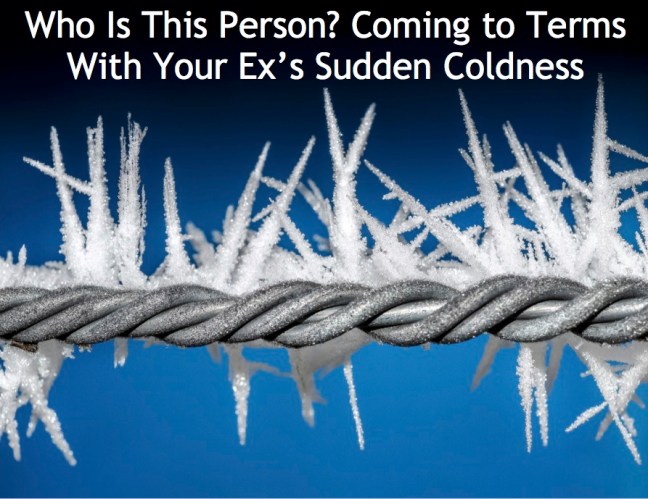
Who Is This Person? Coming to Terms With Your Ex’s Sudden Coldness

sudden coldness

We stood in front of the security line of the Atlanta airport. I felt so loved, so safe in the familiar space created between his chest and his arms, listening to his heart beat through his shirt. I teared up a little as I turned away, already missing my husband of sixteen years as soon as the physical contact was broken.

It was supposed to be goodbye for a week.

It turned out to be goodbye forever.

By the next time I saw him, eight months later in the courtroom, he had become a stranger. A forbidding stranger.

In an instant, this man had gone from my protector to my persecutor. My ally to my greatest threat. And instead of professing love, he was waging war.

It was as though a switch had been flipped.

I just couldn’t wrap my head around the seemingly abrupt transformation. Had this malicious man been hiding in my marital bed the entire time? Did he somehow wake up one morning a different person? Or was he always this way and I was finally able to see the truth?

The reality is probably a little bit of all of those.

Self-protection is at the root of behavior.

To begin with, it’s important to remember that at its core, all behaviors are self-protecting. To that end, it made sense for him to play the part of a loving husband while he chose to remain in the picture. This act allowed him to avoid my rage, sadness and disappointment over the reality of his actions.

Once he left, the distance and coldness again protected him from feeling my pain. In essence, by acting as though he didn’t care, he could begin to believe it. A barrier of disassociation. In this view, the switch was flipped more in an effort to prevent pain than in an effort to inflict damage.

For my part, believing in his good-husband routine insulated me from the painful truth during our marriage. I didn’t want to see the deception he was capable of, so I chose to believe in the best of him. And then once he left, a switch was flipped in me. I couldn’t understand how someone I loved (and who I thought loved me) could do those things, so I chose to see him as all-bad. This view, and the distance it provided, served to protect me from further damage to an open heart.

Cognitive dissonance is a powerful force.

Cognitive dissonance happens when somebody’s beliefs about themselves and their behaviors are not in alignment. It is a very uncomfortable position, and so we often strive to change either our actions or our beliefs so that they again line up.

One of the ways that my ex minimized his cognitive dissonance between the conflicting belief of seeing himself as a good person and the action of committing bigamy is by justifying his choices. Over time (and without my knowledge), he had demonized me, both in his mind and to others.This belief then allowed him to act in a cruel and hateful manner towards me while still maintaining his internal integrity.

My own cognitive dissonance was amplified towards the end of the marriage as the belief that my husband was an amazing guy was beginning to be challenged by the cracks in his facade. And then upon the receipt of the text that ended it, the wool was brutally ripped away from my eyes.

And for the first time, I saw him as he was, not as he wanted to be seen.

You can’t see the big picture until all of the pieces have been assembled.

I now believe that the man I married was not the same man I divorced many years later. He changed, significantly and detrimentally, most likely from a combination of addiction and unaddressed childhood trauma.

Yet, even though he was not the cold and calculating man when we wed, that potential was within him. I saw some of the signs and yet I chose to discount them, brush them off as inconsequential.

And it was only later, once he removed his mask and I began to assemble all of the clues, that I could see how it all fit together. Even though the change felt abrupt, it was more a matter of the final piece being slid into place.

Hate is not the opposite of love.

And then there’s this – the opposite of love is not hate. It’s indifference. When we truly don’t care about someone, we don’t expend the energy to make them miserable. When an ex is trying to make your life difficult or attempting to manipulate you, it’s a sign they have not yet let go. And it can also be an indication – albeit an agonizing one – of their own pain.

When you’re facing the brunt of your ex’s coldness and distance, it’s hard to respond with anything but shock, hurt and indignation. Maybe this will help.


Guest Blog: The Stages of Recovery From the Women Who Made It

By Amelia Meyer


He always chewed his lip when he knew he was in the wrong and, as I sat across the room, waiting for him to speak, I saw him begin to chew furiously. “What’s wrong?” I thought maybe he’d bought another expensive bicycle with the money we had saved for a trip to England. Nope.

“It’s what you think it is.” Typical, he avoided uttering the words and made it seem like something that was already in my realm of imagination. It wasn’t. But I knew him well enough.

“Cheating?” It’s the only thing I really feared. I barely whispered it, but he heard it loud and clear, nodding.

We had been married for 9.5 years and I had no idea. Unbelievable, yes. Stupid, possibly. But the fact remains. In the weeks that followed, I experienced a type of pain I hadn’t imagined possible and all I kept asking anyone that gave me a few seconds of their time (and some who hadn’t) was, “Will I ever be ok again? How long does it take for this feeling to pass?” I needed to know that I would get out of that deep, black hole and be some kind of normal again.

FamilyToday, I’m a different person. I’m happier, stronger, lighter, calmer. But, over the years since my divorce, I’ve had to go through the motions (and emotions) with friends facing a similar fate. Today, they are at various stages of getting from that dreadful pit to where I am. I want to share their stories and mine as a kind of timeline, a glimpse into what to expect and what just cannot be controlled or changed. Everyone’s story is different – their love and their expectations were different. But, meeting women that have experienced the horror, regardless of where they are on the timeline of healing, does give some peace. It did for me.

MEET D – THE BEGINNING

D is still waiting for her papers, but heard only six weeks ago of her husband’s infidelity. She is still raw, reeling from shock and unable to see the glimmer of light at the end of the tunnel. I know D to speak well of her husband always, to build him up in front of friends, and to give of herself to him and their marriage. Then, a few weeks back, he confessed to an affair with his masseuse, a place D had never thought to doubt him. He has moved in with her and her child, leaving D to juggle a world of hurt and betrayal alone.

  1. How do you feel right now?

Intense physical pain. Abandonment.

  1. Was your divorce expected? Why or why not?

Never. He preached loyalty no matter what to everybody who would hear.

  1. What do you remember feeling or thinking first?

Who is this man? I don’t recognize him.

  1. Have you worked through any of the five stages of grief (denial, anger, bargaining, depression and acceptance)? Where are you at the moment?

Yes, even acceptance. But, sometimes, I catch myself hoping/dreaming that he comes back and says he is sorry and made a mistake. I got so angry that I broke so many things in our house after I moved out. I just walked in there and started breaking stuff. Ornaments, microwave and printer to the floor. He called the cops on me. I just told them that it was my house and my stuff and they let me leave in peace.

  1. How do you feel about your ex right now?

He is an evil stranger who tells people that he is in love with this other woman because I was a terrible wife to him. He has me out of my house, out of my job (I worked for him), but I have chosen to let it go. I cannot allow his actions to eat at me like a cancer.

  1. What has surprised you during the break-up or how have you surprised yourself?

Just how cold and calculated he has planned this. His mother told me she always knew he never loved me. I did not see that.

  1. What goals have you set for the next three months?

Not to make any rash/big decisions. To keep a strict watch on my finances, and to stay ever closer to my God and my congregation.

  1. What has been your time-out when things get too much?

A walk. A bath. A cry on my best friend’s shoulder.

  1. If you knew then (maybe just before he told you) what you do now, what would you do differently?

I would just walk away immediately. Many of the things said and done between us during this time was humiliating to me and robbed me of my dignity.

  1. What advice do you have for others that may be at the beginning of this rough road?

Stay away from the alcohol unless somebody trustworthy has your car keys and your mobile phone, lol.

Continue to read the rest.