“When am I ever gonna use this?” As an eighth-grade algebra teacher, I hear this refrain at least once a week. It’s a difficult question to answer. I mean, when is the last time that your employer asked you to factor a polynomial or prove two polygons congruent? The truth is that most of us will never use the myriad of math facts and algorithms in our post-school lives. However, that does not mean that math does not have some valuable lessons for us. The following are lessons that can be learned in an algebra classroom and applied in your life. No calculator required.
I had a statistics professor during my undergrad who used to constantly tap his temple and utter “Columbo logic” followed by a broad gesture with the arms and the phrase “mutually exclusive,” both uttered in a heavy Indian accent. I never learned what he meant by Columbo logic (luckily it wasn’t on the final) but I did master mutually exclusive events.
In mathematics, two events are considered mutually exclusive if they cannot happen at the same time. The main example I use when I teach this to my students is the two sides of a coin. It is impossible for a coin to land on heads AND tails at the same time. Don’t worry, I’m not going to teach you a math lesson; I’ve been doing that all day. It just turns out, that like Venn diagrams and marriage, there is a connection here to the real world. (Side note: If you have kids, please do not tell them that math ever applies to the real world. We math teachers try to keep that a secret. Just kidding 🙂 )
Math is simple and elegant; disjoint sets are easy to recognize and have clear and defined boundaries. Life, on the other hand, is messy and complicated. Mutually exclusive events are all around us, but they are not as simple as heads and tails.
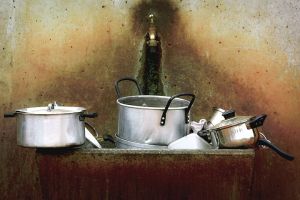
There is a tension that can exist in life when we do not recognize two situations as mutually exclusive and we strive to have both. For example, in my life a clean kitchen and my boyfriend being in town are disjoint. As long as he is here, the kitchen will be messy. If I expect something otherwise, I will only become frustrated. Now, since I love my boyfriend more than I love an empty sink and clean counters (okay, okay, this is true on most days!), I choose to have him around and live with the mess.
We can also use mutually exclusive events to our advantage. For example, I know that it is impossible for me to feel overwhelmed when I am on a hike through the woods. So, if I am overwhelmed and time allows, I strap on my hiking boots.
These are some of the events that are mutually exclusive in my life:
Panic and yoga
A plate of veggie nachos and restraint
Anxiety and a long run
A late night out and a Friday during the school year
How about you? What events are mutually exclusive in your life? Perhaps you could apply some Columbo logic. 🙂
The characteristic that makes possible the control of voltages or currents so as to accomplish gain or switching action in a circuit; examples of transistance occur in transistors, diodes, and saturable reactors.
The characteristic of being resistant to transitions.
Me. Sometimes I feel the need to make up a new word or ascribe a new meaning to an established word in order to say what I want to say. This is one of those cases. Apologies in advance if that offends you.
Anyone involved with education is familiar with the enormous transitions from school to summer and then back again. As a teacher, I am involved with shutting down and then restarting an entire organization every year. It is a transition on a macro scale. Embedded within that transition, each person involved is also facing change. I see it in the rising freshmen in the spring and the incoming sixth graders in the fall. I see it on the faces of the parents as they witness their “babies” growing into maturity. I see it in the teachers as we adapt to new curriculum and new routines. It is an exciting and stressful time for all.
But why is it stressful? The coming of another school year and the aging of children are expected. Normal. So why the anxiety that bleeds into the buzz?
Transistance.
We so easily fall into the trap of thinking that the way things are now is the way they are always going to be. We might plan for tomorrow yet we see it from the perspective of today. That creates a friction between our psyches and the “now” that results in a resistance to change. We know transitions are inevitable yet it is difficult to imagine the biting wind of a winter storm while baking in the summer sun.
The only thing constant is change. Heraclitus
I did not used to be as aware of the affect that transitions had on me. I would find that I didn’t sleep as well or that my mind felt scattered, but I never really dug down into it. I am trying to be more mindful of the transitory periods in my life so that approach them proactively. I make sure to take a little extra time to be quiet: yoga, meditation, or a solo hike or run. I do a better job listening to my body even it that means going to bed before 9:00 p.m. I remind myself that the stress of transition is also temporary and that a new normal will once again be reached. I still experience transistance. We all do. But now I can face it with a smile.
How about you? Have you experienced any transitions lately? Did you have transistance? How do you cope with transitions?
Boston - Boston Common: Parkman Plaza - Learning (Photo credit: wallyg)
One of the things I love most about my partner is that he sees himself as a perpetual student; he is always willing and eager to learn something new, even in an area where he is considered an expert.
Last year, we were out at dinner with a group of friends. One of our friend’s 8 year son opened the conversation with my boyfriend.
“Do you have a black belt?” the boy asked eagerly.
“I do,” came the reply.
“Actually, he has several,” interjected the boy’s dad.
“Wow! Does that mean you know everything?”
“Actually, a black belt means that you are ready to begin learning.”
I loved that response. It serves as a reminder to me to always be open to learning more, especially in those areas where I already have knowledge.
In that spirit, here are ten lessons that I am still learning:
1) Life doesn’t just have two speeds – on and off. It is not only possible to go slowly, but sometimes it is preferable.
2) It is okay not to be the first one at work; stuff still manages to get done even if I arrive after the custodians.
3) I’m working on learning to sleep past 6:00 am and considering the possibility of mastering the power nap.
4) A messy kitchen does not mean a chaotic life. It just means that people actually live in our house.
5) Sometimes it is okay for the play to come before the work. (I got this one from my dog)
6) I am still working on going downhill on wheels (bikes, skates, etc.). I just don’t trust those things!
7) Stretching is worthwhile exercise even if is doesn’t work up a sweat.
8) It is okay to relax.
9) Money will be there; I don’t need to get too stressed about it.
10) Always take time to appreciate what you have and remember to express your gratitude. Especially when the kitchen is messy.
For the most part, I try to steer my own happiness. I work to consciously react to situations and choose my mood. I can’t from the one glaring area; however, where my mood is entirely dependent upon external factors: my students’ success.
Mathematics (Photo credit: Terriko)
Of course, it makes sense that I want my students to do well. I spend the better part of a year forming relationships with them and working hard to help them understand algebra (unfortunately, I do more of the work than they do in many of the cases). I find joy in those lightbulb moments where the elegant simplicity of a linear function becomes apparent to them. I grin from ear to ear when I realize that they have learned the power of persisting through a difficult problem and the satisfaction that comes with a hard-won answer. I love to see them mature over the year and learn more about themselves.
So, what’s the problem? The problem is that the success of a middle schooler on any given day is impacted by such variables as the phase of the moon, Justin Bieber’s current hairstyle, the number of vampire movies playing in the theater, and some complicated formula (pretty sure it’s the inverse square) that involves the length of time since the most recent Gears of War was released and the strictness of their parents. I don’t have a whole lot of influence on those things.
Justin Bieber at the 2010 White House Easter Egg roll. (Photo credit: Wikipedia)
My moods can shift like the tides depending upon how my students are performing. When their test scores are up, so am I. When they fail, I feel like I have. The result? My mood takes on the shape of a sine wave, steered by the hands of 8th graders. I take their grades personally, even though I have limited control over them. The times that make teaching worthwhile are when I hear the words, “Thank you for explaining math to me. I get it now.” My goal is for none of them to ever be held back in their goals due to a lack of math comprehension.
I’m sure this is something that parents feel, only on a larger scale. You want your progeny to work hard and be successful, but you have to step back and accept that they will make their own choices. Yes, you have an influence on their choices and successes, but they ultimately are the ones in control of their actions.
As we head into testing season, I am going to work to separate my happiness from my students’ performance. I want to be more clear in my own mind about my role and the limitations of my role. I can take pleasure in what I can control; I know that I have worked hard to reach the students and to make the math accessible to them. I refuse to let a number 2 pencil dictate my mood. But it will be nice if they do well. Maybe if Justin Bieber cuts his hair…
A standard number 2 pencil, unsharpened. Made by Sanford. (Photo credit: Wikipedia)




 Lessons From the End of a Marriage