The Two Words You Should Never Say

We often utter these two words under the guise of empathy and compassion.

We say them almost automatically when something said triggers a memory in ourselves.

But when we say these words, we are not being empathetic. Or compassionate.

We are being egotistical and worst and narrow-minded at best.

Assuming that we know more and that others’ experiences parallel our own.

“I understand.”

Those two words are dismissive and minimizing.

Rather than provide comfort, they lend an air of superiority that leaves the “understood” one feeling invisible rather than appreciated as it reduces an entire lifetime of experiences and reactions to a mere sketch comprised of conjecture.

“I understand” is built upon a foundation of assumptions.

It assumes that everyone perceives as you do.

Feels as you do.

Responds as you do.

But they don’t.

You can relate. You can identify.

And you can certainly empathize.

But you will never understand.

It’s worse than simply putting words into someone’s mouth.

It’s also putting thoughts into their heads.

And feelings into their hearts.

We feel understood when somebody listens to us, not when they talk at us.

We feel understood when somebody accepts our perceptions rather than when they try to convince us of their own.

We feel understood when somebody honors and respects our differences instead of trying to reduce us to a common denominator.

And paradoxically, we often feel the most understood when somebody admits that they do not understand. And instead of offering words, they give the gifts of presence and kindness.

Because we don’t ever understand what somebody else is experiencing. But we all know what it’s like to be scared or hurting or confused. And we all know how important it is to feel understood and accepted.

So rather than saying you understand their situation, demonstrate that you understand that you cannot fully comprehend their pain yet you can support them just the same.

Be receptive rather than prescriptive.

Ask instead of tell.

And listen more than you speak.

For more on the idea of assuming understanding, read this post on The Good Men Project.

The Entitled Ones

entitled

We all start out believing that we are the center of the world.

And then as we grow, our sense of our place in the world shifts.

Until we realize that we are not the center of the world. but a part of the world.

With a responsibility to step and speak with kindness and care.

Except some people never develop the understanding that they are a part of the world.

They persist in their belief that they are the sun and the rest of us are mere satellites.

And rather than stepping with kindness and care, they stomp on boundaries and crush others beneath their unfeeling feet.

And rather than speaking with kindness and care, they use words as weapons to harm and tools to manipulate.

They are the entitled ones. The self-crowned kings and queens of our realm.

Many were raised to be empowered, showered with excess and unearned praise by parents afraid of setting and maintaining boundaries. They held dominance in their families and assumed that their sway extended outside the familial home. They never learned how to hear a “no” or contend with a limit. They asked and they received.

Parents stepped in and cushioned consequences, so cause and effect was never mastered. They never received education in empathy, so they held on to a young child’s lack of understanding. And perhaps worst of all, these infant monarchs learned how to shuffle blame and avoid responsibility.

Some of the entitled ones earned their badge with an assist from genetics, given a biological limit to their abilities to empathize with and understand others.

In school, these entitled children don the label of “bully” as they use power, fear and manipulation to control the other students. In their world, the ends justify any means necessary and they are quite adept at pulling out every mean possible.

As they grow into adults, the entitled ones often find themselves successful. After all, when you’re ruthless on the ladder to success, you can leave quite a pile of bodies behind you. They can be charismatic, hiding their entitlement behind charm and practiced words. They’re just putting on a show for the benefit of their lackeys while they take what they believe they deserve.

And some of us fall for this charade. After all, it can certainly be a great show.

But these are the people that will pledge fidelity while actively pursuing another. They will set a household budget, yet feel entitled to break it. They will tell you what you want to hear while doing what they want to do.

The only reason needed for any action is,”I felt like it.”

But at some point, the curtains part.

And we see the special effects for what they are.

And we become aware of the strings tied around our own wrists.

Making us an unwilling participant in the entitled one’s play.

And for those of us that understand that we are all in this together, the realization that we were perceived as nothing but minions and pawns is a painful one.

But better to endure the pain of having the strings cut.

Than to never see them at all.

Be stronger than your pain.

Build your boundaries with your entitled one and enforce them with everything you have.

Let them be the center of their world.

But refuse to let them be the center of yours.

When Are You Safe In Marriage?

Imagine stepping onto a baseball field and up to bat. You connect with the ball and begin your run around the bases.

So when would you be safe? When could you relax a little, knowing that the umpire couldn’t declare you out? When could you be assured that the run would be completed and you would make it all the way home?

After first base? Second?

If marriage was a baseball field, first base would signal the completion of 10 years, second base would be 20, third, 30 and circling around to home plate again would represent a lifetime of wedded (hopefully) bliss.

When are you safe in your marriage? When can you breathe easy knowing that your spouse wouldn’t suddenly decide to throw you out? When could you be assured that the marriage will last a lifetime?

After ten years? Twenty?

A friend commented on a local radio personality’s somewhat public and ongoing divorce from his wife. They have been married for twenty years. My friend was shocked, having the assumption that a marriage that has lasted twenty years will last for the remaining decades.

But that’s not necessarily the case, is it?

In a marriage, you can celebrate making it to second base. But you can’t relax.

Some of the hardest years can certainly be the early ones, as negotiations are compromised and compromises are negotiated. You are still learning who your partner is in a variety of situations and learning how to be with them. It can be a time filled with complexity and flexibility as you find your stride.

And if nothing ever changes, perhaps you can relax at that point, resting easy knowing that you’ve worked through all of the kinks in the marital knot.

But something always changes.

Kids come and go. Promotions are gained and jobs are lost. Some selves are actualized and some are minimized. Someone may fall ill or someone may fall in love.

Something always changes.

And when change comes, the marriage must change with it if it is going to survive. (And especially if it is going to survive happily because what’s the point of a long marriage if you’re miserable the entire time!)

Even if it’s been twenty years.

Because in a marriage, there’s no such thing as safe at the plate.

And although that may seem a little scary, it also makes the game exciting. Because how can a marriage between two ever-changing people in a always-shifting environment ever become stagnant or boring?

You have to always keep your eye on the ball and your intention on the journey.

And if you get called out, don’t be afraid to get back in the game:)

Detachment Styles

Much has been written about attachment styles, starting with ways that infants bond with their caregivers and then extrapolated to how people respond in their romantic relationships.

Here is a summary I made of the four primary attachment styles (information from Psychology Today):

attachment stylesIf you are not familiar with attachment theory, it’s worth a look. It’s amazing how much of how we respond in relationships can be described within this matrix.

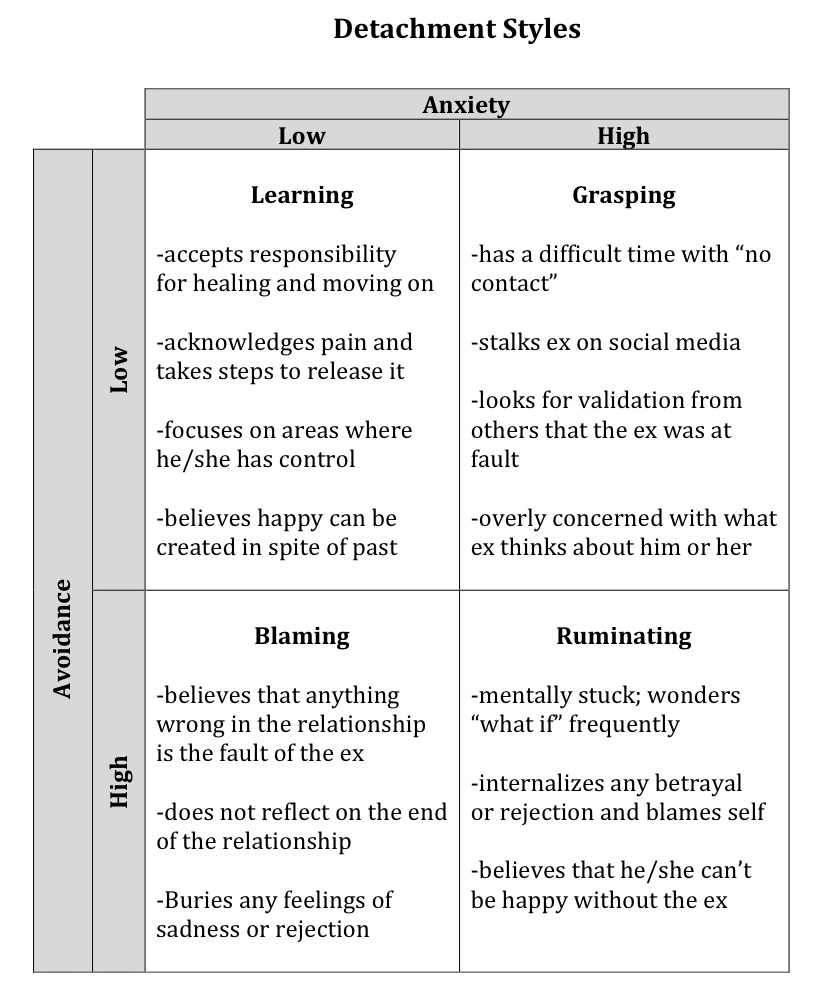
Of course, the way we respond at the end of a relationship also depends upon our personal makeup and early experiences. I created a chart of detachment styles based upon the same criteria.

detachment stylesAs with with attachment styles, you will likely recognize yourself in more than one category or realize that you have moved from one box to another over time. These are not fixed traits; you can change your position with intention and effort.

Breaking up happens. How do you want to detach?

Permission Granted

When I was a freshman in college, I spent a brief period in a grief support group. I was reeling from the deaths of over a dozen friends in the previous few years. There was a young man who had recently lost his mom to cancer and a woman whose brother was killed the previous year in a head-on collision. Three other women rounded out the group. They had all miscarried.

All of our losses, although different in degree and detail, had much in common. But there was one factor missing for the ones who had suffered the loss of their unborn child; they didn’t feel like they had the right to grieve. Either explicitly or implied, they had all received the message from people around them that theirs was not a “real” death and that their level and duration of grief should match that fact. Their grief, rather than being supported, was minimized.

Unlike the rest of us, who were deemed “faultless” in our losses, these three women had faced accusations and associated guilt that they were somehow at fault. That they were responsible for their loss. They had the added burden of a sense of culpability and a target for blame.

I ached for these women.

Their loss was real. Their pain was real.

And the fact that their pain was downplayed and finger-pointed made their grief all the more real.

A divorce is a death.

Not of a person.

But of a marriage.

It is loss of the possibilities of the future.

It is collapse of a partnership and a family.

It is the cleaving of lives and often self.

And part of what makes divorce so difficult is that it is the demise of a marriage and yet there is a stigma attached to grieving its loss. There are no wakes, where loved ones gather and offer support. There are no obituaries published to disburse the news and quiet the rumors. You garner uneasy looks in you mention how you miss your spouse, especially if he or she is playing full-on offense in the divorce. There are no established rituals for mourning a marriage (and I don’t count the uptick in the often-gaudy “divorce party” a grieving ritual). And there are certainly no memorials planned.

It is a complicated grief. The person is still alive, yet the memories are now tarnished perhaps beyond recognition. They become sort a walking dead.

There is always a questioning and doubt as to what you could have done to alter the marital course. And it is a tricky path to walk between responsibility and needless guilt.

You may feel confusion because you initiated the divorce and yet you don’t understand why you are so sad to see the end you hoped for finally arrive.

You hear statements from others like, “My divorce is the best thing that has ever happened to me,” while you’re still reeling from the loss and grieving in silence.

The loss is real. The pain is real.

And the fact that the pain was downplayed and finger-pointed makes the grief all the more real.

So hold a funeral for your marriage, a sign of acknowledging the end and a first step of letting go. Take some tangible piece of the marriage (no, not your ex!) and release it through burial or a funerary pyre.

Write a eulogy for your marriage, telling the whole story from hopeful beginning to bitter end.

Plant a memorial tree symbolizing your roots in the marriage and your limitless growth above.

Re-purpose a memento from the marriage to serve as both a memory of what was and a reminder that you can transform your future.

It’s okay to mourn your marriage.

It’s okay to grieve your loss.

Permission granted.