The Power in Applying “The Four Agreements” to Divorce

four agreements divorce

As a homework assignment for my recent girl’s weekend, I was asked to read The Four Agreements. I was fully willing, but somewhat skeptical, since as the only child of a counselor, I was raised on a steady diet of self-help. I think I overdosed.

After the first few pages, my skepticism was replaced with excitement and understanding. This was one book that made sense to me.

The premise is simple: four agreements that, if followed, will change your life. The book is short and the agreements are extremely simple but nowhere near easy. They are applicable to every area of life and manage to be general and still useful all at once. They are interconnected; one always leads to another.

As part of my own work with The Four Agreements, I am drilling down and applying them to various areas of life. I’ve already explored The Four Agreements in Marriageand The Four Agreements in Wellness. Those were easy applications. After all, those are areas where your intention is to be honest and want to be your best. Now, for the hard one – The Four Agreements in divorce. How can these covenants help you navigate such an awful time with more dignity and awareness? Can these promises actually hold true while in midst of a life disintegration? Can they help to provide support and focus intention in those darkest of days?

I think they can.

The dictionary lists “acceptance” as one of the synonyms of “agreements.” Perhaps that is a better approach when it comes to divorce. After all, you may not agree with the divorce, you most likely do not agree with your spouse or ex spouse and you certainly don’t agree with the courts. But you still have to accept it if you wish to find peace. So, bad grammar aside, here are the four acceptances of divorce:


Be Impeccable With Your Word

“I can be impeccable with my word. He/she is a #$%@! Did you hear the latest?”

I think we have all been there. Refraining from badmouthing your soon to be ex is a daunting task. He or she may appear to have morphed into some cartoon villain, fiendishly planning attacks while safe in his or her secluded lair. You feel justified in your verbal besieges; after all, you’re just responding to the volleys thrown at you.

But step back a moment. Where are your utterances really coming from? You’re hurt and speaking out to try to distance from the pain. You’re scared and trying to armor yourself with words. You’re angry and slinging insult-trimmed arrows. You’re sad and seeking comfort from others.

Are your words really about your ex? Or are they about you?

Is it more impeccable to say,

“I’m frightened. I haven’t been alone in a long time and I don’t know if I can do it. I’m scared that I won’t be able to be a good parent for the kids. I’m worried that I can’t be strong enough for them.”

or

“My ex is such a terrible parent. Every little things is a battle. I don’t even think he/she thinks about the kids, much less wants to be there for them.” ?

This acceptance was extremely difficult for me. I felt justified in my anger and outrage and I needed to express it. I felt like he had stolen my voice by refusing to talk, so I screamed instead. I poured pages of vitriol into my journal, I sent him scathing emails and I cursed him to others.

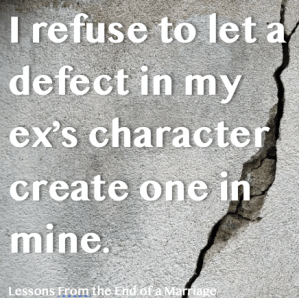
But on some level, I knew that, while purgative, those strategies were limiting. When I painted him as the villain, I cast myself as the victim.

To release my bindings, I had to release him as well.

Do not expect perfection of yourself with the acceptance. You will be disappointed. Rather, keep it in mind and strive to express what you’re feeling underneath the chaos of the split. Try to avoid blaming, either yourself or your ex. Try to accept the entirety of your ex, from the person you loved to the one you no longer know. Speak to them both.

Related: The Blame Game

Don’t Take it Personally

I hadn’t read the book yet, but this little acceptance changed my life. When I embraced this message, I began to forgive and to release the anger. Before that point, I saw him as deliberately working to destroy me. On some level, I pictured him plotting in his basement office, stroking the soul patch on his chin,

“Let’s see… I’ve already maxed out this card. Hmmm…I know! I’ll use the one in her name so that she has to deal with it later. Okay, now that the financial ruin has been planned, what else can I do? Well, obviously, an affair would be upsetting. Now, where can I find a willing woman? Oh, and at some point, I’ll have to leave her – yeah, that will really destroy her! What would be the worst? In person? Phone call? Letter? Sticky note? Skywriting? I know! I’ll do it with a text message. She’ll never see that coming!”

Pretty crazy, huh? I was taking it personally. In reality, he was not thinking of my well-being any more than I considered his during the divorce. Once I realized that his decisions and actions were about him, not me, I could stop reacting defensively and start seeing more rationally. He was hurting too.

It is difficult in a divorce to not take things personally. After all, you two were a partnership, a team, and now your partner has been recast as your adversary. It’s a wake-up call to realize how individual we really are. You were married to each other, yet you each experienced the marriage through your own experiences and perceptions. We can have empathy for another yet we have to take responsibility for ourselves.

Our egos take a beating in divorce. They perceive any attack as directed and they try to fight back. Put down the gloves and accept that the ego is simply protesting, much like a child throwing a tantrum. Let it cry. Let it scream. And then wipe its tears.

Related:Pardon Me, Ego. I Need to Get Through

Don’t Make Assumptions

Divorce is a time of great unknowns. Our brains hate the unknown, those gaps in the narrative. They strive to fill in the missing pieces. The medium used? Assumptions.

We assume we know why our ex is acting a certain way. We assume we know how he or she will respond. We assume that their actions and words accurately reflect their beliefs (as though they are impeccable when we are not).

We respond to assumptions rather than reality, building an entire relationship based upon an ever-weakening foundation of expectations.

We reach conclusions before we listen. We anticipate before we observe. We expect instead of accept.

Assumptions are a surefire way of maintaining your suffering. You are all but guaranteed to be hurt and disappointed when you live off expectations. This is yet another way that we can keep ourselves in the no-responsibility victim role, as we can see our hopes dashed again and again.

A divorce begins with letting go of the assumption that your marriage would last forever. The pain of the divorce will continue as long as you hold on to your other expectations. There is peace in letting go.

Related: Quitting vs. Letting Go

Always Do Your Best

Be gentle with yourself. You have suffered a great loss.

Be patient with yourself. It takes time to heal.

Be loving with yourself. You are deserving.

Be kind to yourself. You are not your mistakes.

Be firm with yourself. Always strive to do better.

…and recognize that your ex is probably doing his or her best as well.

Accept.


originally published in 2013

The Life You Had is Gone

life gone divorce

“The life you had is gone.”

I would tell myself as a lament and in an attempt to force acceptance.

“You now have the opportunity to create a new life.”

I would continue, in a hope that optimism also operated on the “fake it until you make it” principle.

“You can now build a life you want. A better life.”

I was desperately trying to see the good in the devastation that had become my existence.

“But I don’t want a new life! I want my old life. With my husband. I want our imagined and planned-for future. I want what I had!”

The pain of loss and the fear of starting over challenged my resolution to move forward with the energy of an obstinate child.

I didn’t want anything new. Anything else. Anything different.

I wanted what I had. Or at least, what I thought I had.

When I tried to picture a new life, a life without him, my brain responded with the muscle memory of a comic artist who has drawn only a single character. All I could picture was him. I would see myself older and he, changed as well by the years, would be by my side. Like watching a silent movie, I envisioned the life experiences we would daydream about on long car rides or late nights on the deck. I saw things changing around me – new jobs, new homes, new friends. But always, he was the constant.

Even as I reminded myself that it was gone, I resisted letting go. I wanted what was known. Comfortable. I railed against the unfairness of it. The theft of my dreams among the obliteration of his promises.

“But it’s gone,” I reminded myself throughout these visions. “You’re wasting your energy. Throwing good money after bad.” I became my own drill sergeant. “Move on! Drop it! Let it go!”

“But if I let it go, I have nothing,” I whispered back at myself.

I tried to force a new identity on the man in my life vision, but it was like trying to fit a child’s mask on a grown man – it couldn’t block it all. I tried to blur his face in my mind, to smudge him enough that he could be anyone. If my inner voice and I had been female characters in a movie, we would have surely failed the Bechdel Test because all we talked about was a man.

“It’s gone. It’s gone. It’s gone,” became the words that punctuated my footfalls as I ran countless miles in an attempt to purge him from my body. At night, I filled the pages of my journal with both memories and pleas.

I held no love for the man I battled in court. He was a stranger. A monster. I wept for the man that I thought I wed. I cried for the loss of an illusion. But damn, it sure felt real.

But illusions rarely stand the test of time. Like most apparitions, it began to lose it opacity with time. I started to accept the delusions inherent in the former life I pined for. The old existence with its new blemishes no longer held the familiar appeal.

“I can’t build anything new until I release the old,” I was mouthing as I woke up from a dream. A dream where I was alone. Alone and happy.

“The life you had is gone.”

I reminded myself again. Only this time the words had lost their dreadful weight and were infused with a sense of curiosity.

“The life you had is gone.”

“And I wonder what will come next.”

My Lesson From the Blue Zone

This morning, as I was dicing fresh ginger and tumeric for a chickpea curry, I was transported back to a semi-cultivated garden I toured a couple weeks ago in Costa Rica. As we trekked through the plot on our way to a waterfall, the guides would point out interesting plants and invite us to taste the fruits and roots of what we encountered. It seemed that each description included the healing properties of the plants and it was this I was fondly remembering as I compared my small, rinsed tubers this morning with the muddy and generous roots from Costa Rica that seemed to grow with such wild abandon.   Maybe by ingesting these roots I could summon up a little of that pura vida that I feel like I left back in the jungle.

The region of Costa Rica that I visited, the Nicola Peninsula, is one of five so-called Blue Zones in the world, regions that are characterized by widespread well-being and prolonged lifespans. Research has identified the commonalities of these five, very different, zones: plant-based diets, plentiful movement, strong social connections, and moderate alcohol intake are shared traits of these happy and long-lived cultures.

Based on my experience in Costa Rica, I think there is another, less tangible, characteristic.

Acceptance.

A major storm devastated the area mere days before our scheduled arrival. Even after we were assured that the roads were passable and the resort was open for business, I feared the worst.

I need not have worried.

Although the destruction was evident in the flooded yards, potholed roads and washed-away concrete along bridges, the atmosphere was one of lighthearted determination, as people rallied to rebuild the infrastructure before the start of the official high season for tourism.

When asked, the people would speak about the enormity of this flood as compared to the usual deluges of the rainy season. They would describe what was lost and recount some of the more tragic stories. Yet in every retelling, I noticed that something was absent – there was no attachment to the story, no woe-is-me coming through in the tone. The destruction just was. It was a fact, something to be quickly accepted so that the work could begin.

The inhabitants of this peninsula have frequent training in the power of acceptance. Every year, the torrential rains wash away and the dry season scorches. Seismic activity reconfigures waterways and roadways and even reduces concrete to rubble. The wildlife frequently reminds the people that they are merely visitors, as evidenced by a matter-of-fact recounting from a woman about her dog being snatched off its leash by a crocodile.

Our resort had an amazing coffee and juice bar that seemed to be the local equivalent of a Starbucks, where people would bring their laptops and textbooks to work in a communal environment. Only in this coffee shop, the Wi-Fi was anything but a given, as the internet seemed as tempermental as a teenager. And when service was disconnected, the locals seemed to take that as a sign to simply relax for a few minutes or even an entire afternoon.

This attitude of acceptance permeated everything. The country is often described as “laid-back,” but that implies a sense of laziness that is certainly not evident. Instead, the people don’t waste their mental energy on “what ifs” and “why mes.” They reserve their energy and attention for appreciation of what they have and to shape those things they can change.

Pura vida, indeed, and a lesson we can all strive to be better at no matter where in world we reside.


How to Rein In Your Need For Control

control

I was embarrassed to wear shorts.

The insides of my thighs were covered with tiny half-moon cuts and welts, formed by my own finger nails digging into my tender flesh. It hurt. But strangely enough, I did it in an attempt to not feel pain.

It was my first conscious bid for control. Every month, my hormones would send my insides roiling and the uncontrollable pain made me feel like I was a pawn to my body’s commands.

And so I found a way to create a pain that was under my control. A pain that would distract from the other and that I could alter the intensity at will.

The next act of control was also prompted by the actions of my body. After hand surgery and complications, I faced months of physical therapy and time in homebound school. Again, I felt helpless against the pain and limitations of my body.

And this time my dominant hand was unavailable to cut half-moon slivers from my thighs.

So instead, I cut fat from my diet. Today, I probably would be diagnosed as orthorexic, a pattern of eating extremely “healthy,” where major food groups are eliminated. I ate plenty. But still my hair grew thin and my skin dry because of the lack of fat.

I saw it at the time as an example of great willpower.

In reality, it was great fear.

I continued to play this game. Every time life told me I wasn’t in the driver’s seat, I responded with a, “Yeah, watch this! I’m going to MAKE this happen.”

And then I would.

And I would feel a little better for a time.

A little more in control.

And a little less scared.

But it was always temporary. Because life always had something else in store. Something I couldn’t control.

And it took the big one – facing my biggest fears of losing my then-husband along with all of my financial security – to make me finally realize that the joke was on me.

That by trying to control, I was only adding to the tension. The fear.

Because there I was, everything gone. Nothing certain.

And for the first time in my entire life, I felt no need to try to control anything.

Control What You Can (And Only What You Can)

Even in the most overwhelming and devastating of life’s tsunamis, there will always be something that you have some level of power over.

And it’s amazing how far just a touch of control can go in easing your mind. Identify what you can control within your situation and control the heck out it. Be careful here not to make the mistake I did in my youth. You’re looking for areas you can control that don’t cause you additional harm.

For example, I have a friend in the early (and rife with scary unknowns) stages of cancer treatment. There is so much she has no jurisdiction over. However, when she was sent home with a software-protected disc of images and instructions to wait several days until her doctor could read the results, she had other ideas. She controlled what little she could.

Look At the Big Picture

The more narrow your focus, the more likely you are to get upset or scared by what you see. Because in the details, it’s all overwhelming. So take a step back and try to see the bigger picture. Not only does the current situation represent only a small section of your life, but you may also find that the areas where you can take more control will increase in time.

If you’re having trouble seeing the forest for the trees at your current juncture, talk to, read or watch somebody who has been through similar. This will help to provide perspective and give you ideas of how you can work within your particular parameters.

Build Belief in Yourself

Part of what makes a lack of control so scary is that we can easily become afraid that we won’t be able to make it through. So put effort into building your confidence in yourself (guess what – that’s something you do have some control over!).

Remind yourself of areas where you succeeded despite the odds. Engage in activities where you shine. Surround yourself with people that believe in you and build you up. Set (and achieve) small challenges for yourself.

Understand the Difference Between Control and Choice

You cannot always control what happens to you, but you can always choose your response. Rather than get hung up on what you cannot control, recognize the power inherent in being able to select your reaction.

When my first husband ended the marriage with a text, I was so angry at first that I couldn’t make him talk to me. I felt powerless. Like my voice and and my options were taken from me. Eventually, after months of being angry and frustrated, I realized that I was focusing on what I couldn’t do rather than on what I could. And I soon as I made the decision to shift my attentions to my own choices (as opposed to his), the anger and frustration started to dissipate.

It’s a little crazy, the only control he had over me was the control I gave him. Once I decided that I would be okay regardless of him, I took back that control. That’s really what forgiveness is all about – a shift in the idea of who gets to decide when you’re okay.

Learn Your Fear Languages

It’s not just love that has its own languages; fear has its preferred tongues as well. Do you have a tendency to catastrophize, assuming that everything will end in the worst? Are you prone to all-or-none thinking when it comes to life’s struggles? Do you get overwhelmed by the details and fear that you’ll never find your way out? Do you stop sleeping as your nights fill with thoughts? Or do you worry about the future, endlessly ruminating over possible scenarios?

Learn to recognize when your fear is speaking. That alone is powerful. We often interpret its words as facts, when really they’re just opinions. And biased ones at that.

Know Your Go-To No-Goods

We all have distractions we turn to in an effort to take the edge off of the discomfort of being out of control of our lives. I used to tattoo half-moons into my legs and demonize butter. Maybe you turn to alcohol or Netflix or the space under your covers.

Recognize what you are pulled towards that is not good for you or not good for you in quantity. Just naming them can sometimes help lessen their pull. If you find their siren song is too strong, don’t hesitate to get help. Because at that point, you have relinquished control to your particular habit. And isn’t a desire for control what sent you there in the first place?

Learn to Steer Intro the Skid

One of the first safety lessons new drivers learn is what to do in case of a skid. Because untrained instinct, which tells us to pull the wheel sharply against the skid, will only lead us off the road. Instead, we have to be coached (and often convinced) that the best way out of a skid is to move the wheel along with it until control of the car is regained.

And that same principle holds true when life throws us into a skid. Be patient. Work with it. And take control again once you are able.

Remind Yourself Why It’s Worth It

When you’re feeling out of control, it’s easy to center your attention on what you don’t like about the situation. So try shifting it to what you eventually will like about the results. When I was going through my divorce, I wrote a list of all of the things I was experiencing or would (hopefully) get to experience that wouldn’t have happened if the marriage didn’t end. I also constantly reminded myself that the (totally unwanted and totally sucky) situation was also making me stronger, more aware and more compassionate.

Trust That You’ll Be Okay (Even If You Don’t Know How)

So much of a need to control is a desire to know the future. Which, of course, is impossible. For all of us. It really comes down to faith. Trust that even if you don’t know how or when, you’ll be okay.

Time spent worrying and trying to control takes away your happiness now in a barter with life for happiness later. But life doesn’t always honor those rules. You’re much better off taking life as it comes and accepting that the only thing you can ever control is your own response.

So make it a good one.


How to Accept the Apology You Never Received

apology never received

In an ideal world, everyone that causes harm to another, either intentionally or unintentionally, would immediately offer up a genuine apology: accepting responsibility, acknowledging the pain, express empathy and remorse, immediately changing behavior and, if appropriate, making amends for the damage caused. But we know that rarely happens. And it never happens as quickly as we would like.

Instead, we receive a “sorry” tossed out with little thought and nothing to back it up. We hear, “I’ll do better” and better never comes. We may find that in place of an apology, we instead receive blame and misplaced anger as defensiveness leads instead of empathy. The apology may be discounted by the excuses that accompany it. We may see an utter lack of comprehension at the pain that was inflicted. Or we may just be listening to radio silence, waiting for an apology that never comes.

An apology that maybe we don’t even need.

fullsizeoutput_1699

Why do we want apologies?

Children are taught almost as soon as they can talk to say “Please” when they want something, “Thank you” when they receive something and “I’m sorry” when they hurt someone. At the most surface level, we view an apology as a basic ritual of societal order that preserves a sense of fairness and responsibility.

Apologizing has become almost a knee-jerk reaction for many. How often have you bumped into somebody or inadvertently cut someone off with your grocery cart and had the word, “Sorry” out of your mouth without thinking? Even in such a minor interaction without much empathy or remorse behind the word, the apology still carries importance. When it is uttered, it acknowledges the infraction and its impact on the other person. When nothing is said, the other person feels invisible and insignificant.

At its most basic, an apology says, “I see you.”

And a lack of an apology is a passive rejection.

CA1038EE-7DC2-4D0E-985E-0C40AA405ED7

What do we expect from apologies?

Pain wants to be heard; the need for our suffering to be acknowledged drives our need for an apology. And the greater the perceived damage, the greater the perceived need for an apology. We all have an inherent sense of fairness, a balance of how things “should” be. When someone harms us, that balance is disrupted and we presume that an apology will make strides towards correcting that imbalance and restoring a sense of fairness.

We often see an acknowledgement of the slight and remorse for the actions as the keystone in the bridge to healing. As though once that apology is received, the remainder of the recovery follows. And so we wait.

Because we want to be heard. Understood. And the pain keeps screaming until it is recognized.

fullsizeoutput_16fb

What are the limitations of apologies?

Apologies can never undo what was done. They are not a magical eraser than removes any harsh words or caustic actions. When we imbue them with these special powers, we increase our expectations to a level that can never be reached.

No apology will ever be good enough to abolish the pain and reverse the damage. Just as you cannot control somebody else’s apology, they cannot mitigate your suffering.

You can’t outsource healing. You have to do it yourself.

m3kdqp1baos21.jpg

Do we need apologies?

An apology or a lack thereof is a reflection of the other person’s character, not your worth.

When somebody causes harm and refuses to accept responsibility, they are telling you who they are, not who you are.

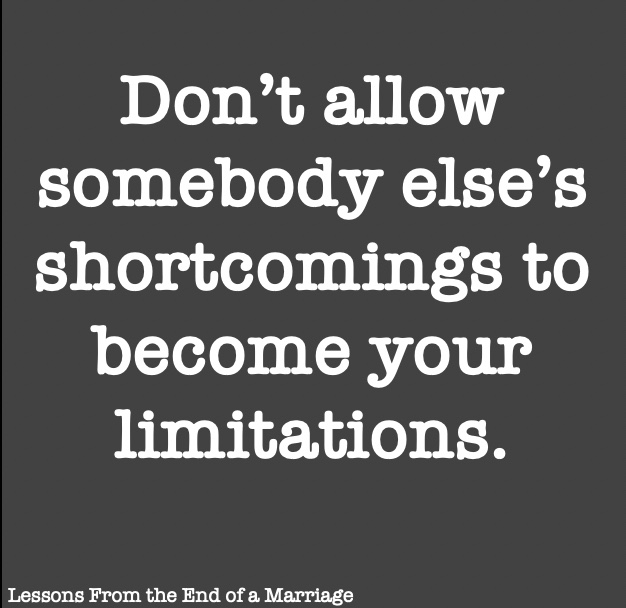
When someone is too cowardly to admit fault, they are showing you their shortcomings, not yours.

And just because somebody displays an utter lack of empathy, it does not mean your pain is not real and valid.

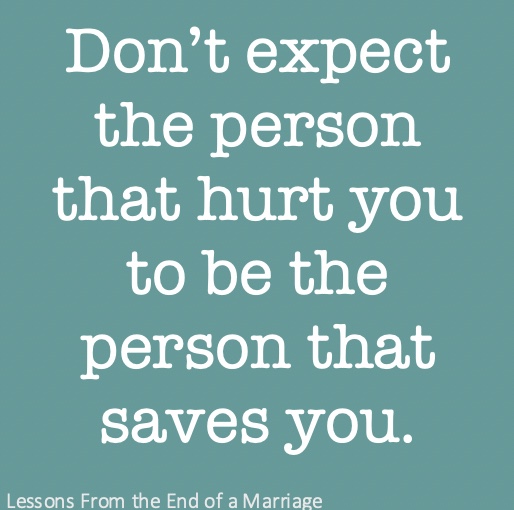
When you wait for an apology, you are allowing the person who harmed you to continue to harm you. You’re letting them decide if you get to be okay again.

And is that really a decision you want to place in the hands of someone who lacks empathy and courage?

If this person is still involved in your life and they are unable or unwilling to authentically apologize, take a good look at your boundaries. Is this someone that you want to remain in your life?

How can you accept the apology you never received?

The most critical component of accepting an apology you never received is to eliminate any magical thinking you have about apologies. They are no holy grail of healing. They do not have the power to erase what has happened. Once you realize that, it becomes easier to let go of the driving need for acknowledgement and amends. An apology is only required if you give it that power.

Your well-being should not hinge on somebody else’s shortcomings.

Their inability to accept responsibility is their problem.

Not yours.

Your healing is your responsibility.

Accept it.

If you’re having trouble accepting an apology you’ve never received, this can help.

fullsizeoutput_16ca