What You Gain From Sitting in the Fire

sitting in the fire

My alarm trills. It’s a cruel imitation of a bird’s chirp welcoming a new day. Except it’s too early for the birds. Or for most humans, for that matter.

But still I get up. Just as I have most every morning for the past four months.

Not because I really want to.

But because I know that the benefits are worth the temporary discomfort.

After I swallowed the first mug of coffee, I strapped the pup into his weighted pack in preparation for our morning power walk, the reason for the early start. Like me, he’s groggy, yawning and stretching as I try to secure the clasps of the pack on his undulating body.

Our first few steps are a bit creaky as we shake off the remnants of sleep. But by the time we exit the cul-de-sac, we’ve hit our stride.

Even as I dread the shortened nights of sleep and the often-unfavorable weather, I’ve come to enjoy our morning exercise. This morning, we got to gaze at the full moon for much of the course. Other times, we get to see the neighborhood fox on a pre-dawn hunt or the deer grazing in someone’s yard until we surprise them with our arrival.

IMG_1847
The local fox in the daytime.
IMG_1908
The full moon in the pre-dawn hours this morning.


I listen to podcasts over our hour-long trek, but it’s mostly a time for me to think. Which at this time of the year, often means that I’m reflecting back on how the school year has gone, considering the lessons I’ve learned and the adjustments I want to make for next year.

Much of my consideration is directed towards my 6th graders, because in many ways, they have the biggest challenge and growth potential over the year. I think about the ones who’ve made it, who successfully navigated the unfamiliar trial of accelerated math. And I think about those that didn’t quite make the cut.

All of these kids have to demonstrate the ability just to be accepted into my class in the fall. So why are some able to overcome the challenge and others never quite find their stride?

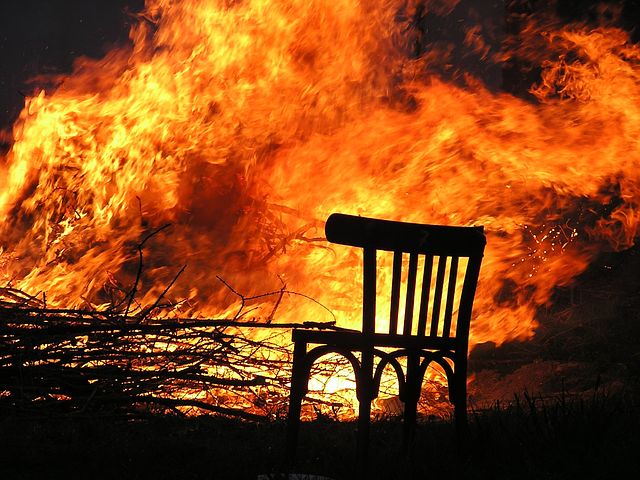
As I turn a corner, I catch a whiff of a fire pit that must have hosted a fire the night before. I smile as I think back to a recent yoga class. Although I certainly wasn’t smiling during the class.

The instructor apparently had some sort of vendetta against quadriceps that day, as we seemed to spend the majority of the 75-minute class in some sort of squat or lunge posture.

“Stay with it,” the teacher said, “You grow by sitting in the fire.”

And that’s the answer, isn’t it? The reason that some students make it and others don’t. The reason that some people return to hot yoga even with the anticipation of difficulty and others vow to never return.

The reason that some people make progress in their lives while others make excuses.

It always amazes me how often people who are looking for advice on how to get into shape, how to rejuvenate their finances, how to navigate a relationship or how to organize their homes know what they should be doing.

They don’t struggle with the know-how.

They falter when it comes to sitting in the fire. To do what they know needs to be done, even when the doing pretty much sucks.


Sitting in the fire is…

The discipline to exchange temporary discomfort for some future benefit.

The commitment to staying on the path you want for yourself even when the terrain becomes difficult.

The courage to tackle something that may lead to failure.

The faith that the pain isn’t as bad as it feels and that it won’t last forever.

The gratitude that you’ve been given this opportunity to test yourself.

And, at least for me on my morning walks, it’s the knowledge that there’s another mug of coffee waiting for me when I get home.


When I left that difficult yoga class the other day, I immediately decided that the efforts were worth it. I was proud in my determination to persist even when child’s pose was calling to me. I felt energized by my perseverance and calmed because my inner critical voice had nothing to criticize.

My students are voicing similar sentiments as they look back at their year. They share how hard it’s been. Remember those moments where they wanted to give up and return to the safety and ease of an easier class. And then satisfaction and self-respect creeps into their countenance as they recount those periods of intense effort and the gains that were made from the achievements.

Kazh the pup has been able to celebrate as well. We’ve put him through the proverbial fire these past few months. We have high expectations for training and behavior and we’ve put lots of time and effort into teaching him how to be in our pack.

And it’s paid off. His first big even, a March of Dimes charity walk for babies, was this past Saturday. Here he is walking a trail filled with people, dogs and strollers without his leash. And he did awesome. It was amazing to watch his face as he settled into the day and into the expected behavior. He was confident. He was proud. He was accustomed to challenge and so he didn’t let it phase him.



IMG_1897
I love how he’s looking at his Daddy to make sure he’s doing the right thing:)


When you sit in the fire…

You feel at peace with yourself because your values and actions are in alignment.

You gain confidence in your ability to overcome and persevere.

You become stronger with every fire you endure.

You feel honor for keeping your promise to yourself.

And you feel empowered by your ability to make it through.


When I finally pulled out of the driveway this morning to go to work, I was a little more tired than I would have been if I had spent that extra hour sleeping. But I was happier that I didn’t simply hit the snooze button.

Because although I have regretted making excuses, I have never once regretted sitting in the fire.


 

Starting Over

“I can’t do this.”

“Why should I try again? I’m just going to fail.”

“Maybe I’m just no good at this.”

“I’m tired of trying.”

I hear those refrains from my coaching clients about lifestyle changes. I hear them from my blog followers about relationships. And, most of all, I hear them from my students about algebra.

My days are filled with students groaning  in frustration, papers wadded up and thrown away in disgust. Every day, I reach into my supply of pencil-topping erasers and provide students with a way to obliterate their mistakes. Sometimes, they become too defeated by even the faintest echoes of work gone wrong, and I have to provide them with a fresh copy, unsullied by their past choices. Some students thrive when they can write on the Activeboard or even with dry erase markers on the desk, where the marks of any error erase without a trace. I model starting over, capitalizing upon rather than hiding my own mistakes at the board.

So much of my day is spent coaching people in starting over – motivating past the initial resistance and guiding new attempts. And even though I coach students on algebra and adults on life, much of the lessons are the same.

We would rather fail because we didn’t try than fail because we couldn’t do.

This was a powerful realization in my early teaching days. I would get so frustrated with students who would just give up and refuse to attempt anything. I saw it as lazy. Or obstinacy. But usually it was a form of self protection. You see, if we try and fail, it reflects upon on abilities. Whereas if we do not try, it only discloses our choices. I learned that in order to reach these students, I had to first convince them that they were worthy in spite of their failures. I found ways to build them up. To let them know that it was safe to try and fail; I would not ridicule mistakes and I would not allow other to either. And then I would find ways to create successes so that they could feel the joy of finally getting something right.

Failure means you’re learning. Starting over means you’re applying the lessons.

We may me more mature than those kids in some ways, but we also shy away from trying because of a fear of how it reflects upon us. We internalize failure rather than see it as a sign of growth. We want to play it safe, stay in known zone where the risks are not too great and the effort not too imposing. We look at the past effort as wasted and we fear starting over because it may lead to another dead end. But the reality is that nothing is ever wasted if you learn from it.

Starting over is overwhelming.

Whether it’s one of students having to re-do a page long problem or a person facing dating again after the end of a long marriage, starting over is hard. Very hard. It’s like taking your first step of thousands in a marathon – your leg is moving forward even as your brain is screaming, “Don’t! It’s impossible!” As with any feat of endurance, the trick is to focus on one step at a time. Starting over requires energy and if you’re mentally biting off more than you can chew, you’re exhausting your resources before you even begin.

When we focus only on the results, we grow frustrated. Celebrate the steps along the way.

I get a strange look from students when I praise their reasoning or skill on one step of a problem but still advise them that their answer is incorrect. “But, Mrs. Arends, I got it wrong. Why are you telling me I did something good?” Learning is a process. Starting over is a process. When we attach too much meaning to the outcome, whether it be a date or an algebra problem, we may miss the signs that we are getting better. So even when the results aren’t what you wanted, celebrate any signs of improvement.

Defeat only occurs when you give up. It’s better to change your goal than to throw in the towel.

In spite of the message put forth by the “everybody gets a trophy” mentality, not everybody can do everything. There are times that you may be trying to accomplish something that is beyond your reach and requires an endless amount of starting over. Rather than just give up completely, shift your goal to something you can do.

When we begin again, the possibilities are endless.

There is something about a blank slate that cultivates enthusiasm. It’s an empty canvas ready to accept whatever you put down. It’s easier to start from the actions of the past, rewriting what we have already tried. But this is your chance to do something new. Different. If one way didn’t work, toss it out and play around with another. If you allow it, starting over can have a sense of playfulness. Curiosity. Wonder and excitement.

Starting over is not doing the same thing again. Starting over is a gift of being able to apply the wisdom of your past to create the image of your future. 

Try. You just might amaze yourself with what you can do.


Feedback in Relationships

I had to deliver some staff development today on the concept of feedback in the classroom (please try to restrain your disappointment at not being invited:) ). As I was moving through the material, my monkey mind was making connections to how we give and receive feedback with students and how it relates to feedback in relationships. So even though you missed my presentation this morning, I’ll still share my thoughts with you and feedback and its role in our relationships. Only now the professional dress has been replaced with yoga pants:)

Feedback is Meant to Improve, Not Shame

There’s a TED talks video by Rita Pierson we always watch at meetings where she talks about putting +2 on a child’s paper rather than -18. That’s because the purpose of feedback is to improve, not to punish or shame. Feedback should never be delivered in anger or in frustration. It’s deliberate. Conscious. Careful.

In a relationship, any criticisms or advice delivered in a heated moment will not be received. If feedback is shared in public in a shaming way, no positive change will occur.If your purpose is to make your partner feel badly, you’re bitching, not providing feedback.

Your first responsibility in a partnership is to change yourself – your perceptions, your actions, your responses. Yet there will be times where you need to work to shape your partner’s actions for the betterment of the pair and feedback is a critical component of this. Before you speak, make sure your intentions are to improve, not to shame or blame.

Climate Comes First

The first goal of any effective teacher is establishing a classroom culture where students feel safe and secure and feel comfortable taking risks and making mistakes. If this climate is not present, any negative feedback tends to lead to defensiveness and shutting down. But once this climate is built, students know that you care about them and they are much more receptive to feedback, even if it is negative.

Relationships are no different. We need to feel safe in our partnerships. We need to trust that it’s okay to not be perfect and that a single mistake won’t mean that we’re kicked out. It’s important to establish a relationship climate where both partners feel comfortable voicing their concerns and receiving feedback from the other.

In the classroom and in relationships, building a positive and safe climate takes time. Trust doesn’t occur overnight; it comes from a pattern of action and response. Energy put into developing this environment goes a long way. Brock and I put quite a bit of effort into this early on (using candles as a signal) and that preliminary work has since paid dividends (and the candles have been in retirement for the last year and a half or so).

Goals Must be Clear and Shared

In the classroom, it’s not fair to give students feedback on their progress when they do not know or understand the goal they are trying to reach. Teachers use a variety of methods to communicate learning expectations to the students so that not only do they have an idea of where they are relative to where they need to be, but they have a clear picture of the ideal destination.

We know how important communication is in relationships and how easily misunderstandings can spiral out of control. Just as it’s not fair to berate a student for failing to achieve some mysterious goal, it is unfair to a partner to expect him/her to read your mind and then react with negative feedback when he/she doesn’t make strides to the goal you had in mind.

The learning goals for my classroom are constantly changing (thanks Common Core and meddling politicians!) and goals in relationships are often as malleable as curriculum. It’s important to continually touch base and ensure that the relationship-related goals are clear and shared.

Feedback Should be Formative, Not Only Summative

Teachers divide learning activities into two categories: formative and summative. The former describes the activities that occur during the learning process, such as practice and quizzes. The latter applies to the culminating event, such as an exam or project, where a student is expected to demonstrate mastery of a concept. Effective feedback occurs during the learning process so that the student can shape his or her actions towards the stated goal. It’s not fair or effective for the first feedback to be received when it really counts.

So, as that relates to relationships, don’t do what my ex did. The first time I knew there was a problem in the marriage was when he left with a text message. If there had been formative feedback along the way, there may have been an opportunity to change. There’s often a balance in relationships – sometimes you need to bite your tongue and avoiding bringing something that is minor or fleeting. And you also need to address any issues before they build to a level that destroys the partnership.

If the point of feedback is to improve, make sure that it’s given along with a chance to make the improvements. Otherwise it’s not feedback, it’s just a bunch of red x’s and a big, fat “F.”

Address the Actions, Not the Person

The fastest way to alienate a kid is to attack their person, to imply or state that they are “stupid” or “no good.” They will quickly live up (or actually, down) to the claim. Teachers have to be careful to address issues the kids can control – study habits, practice, etc. rather than things they cannot – learning disabilities, sub par schooling, etc.

We all have innate tendencies and backgrounds that we cannot control. When those are attacked, we shut down as we internalize the message. When you are giving feedback to a partner, be careful not to condemn areas they cannot change or that are an inherent part of who they are. Focus on the actions and behaviors that are transient and reworkable.

Feedback Should be Specific and Actionable

Students don’t grow when they receive a failing grade on an assignment with the implied message “you suck at this.” It’s overwhelming and they give up. Instead, they improve when they are given specific and actionable feedback that addresses one or two areas at a time with recognition given for progress along the way.

Baby steps work for relationships too. Don’t flood your partner with a laundry list of feedback. Start small, focus on one behavior. Acknowledge improvement, no matter how small. Be clear and specific. When the intent is clearly stated, it’s more likely to happen.


Just like with teaching, feedback does not only flow one direction. Be open and receptive to your partner’s feedback. Assume that their intent is to make you better.

And remember, we are all still learning. Always.


I Never Learned This in School

So December 2013 is another month marked by yet another school shooting. It’s almost commonplace now yet as I looked around the excited faces of our middle schoolers at their annual basketball pep rally this afternoon, it’s unimaginable. I cannot envision one of them turning on their classmates and teachers with a deadly weapon. I cannot picture an armed intruder entering our school.

And I don’t want to.

After Brock heard about the latest incident on the news, he brought up the idea of doing some pro bono training for teachers. This is a man who has made his life’s passion about protection and defense. I have no doubt that his empty hands against a gun would at least result in a fight. He wants to share his expertise so that teachers could be better prepared. I appreciate and understand his motivation and intent.

But I don’t want to.

I don’t like assuming the role of a security officer at school. I am stretched enough as teacher and counselor and social worker and nurse and cheerleader. And playing police defeats those other roles. The roles I signed up for. I don’t know if I possess the capacity for the duplicity required. Middle schoolers don’t respond to clinical detachment; you have to form relationships. But how do you build a relationship at the same time you train how to take them out? Perhaps it is something that can be learned.

ButI don’t want to.

It makes Brock upset. And, I’m sure, scared every time he hears those reports. He knows techniques and strategies that could potentially help. It frustrates him that I don’t want to learn those operations. But I don’t know if I can and continue to work in my role as a teacher.

I never learned this in school. I was taught how to attack curriculum, not people. I was taught how to motivate kids, not take out adversaries. I learned how to break apart the processes of math, not the bones of others. I am sure I could learn these other lessons,  these techniques more suited to SWAT than pep rally.

But I don’t want to.

Maybe it’s my way of keeping my head in the sand. Keeping the possibility at a safe enough distance. Maybe it’s because being a teacher is overwhelming enough and I can’t imagine adding another layer to balance. Perhaps I’m just not made of the right stuff to be able to respond tactically in chaos. Maybe it seems futile because I can not (will not?) dedicate the time needed for real training.

I don’t know.

But I do know that these reports always shake me to the core.

The hard slap of reality delivered with a frightening regularity.

I do know it makes me want to hug my students.

And assure them they’re not alone.

I do know it changes the way I feel, walking into my job every day.

It puts the little things in perspective.

I just read an article today that discussed the first national summit on school shootings. Those involved were trying to come with a profile that would fit the classic perpetrator. And basically, what they came up with was a pretty typical teenage boy. Not necessarily a loner, no more likely to come from a single parent home. Just a kid.

The kind that move through my classroom every day by the dozens.

I don’t want to view each of those kids as a potential shooter.

I can’t.

What I can do is try my best to see each one as an individual. To build relationships. To reach out. To listen. To get help when needed. To reassure and motivate. To build community and trust.

I may not know how to wrestle a gun from someone’s hands. But maybe I can do a little bit to keep it from those hands in the first place.

And hope that is enough.

The End.

You would think that I would be used to endings by now. I finish several books a week, following the tales to their final word. I run races, keeping my eye on the finish line. My weekdays are filled with bells that signal the end of a class period seven times a day. I’ve been through 29 last days of school – some as a student, some as a teacher and a few as both. Hell, even my blog is about an end.

So why do endings, even the ones I look forward to, still manage to feel abrupt? Too soon? A premature conclusion reached before resolution?

This past Friday was the last day of school with kids. I had been waiting for that day, counting down since the end of the spring testing season. Many days, it felt like the end would never come. The days felt longer, the children squirrelier.

But then, that final bell did ring.

As I watched those faces pull away in the school buses for one last time, I felt a loss. For the past nine months, I have laughed and cried with those kids. I have driven them crazy and they have driven me crazier. I’ve struggled to help them make sense of algebra and we have struggled together to make sense of tragedy. For nine months, those 120 teenagers are part of my extended family. And then they’re gone. I will never see or hear from most of them ever again. In one day, they go from constant presence to memory.

Eighth grade is a crossroads year. It is time when teenagers are beginning to develop themselves apart from their parents. They are learning to make choices and beginning to understand the nature of consequences. They try on different personas as often as outfits, going from class clown to teacher’s pet and back again in a blink of an. I call them 150 lb two-year-olds, as they test boundaries yet want to know that you’re still looking out for them. I see them develop over the year into more independent beings but I don’t get to see the conclusion. In May, many of them are still at a crossroads and I am unsure which path they will choose.

It often feels unfinished. I find myself, years later, wondering about certain students. Hoping they did okay yet fearing that they did not. I have to trust in them and relinquish any influence. Sometimes, I receive the gift of an update when former students track me down. It’s funny – I can see the echo of the eighth grader I knew in these adults, yet there are years of experiences that have shaped them after they left me. In some ways, they are frozen in time for me: middle school in perpetuum (now that’s a nightmare!).

I think we all struggle with endings, even those that we initiate or those which we welcome. Every ending has elements that we relish leaving behind and facets that we will miss. Every ending brings uncertainty and transition. Every ending requires a re-scripting and reappraisal as we disentangle ourselves from the past and set course for the future. Every ending has opportunity.

My school year begins with a list of names. Monikers with no faces, no personalities. My year ends with a list of names, as I file reports and stuff report cards. Only now these names have meaning. Visages. Character. The year may have ended, but its impact has not. Those nine months together have influenced us all regardless of what our collective futures hold.

We tend to see endings as a termination, a conclusion. Perhaps it more accurate to think of them as a transition, a sign of change. It may be over, but its reverberations carry forth.