I Was Married to a Con Man

con

I thought he loved me. It turned out that he was more con man than confidant. 

If my husband had been Pinocchio, his nose would have been a giant redwood. While we were married, I thought he was a real boy. Once he disappeared, I learned otherwise.

My husband and I used to watch “Lost” and shake our heads in disbelief at Sawyer’s deceptions. We laughed at “Dirty Rotten Scoundrels” when the con artists were conned themselves. We were shocked at the audacity of Leonardo DiCaprio’s character in “Catch Me if You Can“, and we were disturbed when we discovered the movie was based on a true story. While I thought he shared my disdain for the trickery and fraud in these tales, it seems as though he had been taking notes. Overnight, I went from an ordinary life to one that felt more like a movie.


My husband was a brilliant and talented man whose skills included creating and maintaining a separate existence. He had two cameras. Two bicycles. Two wallets. Two wives. Two distinct lives. When the financial mess he created in his life with me became too great to keep hidden, he broke up with me via text and vanished. That was when I learned that my husband was anything but a real boy — he was a con man.


My life was a virtual reality — my home a movie set consisting of false fronts.


He was an expert lie crafter; he always knew the exact proportion of truth to weave into the falsehoods to make a story believable. He always had an answer; he never hesitated. His office must have been like a busy air traffic control tower as he directed emails, texts, and phone calls to support his various tales. The extent of his deceptions was made clear when I sat with an auto insurance card in my hand — my name had been digitally removed — while I pulled up the file from the insurance company and verified that both names were present on the actual document. He thought he could erase me as easily as he could my name using Photoshop.


While my husband was in jail after being arrested for felony bigamy, I talked with his other wife, who was as stunned by the situation as I was. No woman should ever have to have a conversation about “our husband,” even if it is a cordial and informative discussion. I learned that when he was pulled in for questioning, his lies became increasingly absurd as he struggled to maintain his façade. My favorite? He claimed that he and I had divorced years earlier and I had since married a chiropractor named Mark Mercer. Mark, if you’re out there, I’m sorry that I have no recollection of our marriage and that I have never recognized our fictitious anniversaries.


One of the saddest aspects of the situation is that he was conning himself just as much as he was fooling those around him.


In trying to pull the wool over others’ eyes, he inadvertently knitted himself a mask with no eyeholes. He told so many lies for so long, he began to believe his own fabrications (he even admitted as much in a text to my mother). It became impossible for him to tell where the lies ended and the authenticity began. In trying to keep everyone else in the dark, he lost himself. The real boy was replaced with a hollow man.


I came out of the marriage confused, unsure of what was real and what was fabrication. I was embarrassed. How could I have been such a fool? My anger was explosive as I came to the realization that I had been literally sleeping with the enemy. The crime was intensified by the fact that it was carried out by the man who had sworn to love and protect me. Yet, eventually, I began to feel compassion for him, as I saw through the lies to the pain that must have born them.


I have come to the realization that the life I knew was real to me, and that has to be enough. I will never know what prompted his moral malignancies nor will I ever find certainty in truth.

I was conned, but that is not the end of my story. I am now exploring the world un-shaded by his lies.

Feel Like A Man

One of the moments when I loved my now-husband the most is when I witnessed him slide a BB gun into a man’s hands, propping the barrel on the porch railing where it was aimed for some cans.

Although no words were spoken, I understood his motivation.

He wanted his friend, weak and shaky from a degenerative neurological condition, to again feel like a man. And that was an importance I was only just beginning to understand.

My now-husband is a man’s man. He wears his masculinity on his sleeve and is both astute at identifying the characteristics of manhood and at communicating them.

And from him, I’m starting to understand the importance of feeling like a man. And how damaging it can be when that feeling is taken away.

Feeling like a man means that you feel powerful in your own domain. It means that you have control over many aspects of your life and that you receive respect and recognition for your strengths.

Feeling like a man means that you are able to take care of your family. Most often this is financially motivated, but it can also manifest in creating and maintaining a home.

Feeling like a man means that you take seriously the charge of protecting your family. It means that if harm befalls one of your own, you interpret it as a personal failing.

Feeling like a man means trying to find a balance between the very real and powerful emotions that arise within and the cultural message that “big boys don’t cry.”

We ask a lot of our men.

And they ask a lot of themselves.

And sometimes life doesn’t cooperate, stealing away the very things that allow a man to feel like a man.

Health crises rob the body of its strength. Turning a once-strong man into a weak and dependent form. The one whose broad shoulders used to carry others is now reduced to the one being carried.

Jobs are lost and with them, the confidence that comes from respect for position and knowledge. Lost as well is the knowledge that the family is being provided for.

Appreciation and recognition is withheld, perhaps replaced with nagging for what is not done instead of seeing what is done.

Someone in the family is harmed or is unhappy and the situation is internalized, a personal short-coming even when the cause is outside of anyone’s control.

Vulnerability is encouraged, yet that very trait can be turned against him when he is seen as weak or incapable.

I’m learning that all men, not just the alpha, masculinity-on-the-sleeve types, have these basic needs. These primal motivations.

And when a man doesn’t feel like a man, it is all too easy for him to feel like a failure. Depression seeps in, displacing any remaining confidence. He is prone to withdrawal as he questions his value. Addiction can become a welcoming refuge from the shame. It’s a vicious cycle – the less he feels like a man, the less he engages in the actions that make him feel like a man. And that’s the very cycle that consumed my first husband. Only I didn’t see it at the time.

As I watch my husband with his ever-weakening friend, I am grateful for the insight into what it mean to feel like a man.

And I’m careful to not take that feeling away.

How to Change a Man

I met up with a friend the other day. She’s at a crossroads with the man she’s been dating for the past year or so. She wants marriage. Not now, but she wants to move that direction and wants that to be the mutual end goal. At this point, he states he does not want marriage. Now or at any point. They’re in that difficult place where the relationship works, but the objectives of the partnership don’t align.

Having known Brock back in the days when he said he never wanted to be married, she inquired, “How did you get him to change?”

The short answer?

I didn’t.

And I couldn’t. At least not in any meaningful and lasting way.

I didn’t make him change. I didn’t ask him to change. I didn’t expect him to change.

But here’s what I did do:

I Accepted Where We Were

I always knew I wanted to be married (or at least something like it) again. But that didn’t mean I wanted to jump straight into commitment immediately. In fact, Brock was always the forerunner on taking the relationship to the next level.  And we baby-stepped it from one level to the next. And as we slowly integrated our lives and tore down our walls, I simply enjoyed the place where we were.

I Accepted Him

As with any relationship, as the newness wears off and the pedestal lowers, you discover certain traits and characteristics of your partner that drive you a little nuts. Since none of his quirks were red flags or deal breakers, I worked on accepting them. In fact, I’ve even learned to appreciate some of what can easily annoy me.

I Limited Expectations

I knew that our relationship may not progress to marriage. And I was okay with that. I had no expectations of a wedding or a white picket fence. I simply knew that I loved him and loved being with him. And that the time together wasn’t wasted even if it didn’t result in nuptials. Besides, I had learned about the dangers of expectations:)

I Didn’t Push

I never initiated a “where are we going?”talk. In fact, the only relationship-oriented talks we had were about where we were, making sure that we were on the same page along the way. I was patient as he learned how to be in a serious relationship and, later on, learned how to share a home and a life. I gave him time and space to acclimate.

I Worked on Myself

Whenever I found myself frustrated or disappointed by something in the relationship, I made an effort to examine my own responses (which, no surprise, were often overreactions). I learned that by changing my reactions, I could change the dynamics of our interactions.

And over time, the man that never thought he would be married, not only decided that he did, he also became an amazing and dedicated husband.

But the most important part wasn’t what I did.

It’s what we did.

Because everything that I did that compelled him to change, he also did for me. In spades.

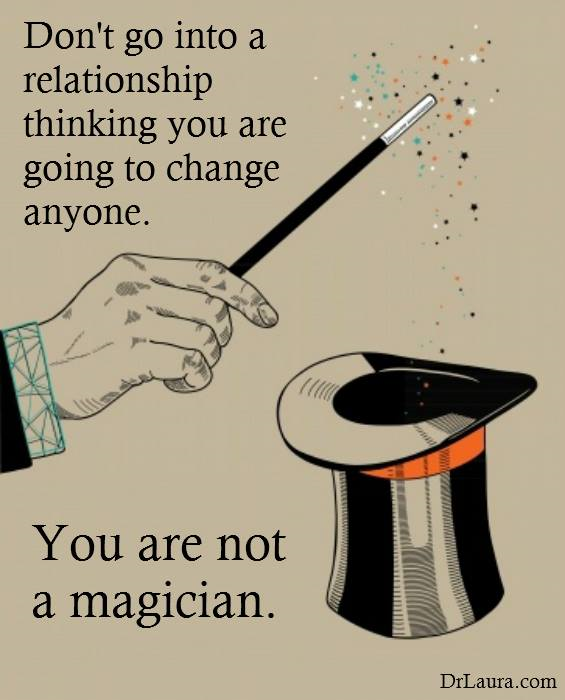
You cannot ever change your partner.

But you can be someone that inspires them to change themselves.

Because ultimately, the only guaranteed way to change a man (or a woman) is to change yourself.

2015/02/img_4385-1.png