How We Handle Failure

As I was reacquainting myself with my students last week (yes, we start school WAY too early in the south!), I reminded them of my belief that the math they will learn in my class is important. But the lessons in learning how to handle frustration and failure are even more important. Because, let’s face it, many of these kids may never have to solve a quadratic equation as an adult or explain why an exponential function has an asymptote, but they will certainly face failure. Probably many times.

images-53.jpeg

And I’ve to realize how important learning how to handle failure really is. In fact, I would go so far as to say that it is one of the primary forces that shapes who we become. The good news? Even if we have a had a subpar response to defeat in the past, with practice and the right mindset, we can learn to improve our relationship with failure.

images-52.jpeg

Five Negative Responses to Failure

Giving Up

I think all of us have released the words, “I give up!” in frustration when the fifteenth attempt at something still neglects to result in the desired outcome. It’s easy to become fatigued and weary, especially once the thinking brain has expended all of its energy and allows emotions to take the helm.

Internalizing the Message

“I suck,” we mutter to ourselves, confusing the line the action with the person, believing that we ARE a failure instead of a being that failed at something. This response is often ingrained in childhood when perfection (or at least the illusion of it) is expected of you from the adults in your life. You equate failure with rejection.

Avoiding Risk

If you don’t try, you cannot fail. Some respond to failure by refusing to take risk, preferring to practice the perfect and staying safely on known ground. This choice is rationalized as prudent, even wise. Yet the decision is made out of a fear of failure rather than a careful weighing of the potential risks and rewards.

Lashing Out

Some get angry when facing failure, attempting to cover the discomfort and vulnerability inherent in defeat with a veneer of hostility. “It’s not me, it’s you!” the response insists, hoping that by keeping people on the defensive, the failure will be overlooked.

Hiding the Evidence

This response is another that develops when failure is not accepted. When the inevitable happens, it is seen as shameful. And what do we do with that which shames us? We bury it.

images-8.png

Five Positive Responses to Failure

Accepting the Inevitability

Perfection is an illusion. There is no creature on this earth that succeeds in everything it tries. The newborn foal stumbles and falls before it learns how to walk on its shaky and spindly legs. The tree fails to root down deeply enough into the dense soil and almost topples during a storm.

And we are no different. Failure is as much a part of life as breathing. By accepting that, we can remove some of the emotion often associated with it. Rather than being shameful or a sign of weakness, failure is a sign of life.

Viewing Failure as Information

When I was preparing my classroom for the new school year, I had to adjust the legs on several of the student chairs. I glanced at the screws holding the legs together and estimated the proper size of screwdriver needed. On my first attempt, I managed to almost completely strip the screw while failing to loosen it enough to adjust the leg. That failure provided me with information – the screwdriver was the wrong size.

Once we have information, we are able to make adjustments and try a new approach. Without failure, we would never know what modifications are beneficial. Failure is a part of evolution; it steers us towards what works.

Taking Responsibility Within Locus of Control

Those that know how to use failure to their benefit are quick to own their failures, but only the ones within their control. There are two important facets to this response. The first is that once we claim responsibility for something, we give ourselves the power to change it. Secondly, by only accepting responsibility for things within our influence, we refrain from wasting energy trying to change things that we do not have dominion over.

It can be scary to admit that you failed. We don’t want others to see us as weak, as flawed. Yet by taking ownership, you remove the opportunity for others to use your failures against you. And the reality is that much of the time, people respect those that immediately and completely admit their failings as long as they are also making an honest attempt to learn from those defeats.

Reminder to be Open to Learning

Do professional athletes ever outgrow their need for a coach?

Nope.

Yet all too often, we become so comfortable (okay, cocky) within our own areas of expertise that we forget that we should still be learning.

And failure is happy to give us that reminder that there is always room for growth. For improvement. Failure equals humility and humility keeps us open and pliable.

See Failure as Opportunity

And this is what it comes down to.

Every failure is an opportunity.

A chance to try again.

Only now with more experience and knowledge of what doesn’t work.

Every failure is an opportunity.

A change to do better. To respond differently.

Without failure, there is no learning. No growing.

When we see failure as something to avoid, we are robbing ourselves of the opportunity to become the best version of ourselves.

And when we are able to become comfortable with failure, we are able to use it to take the next step. And then the next.

We will stumble. We will fall.

But as long as we get back up, learn from what didn’t work and keep trying?

Well, there’s no stopping us.

images-51.jpeg

One Event Does Not Define You

It was parent conference week at my school this past week. It’s a week I always look forward to (even while I dread the long hours required). I love getting a chance to talk with the parents after I have been able to see their child’s strengths, weaknesses, celebrations and struggles. Most of the conversations and strategies are pretty run-of-the-mill. Helping middle schoolers learn to prioritize, time-manage and organize is an on-going and ever-present task.

But every year since my first in the classroom, I have had a handful of conferences that are anything but run-of-the-mill. Some of the kids that come through my classroom have been through tragedy. Loss. Trauma. And as the teachers sit around the table and learn the information, the missing assignments suddenly become less important than the missing childhood. The focus shifts from succeeding in school to creating a support system to help the child succeed in living.

Once I learn of the background, there is one talk I always make sure to have with any student that went through too much far too soon.

I call it my “defining speech.” And it goes something like this:

———-

“Make a line through this point,” I ask, drawing a dark mark in the center of a blank white sheet of paper.

point“Where should I make the line?,” some students inquire, while others simply follow my command and draw a line on the paper. The perfectionists make themselves known by insisting upon a ruler.

line

“Is that the only line you can make through that point?” I ask.

“Well, no. I could make a bunch of different lines.” I gesture for them to show me.

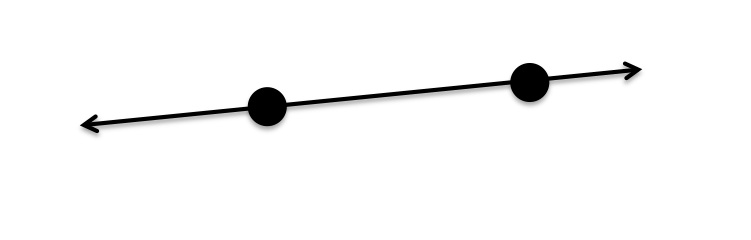
linesssI then turn the paper over and draw two points.

pointsss“Make a line through these.”

line2“Is that the only line you can make through these two points?”

I usually get a “Is my teacher crazy?” look at about this point.

“Well, yeah? I mean, two points make a line, right?”

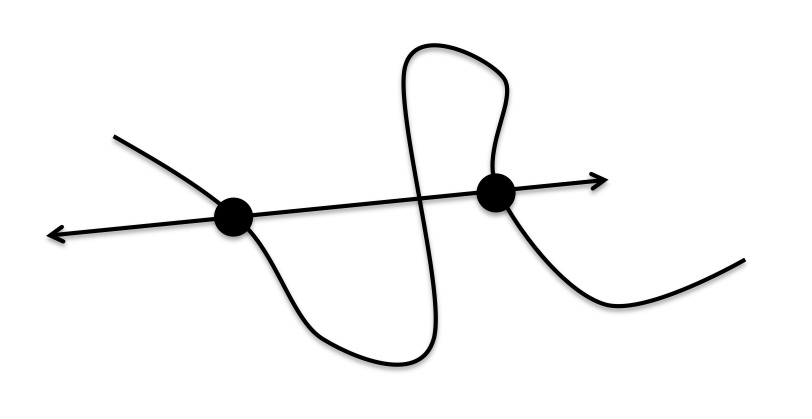
“True. If it’s straight,” I say with a slight smile. “Try connecting them with something that isn’t linear.”

This is where I can tell who is willing to take risks. But they all manage to create some sort of nonlinear path through the two points.

curve“Is that the only curve you can make that can connect these two points?” I continue.

“No. Do you want me to draw more? I mean, there are infinite ways!”

“No, it’s okay. I just want you to see that there are multiple paths to get from one of those points to the next.”

The shoulders relax as the brow rises, wondering about the point of this exercise.

“Almost done. I just have one more for you.”

scatter“Connect ALL of these points any way you want to.” If I do this after our lessons on scatter plots, it drives them crazy not to simply draw a line of best fit 🙂

Once they’ve completed the task, I bring the point home. Yes, pun intended.

“I want you to think of these points as events that happen in life. When you have a single point or event, it does not define your path. There were many routes you could take. When there were two points, there was only one way if you chose to see it that way. If you were more creative, you could find many more. But life doesn’t consist of just one or two events, even though certain ones may stand out more than others. Life is a series of events. And it is your choice how you move through them. Look at how you connected your points here on your last picture. You had to include the outliers, but it didn’t completely change the general shape of the graph.”

“I know you’ve had some stuff in your past that makes you feel like you’re stuck on a predetermined path. But you’re not. You had to walk through that point. That event or series of events. And now you decide what direction you go.”

“One event does not define you. YOU define you by the choices you make and the path you choose.”

Okay, class dismissed 🙂

What Makes a Marriage Successful? (And Why Divorce Does Not Mean Failure)

marriage successful

What REALLY makes a marriage successful? I’ve always found it funny/sad how we classify marital success purely by its duration. I mean, imagine if we applied this same metric to other areas of our lives –

She was a really great student – she was in school for fifty years!

He was an amazing dog, but he was a failure as a pet because he died before he turned ten.

It was a wonderful dinner. The service was so slow that the meal lasted for hours!

I’m afraid I have to give the book only one star because it ended.

Pretty crazy, huh?

So why do we then so easily apply this faulty logic to marriages? Classifying them as failures if they end and successes if they persist?

I think we all have seen (either from within or from the outside looking in), marriages that go the duration yet are filled with contempt, isolation and misery.

And we have all witnessed relationships that were once strong and fulfilling come to a premature end as the individuals or the circumstances changed.

Yet in our cultural lexicon, the first couple is heralded as a success (and sometimes even asked for their marital wisdom) while the latter is written off as a failure.

IMG_4361

Perhaps it’s time to reevaluate what makes a successful marriage.

Because it is certainly both more complex and more challenging than simply managing to hold on to one another for a lifetime of journeys around the sun.

In a successful marriage,

You both play for the same team. You know that there will be disagreements about how things should be done. But rather than view your spouse as your opponent in these arguments, you see him or her as your ally in life.

The good interactions outweigh the bad. There will be rolled eyes and hurt feelings. And they will be smothered by hugs and positive words.

You share common goals and values. Even when you take different paths to get there.

IMG_4359

Support is given freely and challenges are presented. You don’t seek to change your partner; you want to enhance the best parts of your partner.

A growth mindset is present. Both for the marriage and for the individuals that comprise the union. Each person learns and grows in response to struggle and success.

Mistakes are perceived as opportunities. And the actions are condemned. Not the person.

There is a balance of independence and interdependence.

IMG_4360

The difficult conversations happen. And problems are perceived as a challenge to overcome together.

Each person takes responsibility for his or her own stuff. And each person is willing to carry more than his or her share when the situation demands. Because there will be days when the commitment to the marriage is greater than your commitment to your spouse.

A legacy is left, either by the children born from the union or the others inspired or influenced by the couple. A successful marriage is greater than itself.

And here’s the hard part –

A successful marriage accepts when it is no longer successful. It is willing to make the agonizing decision to pull the plug rather than condemning both people to live in the diminished world of a marriage on life support.

IMG_4362

Now it is true that no good marriages end in divorce.

But it is also true that the marriage that ended may not be the same marriage that existed for some time before.

It’s not just about the number of years.

It’s more about what you do with those years.

And if that marriage brought a smile to your face and eased your burden,

If that marriage challenged you to learn and grow,

If that marriage taught you what it was like to share a common dream and common goals,

If that marriage opened your heart and made you feel seen and understood,

If that marriage made an impact on others,

If that marriage pushed you and tested you,

If that marriage made you realize that nobody else can make you happy,

If that marriage taught you what you don’t want,

If that marriage inspired you to never again allow anyone else to reduce your worth,

If that marriage taught you how strong you are,

Then that marriage was successful.

No matter how long it lasted.

Or how it ended.

Take the lessons and move on.

Because the only failed marriage is one that you refuse to learn from.

Related:

Why I Don’t Want a Perfect Marriage

10 Contradictory Qualities of a Good Marriage

Term Limits

I have several people in my life who are at the difficult stage of having to make the decision to put a beloved family pet to sleep. I feel for them and I know that I will join them soon with my own Miss Kitty.

It’s hard – we take in these creatures and they become an integral part of our lives. They lick tears off our faces when we’re sad, comfort us when we’re sick and greet us with a smile even when the world seems to have nothing but harsh words for us. They follow us through life transitions – vetting dates, sniffing infants as they arrive from the hospital and filling a void when children leave. They are the trusted confidants of the entire family. The house clown and the soft teddy bear.

We take them on knowing full well that they will only be with us for 10 years. Or 15. Or, if we’re really lucky, a few more. But we still know that their time with us has a limit. And that no matter when it arrives, the end will come before we are ready.

On my evening run today, thoughts of our animals swirled around with thoughts of marriage. I was just coming off an interesting Twitter discussion with @survivinglimbo and @OMGchronicles where we were debating the concept of divorce as a failure. Here is Surviving Limbo’s take. And here is Vicki Larson’s, aka OMG Chronicles, perspective.

I think I’m somewhere in between. Here’s what I’ve written in the past, before marriage #2. I know I don’t view my first marriage as a failure even though it ended. I guess to me it was good (at least from what I knew) while it lasted and I learned from its ending. That’s not a failure in my book. At the same time, I experience discomfort with Vicki’s concept that maybe a marriage should be term limited with an option to renew the contract at a particular point. Perhaps I’m still naive or idealistic, but I continue to hold onto the intent of a marriage lasting a lifetime (even though I am well aware that the reality may be different).

But maybe sometimes marriage is not unlike our animals. It comes in, occupies every corner of our lives. It brings smiles and joy. And then (sometimes) it fades away. Maybe in 10 years. Or 15. Or for those that are very lucky, a few more.

For me, I like the idea of a lifetime commitment. To doing all that I can do make it work. I don’t like living with the end in mind.

But even when ends come, it just means the term limit has expired.

It says nothing about the term itself.


Excuses

Our brains are rather comical creatures. Have you ever noticed how they have a tendency to throw up excuses faster than a juggler’s balls in the final act rather than simply face reality? Have you observed the energy expended as your children come up with one creative reason after another to avoid homework or cleaning their room when simply addressing the task at hand would often be easier? Do you get frustrated with friends or family when they complain about a situation and yet fail to make any changes?

Do you ever notice your own excuses?

It’s okay.

We all make them.

You can admit it here.

Sometimes it can be helpful when someone calls us out on them.

(Assuming we’re willing to listen, of course.)

Often others see what we cannot.

But sometimes, you’re on your own. Maybe others do not register your excuses. Or maybe they perceive you as too fragile to tackle them head on or they are too timid themselves. Or perhaps they’re busy creating their own excuses as well.

Regardless, sometimes you have to push your own head down into the metaphorical bucket of cold water. To wake up. To stop the stutter of excuses.

When these excuses get in the way of moving forward, I call  them healing hangups. They are beliefs and perceptions that hold us back.

I caught myself in two healing hangups after the divorce and it wasn’t until I addressed them both that I was able to unhook from the pull of the past.

The first hangup I had was the belief that in order to heal, I would have to find understanding. I was so blindsided that I felt a desperate need to understand why my husband could do those things. I needed to to know what drove his actions. I grasped at labels for a time, seeking comprehension in a diagnosis. I read books. I talked to others. I was always searching for elusive “why.”

I now see it as a snipe hunt; there was no label, no information that would really answer the question that my heart cried out for – How can you betray someone you claim to love? How can hold me so closely while planning your escape? How can leave me when you swore you would protect me? There are no answers. No understanding.

No answer that would make it okay.

It was a slow process, that shift from wanting to know why to learning how to find peace in spite of. Part of it was creating my own understanding without worry for its veracity.Some of it was realizing that if I could understand why he did what he did, it would mean that I was capable of the same. And part of it was realizing that I was using that as an excuse to delay healing –

“I’ll be okay once I understand why.”

But if I held on to that excuse, I would never be okay. And, at some point, I realized that it was more important for me to be okay than to understand.

Of course, excuses rarely travel alone; they bring plenty of backup. In my case, my other healing hangup was my need for him to face consequences. Now, sometimes those were elaborate schemes dreamt up in my raging mind (how does circumcision by paper cut sound?), but most of them were a need to simply face the natural and legal consequences of his actions.

I held tightly to those excuses. I intentionally delayed trying to address the anger until after his court date for the bigamy had arrived. I was so sure that I would feel relief once he had to face the consequences – feel the blowback of his choices.

Unfortunately, that consequence proved to be a dud.

No problem. I had another excuse ready. I’ll be able to release the anger once he faces me in civil court for the divorce.

Uh, yeah. Another dud.

So, there I was. Court dates over and he escaped with only the most minor of scratches.

Again, I had a choice. I could continue to let it be an excuse holding me back or I could choose to let it go. I’ll let the title of this post let you know the selection I opted for: Why Criminal Pursuit is a Game I Refuse to Play.

There were no consequences that would make it okay.

Those choices were not easy. Taming excuses is like playing Whack-a-Mole with your mind. You gotta be fierce and determined to hit them all. And, of course, a helping hand is always advantageous.

Are there excuses that you have noticed your mind creating to shield you from the difficult and real work of moving forward? What healing hangups do you have?