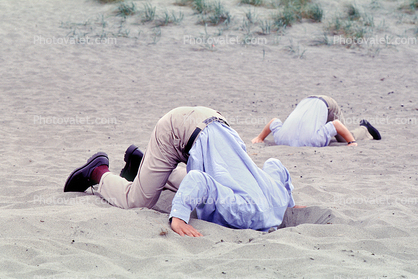
Love Is Only Blind When Your Head Is In the Sand

Do you ever look back at a former relationship and wonder what you saw in your one-time flame?

Or do you ever question a friend or family member’s choice in partners?

It’s easy when you’re outside of a relationship to view the bigger picture, the distance providing perspective while damping emotions.

But when you’re in it?

It’s all too easy to bury your head in the sand.


We stick our heads in the sand in relationships for a variety of reasons:

Avoidance

A wife sees a suggestive text on her husband’s phone from an unknown female. Her heart begins to race and panic floods her system. The hint of an affair is overwhelming to her; she cannot face the thought that her marriage is in trouble and that she may lose her husband. She turns away from the text and tries to pretend that she never saw it. That it didn’t happen.

When we see something that frightens us, we have two choices: approach or hide. In a relationship, the latter can cause problems as the truth is not faced because of the anxiety of losing the partnership. Of course, the fear persists even when the truth is not faced head-on. This state is usually temporary when either the truth becomes too big to avoid or the anxiety becomes too high to tolerate and the evidence is finally challenged. Burying your head out of fear may make you blind but it leaves you even more vulnerable to attack.

Mindlessness

A husband is busy at work, long hours and stressful clients have kept him away from home both physically and emotionally. He prides himself on providing for his family and doesn’t really have the time or energy to consider the status of the marriage as a whole. His wife, meanwhile, appreciates his efforts but feels isolated and lonely as her partner has become a husband in name only.

Heads can end up in the sand even without intentional digging. Stay still long enough and the tides will conspire to bury you. This is a blindness born of inattentiveness and busyness rather than willful evasion. Regardless of the motivation, the outcome is still a relationship in danger due to a lack of clarity and communication.

Willful Ignorance

A wife is pretty sure that her husband has a mistress. She intentionally chooses to turn a blind eye to his affair because he is a good father and stable husband. So she decides not to confront him and, even more, chooses to avoid situations that may reveal evidence of the infidelity. She knows something is there but chooses not to look.

This blindness is born more of pragmatism than fear. The reality is known to an extent and even quietly accepted. It’s a desire to pretend that life isn’t messy and emotions can be subjugated to reason. It’s a carefully edited and narrated form of the relationship. Although often dismissed, there is a sadness in this buried head that comes from lack of vulnerability and associated intimacy.

Bargaining

Prior to the marriage, a husband knows that his wife has problems with anger. He is uncomfortable with her temper and it raises red flags for him. However, he wagers her temperament against her other qualities and decides that the good outweigh the bad. When others bring up her outbursts out of concern, the husband responds by dismissing the concerns and tallying the pros that she brings to the table.

This is a common approach when a partner has issues with violence and/or substance abuse. There may be several very good qualities that are only occasionally accompanied by the bad. It’s a dangerous game; however, as the blinded partner slides into enabling the poor behaviors and choices.


A healthy relationship is one where both partners have their heads tall, looking out for problems on the horizon and addressing them as they approach. Burying your head may make you feel safe for a time but it’s no way to live.

Have the courage to lift your head.

Trust that you can handle whatever you see.

True love isn’t blind.


The Stages of An Ending

Ever since Elisabeth Kubler-Ross developed the 5 stages of grief to describe the emotions that terminal patients experience, similar stages have been used to describe loss in all its forms. These descriptions are helpful; they help to confirm that our wildly fluctuating emotions are normal and okay while also providing hope that we can progress out of a current stage.

This article from Psychology Today  is one of the better descriptions of the stages after the end of a relationship that I have read. However, I experienced a couple stages that are not described.

How about you – what stages would you add?

You’re Not Special

You’re not special.

That realization was the  hardest pill for me to swallow post-divorce.

I would read or listen about the depths of pain others experienced through divorce and silently believe that my pain had to be different.

Special.

And I had plenty of evidence to back up my belief. After all, how many 16 year relationships end with a text, fraud and bigamy?

It was a great excuse to delay the real work of healing for a time; by focusing on the sordid details, I gave myself a reason to ignore the collective wisdom from the universal experience of love and loss. On the surface, I would graciously accept guidance and advice while tacitly believing that it didn’t apply to me.

Because I thought that my situation, my experience, my pain was special.

I focused on what set me apart rather than what bound me to the common.

I thought I was special. And that belief was both affirming and alienating, giving blessing to the pain and isolating me from others. It’s a lonely place, sorted into a group of one by the particulars of your story. The blessings of excuses soon wear out their welcome and the focus on the details begins to feel like an un-welcomed quarantine.

My unexpected guide out of the isolation chamber of my perceived specialness came in the form of books. Fiction, mostly, and in many cases, not even particularly good fiction. As has always been my habit, I made a weekly library trip and loaded up on whatever was available – mystery, thriller, historical and even some that could be classified as chic lit.

And I read.

And, as is to be expected, my own recent experiences altered the lens I used to view these fictitious worlds; I related to characters who were facing some unimaginable trauma and were suddenly tasked with the seemingly impossible assignment of rebuilding their lives.

And I learned that when it comes to pain, the details don’t matter.

I empathized with characters facing illness, losing loved ones in myriad ways, dealing with natural and manmade disasters and even with those experiencing what would be classified by most as a minor loss. I related to the antagonists and protagonists, men and women, children and elderly and even the occasional non-human. In almost every story, I found elements shared with my own.

My focus blurred, editing out the details and seeing instead the ever-present themes of love and loss, of fear and shame and of hope and persistence.

I wasn’t special.

And I welcomed that realization.

It meant I wasn’t alone. That others had faced similar and thrived. That even though this was a new path to me, it was well-worn and well-marked.

Pain isn’t a solitary experience and healing is not a solo journey.

And even though you are unique and awesome in your own way, when it comes to suffering, you’re not special.

Rather than focus on what sets your pain and experience apart, find comfort in what binds you to others.

You’re not special. And you’re also not alone.

Group hug?:)


Mother’s Maiden Name

I knew his mother’s maiden name.

His parent’s middle names. His social security number. I could list his schools and their associated mascots. I knew the name and breed of every dog his family every owned. I’d sifted through all of his baby pictures, watching the chubby toddler grow into the awkward, skinny boy who finally transformed into the teenager I loved. I knew the family recipes and the family secrets.

But I keep coming back to his mother’s maiden name.

I used to find security in that knowledge, as though it was some talisman against future tragedy. I thought I knew everything about him. That I was so deep within the fold that secrets couldn’t exist between us.

It was an illusion, of course. You never completely know another person; you only know what they choose to show you.

It’s funny sometimes how life works out. The day after the text that ended it all, his mother’s maiden name gained me access into our joint accounts after he changed the password.

The talisman against tragedy became the key to unlocking the scope of the tragedy.

And in the end, that’s really all his mother’s maiden name was good for.


The Best is Yet to Come

I had a conversation the other day where I challenged someone to describe the good that came from a recent and devastating break-up (I know, you’re shocked, right?).

Part of her response-

I love knowing that my best and happiest love is yet to come. I have that to look forward to.

She actually made me speechless with that assessment. In all my years of dissecting out every little scrap of good from my horrific divorce, this was one benefit I never unearthed. And yet, as soon as I heard it, I felt it.

And she’s right.


It’s so easy to grasp onto what was rather than hold hope for what can be.

It’s so easy to view the past through a rose tint and imagine that no future can ever measure up.

It’s so easy to focus on what has been lost rather than what can be gained.

It’s so easy to fill up on sadness and not leave room for smiles.


We zero in on what we know and what we know is the past, the pain.

Try making the belief that the best is yet to come at the center of your heart and aim your thoughts that way.


What I love about her words is that they focus on hope. They build excitement and anticipation. They speak of an assurance that our hearts are capable of love even after heartbreak.

The best is yet to come.

Are you ready for it?