How Teaching 8th Grade Helped Me Through Divorce

“I don’t get it,” one of my coworkers said to me the other day, “All of a sudden I have a bunch of kids failing that have always been A or B students!”

“That’s normal this time of year,” I explained, “As high school looms ever closer, some of them express their fear through self-sabotage. Others regress and become more immature. Some become clingy, like preschoolers holding tight to a parent’s leg. It’s a big transition and they’re scared. But only a few are ready to articulate it, face it and step up responsibility. It’s our job to help them all get there.”

Teaching 8th grade is like tending to hundreds of metamorphizing pupa. With attitude. Sometimes LOTS of attitude. It can get messy and yet the end results make it all worth it.

The year is all about transition. From child to adult. From parent’s control to self-control. From being told what to do to making decisions. From being shielded to facing consequences. From passing off liability to shouldering responsibility.

And transition is always hard.

Not just for teenagers.

For all of us.

I’ve been in a unique position to observe thousands of young people undergo transitions over my career. It allows me to interpolate trends and analyze patterns.

Patterns that hold true for anyone undergoing transition.

Transition is Messy

I used to have a snake, a small Kenyan sand boa. He was generally docile except when he was preparing to shed his skin to account for his expanding body. For several days a few time a year, he became irritable. Short-tempered. He would demand food and then turn his nose up at the offerings. Once his old skin was peeled off like a soiled tube sock left on the floor, he would again return to his amicable self. Until the next growth spurt.

Transition is messy. Dirty. Often ugly. It’s rarely a smooth process and never a linear one. The movies make it seem like it’s easy to go from ugly duckling to sensational swan in a few challenging moments and a short montage set to great music. The movies lie. The reality is much longer and more difficult than many of us realize.

And those undergoing transition can be difficult to live with (especially if it’s yourself!).

They’re irritable. Short-tempered. Demanding.

But that’s only because they’re confused. Scared. Uncomfortable.

Because transition is hard.

Self-Sabotage

It can be scary to reach for new heights. And sometimes it’s easier to act as though you couldn’t do it rather than try and risk failing. It’s common for people in transition to hamstring themselves, to make decisions and act on impulses that are in opposition to their stated goals. It’s a way of staying comfortable.

It’s the student refusing to turn in assignments. It’s the recovering alcoholic taking a job at a nightclub. The woman trying to save her marriage flirting with her coworker. The newly divorced constantly complaining about the ex. The newly dating turning all of their energy towards work and wondering why new relationships continue to falter.

Grasping

In order to make a life transition, you have to first let go of your former life. It’s an act of great courage and great faith. And before many are ready to take that leap, they respond to the idea of letting go by holding on ever-tighter.

Sometimes the grasping may latch onto something or someone in the present that is a stand-in for something or someone from the past. This can be a flash-in-the-pan rebound relationship or the sudden and overwhelming attachment to a new hobby or habit.

Regression

Periods of growth are often preceded by periods of retraction, as the increased vulnerability of change prompts a desire to be taken care of and protected. Many people who have two or children are familiar with this tendency as they watched their toddler revert to diapers or preschooler beg for the bottle upon the birth of a new baby. It’s a lot of responsibility to be the “big one” and sometimes we all just want somebody to take care of everything.

It’s okay to need and seek extra help during times of transition. In fact, that’s completely normal and healthy. Be careful not to become too dependent for too long; however, or you risk giving up control of your life.

Taking Risks

Transition is a time when you’re neither here nor there. It’s a time of changing boundaries and it’s natural to explore where those boundaries now lie. When nothing is certain, everything feels possible and it’s exciting to explore a world where limitations don’t seem to exist.

Risks still have consequences. It’s great to explore. But please, take your brain with you!

Acceptance of Past

This is one conversation I wish I never had to have with a student again. And yet, every year, I have to have it with several. Some of my kids have had the misfortune to have absent parents. Or abusive ones. Or they’ve just had way too much happen to them at a young age. And I have the frank conversation with those kids that they are coming up on the age where they have to decide if that’s going to hold them back or if they’re going to succeed in spite of it.

And that’s a huge part of transition – accepting the parts you cannot control and taking responsibility for those you can.

Confidence

Transition often starts with “I can’t.” Because you can see where you’ve been and you struggle to imagine where you’re going. But with every step taken with courage and faith, confidence is built.

My favorite part of watching people in transition is seeing the growth in confidence. I love observing “I can’t” morph into “Look what I did!” and “I got this!”

Transition is Temporary

When my former students visit or write and I get to see the results of those difficult days, it makes it all worth it. Transition is temporary. It doesn’t last. You outlast it. Emerging bruised and battered. And also better.


Post-Divorce Growing Pains

growing pains

I spend my days working with adolescents and my evenings working with the recently divorced. And apart from the taste in music, I increasingly find that the two groups share many growing pains as they navigate one of life’s major transitions. Both teenagers and the recently divorced are:

Learning to Be Independent

The teenagers I work with are just beginning to form their own opinions and beliefs apart from their parents. They are practicing how to navigate the world without an adult stepping in and taking care of business for them. After divorce, people are also learning to be independent, teasing out their own opinions from those of their spouse. They may have to take on new tasks that were once the domain of their partner. In both cases, the additional responsibility is scary yet the increasing independence is empowering, building confidence with each step.

Playing With Identity

I am no longer surprised when a previously preppy student comes in with hot pink hair or a teenager who listened to One Direction one week proclaims to love hard core rap the next. Young adults are famous for trying on and discarding identities like blue jeans in a dressing room. The recently divorced also have a tendency to play around with identity. The old identity no longer fits and it takes time (and some trial and error) to figure out the new one. With the divorcee, this exploration often extends to trying on new careers, new cities, new hobbies, new “types” when dating and a new appearance.

Struggling With Insecurity

Teenagers are notoriously insecure. They pull their hair down over their pockmarked faces, hoping that nobody will notice their pimpled skin. They stress over class presentations, convinced that their classmates are secretly laughing at them. The insecurity of the newly divorced is enhanced by a feeling of rejection. They worry that they are too old, too fat or too damaged to reenter the dating scene. Both groups can be found posting excessive selfies, not to show off, but to build confidence.

Trying to Make Sense of Emotions

Teenagers can be loving and sweet one moment and screeching baboons the next. They don’t mean to, they’re just trying to make sense of the world through the chaos of their changing brains and growing bodies. Their divorced counterparts may not be dealing with an influx of hormones, but they are learning how to deal with emotions powerful enough to level small towns. In both groups, expect plenty of tears, lots of shouting, out-of-control laughter and a rapid-fire switch between the three.

Scared and Excited About the Future

As high school approaches, my 8th graders lose their confidence and seek more attention from their teachers. They’re excited about the next chapter, but they’re also scared. Scared of new demands. New people. New responsibilities. And more opportunities for mistakes. After divorce, the future is also both scary (What if I never love again? How will I survive on only income? What if I only attract toxic relationships?) and exciting (I get to rebuild my life the way I want! I can finally buy that blue sofa he hated! I get a chance to date and explore new people!). Whether you are launching or relaunching, it’s not easy.

Figuring Out How to Belong

Middle schools are organized by cliques. And teenagers spend an inordinate amount of energy navigating these groups and figuring out where they belong within them. And there is always drama as allegiances are built and disassembled. After divorce, people have to renegotiate relationships with friends and family members. Lines are drawn. Friendships are dismantled. And new social groups are often sought.

Negotiating Boundaries

Teenagers negotiate for freedom yet crave the security of boundaries. They push and push until they hear “no” and then they push some more just to make sure. The recently divorced are also negotiating boundaries. With their ex and also with themselves. It’s a time of change. The freedom feels good to an extent. But it’s also good to know the limits.

If you’re feeling crazy after divorce, don’t worry. You’re just experiencing growing pains. Handle yourself the way you would a changing teenager. And find some relief that adolescence is just a phase.

How to Create Lasting Change

Transformation requires change both in thoughts and in actions. And change is difficult to initiate and often even more difficult to sustain. The following are some tips and suggestions for creating lasting change in any area of your life:

  • Make your goals specific, actionable and measurable. For example, saying. “I want to be happier,” is vague and impossible to measure. If your goal is be happier, begin by breaking that down into smaller pieces. Perhaps part of being happy for you is to spend social time with friends, specifically having at least two hours a week of adult friend contact. That is now something you can recognize and word towards.
  • Focus on your most important goals. A shotgun approach rarely works; select one to three areas to focus on at a time. Once a goal is attained or becomes obsolete, replace it with a new intention.
  • Visualize success. What will you feel like when you have attained your goal? Look like? See yourself reaching your intentions and paint every detail in your mind.
  • Be realistic. If you hate fish, don’t set a goal of eating salmon at least once a week. If you are afraid of public speaking, don’t make your first goal a TEDtalk. Start where you are and use what you have.
  • Write your goals down. Writing down your goals helps in two ways: First, it helps you clarify exactly what you are working towards. Secondly, if you post your goals in a prominent location, it serves as a reminder of what you want to achieve.
  • Track your progress. When progress is incremental, it can be difficult to gain perspective on how far you have come. And, when you don’t have a sense of the bigger picture, small setbacks can be very discouraging. Find a way to record your progress. This can be as simple as re-reading earlier journal entries to see how your perspective has changed or it can take the form of measureable data. The “how” isn’t important; the acknowledgement of overall progress is.
  • Tell somebody. Most people feel more accountable when others know of their intentions. If you are the only aware of your goal to run a 5K in eight weeks, it’s pretty easy to skip your training runs and retire to the sofa. If, however, your friends and family know of your goal, you’ll be more encouraged to make sure you don’t end up backing out of the race. If you don’t want to involve your social group in your goals, you can start an anonymous blog or Twitter account. Even if you have few readers, just the act of making your intentions public creates accountability.
  • Join a group. When you’re surround by like-minded people that are trying to achieve a similar change, it makes it easier to make those changes and make them stick.
  • Utilize technology. Put goals and plans on your calendar. Set reminders and alerts. Change your home screen to a reminder of your goals. Download an app that helps you implement or track your goals. It’s easy to neglect your own well-being while you’re taking care of others. Make sure you clamor for own attention too.
  • Tie new habits with established ones. If you already brush your teeth each day and you want to start a daily meditation practice, make a habit of meditating every day after you brush your teeth. It’s easier to start something new when it’s paired with something familiar.
  • Pair a desired action with something desirable. Want to go to the gym every morning? Splurge on your favorite shower gel and keep it in your gym bag to be used after that early workout. Need an incentive to journal every week? Head to your favorite coffee shop to get your writing done. No journaling, no coffee shop.
  • Create a challenge. If you are competitive by nature and you enjoy making a game out of things, join a challenge group or create your own contest. One way to do this is through a streak where you have to complete a certain activity for a specified amount of time for a certain number of consecutive days. For example, you may challenge yourself to walk at least a mile every day for a month. You can also ramp up the challenge – a mile a day at the beginning that slowly increases to three miles a day at the end. If you miss a day, the challenge starts over. That’s a great incentive to stick with it!

How to Change a Man

I met up with a friend the other day. She’s at a crossroads with the man she’s been dating for the past year or so. She wants marriage. Not now, but she wants to move that direction and wants that to be the mutual end goal. At this point, he states he does not want marriage. Now or at any point. They’re in that difficult place where the relationship works, but the objectives of the partnership don’t align.

Having known Brock back in the days when he said he never wanted to be married, she inquired, “How did you get him to change?”

The short answer?

I didn’t.

And I couldn’t. At least not in any meaningful and lasting way.

I didn’t make him change. I didn’t ask him to change. I didn’t expect him to change.

But here’s what I did do:

I Accepted Where We Were

I always knew I wanted to be married (or at least something like it) again. But that didn’t mean I wanted to jump straight into commitment immediately. In fact, Brock was always the forerunner on taking the relationship to the next level.  And we baby-stepped it from one level to the next. And as we slowly integrated our lives and tore down our walls, I simply enjoyed the place where we were.

I Accepted Him

As with any relationship, as the newness wears off and the pedestal lowers, you discover certain traits and characteristics of your partner that drive you a little nuts. Since none of his quirks were red flags or deal breakers, I worked on accepting them. In fact, I’ve even learned to appreciate some of what can easily annoy me.

I Limited Expectations

I knew that our relationship may not progress to marriage. And I was okay with that. I had no expectations of a wedding or a white picket fence. I simply knew that I loved him and loved being with him. And that the time together wasn’t wasted even if it didn’t result in nuptials. Besides, I had learned about the dangers of expectations:)

I Didn’t Push

I never initiated a “where are we going?”talk. In fact, the only relationship-oriented talks we had were about where we were, making sure that we were on the same page along the way. I was patient as he learned how to be in a serious relationship and, later on, learned how to share a home and a life. I gave him time and space to acclimate.

I Worked on Myself

Whenever I found myself frustrated or disappointed by something in the relationship, I made an effort to examine my own responses (which, no surprise, were often overreactions). I learned that by changing my reactions, I could change the dynamics of our interactions.

And over time, the man that never thought he would be married, not only decided that he did, he also became an amazing and dedicated husband.

But the most important part wasn’t what I did.

It’s what we did.

Because everything that I did that compelled him to change, he also did for me. In spades.

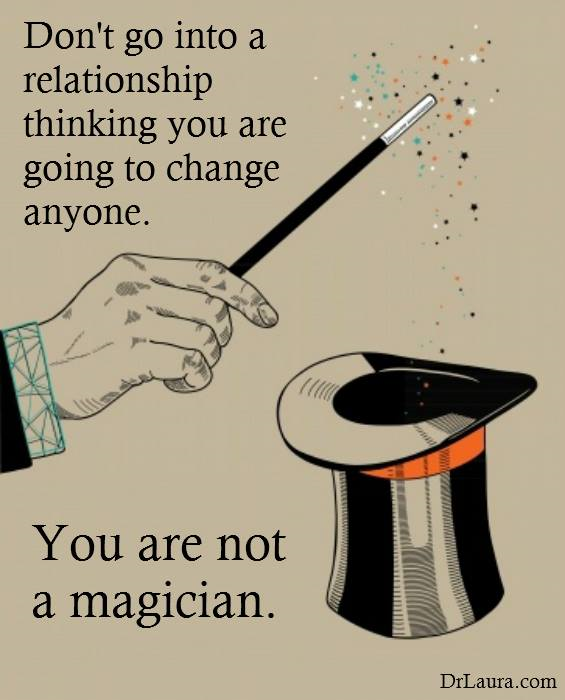
You cannot ever change your partner.

But you can be someone that inspires them to change themselves.

Because ultimately, the only guaranteed way to change a man (or a woman) is to change yourself.

2015/02/img_4385-1.png

Check In – How Have You Proved Yourself Wrong?

Back at the beginning of the year, I proposed a challenge for 2015 – Prove yourself wrong:

I’ve never been much of a fan of resolutions. Perhaps it’s because I see the bodies flock to the gym every January only to be back on their respective couches by Valentine’s Day. Or I see the impassioned declarations about eating clean shared publicly on Facebook and I spy a doughnut in the poster’s hand before the month is out. I get it. Change is hard. And in order for change to occur, you have to be ready. And that may not correspond neatly with the dawning of the new year.

Which is why I like to offer up a little twist on the traditional resolutions.

Here is my offering from last year: Celebration, Enhancement, Intention.

This year is a little different. This year I propose a challenge. To be completed by December 31, 2015. And, yes, I will be holding you accountable.

Nervous yet?

Don’t be.

Here it is – over the year, I want you to prove yourself wrong.

That’s it.

No calories to count or reps to complete (unless of course, that’s how you’re proving yourself wrong).

All you have to do is find one belief you currently hold and change your mind about it.

Confused? I’ll give you some ideas:

-Start by thinking of the things you say you “can’t” do. Pick one and do it.

-Examine your thoughts for traces of “always” or “never;” those words usually indicate an underlying stereotype or assumption. Find a counterexample.

-Sift through your responses to people and claims. Look for those topics that make you defensive. That’s a sign that you think you can’t handle some truth. Prove that you can.

It’s so easy to operate within a prison of possibilities built by our own limiting thoughts.

This is your year to break through.

Prove yourself wrong.

Remember, I’ll be checking up on you:)

Now here we are. Six weeks later. Over forty days and countless opportunities to prove yourself wrong.

So have you?

I proved myself wrong just yesterday. I’m probably the world’s worst napper (just ask my mother, who had to survive my infancy). When I was tired and sluggish yesterday afternoon, the idea of a nap sounded appealing, but then I shut down the idea with the though, “You know you can never manage to nap.”

And I became determined to prove myself wrong. To tell that internal limiting voice to shove it so that I could sleep.

And sleep I did.

With only the slightest amount of guilt for “wasting” part of a Sunday afternoon.

It felt wonderful not only to rest, but also to prove myself wrong.

What have you done in the past 6 weeks that you thought you could not do?

How have you proved yourself wrong?