Shame: The Silent Relationship Killer

shame

Is shame at the root of your relationship problems?

In most discussions of the common relationship killers, the usual suspects are named: infidelity, finances, addiction, abuse, changes in external demands, or a growing distance between the partners. Yet, there is a silent relationship killer that often lurks underneath those commonly listed reasons and is a contributing factors to many reasons cited for a relationship’s demise. A condition that affects many, yet is rarely recognized and even more infrequently discussed.

Shame.


Shame is poorly understood; it is often seen as interchangeable with embarrassment. Yet they’re not the same. You’re embarrassed when your zipper fails and you have to resort to staples to get through the day without an inadvertent indecent exposure charge. You’re ashamed when you live and work alongside financially secure people and you’re wearing pilled and tired attire because you cannot afford new clothes. In the first case, the problem is with the item of clothing. In the second scenario, the clothes are only the surface. The real issue is deeper, perhaps a feeling of being unworthy and inferior.


Shame tells you that you are not enough. 


Shame is a hidden condition. It hides behind happy faces and lives inside enviable homes. It’s often ignored. Frequently misdiagnosed. And almost always malignant, spreading its blight throughout.

The causes of shame are variable and are often embedded in childhood where the message was either explicitly received or inadvertently assumed. The child that feels unwanted can become an adult burdened by shame. Children who are raised around addiction often assume the blame for the disease. Those that face unending criticism or unachievable goals may continue to feel “less than.”


Shame strips you of your power. It makes you feel small and vulnerable. 


Shame is toxic to relationships. It encourages secret-keeping by insinuating that if revealed, the person will no longer be loved or even accepted. Shame creates distance between the partners as one feels unseen and the other feels excluded. Shame becomes the elephant in the room, unspoken of yet so big that it has its own gravitational pull. Shame says, “You’re not okay. And if people discover that truth, you’ll be discarded.”


Shame wants to be hidden because exposure removes its leverage.


Holding on to hidden shame is ultimately a losing battle. It grows like dough set out to rise, stubbornly overflowing its barriers. It manifests in unhealthy behaviors, everything from overeating to toxic masculinity.

And many of those unhealthy behaviors are potentially relationship-destroying.


Shame and Infidelity

The causes of infidelity are myriad and complex. And shame is a companion to many of those justifications. When someone is feeling shamed, they may be tempted to exert their power wherever they can. It’s a childlike, “I’ll show you,” reaction that can have disastrous consequences. When feeling less than, any attention from somebody who is “forbidden” will be especially attractive, especially if the shame is anchored in ideas around sex (think about the common Madonna/whore complex).


Shame and Money

When a child first realizes that their family does not have the same means as the others, it becomes a shameful secret to keep hidden. No matter how much material success is found in adulthood, that early lesson may remain tucked away. For others, this shame begins when a job is lost or when illness steals away the ability to earn. Our culture places a great deal of emphasis on earning power (especially for men), leaving those on the lower end of the spectrum feeling as though they are inferior.


Shame and Addiction

This is such a complicated relationship. If addiction is in the family of origin, shame was a constant companion from the beginning. many people try to silence their shame through the use of substances and then the addiction in turn feeds the feelings of shame. Notice that the first step in any twelve step program is braving the influence of the shame and being willing to admit to having a problem.


Shame and Abuse

In the typical abuse cycle, the frustration and discontent builds until there is an eruption of fists or angry words. Then, a feeling of shame and regret prompts the abuser to attempt to make amends. Until the energy builds again and the cycle is repeated. The abused also may feel ashamed, believing that they deserved the mistreatment (hint: they don’t).


Shame and Distance

It’s impossible to be truly close to someone who is secretly battling shame. They have walled off a huge part of their history and their psyche. They are afraid of letting you in, of letting you see. So instead, they play a role and pretend to be the person they wish they were. And the most unfortunate and unfair part? You will likely be accused of not understanding them even though you have repeatedly tried.


Shame does not have to be a permanent condition.


In fact, the remedy for shame is actually pretty simple (although far from easy) – talk about it.

Shame tells you that you’re the only one. Talking about it provides the opportunity for you to hear, “Me too.”

Shame tells you that you will be rejected. Supportive comments and reactions allow for you to be seen and accepted.

Shame tells you that you have to carry the burden alone. Sharing it means that the load is dispersed.

Shame tells you that you’re broken.

Revealing the cracks lets the healing light in.


Are you struggling with moving on? Life at the Intersection of Yesterday and Tomorrow is for you.


Don’t Get Married Before You Can Answer “Yes” to These Ten Questions!

Marriage is a big step. A significant commitment. To help ensure that you’re making the right decision for you, make sure that you can answer “yes” to these ten questions before you say “yes” to marriage!

1 – Can you be alone?

If you are afraid of being alone, how do you know that you’re acting from a place of love rather than making decisions based on fear? Ideally, you’ve had some adult years on your own so that you learn what you’re capable of and you feel secure with yourself.


2 – Are you more in love with the person than you are with the idea of being married?

It’s easy to feel pressure to get married and to desire the sense of security and stability that often accompany marriage. As a result, sometimes you can be in love with the idea of being married more than you are in love with the person.


3 – Do you have your own life?

Do you have your own interests? Friends? Thoughts and opinions? A healthy marriage is own of interdependence, not dependence. Ensure that you’re positioned to maintain your independence. 


4 – Have you met their people?

Not only are we drawn to people that mirror our beliefs, we have a tendency to become more like those that we spend time with. Make sure that you have spent time with the people that your partner chooses to associate with.


5 – Have you had (and continue to have) the difficult conversations?

In order to have a thriving marriage, both you are your spouse have to be able to say things (with kindness and compassion) that you know will hurt your partner. It’s important to have these conversations before marriage to ensure that you’re on the same page and to practice speaking and hearing hard truths.


6 – Can you accept them even if they never change?

When you say “I do,” you’re effectively signing that you accept this person as they are. Whatever qualities and characteristics they have (even the ones that drive you crazy) are grandfathered in. It’s unfair to both of you to expect anything different.


7 – Do you have a growth mindset about marriage?

The marriage you have on the day you say, “I do” is not the same marriage you will have ten years down the road. You will change. Your partner will change (and not necessarily in the ways you want). A healthy marriage is one that can grow and adapt throughout the years.


8 – Are your expectations about marriage reasonable?

We often ask too much of marriage and can easily end up disappointed or even angry when reality fails to match our mental picture. Read over these sixteen common misconceptions about marriage and make sure that your expectations are attainable.


9 – Are you prepared to contribute more than 50% to the marriage?

There will be times when you are responsible for carrying most of the emotional weight in the relationship. And at times, the load will shift to your partner. Even when the contributions are relatively equal, it’s common for each person to feel as though they are providing more than their share. Make sure you’re ready for that responsibility.


10 – Do you see and respect your potential spouse as an individual?

Yes, this person will become your wife or husband. But before that and after that, they are still their own independent person.  They will have different views, goals and perspectives than you. It doesn’t mean that one of you is right and the other wrong, it simply indicates that you are two autonomous beings that are choosing to spend your lives together.


How to Maintain Your Independence in a Marriage

When I first married at the age of twenty-two, I was happy to trade in my independence for what I thought was a guarantee of partnership and togetherness. By exchanging “me” for “we,” I knew that I was making the promise to consider his opinions and needs when making decisions and that I was committing to putting the marriage before my own desires and dreams. A transaction that seemed completely reasonable at the time.


I didn’t lose my independence all at once.


Its integrity frayed slowly, like fabric subject to excess friction. Sometimes, it simply didn’t feel worth the energy to assert my own opinions. Other times, I found that I too easily adopted his views as my own. He became my primary confidant, my go-to social partner and we undertook most tasks and errands together simply by default.

Some of my actions were driven by consideration and respect – I would notify him if I was running late, consult him before making a major decision and seek his approval before spending a significant sum.

Other behaviors seem more concerning in retrospect. I was always careful to consider his feelings or preferences, yet I often neglected to examine my own.  I looked for his validation when I took up running at the age of thirty. I rarely went to parties or other large-group gatherings without him. And I relied on him to take over tasks that I found difficult instead of pushing myself outside of my comfort zone (the one that stands out the most here is making returns at a store – I HATED doing that to the point of mini anxiety attacks).

On one of my first shopping expeditions after he left, I impulsively grabbed a pack of strawberry-flavored gum at the register. Not because I have a particular fondness for fruit gum, but because he despised it so much that I never chewed the stuff. Not even in the hours I spent away from him each day.

That small act suggested a large step.


It was time to take back my independence and again find the “me” that had been lost in the “we.”


It was strange at first, acting without consulting anybody else. Making decisions on my own (and also facing the consequences of those choices on my own). I felt a little lost, like a kid at their first summer camp, unsure how to act when the accustomed structure was no longer apparent. Then, over time, the independence became comfortable and ultimately, essential. That autonomy that I had so willingly signed away years ago had become imperative to my well-being. Even though I wanted another partnership, I vowed to never again give away my independence.

My marriage now looks very different than my earlier marriage. We came together later in life, with established careers, friendships, bank accounts and habits that we weren’t willing to lose in order to enter into a relationship. Instead of there being an assumption that everything would become shared, we negotiated what elements we would merge and what would stay more autonomous.

I feel that I now truly have the best of both worlds – I know that my husband has my back but I also have my own mind (and vice-versa). There’s a much better balance; whereas my first marriage was dependent, this one is interdependent with a hearty sprinkling of independence.


The fear of losing oneself upon entering a relationship is a commonly cited reason for resisting commitment.


And rightfully so.

It’s easy to get so caught up in your role as wife, husband, mother or father that you no longer have the time or energy to devote to those things that used to bring you joy. You can find yourself slowly losing your desire or even ability to make decisions on your own, deflecting these to your partner and neglecting your thoughts in the process.

Maybe you came out of your previous marriage with the realization that you lost yourself somewhere along the way. Maybe, after years of hard work, you feel like you’ve found yourself again. You like your life. Love your independence and the confidence and freedom that comes with it. And still, you may find that you’re feeling pulled towards partnership. But you know that you don’t want to lose that independence that you’ve fought so hard for.

Good news. You can maintain your independence even within a marriage.


  How to Be Married (and Still Be Yourself)


Choose a Partner With Similar Requirements

There are some people who want to spend all of their time with their spouse. They share email addresses, home offices and friends. Others prefer to have more delineation between mine, yours and ours, creating and maintaining boundaries between areas. Some married couples even agree to live separately and only have the smallest regions of intersection between their lives.

No situation is better than the other and any variation within this continuum is perfectly fine as long as both partners are in agreement with the terms. And since you’re concerned about maintaining your independence, seek out people that are equally dedicated to maintaining their freedoms as well. Those that have full lives are more likely to respect your interests and passions and willing allow you the time to operate solo.

If, like me, you’ve experienced more overlapping lives in your past relationships, be aware that it may take time for you to adjust to this shift in the dynamic. You can’t have it both ways – if you’re going to maintain your independence, you also have to accept that you will receive less attention from your partner because they will also be busy with their own lives.


Distinguish Between Independence and Consideration

When I was single, I could go away for a weekend and not tell anyone as long as I returned in time for work on Monday morning. Now as a married woman, I can still go away by myself for a weekend, but I do have to at least inform my husband first. To leave without the respect of ample notice would be rude and inconsistent with a healthy partnership.

Sometimes, when people say they want to maintain their independence, they really mean that they do not want any responsibility to anybody else. Which is ultimately incompatible in a relationship (How many of you have been married to people like this who think that everything is always and only about them?).

When you enter into a relationship, you have a responsibility to the other person. And one of those duties is to be considerate of their rights and needs. And that consideration may sometimes step on the toes of your desire for independence. But when you enter into a marriage, that’s the choice you’ve made.


Determine What is Important to You

When I lived alone, I played heavy metal in the living room during 4:00 am workouts. I came home every day to clean kitchen and relaxed every evening on my white slipcovered sofa. When I moved in with my now-husband, I knew that all of those things would be history. And I also decided that those things weren’t important to me.

Of course, there were other considerations that I deemed vital. I needed to have my own space in the home, I needed to be able to schedule my evenings and weekends the way I wanted and I had to maintain control over my own paychecks and accounts. I actually made a list of the specific types of independence that were important to me; I wanted to make sure that I didn’t inadvertently lose my autonomy again.

Take the time to decide what independence looks like for you. What makes you feel controlled or trapped? What conditions allow you the freedom you want?

Is this compatible with a relationship? With parenthood (or parenthood of younger children)? Be honest with yourself here. If you try to pigeonhole yourself into too small a hole, you will inevitably feel constricted. It’s better to start with less commitment and responsibility and see if you want to grow towards more.


Communicate Your Needs Clearly and Early

All you need to do to understand the struggles inherent in a bid for more independence is look at teenagers and their parents. The teens want more freedom; the parents fear losing their kids. The kids push their parents away and the parents often take these words and behaviors personally.

It’s not that different in a partnership. When one person suddenly makes a stand for more independence, it can be seen as a threat to the relationship and can be taken personally. This is a great place for those famous “I statements,” to communicate that this is about what you’re needing, not about the other person.

Whenever possible, communicate your needs for independence at the beginning of the relationship. If your needs have changed over time, be aware that the information may be difficult for your partner to receive and that it may take a series of conversations (and time) to fully negotiate the changes.


Listen to Your Partner and Ignore the Peanut Gallery

When I was on my recent trip and mentioned my husband (who was home in Atlanta) to someone, I often received a raised eyebrow, “Why aren’t you doing this trip together?” I gave them a pat non-answer because the real one would be a bit longer.

Travel is important to me. I only recently have the means to enjoy it again after recovering from my ex’s financial shenanigans. In my former life, I waited too much to live, always promising myself that I would do all of the things once some benchmark occurred. And after? I promised myself that I would never again wait to live. Or to travel.

It’s different for my husband. He has to travel for work and being away means that he can’t train martial arts (his passion). His preferred funnel for the “I’ve made it tough to exhale” funds is his Corvette. And he much prefers waking up in the same bed each day to days full of the unknowns and inevitably discomforts of travel.

So I travel and often he does not. And it doesn’t matter what anyone thinks of that other than the two of us (and Kazh too!).

Do what works for you and your partner and feel free to turn a deaf ear to those that want to criticize from afar. After all, the ultimate independence is the freedom to build your life in the way that works for you. Whatever that may look like.

“I Want You” vs. “I Need You”

I want you I need you
There’s nothing sexy about being needed.

I feel it after a long day at work after hundreds of children have made their demands, becoming more task-monitor and cognition-manager than woman. Mothers describe feeling like little more than a milk-generating machine during those months when breastfeeding may be a constant. Bread-winners may start to feel more like a money-making automaton than a living, breathing creature. Caretakers often begin to resent their charge, love clouded by a fog of endless need.

Those on the other side often chafe at their sense of dependency. They need, but they don’t want to need. They desire independence, yet may be unable (or unwilling) to strive for it.

There’s nothing sexy about being needed.

Yet, so often, “need” is exactly the energy that begins to permeate our relationships after the initial, heady rush of burgeoning love. As “I want you” is slowly replaced by “I need you.”

You hear this from people who bemoan that their spouse is essentially another child who is absolutely clueless at handling the day-to-day on their own. They begin to see their partner as dependent and incapable, neither of which are particularly attractive traits. Others may become overly needed on an emotional level. Often called emotional labor, this feeling of always being “on” and taking care of the family’s relationship, communication and emotional needs is as tiring as physical labor (if not more so). Those that are fearful of being alone may overly cling to their partner. And feeling suffocated by somebody’s anxieties is a sure way to dull any attraction.

And in all of these cases, the needed one speaks to seeing their spouse as more like a friend or a roommate than a romantic partner. The more needy partner can begin to take offense at their position and may begin to act out. Furthermore, the unhealthy dynamic can lead to an increase in irritations and frustrations on both sides.

Here’s the unbridled truth – if you are both adults, neither one of you truly needs the other (no matter what it feels like).

In fact, I think this is possibly the most important lesson I learned from the end of my first marriage. I sure believed that I needed my first husband. After all, I had never navigated adulthood without him. He would handle making retail returns and spending hours debating with the gas company on the phone, both tasks with which I struggled. He knew just how to soothe me after a stressful day and he would laugh at all of our inside jokes. He (sometimes) brought in needed income and used his impressive carpentry and handy-man skills to upgrade and maintain our home on the cheap. He was always willing to talk (even in the middle of the night) and so I rarely felt alone or ignored.

I thought I needed him.

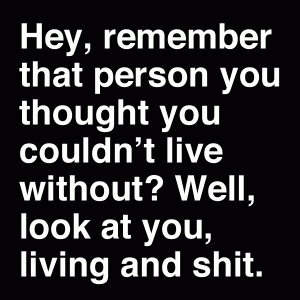
But it turned out I was wrong. Somehow, with a few changes and some missteps along the way, I was able to survive (actually thrive) without the person I thought I couldn’t live without.

Thank goodness:)


lookatyoulivingandshit


Being needed can feel good. It gives you purpose. Shores up your confidence and helps to mitigate any fears about being alone (after all, if someone needs you, they’re unlikely to leave you). Yet, taken too far or applied too liberally and being needed can begin to feel like an inescapable prison.


On the other hand, we all like to feel to wanted.

It’s a compliment, an acceptance. It makes us feel both desirable and powerful. It speaks to being chosen. Appreciated and valued.


“I want you” vs. “I need you”


I need you says that you are responsible for my happiness.

I want you declares that I’m happier when you’re around.


I need you implies that neither one of you are free agents and that you’re trapped.

I want you suggests that there are other options and you are the chosen one.


I need you sets the stage for an imbalance of power as one gives and the other takes.

I want you acknowledges the power within both of you and allows for an equal exchange.


I need you speaks to what you can do for the other person; it focuses on the tasks you perform.

I want you expresses a desire for the person; it focuses on who you are.


There’s nothing sexy about being needed and there’s nothing sexier than hearing someone you care about say,

“I want you.”


Just Because You Love Someone…

love

Sometimes love is not enough…

When we were on the lookout for a new dog this past winter, one thing became immediately clear – the shelters and the foster homes were filled with amazing dogs who had been surrendered by their original families. In most cases, these dogs were relinquished not because they weren’t loved or because they were “bad” dogs, but because they were not the right dog for the family. A painful choice, but sometimes the best one once a mismatch has been made.

Human relationships often fall into the same category. We choose poorly or the situation changes after we’ve made our choice. We struggle to admit that maybe we were wrong. We hold onto hope that maybe things will improve. We fear ending things because sometimes being with anybody is better than being alone. And we justify our inaction or our excuses by declaring our love.


When you say, “I love them, but…,” it’s the words that follow that are the most important to pay attention to.


Amazing things are accomplished in the name of love. People are nurtured and challenged, accepted and encouraged. Love gives us hope and purpose, bringing light into even the darkest corners.

Yet sometimes love is used as an excuse. A reason to avoid making those difficult choices that sometimes life brings our way.


Just because you love someone…

You do not have to maintain a relationship with them. Whether it be an abusive relationship with a partner or a toxic relationship with a parent, you can love someone and keep them at arm’s reach (or even further). This can be a decision made from a place of compassion, recognizing that continuing the relationship is harmful for one or both parties. Love means that you want the best for them, but this doesn’t have to be at the exclusion of your own well-being.


Just because you love someone…

You do not have to tolerate their abusive and cruel words or behaviors. It’s rare that abusive people are all-bad; there is often a soft and vulnerable and wonderful side as well. And you can love that part of them while at the same time, refusing to put yourself in the position of being subject to their bouts of anger or coercion. Maybe you limit your exposure or make a promise to yourself to walk away whenever things turn sour.


Just because you love someone…

You do not have to agree with their choices. You can love the person and hate the actions.    Furthermore, love does not preclude you from letting them experience the repercussions of their choices. Sometimes love means doing what is best for the person in the long run even though they may not be able to see it in the short term.


Just because you love someone…

You don’t have to like them. In this moment or in general. Everybody is worthy of love, but you have to really put effort into being liked. Here’s the hard part, though – when there is love without like, there is also great internal conflict as you wrestle with the often conflicting emotions.


Just because you love someone…

Doesn’t mean they are the right person for you. This can strangely be one of the harder positions to be in. When you love them, believe they are a good person and yet, for whatever reason, you’re unsure about the relationship. There are no easy answers here, no strong, solid reasons to leave that accompany the, “I love them, but…” It is possible to love someone. To like them and respect them. And also recognize that they are not what you’re looking for. A painful choice, but one that may allow both of you to move forward and find someone you love without the “but.”