The Pros and Cons of the Increased Awareness of Narcissistic Abuse

narcissistic abuse

Narcissism has gone from the relative anonymity of Latin mythology or the contents of the DSM to mainstream headlines. Much of this increased awareness is helpful to those who have been affected by narcissistic abuse, but there are some downsides to be aware of.

The PROS of the increased awareness about narcissistic abuse:



snake-2487291__480

Helps You Find Your Community

“I’m not alone,” is usually the first response when somebody first finds others have a story as twisted and crazy-making as their own.

I know I felt that way. I was certainly no stranger to divorce when my ex left, but the template followed by other parting spouses was meaningless when applied to my ex. He not only disregarded the rules, he kept making up new ones at every turn.

I felt so alone. So isolated in my experience.

Until I first stumbled upon a community taking about sociopathic behavior. And I read stories from others who had experience with people like my ex. I remember feeling giddy with the discovery, flying down the stairs and announcing to my friend, “I’m not the only one!”

There is enormous power in finding others that share your experience.


target-1955257__480


Assists With Scrubbing Off the Target

When I thought I was the only person that had been subjected to the upside-down world of covert abuse, I took the entire experience personally. I believed that I was the target of,  and the purpose for, his twisted lies.

Once I learned more about narcissistic and other similar traits, I started to see the common patterns and understand that these behaviors occur no matter who is in their way. And once I understood the universal nature of the favored tools of manipulation and control, I started to feel less like a target and more like collateral damage.

And I was able to accept that just because it happened to me, it didn’t happen because of me.


scrabble-243192__480

Provides a Common Language

It’s interesting how the term “gaslighting” is rarely known until it is lived.

Once you find yourself in the world of recovery from narcissistic abuse, you’ll learn the language that describes your experience. Maybe for the first time, you’ll be able to put words to what you lived through.

And there is something so powerful about assigning a name to something – it begins to give you some dominion over your experience. And having some semblance of control after emotional abuse is a powerful and healing feeling.


confused-880735__480

Reassures You That You’re Not Crazy

So many people who have been affected by a narcissist refer to their story as, “Hollywood.” That’s because the character(s) and the plot twists are often so extreme that they should only exist in a movie.

And yet they’re real. Fiction crashing into real life. The resulting debris can make you feel as though you’re crazy, like you don’t have a grip on reality and you’re living in some hellish limbo between worlds. Finding out about the characteristics of narcissistic abuse can provide welcome reassurance that you’re not crazy and that sometimes the truth is stranger than fiction.



steel-scaffolding-1569598__480

Gives a Framework For Understanding

One of the biggest hurdles to overcome after suffering from narcissistic abuse is how to handle the internal questions –

Why did they do this?

How could they have done this?

Who is this person?

Are they even capable of love?

Once assigned, the label of “narcissist” gives a framework for beginning to understand these seemingly unanswerable questions. As you study, you learn about the gaping holes within a narcissist and how they strive to fill them. You glean some insight into their lack of empathy and their attempts to manipulate and deceive those around them. You still can’t quite grasp it (nor do you really want to be able to understand that frame of mind), but you feel like you have at least some comprehension about how and why this happened.


sonnenanbeterin-884823__480

Offers Tools and Ideas For Recovery

When you’re dealing with a narcissist, the normal rules of engagement do not apply. It can leave you feeling isolated and hopeless as you try to navigate back to yourself. The increased awareness of narcissistic abuse gives you signs and even guides that can help you find your way.

This is perhaps the greatest gift of the expanded insight into this phenomena – the creation of an informal database of ideas and strategies to help you recover from the covert abuse. Breadcrumbs left from those who have been there to help you find your way through the darkness.


The CONS of the increased awareness about narcissistic abuse:


lens-1209823__480

Can Encourage a Narrow Focus

Imagine you’ve been hit by a car. You’ve survived, but you have some serious injuries that will require months, if not years, of rehabilitation and therapy. How much of your time are you going to spend researching the make and model of the car that hit you? And much of your energy are you going to dedicate to your own healing?

Once a label of “narcissist” has been assigned, it can be tempting to act like you’re writing a doctoral thesis on the disorder, researching and analyzing every last detail and interaction. Yet energy is finite. If you’re focusing it on the narcissist, how much are you leaving towards your own recovery?



pharmacy-2066058__480

Simplifies the Explanation

Sometimes it seems like “narcissist” has become synonymous with “asshole.” It’s both a watering-down of the term and a misunderstanding of the underlying pathology. Even when the label does appear to fit, it’s still a distillation of that person, an oversimplification.

Furthermore, it can be concerning when laypeople conclude a psychiatric diagnosis without formal training or clinical diagnostic instruments. It often ignores the role that addiction can play in the appearance of personality disorders and it may confuse other similar or overlapping conditions. The label of “narcissist,” when informally applied, is better used as a construct for understanding than a definitive diagnosis.


chains-19176__480

May Promote Victimhood

When something so life-altering happens, it’s easy for it to become your identity. To begin to see yourself – and project yourself – as the victim of a narcissist. And yes, you have borne the brunt of the narcissist’s attack. You have weathered the emotional abuse. Yet you are more than what was done to you.

One of the problems with labels – any labels – is that we try to use them to describe the entirety of a person or situation when really they are simply a type of shorthand. The quandary with the term “narcissist” is that the other side of the coin is “victim.” And that’s not what you are. You’re a survivor who is going to use what happened to become better and stronger and wiser and more compassionate.


weaving-1821311__480

The Community Can Become Enabling

Support communities for narcissistic abuse (or for anything really) can cross the line from helpful to enabling. This happens when the focus becomes on the stories, each person competing for the “Most Likely to Become a Soap Opera” award. It occurs when victims are overly coddled and encouragement to move forward is lacking. And it happens when the shared identity becomes more “victim” than “yeah, this happened but I am the driver of my life and I’m not going to let this detour keep me off course for long!”

The needs of narcissistic abuse survivors evolve over time. At first, the primary needs are the reassurance that you’re not alone and the almost compulsive drive to tell your story. As the shock begins to fade and the rawness of the wound begins to scab, there is a need for understanding and hope. Often around this time, encouragement (even in the form of some tough love), may be needed to move through the events of the past. A healthy community provides support for those at every stage and discourages people from staying in the early phase for too long.


nature-845849__480

Can Distract From Personal Responsibility

The abuse you endured is not your fault. You did not deserve what happened to you and you are not the cause of what happened to you. I am so sorry that you’ve been thrust into this nightmare against your will and that now you’re struggling to heal from the inflicted psychic wounds. It sucks. It’s not fair. And it’s something that you will never forget.

The narcissist’s issues are theirs to deal with (or not, as they tend to do). Their choices, and the associated consequences, are theirs to own.

And your choices are now yours to make.

You’ve survived an encounter with a narcissist.

And what are you going to do now?


Gaslighting – The Flame That Refuses To Be Stamped Out

Just when I think I’m healed…

I’m having a big old trigger attack today. My heart is racing. My gut, nauseous. My brain is split between two years – 2009 and today.

And all because I bought a computer.

This one’s going to require a little back story.

In the suicide note (He’s still alive, as far as I know. Go here to learn more) that my ex left to his other wife and my mother, he described how I always needed the latest and the greatest. He painted me as needy, whiney and horrible with money.

That statement was far from true. Not only was it gaslighting, it was projection. My ex bought an iPhone months after they were first released. Had a first generation Kindle. And always had multiple Apple computers, each one the top of the line at the time.

He always justified the computers by saying they were for work. In the final few years, he was supposedly using them for graphic design. Although since I learned that most of his “income” came from credit cards (including ones in my name), I now doubt that the machines did much more than run World of Warcraft.

When he left, I gathered up a few belongings and escaped to my friend’s house. One of my excerpts from my old life was a tired MacBook Pro that my ex had deemed too slow for his purposes. This machine held me until 2012 (even though I wanted to vomit every time I saw his name as the computer’s “owner”).

At that time, I was writing and needed a basic machine for that and for school purposes. I bought the cheapest Mac I could find – a two-year-old refurbished 11″ Air. And it felt good. I paid cash and I had a machine that was all mine. And it didn’t trigger me because the old one was really quite dead and the new one was bargain basement.

But now is different.

My little MacBook Air is still chugging along for writing. But as my eyes get worse and my writing and curriculum projects more numerous, the small screen has become a challenge. The memory struggles to manage working with images or even MathType (not good for a math teacher). And the clincher? iMovie won’t even pretend to function anymore.

I knew it was time for an upgrade. I looked at my budget and made a conservative plan to purchase a desktop this winter once I could save up enough to pay cash.

But then this morning, frustrated with a movie idea I couldn’t act upon and dreading the final edit of my book on a minuscule screen, I decided to see if I could act early.

I logged on to the Apple page, navigated to the educator section (woo hoo for teacher discounts!) and selected the machine I wanted for my purposes. I then clicked on “special financing” and noted that, if approved, I could get 18 months with no interest. And the monthly payment would be well within reach.

I called my husband to talk through the idea of buying now. He was wonderfully supportive, both emotionally and financially.

I decided to pull the trigger.

And now I feel sick.

In my head, I hear my ex’s voice whining about I always need the lastest and the greatest. And this time, I didn’t buy used or the cheapest model. Although it’s still FAR from the top of the line.

When my parents both noted that I am a writer and that a computer is a key tool of my trade, I hear my ex’s excuses that he “needed” his computers for work. And I think about how I could continue to scrape by with the old one.

With another credit card in my name (and ONLY my name), I’m reminded again of all the debt my ex racked up and left me with.

I know this is different than his spending. I CAN afford this. I’m NOT hiding the purchase. I WILL pay this off before the grace period ends. And I DO need this (and no, not for shooting warlocks).

Yet the damn gaslighting is still doing a number on me. Between trying to prove his stupid voice wrong and having to live so lean while I paid off his debt, I have a really hard time spending money. Especially on technology. And even more so on a Mac.

It just feels too close to what he claimed I was. And I feel like I have to climb my way out of his mind games yet again. And added to it now is the fact that I’m angry at myself for reacting this way. I should be happy I can do this. I should be excited for the new machine. I should be past this shit already.

For tonight, hot yoga. There will most likely be tears. Of anger. Of confusion. Of gratitude. Of relief.

And tomorrow, when that box shows up at my door, I hope that I can be excited for today and leave yesterday in the past.


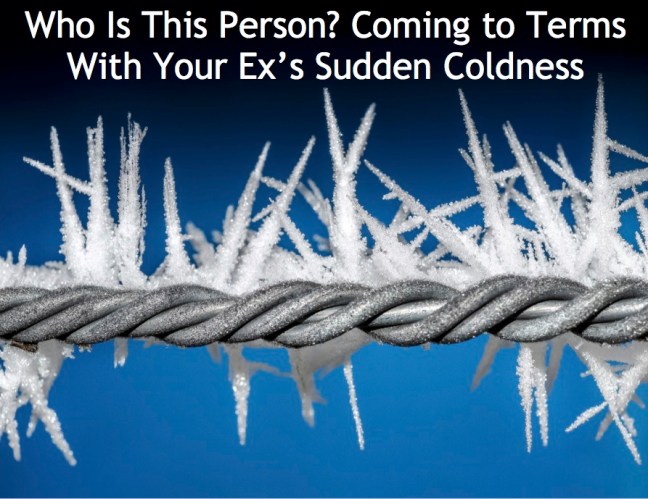
Who Is This Person? Coming to Terms With Your Ex’s Sudden Coldness

sudden coldness

We stood in front of the security line of the Atlanta airport. I felt so loved, so safe in the familiar space created between his chest and his arms, listening to his heart beat through his shirt. I teared up a little as I turned away, already missing my husband of sixteen years as soon as the physical contact was broken.

It was supposed to be goodbye for a week.

It turned out to be goodbye forever.

By the next time I saw him, eight months later in the courtroom, he had become a stranger. A forbidding stranger.

In an instant, this man had gone from my protector to my persecutor. My ally to my greatest threat. And instead of professing love, he was waging war.

It was as though a switch had been flipped.

I just couldn’t wrap my head around the seemingly abrupt transformation. Had this malicious man been hiding in my marital bed the entire time? Did he somehow wake up one morning a different person? Or was he always this way and I was finally able to see the truth?

The reality is probably a little bit of all of those.

Self-protection is at the root of behavior.

To begin with, it’s important to remember that at its core, all behaviors are self-protecting. To that end, it made sense for him to play the part of a loving husband while he chose to remain in the picture. This act allowed him to avoid my rage, sadness and disappointment over the reality of his actions.

Once he left, the distance and coldness again protected him from feeling my pain. In essence, by acting as though he didn’t care, he could begin to believe it. A barrier of disassociation. In this view, the switch was flipped more in an effort to prevent pain than in an effort to inflict damage.

For my part, believing in his good-husband routine insulated me from the painful truth during our marriage. I didn’t want to see the deception he was capable of, so I chose to believe in the best of him. And then once he left, a switch was flipped in me. I couldn’t understand how someone I loved (and who I thought loved me) could do those things, so I chose to see him as all-bad. This view, and the distance it provided, served to protect me from further damage to an open heart.

Cognitive dissonance is a powerful force.

Cognitive dissonance happens when somebody’s beliefs about themselves and their behaviors are not in alignment. It is a very uncomfortable position, and so we often strive to change either our actions or our beliefs so that they again line up.

One of the ways that my ex minimized his cognitive dissonance between the conflicting belief of seeing himself as a good person and the action of committing bigamy is by justifying his choices. Over time (and without my knowledge), he had demonized me, both in his mind and to others.This belief then allowed him to act in a cruel and hateful manner towards me while still maintaining his internal integrity.

My own cognitive dissonance was amplified towards the end of the marriage as the belief that my husband was an amazing guy was beginning to be challenged by the cracks in his facade. And then upon the receipt of the text that ended it, the wool was brutally ripped away from my eyes.

And for the first time, I saw him as he was, not as he wanted to be seen.

You can’t see the big picture until all of the pieces have been assembled.

I now believe that the man I married was not the same man I divorced many years later. He changed, significantly and detrimentally, most likely from a combination of addiction and unaddressed childhood trauma.

Yet, even though he was not the cold and calculating man when we wed, that potential was within him. I saw some of the signs and yet I chose to discount them, brush them off as inconsequential.

And it was only later, once he removed his mask and I began to assemble all of the clues, that I could see how it all fit together. Even though the change felt abrupt, it was more a matter of the final piece being slid into place.

Hate is not the opposite of love.

And then there’s this – the opposite of love is not hate. It’s indifference. When we truly don’t care about someone, we don’t expend the energy to make them miserable. When an ex is trying to make your life difficult or attempting to manipulate you, it’s a sign they have not yet let go. And it can also be an indication – albeit an agonizing one – of their own pain.

When you’re facing the brunt of your ex’s coldness and distance, it’s hard to respond with anything but shock, hurt and indignation. Maybe this will help.


The Power of “Me Too”

I recently responded to a woman over at Divorce Force. She had just discovered that for 30 of the 34 years she spent with her husband, he had another family. Her post is brief, the details sparse. But I’m confident that one of the many overwhelming emotions she is feeling right now is that of being alone in this experience.

I’m confident because I remember feeling the same. Convinced that there was nobody else who could possibly relate to the shock of sudden abandonment and the crazy making aspects of divorcing someone who made his own reality.

And then I found some message boards. A few articles. A book. And those words all whispered, “Me too.”

“My husband left me a note on the counter and I never heard from him again.”

“My wife simply didn’t come home from work. I found out later that she moved in with her boyfriend that same day.”

“My ex husband  fabricated all of the documents that were submitted to the courts. It’s all lies.”

“My ex wife falsely accused me of being abusive. Now the judge looks at me like I’m the bad one.”

As I read these entries, I felt sorry for those that had endured. And I also felt some relief. Some companionship. Some sense that I had found my tribe.

All because of the power of “me too.”

“Me too” doesn’t try to compete for the greatest pain trophy. It doesn’t try upstage the circumstances or tell a better story. It doesn’t engage in a game of tug of war, attempting to direct all of the energy to one side. “Me too” doesn’t claim to understand all of what another is feeling or to insinuate that the paths are the same.

What “me too” does is tell you that you’re not alone in your experience. That others have been in a similar place and can empathize with how you are feeling. “Me too” provides hope as you learn that others who are doing okay now were once not okay. When you hear the words, “me too,” you know you have a compassionate and nonjudgmental ear where you can feel safe and understood.

If you’re feeling alone, seek your tribe and find peace among those who whisper, “me too.” And once you’ve been there and through the other side, be brave enough to remember your own struggles, share your own “me too” and then just be there and listen.


7 Subtle Signs You Have a Backseat Driver in Your Life

For a long time (okay, even now), when my now-husband would vocalize his opinion about something that he thought would be good for me, I recoiled. It felt almost invasive.

Smothering.

Controlling.

Not because of what he was saying, but because of what I have been through.

My now-husband is direct, expressing his thoughts and feelings overtly and directly (a trait I very consciously looked for the second time around). Sometime I chafe, but I love the fact that it’s all on the table. And even though it’s not always comfortable, I love that he challenges me to defend my decisions and actions because it serves to help make me better.

My former husband was covert, passive aggressive and manipulative in his approach. Unflinchingly supportive on the surface of any thought or action I undertook, while silently steering me in the direction he wanted. He never questioned me, never told me what to do (except to relax while he tackled some chore on his own). His control was subtle, which is exactly why it was so powerful. My defenses were never triggered until it was too late.

The following strategies are commonly used by people who are passively controlling. Those who, rather than overtly take over the wheel of your life, cunningly influence how you turn the wheel. All of these signs can have multiple meanings; on their own they do not indicate control. But when more than one show up along with a sense that boundaries are being crossed, it warrants a closer look.

The tears may be real, but the emotion is not. This trick is learned in infancy, as babies realize how tears can halt punishment and bring attention. Some never abandon this trick and persist in using tears to manipulate those around them. Look out for waterworks that only come when something is desired and seem to halt as soon as the goal is obtained.

Affection and attention are doled out as a distraction and a pacifier. This was my ex’s favored ploy. It sounds crazy to complain about an attentive husband, but when I look back, the affection was increasingly used whenever I came dangerously close to the truth. His great big bear hugs felt protective at the time, now they seem more like a martial arts-style submission.

Decisions are held back. Waiting to make and/or communicate a choice is a particularly crazy-making form of covert control. Everybody else is held in limbo, their own lives and decisions delayed. Doing nothing can carry with a great deal of power when others are depending upon you.

Money is used as a mode of communication. Sometimes finances are used in overt control, such as when one spouse makes all of the financial decisions and doles out an allowance to the other. But it can also be more indirect, such as when purchases are kept hidden or the partner with the higher income feels entitled to make decisions for everyone.

Judgement is passed. This can be direct, “You look like you’re trying too hard when you wear that skirt,” or indirect, pronouncing something unacceptable in someone else. My ex took it a step further and frequently renounced choices and behaviors in others that he was guilty of himself.

The favors and gifts are given with some sort of reciprocity in mind. The stereotypical idea of a wife using sex to get her husband to do things comes to mind here, but it’s by no means the only modality used. Handouts can be used with great efficacy to shape behaviors. After all, there’s a reason we train animals that way.

They accuse you of being controlling. Projection and gaslighting at its finest.


In a healthy relationship, each partner challenges the other and accepts influence from the other. It flows both ways, balanced.

When there is controlling behavior present, the interchange is not equal. One holds more power than the other.

And when there is a backseat driver, a more passive controller, this imbalance can be difficult to pinpoint.

Control thrives when you’re too close to it, too afraid to see it and unwilling to erect and maintain boundaries.

Take a step back, trust in yourself and practice making decisions by yourself and for yourself.


Related:

I Hate Mums

I Reject Your Reality and Substitute My Own

Subtle Signs You’re Being Manipulated By a Covert Abuser

The Misuse Of Affection