Finding Your Strength Through Your Victim Impact Statement

At the gym yesterday, there was a man near me who was using his headset to have a phone conversation. Hearing the one-sided discussion about inane business matters made me irrationally angry. I kept trying to tune him out, to let the music and other voices drown out his, but my attention kept being drawn back to him.

Science has studied this phenomenon and has confirmed that we find one-sided conversations particularly distracting. It’s proposed that this is because our brains detest a void and so they are working overtime in an attempt to piece together the missing part of the exchange.

I partially credit this fact with my obsession of having my voice heard after abandonment. It felt like an important conversation, interrupted. He said his piece and my brain was desperate to fill in the response. When all of my attempts at establishing a dialog were ignored, I became desperate to be heard.

I was first asked to write a victim impact statement by the district attorney’s office in association with the bigamy charge. I actually had to have my mom help with the first iteration, as I was not yet able to articulate the extent of the emotional, financial and physical fallout of his actions.

I was more prepared for the second impact statement, part of the required documentation by the IRS for Innocent Spouse Relief. As I composed the statement, I imagined I was speaking to my ex-husband. As I detailed his egregious acts, I started to feel a little better as my reply to his side of the conversation was recorded. And when the federal government validated my response by grating me relief, I felt even better still.


Not all victims are recognized by the legal system and given the opportunity to compose a victim impact statement. But that doesn’t mean that you can’t choose to write one yourself.

When you have been victimized, there is a power imbalance at play. You feel like you’ve been disregarded, disrespected and even dismissed. A victim impact statement is a way of taking back some of that power. Of saying, “I have a voice and my voice matters.”

An impact statement both highlights the injustices committed and describes the impact that those acts have had upon you. It gives you the space to say, “What you did was not okay and it hurt me.”

Being victimized often carries with it some shame. Abuse flourishes when people are too scared or too embarrassed to speak out. By writing your statement, you are saying, “I have the courage to speak up and take a stand against your behaviors.”

And finally, composing a victim impact statement can be the first, critical, step of taking ownership over your own life again. It’s a way of saying, “You hurt me, but you did not silence me. You harmed me, but you cannot stop me. You tried to keep me down, but I will rise again, stronger and even better than before.”


In some ways, this blog and my books have become an extension of my own victim impact statements. My way of refusing to be silenced.

6 Truths You Need to Know After You’ve Been Cheated On

cheated

Have you been cheated on? Here’s what you NEED to know from someone who has been in your shoes…

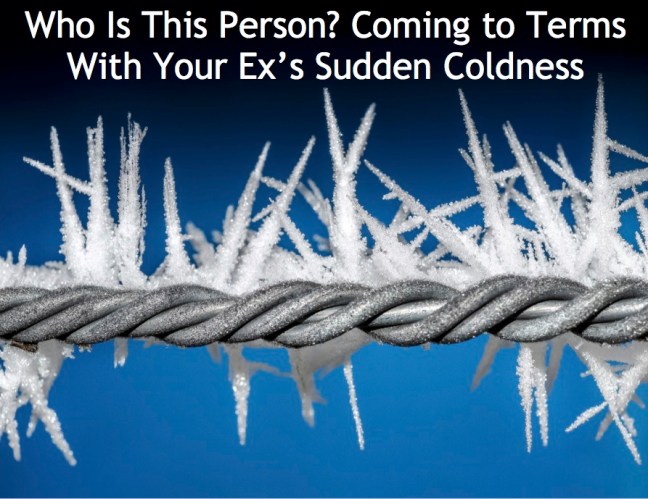
Who Is This Person? Coming to Terms With Your Ex’s Sudden Coldness

sudden coldness

We stood in front of the security line of the Atlanta airport. I felt so loved, so safe in the familiar space created between his chest and his arms, listening to his heart beat through his shirt. I teared up a little as I turned away, already missing my husband of sixteen years as soon as the physical contact was broken.

It was supposed to be goodbye for a week.

It turned out to be goodbye forever.

By the next time I saw him, eight months later in the courtroom, he had become a stranger. A forbidding stranger.

In an instant, this man had gone from my protector to my persecutor. My ally to my greatest threat. And instead of professing love, he was waging war.

It was as though a switch had been flipped.

I just couldn’t wrap my head around the seemingly abrupt transformation. Had this malicious man been hiding in my marital bed the entire time? Did he somehow wake up one morning a different person? Or was he always this way and I was finally able to see the truth?

The reality is probably a little bit of all of those.

Self-protection is at the root of behavior.

To begin with, it’s important to remember that at its core, all behaviors are self-protecting. To that end, it made sense for him to play the part of a loving husband while he chose to remain in the picture. This act allowed him to avoid my rage, sadness and disappointment over the reality of his actions.

Once he left, the distance and coldness again protected him from feeling my pain. In essence, by acting as though he didn’t care, he could begin to believe it. A barrier of disassociation. In this view, the switch was flipped more in an effort to prevent pain than in an effort to inflict damage.

For my part, believing in his good-husband routine insulated me from the painful truth during our marriage. I didn’t want to see the deception he was capable of, so I chose to believe in the best of him. And then once he left, a switch was flipped in me. I couldn’t understand how someone I loved (and who I thought loved me) could do those things, so I chose to see him as all-bad. This view, and the distance it provided, served to protect me from further damage to an open heart.

Cognitive dissonance is a powerful force.

Cognitive dissonance happens when somebody’s beliefs about themselves and their behaviors are not in alignment. It is a very uncomfortable position, and so we often strive to change either our actions or our beliefs so that they again line up.

One of the ways that my ex minimized his cognitive dissonance between the conflicting belief of seeing himself as a good person and the action of committing bigamy is by justifying his choices. Over time (and without my knowledge), he had demonized me, both in his mind and to others.This belief then allowed him to act in a cruel and hateful manner towards me while still maintaining his internal integrity.

My own cognitive dissonance was amplified towards the end of the marriage as the belief that my husband was an amazing guy was beginning to be challenged by the cracks in his facade. And then upon the receipt of the text that ended it, the wool was brutally ripped away from my eyes.

And for the first time, I saw him as he was, not as he wanted to be seen.

You can’t see the big picture until all of the pieces have been assembled.

I now believe that the man I married was not the same man I divorced many years later. He changed, significantly and detrimentally, most likely from a combination of addiction and unaddressed childhood trauma.

Yet, even though he was not the cold and calculating man when we wed, that potential was within him. I saw some of the signs and yet I chose to discount them, brush them off as inconsequential.

And it was only later, once he removed his mask and I began to assemble all of the clues, that I could see how it all fit together. Even though the change felt abrupt, it was more a matter of the final piece being slid into place.

Hate is not the opposite of love.

And then there’s this – the opposite of love is not hate. It’s indifference. When we truly don’t care about someone, we don’t expend the energy to make them miserable. When an ex is trying to make your life difficult or attempting to manipulate you, it’s a sign they have not yet let go. And it can also be an indication – albeit an agonizing one – of their own pain.

When you’re facing the brunt of your ex’s coldness and distance, it’s hard to respond with anything but shock, hurt and indignation. Maybe this will help.


What Is Your “I’m Not Enough” Telling You?

“Why wasn’t I enough for him?”

I posed this question to my journal soon after discovering that my then-husband had obtained a new wife.


“What does she have that I don’t?”

I asked of the page, not expecting an answer.


“How could he do this to someone he loved?”

The words perforated the page like his actions pierced my heart.


“He threw me away like so much garbage!”

My tears fell on the page, causing the words to bleed down the paper.


I felt worthless, discarded. I wore this self-image like a corset, hidden from public view yet restricting my movements nonetheless.

I rationalized that if I had been a good enough wife, he would not have secured another. I believed that if I had only been a better partner, he would not have left. Even while publicly blaming him, I secretly blamed myself. Convinced that I was not enough.

My “I’m not enough” taunted me when I faced my fear of going downhill, telling me that I would fall. It threatened that I would never find someone to love me. It followed me into dating, acting surprised when anyone was interested in a second date.

I carried this feeling into my second marriage, determined for a time to be a “perfect” wife. And fearful that when I fell short of this impossible goal, I was risking abandonment again.

My now-husband picked up on this underlying anxiety and reassured me that I was enough. Imperfections and all.

But it still took time for me to really believe it.

And even though it’s largely gone in the context of my marriage, it still haunts me at other times.

It still whispers every time I press the “publish” button, apprehensive about the reactions. I have to work to quiet it when I face criticism. And I still have to tell it to shut up when it tries to take everything personally and assume the responsibility for everybody’s happiness.

The voice isn’t so loud now, but it still exists. It drives me to achieve, which would be good if it didn’t have the aura of fear around it. It encourages me to always strive to be better, do better. I have to constantly work to find that balance between believing that I AM enough and that I can always be more.

When you’re rejected by someone you value, it’s not easy to separate yourself from their actions. It’s hard to trust that you ARE enough.

In the beginning, I felt like I needed to prove my worth TO my ex (even though he was out of the picture). It had a, “I’ll show him” motivation behind it.

And then one day I realized that I was allowing a person of questionable character to determine my worth, which is pretty much like letting a known embezzler set the market price of gold.

If I didn’t value his opinion about anything else, why would I let him decide that I was not enough?

I felt pretty silly.

And so I stopped trying to prove to him that I was worthy.

But I still felt a need to prove it to myself. That little voice of insecurity still pushing through like a pessimistic parrot on my shoulder.

So that’s where I am now – working to let go of that residual feeling of not being enough.

Recognizing the voice for what it is – a lie based on fear.

And learning to trust that I. Am. Enough.


Do you ever have the feeling that you’re not enough? What does that voice try to tell you?


The Power of “Me Too”

I recently responded to a woman over at Divorce Force. She had just discovered that for 30 of the 34 years she spent with her husband, he had another family. Her post is brief, the details sparse. But I’m confident that one of the many overwhelming emotions she is feeling right now is that of being alone in this experience.

I’m confident because I remember feeling the same. Convinced that there was nobody else who could possibly relate to the shock of sudden abandonment and the crazy making aspects of divorcing someone who made his own reality.

And then I found some message boards. A few articles. A book. And those words all whispered, “Me too.”

“My husband left me a note on the counter and I never heard from him again.”

“My wife simply didn’t come home from work. I found out later that she moved in with her boyfriend that same day.”

“My ex husband  fabricated all of the documents that were submitted to the courts. It’s all lies.”

“My ex wife falsely accused me of being abusive. Now the judge looks at me like I’m the bad one.”

As I read these entries, I felt sorry for those that had endured. And I also felt some relief. Some companionship. Some sense that I had found my tribe.

All because of the power of “me too.”

“Me too” doesn’t try to compete for the greatest pain trophy. It doesn’t try upstage the circumstances or tell a better story. It doesn’t engage in a game of tug of war, attempting to direct all of the energy to one side. “Me too” doesn’t claim to understand all of what another is feeling or to insinuate that the paths are the same.

What “me too” does is tell you that you’re not alone in your experience. That others have been in a similar place and can empathize with how you are feeling. “Me too” provides hope as you learn that others who are doing okay now were once not okay. When you hear the words, “me too,” you know you have a compassionate and nonjudgmental ear where you can feel safe and understood.

If you’re feeling alone, seek your tribe and find peace among those who whisper, “me too.” And once you’ve been there and through the other side, be brave enough to remember your own struggles, share your own “me too” and then just be there and listen.