Five Vows to Make With Yourself After Divorce

Divorce affects us all differently. Some come out of the courthouse immediately feeling lighter, while others carry the heavy weight of sadness for many years. Some look forward to a new beginning; others grow fearful or hopeless about their imagined futures. Some cry. Some scream. Some grow bitter. And some grow more determined.

Yet no matter your personal circumstances or your individual response to divorce, this is an opening. An opportunity. A chance for you to take stock of your life, realign yourself with your values and purpose and make a commitment.

Not to another.

But to yourself.

These are the five promises I made to myself after divorce (I think #5 was the hardest and also the most important).

Have you made vows with yourself after your divorce? If not, maybe it’s time. After all, the promises we make to ourselves are perhaps the most important ones of all.

On a Dime

It never ceases to amaze me how quickly life can change.

How fast it can go from routine to survival.

How rapidly the big priorities are forgotten once other needs force their way to the top of the heap.

And how suddenly the attitude can shift from high expectations to one of immense gratitude for even the smallest blessings.

One week ago today, things were good. Normal. I snapped this picture of Kazh on our morning walk and captioned it, “Bat Boy.”

A few hours later, a normal walk became an impossibility.

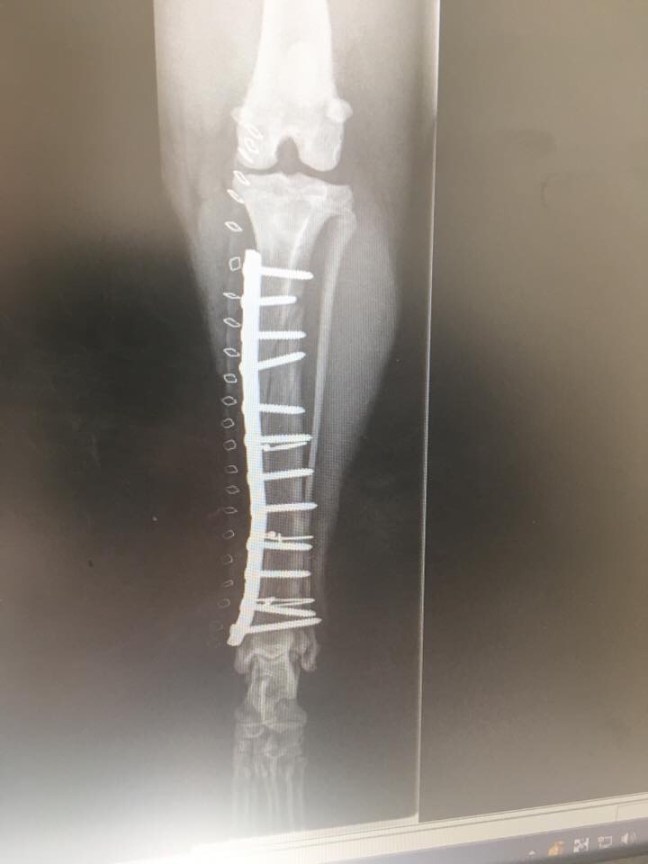
Filled with more enthusiasm than grace, our boy broke his leg later that afternoon in a heroic attempt to catch a tennis ball.

It was bad. Brock and I both heard the snap of the bone and we both cried out that his leg was broken. We rushed to our vet, thankfully just down the street.

In the exam room, our emotions were high. Not only was it hard to see him consumed with pain and fear, it was all-too-familiar waiting on news from the vet. Tiger’s loss is still very fresh.

We were sent home with pain medication, a temporary splint and a CD with X-rays that confirmed the break, due to be delivered the following day to the surgeon.

It was a long night. Brock built me a pallet on the floor next to Kazh’s bed. The initial shock had worn off and the medication wasn’t able to eliminate the pain. All I could do was hold him as he cried and shook.

The break was a doozy- a spiral fracture the entire length of the tibia, missing the ankle by a mere millimeter. The surgeon implanted a plate, held with twelve screws.

And now the long, slow and frustrating process of healing has begun.

As soon as the bone was anchored, his pain became manageable. However, he’s not allowed to bear weight on the injured limb for several weeks.

It’s like having a newborn. He can’t be left alone. He’s on a regular schedule of food and medication. And a simple trip to the bathroom requires a waterproof sock over his cast, a sling under his belly and a leash to hold him back from his instinct to run and play.

It’s hard right now. We’re all sleep deprived. Stressed. And having a hard time accepting the slow pace of healing and the restrictions it requires.

And yet, we’re incredibly grateful that our boy will be okay, that we’re able to take care of him and that we have each other to help us through.

Life. It definitely keeps us on our toes.

Four Surprising Emotions You May Experience When You’ve Been Cheated On

cheated on

Shock?

Check.


Anger?

In droves.


Sadness?

The tears were surely a testament to that.


Fear of what was to come?

In every moment.


Those were some of the emotions that I experienced when I discovered that my first husband had been having an affair. None of those feelings surprised me; they were the emotions I would have expected to follow the gut-wrenching discovery of betrayal.

But they weren’t the only feelings that I experienced. And the others caught me off-guard. Here are four unexpected emotions that you may experience after the discovery of infidelity.

Five Signs That You May Be in Denial

If I had been able to be honest with myself during my first marriage, I would have known that something was wrong.

But I wasn’t honest with myself. Instead, I was doing the adult equivalent of the child hiding under the covers when a strange noise reverberates throughout the house. Part of my brain was acting in an attempt to protect me; keeping me blinded from the truth and providing me with the illusion of security.

At the time (and even in the months following the brutal discovery of what was happening beyond my closed eyes), I wasn’t able to tell that I was in denial. When asked, I would describe in detail the extreme efforts that my ex undertook to keep the truth hidden from me. But I would stubbornly refuse to acknowledge the efforts I went to in order to keep the truth from myself.

Looking back, these are the five signs that suggested that I was in denial:


1 – I Made Excuses

I attributed my stress to work. I brushed off my then-husband’s strange comment to his health-related tension. I excused the rejected debit card as a miscommunication with the bank. There was always a reason for everything, and that reason never had anything to do with my husband embezzling marital funds or seeking another wife.

When excuses, for yourself or others, become the knee-jerk reaction, it’s a sign that you may be ignoring something important. Pay attention to your pardons. If they are frequent, especially with regards to a certain person or situation, it would be wise to consider looking deeper.


2 – My Reactions Were Over-the-Top

When my husband would call and announce that he would be home late from work, I would have to fight back my initial strong response. When he made a minor – and admitted or visible – mistake, I would find myself becoming irrationally upset. And that’s because I wasn’t responding to the situation at hand; I was reacting to what I was not allowing myself to see.

Pay attention to your reactions. If they are consistently rating a 10 in response to a level 2 or 3 offense, your emotions may be due to something else entirely. Take a moment and explore what is really upsetting you.


3 – Certain Thoughts or Topics Were Off Limits

We never talked about what would happen if our relationship didn’t go the distance. We never discussed infidelity or the temptations that all people can encounter. I never allowed my thoughts to wander in the direction of my husband being anything but loving towards me.

When certain topics are in the no-go zone (either between you or even within your own mind), it is an indication that you may be intentionally refusing to explore what is hidden there. Those darkened spaces become the closet where the monstrous secrets can hide until they grow too big to contain.


4 – I Had an Underlying Current of Anxiety

It was electric, a strange buzz that radiated through my entire body. It came on slowly, so it was difficult to say for certain that it hadn’t always been there. It reminded me of the spidey sense I get as a teacher before a fight breaks out – it’s a physical awareness of emotional energy.

Even when our brains are stubbornly refusing to acknowledge something, our bodies are often clued-in. Pay attention to your physical symptoms – elevated heart rate or blood pressure, stomach issues or frequent illness. Your body may be trying to tell you something.


5 – There Was a Disconnect Between Observations and Conclusions

I believed that my husband was a good man. Kind. Caring. And hard-working. Yet there were times that his actions didn’t support those presumptions. So I simply brushed those times aside.

This is confirmation bias at its worst – we make conclusions and then proceed to seek out evidence that supports it and reject any information to the contrary. This is a cognitive distortion that we are all subject to, yet awareness of it goes a long way in limiting its reach. Don’t allow your conclusions to be so entrenched that you ignore any further observations.


Denial seems like it’s a comfortable place. After all, the child hiding beneath the covers convinces himself that there is safety to be found on the bed. At the same time, he is held prisoner beneath the sheets, convincing himself that to step out from the covers would be dangerous even as he constantly worries about what lurks outside.

Instead, if the child throws back the sheets and summons the courage to investigate the strange noise, the worry dissipates as he either discovers that the threat is imagined or he learns the true nature of the danger.

Denial comes a great cost. It provides you with some temporary security and asks for your constant fear in return. Trust that you can face whatever scares you and you will find that your fear fades away.


7 Vital Lessons Divorce Teaches Children

children

I was in elementary school when my parents divorced and my dad moved out. I remember being confused – how could a family suddenly be not-a-family? I was sad – not only did I miss my dad, but I saw that mom was hurting. And I was ashamed, concerned that somehow my friends would judge me and my family because of the split. As I grew older, I began to internalize some of the events and developed a feeling that I wasn’t enough.

There’s no doubt about it, their divorce impacted me.

And not all of the effects were negative.

In fact, I now credit their divorce (and the way it was handled with me) with being the source for some of the most important messages I received in childhood.

I know that divorce is the last thing you ever wanted your children to experience. But there are ways to make the best of it. Here are seven vital lessons that your children can learn from your divorce.