
Benefits of Traveling Outside Your Comfort Zone

comfort zone

images-33

I had two choices for my morning run today – the relative comfort of a treadmill in my dry and air-conditioned gym or the muddy trails of a nearby park in the rain and oppressive mugginess that blankets the east coast in the warm months.

I debated for a few moments, considered how miserable I would likely be on an outdoor run as I struggled to breathe in air that was more water than oxygen and how tempting it was to remain in the manufactured comfort of air-conditioned space.

After swallowing the last of my coffee, I went downstairs and selected my trail-running shoes, opting for the less comfortable option. At the beginning of the trail, I questioned my choice. The sweat was already soaking through my shirt, my lungs were threatening to wheeze and a strange guy on the relatively empty trail caused me to grip the mace I carry just a little tighter.

But then after the first mile, I began to find my stride. The moisture in the air became less noticeable, my breathing began to acclimate and the weird guy stayed weird, but also stayed back. And by the time I made it back to my car, looking like I had just completed a mud run complete with a culminating dunk in a body of water, I was happy that I chose the less comfortable route.
images-36


Which are you more likely to regret – the step that takes you out of your comfort zone or the inaction that keeps you there?


We all like to be comfortable. All of us fear the unknown and to some extent, shudder at the thought of potential failure. We shy away from experiencing any sensation that could be labeled as unpleasant. All of us have become experts at crafting and disseminating excuses that give us permission to maintain the status quo, telling ourselves stories to justify our inaction and our conclusions.

images-34

Life – real life – happens outside your comfort zone.


When we take steps outside our comfort zone, we are granted permission to fail.

Once you’ve been labeled “good” at something, you are expected to perform at a certain level every single time. In contrast, when something is brand new to you, any failure is somehow less personal and more situational. That makes it much easier to face.


When we take steps outside our comfort zone, we are allowed to be unsure.

I don’t know about you, but I always feel pressure to appear confident about my decisions and my actions. I feel like this is one of the great lies of adulting. When we were little, we assumed that adults knew what they were doing. Only now, we’re the grown ones and we’re just faking it. When you’re doing something new, you’re allowed to reveal that insecurity.


images-32

When we take steps outside our comfort zone, small achievements are recognized and celebrated.

When you were a baby, your every “first” was marked and even memorialized. That recognition of small successes often fades as we age. When you’re outside your comfort zone, you are far more aware of those “firsts” and mark them of signs of growth.


When we take steps outside our comfort zone, we have fewer expectations from ourselves or from others.

Expectations can be powerful limiters. Just look at those studies where teachers of completely average classes were either told that their children were brilliant or behind. The children performed not based on their ability, but according to their teacher’s expectations. And in our day-to-day lives, we are just as likely to limit ourselves with claims of, “I can’t.” When we take that step outside of our comfort zone, we are instead asking, “But what if I can…?”
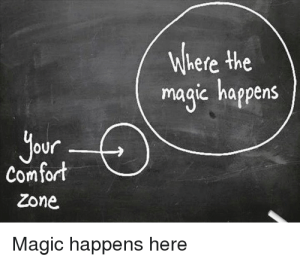
our-comfort-zone-where-the-magic-happens-magic-happens-here-18784279


When we take steps outside our comfort zone, assumptions – and beliefs – are challenged and often adjusted.

WE often reach conclusions based on what we experience. So the more limited your experiences, the less-informed and potentially more biased your assumptions will be. When we meet new people and experience new ways of seeing the world, we are forced to re-examine and maybe even readjust our beliefs.


When we take steps outside our comfort zone, learning combats frustration born of stagnation.

Humans get bored. Just watch a modern queue and take notice of how many people are engaged in their phones to avoid a few minutes of idle and purposeless time. The same thing happens on a larger scale. We thrive on novelty, on challenge. When there is nothing left to learn, we become stagnant and then frustrated. The space outside a comfort zone offers unlimited opportunities for learning.

images-35


When we take steps outside our comfort zone, curiosity dominates and inspires wonder.

Have you ever watched a kid in a new environment? A place that is known to you suddenly becomes alive with possibility when seen through their eyes. Our brains have literally evolved to disregard that which is too ordinary. And when your life is spent entirely within a comfort zone, you risk having your brain ignore it all. Newness encourages our brains to wake up and pay attention, bringing with it a childish sense of exploration and wonder.


When we take steps outside our comfort zone, we allow space for authenticity and purpose.

We all-too-often become our labels – mother, father, caretaker, employee, etc. We forget who we really are and what really inspires us and drives us. When we leave our comfort zone, we often discard those labels for a period of time, allowing us the the opportunity to discover what is really important to us.
 

images-37


Common Challenges in Post-Divorce Relationships

relationships dating divorce

Post-divorce relationships are often where the fears of experiencing heartbreak again collide with the hope and heady infatuation of early attachment. These opposing emotional forces, along with any lingering unresolved divorce issues, present certain common challenges in relationships entered into after one or both parties experienced divorce.


You meet the right person at the wrong time.

Finding a good match is as much about the timing as it is the person. You may encounter somebody who radiates potential, but if either one of you is not yet ready for a relationship, that potential has to be put on hold. It can be tempting to try to push it; to discount the warning signs that there is still healing work to be done. It’s scary and disheartening to release the possibility of a connection when you have been feeling alone and afraid of finding somebody. Yet sometimes, accepting that the timing isn’t right is exactly what is needed so that you’re not pouring energy into a relationship that is built on unstable ground.


You carry over blame or suspicion meant for your ex to your new partner.

If your ex behaved badly, you may be primed to assume that your new partner is also up to something whenever your back is turned. Instead of coming from a place of innocent until proven guilty, you may be operating from a place of assumed guilt where you’re looking for evidence to support your beliefs. This is easy to do. If you’ve been fooled once by a liar or a cheater, you don’t want to ever experience that humiliation and betrayal again. However, there is a big difference between staying alert for bad behavior and assuming that bad behavior is occurring.


A fear of further heartbreak or relationship failure hinders – or prematurely ends – the relationship.

The pain that comes from the end of a relationship is brutal and it’s only natural that we act to avoid experiencing similar heartbreak again. A healthy approach to this is to address the factors that led to the divorce and to learn to accept that sometimes relationships serve their purpose and come to an end. Yet, more commonly, the fear of further pain prompts a person to leave before they’re left, making an exit before the attachment – and the predicted pain – becomes too strong.


You expect the new relationship to be as intimate and fulfilling as a marriage from the very beginning.

After divorce, the loneliness and isolation are gutting. So when you meet someone and feel those initial sparks fly, you become hopeful that the loneliness is over and that you again have someone that will truly see and appreciate you. Yet, this neglects to acknowledge that building a relationship and a shared history takes time. It’s not fair to expect that level of a connection in the beginning; you have to provide it with the opportunity to grow.


You are expecting the new relationship to heal you and to fill in the gaping void you’ve felt since divorce.

If you believe Hollywood, all you need is the right person to come into your life when you’re down and everything will be better. There’s a reason that these stories are presented as fiction; it doesn’t happen that way. There are certain post-divorce wounds that can only be healed within the context of a relationship (not necessarily a romantic one), but the work is still yours to do.


You are afraid of being open and vulnerable again, so you only let them in so much before the walls come up.

When we’re afraid, sometimes we fight, sometimes we flee, and sometimes we simply freeze. The latter is what happens when you feel too exposed in a new relationship and so you tuck yourself away behind carefully constructed barricades, built in an attempt to protect the heart from further assault. Although this strategy does limit risk, it also inhibits growth and fulfillment. It’s much like an attempt to learn to swim while refusing to get out of the shallow end of the pool.


You mistake the intensity of early attraction as the sign that you’ve found the “right one.”

In a long marriage, the intensity of the initial attraction inevitably fades over time. And so when you experience that jolt of biochemical desire again, it sends a powerful message. It’s easy to interpret this common biological response as a sign that this is the right person for you. By all means, enjoy the surge of passion and excitement, yet refrain from making any major decisions until you’ve given your body chemistry time to normalize.


You overreact to benign situations because it triggers memories from your marriage.

There will be times when you and your new partner are reading from different scripts. They may think that you’re arguing over something in the present while you’re whisked backwards in time and replaying a role from your marriage. These moments are challenging in a new relationship because the person who is triggered is flooded with emotion and if that continues unaddressed, it threatens to drown the new partnership as well.


You grasp onto a relationship that isn’t working because you want to avoid another ending.

Sometimes, we fall prey to the belief that someone is better than no-one. We will grasp onto a relationship not because we love the person, but because we fear being without a person. This is one of the main reasons for the advice to spend some time single before you enter into a new relationship. If you know that you’re okay alone, you’re much less likely to stay with somebody just for the sake of being coupled.


You attribute everything that was wrong in your marriage to your ex and expect everything to be instantly better with a new person.

Choosing the right person is certainly important. But it’s not everything. No matter what went wrong in your marriage, it is your responsibility to identify and address areas where you can do better. If you don’t, you may find that similar patterns continue to play out in future relationships, no matter who you choose to partner with.


Jealousy of former partners or relationships poisons the new connection.

It can be strange entering into a relationship with somebody that had an entirely other life – and love(s) – before you. It can be threatening to see evidence of this former life. Depending upon the situation, ex-spouses may even be a part of the new relationship. It takes a certain amount of maturity to recognize and accept that these early loves can coexist with your new one.


You compare your new partner to your ex.

It’s only natural to compare two different people who fill a similar role in your life. Yet comparison can be damaging if it impedes on your new partner’s ability to be accepted as their own person with their own inherent strengths and weaknesses. They will not be the same as your ex. In some facets, they will be a dramatic improvement and in others, they may be lacking. It’s up to you to select someone who has the characteristics that you deem critical and it’s up to you to not expect them to meet all of the positive traits that your ex possessed.


You experience an increased complexity in joining established lives.

If you married young, commingling two lives was probably relatively simple. That’s not the case in post-divorce relationships, with their higher bank accounts and debts, increased responsibilities and commitments and maybe even children or an ex that is still in the picture because of shared responsibilities. These external demands and restrictions are very real and can add a significant amount of challenge to a post-divorce relationship.


Common relationship challenges and transition points cause panic that the end is nearing.

Especially if the end of your marriage came as a surprise, you may find yourself panicking anytime your new relationship hits a rocky patch. This is tricky, because you want to take these signs seriously, yet if you overreact, you may end up sabotaging what you’re trying to save. It may take some practice to approach these issues with the right amount of energy and attention.


None of these common post-divorce challenges are insurmountable. Love after divorce is not only possible, you may even find that it’s better than before.


A “Safe Space” With a Purpose

One of the most precious gifts I received during my divorce was the gift of safe spaces. I had my dear friend’s kitchen floor, where I could cry and curse without judgment while surrounded by the comforting activities of normal family life. I had my team at work who seemed to know whether I needed a hug, a bite to eat or simply a moment by myself. I had my family, who although spread around the country, would send me emails of support and understanding (liberally peppered with humorous anti-ex sentiments).

Those safe spaces were so treasured because the larger world was anything-but-safe. I had acquaintances question what I must have done to have deserved betrayal and abandonment. I had men at the gym view my fragility and naiveté as an invitation to pursue me long before I was ready to consider a new relationship. And social media? Ugh. It seemed like every message of well-stated support was followed by something well-meaning but clueless (“Don’t worry, honey. There are plenty of other men out there. And you’re still not too old to have babies.”). And then there were those that treated me like a pariah, as though divorce was somehow contagious and by consorting with me, they risked bringing it into their own homes.

There have been many groups that provide a safe space for those undergoing divorce. Each one strives to be a place free from the blaming and shaming that so easily follows the end of a marriage.

Divorce Nation is a little different. It is the safe space, offering virtual community so that those experiencing divorce don’t feel so alone. But unlike most other groups, they don’t just want to help you heal emotionally; they want to help heal your body too. Which from my experience, is a critical component to divorce recovery.

Exercise has been a part of my life as long as I can remember. And so when faced with the enormity of the challenge of coming back from the beat-down of divorce, it was no wonder that it became a significant part of my tool kit. Through fitness, I learned how to release the trauma from my body. The cage erected around my still-bleeding heart began to relax, allowing the lungs to again expand. Running released the excess anxiety while providing a welcomed sense of movement and progress. And yoga, my blessed yoga, continues to teach me that strength can exist alongside vulnerability.

I don’t think I could have made it through the divorce without the benefit of exercise.

Maybe exercise hasn’t been a part of your life. Or perhaps your once-welcoming gym now feels like a danger zone filled with happy-go-lucky youth or predatory singles. Divorce Nation wants to help you bring exercise into your life and teach you how it can help you heal and move forward, stronger in both mind and body.

I’m jealous of those in the Cleveland, Ohio area. A physical gym is in the works that specifically caters to those working through the end of a relationship. The vision is a safe space, a welcoming community with therapeutic support and the opportunity to allow the body to help heal the soul.


Here are the pertinent links for Divorce Nation:

Website

Instagram

M&P Fitness 


Growing Apart in Marriage

growing apart

We were inseparable for the better part of ten years.

We met at the age of four at a Mother’s Day Out group at our church. I remember being drawn to her pigtails, her white-blond cornsilk hair reminded me of one of my dolls and stood in contrast to my much wilder and darker mane. By the time we were in first grade, we had graduated to official “best friend” status, proudly advertised on our silver James Avery half-heart charms worn on matching chains around our necks.

We did everything together. Completed each other’s sentences and knew the other’s every wish. The other kids seemed to understand that we were a package deal – make one friend and get another one free. Our friendship navigated the transition to middle school where afternoons spent catching toads were replaced with evenings endlessly dissecting interactions with the boys. Even as we took our first shaky steps into relationships with the opposite sex, we would always return to each other to seek advice and approval.

But then high school happened and those small differences that has always existed between us were suddenly magnified. My preference for Metallica drew me towards an older crowd and her love of the stage pulled her into theater. Our classes, which had rarely ever been together, were suddenly on opposite halls and our lockers were assigned in different buildings. Over the span of a semester, we went from being inseparable to being casual friends who largely moved in separate circles.

There was some sadness. I would see her under the lights on stage, those cornsilk pigtails now released into a shining wave down her back, and remember how familiar she once was to me. There were moments when I would see her name in its first-place position on my speed dial and would mourn for the connection that we shared.

Yet even with the pinch of grief that would tag along with my memories, I understood that this transition was natural.

We had simply grown apart.

Our interests, our goals and eventually, our experiences, meant that we no longer occupied the same space. And even though it was sad, it was okay. We each had our own path to take and we could remember with fondness those years when our paths converged.

Why is it that we treat marriage so differently than other relationships? We acknowledge that friendships grow and recede, changing over time, yet we fear our marriages being anything but static, constant. When we sense that our partners are growing away from us and we catch a glimpse of diverging paths, we respond with panic or a quiet denial instead of acceptance.

We accuse them of no longer being the person that we married, beg them to stay the same as they were. We project our own discomfort with change onto their shoulders, penalizing them for wanting to change direction.

It’s sad when two people who were once so compatible begin to grow in opposite directions. It’s painful to be presented with the choice of following your heart and moving in a new direction or silencing your heart in order to preserve a relationship. You may secretly crave a reason to end the relationship, struggling to acknowledge that it has outlived its usefulness when there is nothing identifiably wrong with it.

You fear breaking hearts, yet your heart is breaking every time you feel like you have to make a choice between your partner and your purpose.

There are no easy choices when a couple has grown apart. Choose to stay and you and your partner risk feeling diminished and stifled. Attempt to renegotiate the marriage and you may find that the terms are not agreeable or that they are not sufficient to mitigate the growing distance. Walk away and you invite loneliness and regret even as you move towards your light.

This is not to say that marriage should be discarded as easily as a shirt once fashion changes. There is a commitment. A promise. Ideally, core values and goals are still in alignment and individual growth can occur within the supportive structure of the marriage.

But that is not always possible. The couple that met through faith and always held religion as the cornerstone of their union will be rocked if one partner disavows their church. Or, if two people came together with the express wish of starting a family and one later decides to remain childless, the bedrock has been fractured. You can fight the situation, but your protests will only go so far.

I often learn about acceptance through nature. My backyard is comprised of a small oval of grass surrounded by trees and shrubs. Most of them happily grow together towards the sun, leaning against each other for support and generously sharing the sunnier spaces. Or, they renegotiate, sharing the same soil yet bending their stems in different directions in order to both have their needs met.

Some become bullies, so concerned about their own needs that they shade out those around them. Others allow themselves to be shaded, giving up their own potential for growth with barely a whimper. I rarely intervene, but when I see a plant failing to reach its potential because of its location, I feel obligated to step in and either move the limbs that are blocking the light or replant the stifled one in a more favorable location. I don’t brand this intervention as “failure,” it doesn’t indicate a problem with the individual plantings. It’s simply something that needs to happen for growth to continue.

Yet marriage is more important than a bunch of flowers looking for their own stream of sunlight. We build lives together, share dreams and fears as we layer years of shared experiences. There is a vision of a shared future, moving forward along the same trajectory that was envisioned from the beginning.

And yet…

Change is inevitable. And sometimes endings are as well. There are times when the kindest action is to honor when your paths converged and allow them to continue along their own course.


Taking the Long View

long view divorce debt

Yesterday was a big day for me.

After two decades of carrying the burden, I finally paid off the last of my student loans.

I have to say, I was a little disappointed in Discover’s response to the zero balance. I wasn’t expecting anything too major, maybe just some balloons dropping down from the ceiling, applause coming through the speakers on my computer and a moderately-sized parade in front of the house. As it was, I had to make do with a sentence sandwiched between the ads for a credit card and a personal loan: “Congratulations. The balance on your student loan account is now zero.”

It’s been a long journey getting to this point. Much longer than planned-for or anticipated.

Life is funny that way.

And in so many ways, this slog back to financial health mirrored the emotional healing from divorce.

I don’t know what my credit score was on the day my world exploded. I refused to look. The last time I had checked, it was just above the 800 mark. But that was before my then-husband maxed out my credit cards, stopped paying my student loans and took out additional credit lines in my name.

I considered bankruptcy. The financial counseling session that I was required to complete as part of the pre-qualitification for the process left such a sour taste in my mouth. The advisor kept questioning my claims about my budget, unable to understand how I ended up in such a mess with a relatively frugal spending pattern. No matter how many times I explained what my husband had done, she didn’t seem to get it.

She blamed me. And I blamed me too.

Not for spending the money, but for being so stupid as to allow it happen without my notice.

So I hung up and took out a pad of paper to work out how I could pay back the money on my teacher salary without resorting to filing for bankruptcy.

I had to be strategic, although I wanted nothing more than for all of those debts to be instantly reduced to zero (and for my checking account to rise above sea level since he had left me with a negative balance). Silently, I yearned for my credit score to again be solid, instead of the shamefully low number that I knew I carried as a virtual scarlet letter, branding me as someone who didn’t have it together.

Over the next five years, I slowly and steadily paid off his parting gifts – a sum total of $80,000, if you include the legal fees that he was ordered to pay and never did. Three years after he left, I finally summoned the nerve to check my credit score. It wasn’t good, but I knew it was better than it had been.

I understood that this wasn’t a quick fix. It may have been destroyed in an instant, but rebuilding was a long game.

But even then, with the bulk of the debt resolved, it wasn’t over. The foreclosure (yet another gift from my ex and a legal system ill equipped to deal with manipulators), still pulled down my credit score, an anchor to the past. And the student loans, which were supposed to be paid off (according to the financial plan I had with my then-husband) in 2012, had instead been relegated to minimum payments in order to focus on the accounts with higher interest rates first.

Last year, the foreclosure dropped off my record, instantly catapulting my credit score almost 70 points. And then yesterday, I wiped out the student loans, which should bring me back up to my starting place of just over 800.

fullsizeoutput_d09

It’s taken 9 years and 51 days to get here (But who’s counting?). There were certainly improvements along the way, some major and some so small that they were barely noticeable. But until yesterday, I didn’t feel as though it was “done.”

And that’s how the emotional work felt as well. I wanted it to be resolved quickly. I told myself that once the legal process was over, I would refrain from looking back.

Yet just as the foreclosure pulled down my credit score, the divorce still weighed down my heart.

It was a long, slow climb back to emotional health and stability. Some days brought great improvement. Most heralded imperceptible improvements. And still others sent me tumbling backwards, leaving me bruised and fearful that I would never make the climb.

Yet, at some point, it happened. Unlike with the financial health, I don’t have a single event that I can point to where I was informed, “Congratulations. The balance on your emotional trauma has now reached zero.” But I can look back at my writing and see a difference. In 2016, there were still posts where I was struggling with trust and abandonment and vulnerability. In 2017, those are absent. And that continues. That doesn’t mean that life is always easy, but it does indicate that I am no longer responding to the events from the past.

Healing from anything requires taking the long view. It demands patience and persistence, especially in those times when progress feels sluggish and uncertain.

Keep at it. One day you’ll be able to look back and realize that it’s no longer a reality, simply a memory.