Sometimes Life Sucks…


My new book is now available on Amazon!
I’m really excited about this one! As my mom recently said, “I feel like all of the writing you’ve been doing the past several years was for this purpose.” And I have to agree.
Here is the introduction:
Life is meant to be lived in the present. But there are those times when it feels as though the present is a holding cell between the memories of yesterday and the dreams and fears of tomorrow. Those days or weeks or months when one wave hits after another and you feel as though you’re being beaten down by life itself. And you can’t imagine how you’re ever going to get back up again.
I occupied this state of limbo for several months after a tsunami divorce robbed me of life as I knew it in the summer of 2009. It began with a surprise text, from my partner of sixteen years, stating that he was leaving the marriage and leaving the state. That was followed by the discovery of fraud, marital embezzlement and bigamy.
That confusing and grueling period is one I hope to never repeat. Yet at the same time, I am now immensely grateful for its lessons. That experience has made me more compassionate towards myself and others and more understanding about why we respond to stress the way we do. It’s made me more grateful for what I have and less critical of what I don’t. And most importantly, it’s motivated me to help others move through their own challenges.
The difficult times in life both reveal who we are and shape us into what we can become. In the struggle, there is opportunity. In the challenge, there is growth.
Even though this book shares essays about my own personal experience, it isn’t about me. In fact, as I learned when facing my own trials, the details of our situations really don’t matter as much as we think and the broad strokes of our experiences all share certain common truths.
These selections address the challenges that we all, regardless of our circumstances, face throughout life – love, loss, fear, isolation, hope, and the challenge of getting back up when life has repeatedly kicked us down. You will laugh. You will cry. You will shake your head in recognition. And then you’ll be ready to get back up and begin living again.
Sometimes life sucks. But you don’t have to let it suck the life out of you.

Disclosure: This book contains some of the essays that have been published on my blog throughout the last five and a half years. They have been edited and organized in order to provide a “how to” guide for moving through trauma of any kind.

“I just want to go back to how things were.”
Have you ever uttered those words? Experienced that sentiment?
I know I have.
Had that desire for a time machine or, at the very least, a teflon skin that deflects any residue of experience.
A feeling that I’m somehow worse for wear, a sweater carelessly thrown into the dryer, its once-secure weave now shrunken and puckered and pilling.
I sometimes wish I had experienced an air-dry life, gentle and considerate, leaving me washed and yet untouched.
But then I think about having that kind of life. Living like you’re the prized possession too valuable to be removed from the box.
And what’s the point of a life that isn’t really lived?
I’d rather live to the fullest. Take risks. Feel the pain and wear the scars. Embrace the collisions with life as an opportunity to transform.
And to allow those things that hurt me, change me.

It was parent conference week at my school this past week. It’s a week I always look forward to (even while I dread the long hours required). I love getting a chance to talk with the parents after I have been able to see their child’s strengths, weaknesses, celebrations and struggles. Most of the conversations and strategies are pretty run-of-the-mill. Helping middle schoolers learn to prioritize, time-manage and organize is an on-going and ever-present task.
But every year since my first in the classroom, I have had a handful of conferences that are anything but run-of-the-mill. Some of the kids that come through my classroom have been through tragedy. Loss. Trauma. And as the teachers sit around the table and learn the information, the missing assignments suddenly become less important than the missing childhood. The focus shifts from succeeding in school to creating a support system to help the child succeed in living.
Once I learn of the background, there is one talk I always make sure to have with any student that went through too much far too soon.
I call it my “defining speech.” And it goes something like this:
———-
“Make a line through this point,” I ask, drawing a dark mark in the center of a blank white sheet of paper.
 “Where should I make the line?,” some students inquire, while others simply follow my command and draw a line on the paper. The perfectionists make themselves known by insisting upon a ruler.

“Is that the only line you can make through that point?” I ask.
“Well, no. I could make a bunch of different lines.” I gesture for them to show me.
 I then turn the paper over and draw two points.
 “Make a line through these.”
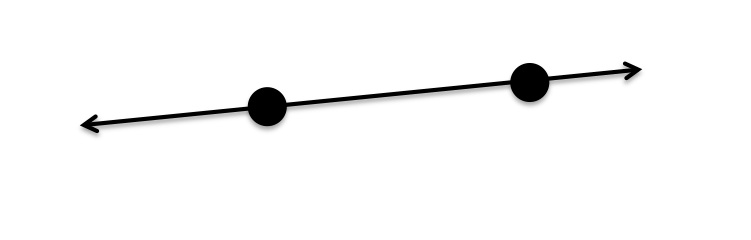 “Is that the only line you can make through these two points?”
I usually get a “Is my teacher crazy?” look at about this point.
“Well, yeah? I mean, two points make a line, right?”
“True. If it’s straight,” I say with a slight smile. “Try connecting them with something that isn’t linear.”
This is where I can tell who is willing to take risks. But they all manage to create some sort of nonlinear path through the two points.
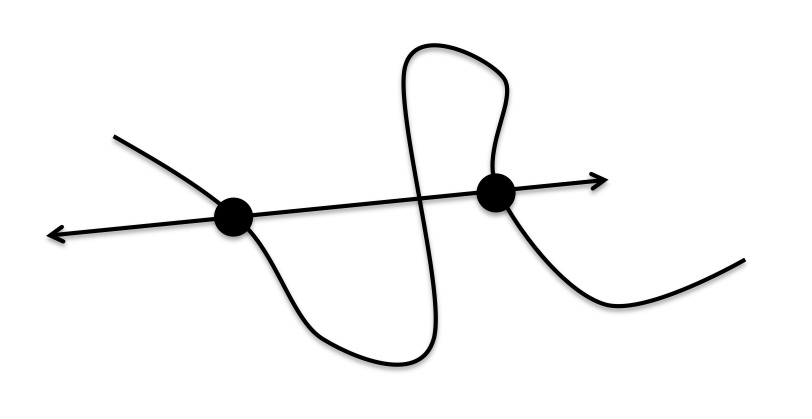 “Is that the only curve you can make that can connect these two points?” I continue.
“No. Do you want me to draw more? I mean, there are infinite ways!”
“No, it’s okay. I just want you to see that there are multiple paths to get from one of those points to the next.”
The shoulders relax as the brow rises, wondering about the point of this exercise.
“Almost done. I just have one more for you.”
 “Connect ALL of these points any way you want to.” If I do this after our lessons on scatter plots, it drives them crazy not to simply draw a line of best fit 🙂
Once they’ve completed the task, I bring the point home. Yes, pun intended.
“I want you to think of these points as events that happen in life. When you have a single point or event, it does not define your path. There were many routes you could take. When there were two points, there was only one way if you chose to see it that way. If you were more creative, you could find many more. But life doesn’t consist of just one or two events, even though certain ones may stand out more than others. Life is a series of events. And it is your choice how you move through them. Look at how you connected your points here on your last picture. You had to include the outliers, but it didn’t completely change the general shape of the graph.”
“I know you’ve had some stuff in your past that makes you feel like you’re stuck on a predetermined path. But you’re not. You had to walk through that point. That event or series of events. And now you decide what direction you go.”
“One event does not define you. YOU define you by the choices you make and the path you choose.”
Okay, class dismissed 🙂

Every year I have some kids who break my heart.
It happens as soon as I task them with completing some assignment and they whisper to me with down-turned eyes, “I’m not smart enough.”
And my heart breaks for the broken spirit of the child.
Because the truth is, there are very few kids that are truly not smart enough to understand the math I teach and those are never even in my class.
But I can see how some may conclude they are not smart enough. After all, they see some of their classmates tearing through assignments like a kid at Disney World. They hear others volunteer answers before they have even processed the question. They feel their struggle while they see others’ successes.
But the problem is not that they aren’t smart enough.
Maybe they are not skilled enough, having missed earlier important concepts.
Maybe they are not present enough, excessive absences interfering with their ability to comprehend the material.
Maybe they are not supported enough, missing out on the help needed at home or at school.
Maybe they are not focused enough, allowing in outside distractions that make it difficult to think clearly.
Maybe they are not disciplined enough, forgoing homework for the call of video games and not participating in the needed practice.
Maybe they are not understanding enough, ignorant of their own ways of learning and demonstrating knowledge.
Or maybe they are not confident enough, perceiving themselves as lacking in some fundamental way that is fixed and rigid.
None of those things have anything to do with smart.
And all of those things can be addressed.
And overcome.
To expose the smart kid that was there all along.
Hiding behind those limiting beliefs.
———-
With adults, I rarely hear, “I’m not smart enough.” Yet I often hear, “I’m not strong enough.”
And it breaks my heart to hear the broken spirit.
Because the truth is, there are very few adults that are truly not strong enough to overcome the challenges that fall into their path.
But I can see how some may conclude they are not strong enough. After all, they see others speak and write and sing about their own journey and the conquering of it. They see others reach the finish line of their trauma before they have even finished processing their own. And they feel their struggle while they see others’ successes.
But the problem is not that they aren’t strong enough.
Maybe they are not skilled enough, having missed earlier opportunities to practice struggle and the overcoming of it.
Maybe they are not present enough, not able to put the time into healing that it requires because of other demands.
Maybe they are not supported enough, lacking the buttressing effect of family, friends and professionals.
Maybe they are not focused enough, allowing in outside distractions that make it difficult to think clearly.
Maybe they are not disciplined enough, electing to avoid the pain rather than face it and move through it.
Maybe they are not understanding enough, unaware of their own needs and what tools are effective for them.
Or maybe they are not confident enough, judging themselves as broken and somehow less than others.
None of those things have anything to do with strong.
And all of those things can be addressed.
And overcome.
To expose the strong person that was there all along.
Hiding behind those limiting beliefs.
———-
In the classroom, I work to help figure out what needs each kid has and then we work together to discover what methods and tools best meet those needs. I act as a cheerleader when they’re discouraged and a butt-kicker when they’re trying to avoid. I reveal my own struggles to them and help them to see their own strengths. I give them opportunities to shine when the quick-to-get-it kids often falter and I praise the effort that moves them forward. I highlight their progress, comparing them to themselves rather than to anybody else.
We talk about how everybody has some things that come easy and some things that don’t. And how often those that struggle become the better for it. They laugh when I tell them that math was my worst subject and that I almost failed Algebra II. They laugh, and then they smile because it gives them hope.
In the adult world, I do much of the same. I help people figure out their own needs and what tools will best match those needs. I encourage when the spirit is down and kick some butt when it is dragging. I share my own struggles (and the struggles that others have made public) and I help them to see their own strength. I look for opportunities for them to shine when maybe the quick-to-heal folks still stumble. I highlight their progress, comparing them to their earlier version rather than to somebody else.
We talk about how some people seem to move through trauma easier than others due to a blessing of biology, support, environment or prior experience. And that some may have to struggle more to get there.
And that struggle can make you better.
I had one client that had a life relatively free of trauma until a big one that sent her to me. She knew that it was harder for her to deal with the situation than others because as she was processing the pain, she was also doing the hard work of identifying her own strengths, weaknesses, needs and tools of best fit.
And she appreciated that effort even as it wore at her.
“I know this won’t be the only thing I have to go through in my life. If I do it well, it will serve me going forward and if I don’t do it well, it will become the thing that holds me back.”
And she’s right.
At the beginning, she wasn’t strong enough to reach the summit.
But she was strong enough to take the first step.
And then the next.
And each step built her strength.
Her confidence.
Her resolve.
YOU are strong enough.
I see it.
I want you to see it too.
And you don’t have to do it alone. Learn more.
 Lessons From the End of a Marriage