And for my fellow introverts, here’s an open letter to share with the extroverts in your life.


My alarm trills. It’s a cruel imitation of a bird’s chirp welcoming a new day. Except it’s too early for the birds. Or for most humans, for that matter.
But still I get up. Just as I have most every morning for the past four months.
Not because I really want to.
But because I know that the benefits are worth the temporary discomfort.
After I swallowed the first mug of coffee, I strapped the pup into his weighted pack in preparation for our morning power walk, the reason for the early start. Like me, he’s groggy, yawning and stretching as I try to secure the clasps of the pack on his undulating body.
Our first few steps are a bit creaky as we shake off the remnants of sleep. But by the time we exit the cul-de-sac, we’ve hit our stride.
Even as I dread the shortened nights of sleep and the often-unfavorable weather, I’ve come to enjoy our morning exercise. This morning, we got to gaze at the full moon for much of the course. Other times, we get to see the neighborhood fox on a pre-dawn hunt or the deer grazing in someone’s yard until we surprise them with our arrival.


I listen to podcasts over our hour-long trek, but it’s mostly a time for me to think. Which at this time of the year, often means that I’m reflecting back on how the school year has gone, considering the lessons I’ve learned and the adjustments I want to make for next year.
Much of my consideration is directed towards my 6th graders, because in many ways, they have the biggest challenge and growth potential over the year. I think about the ones who’ve made it, who successfully navigated the unfamiliar trial of accelerated math. And I think about those that didn’t quite make the cut.
All of these kids have to demonstrate the ability just to be accepted into my class in the fall. So why are some able to overcome the challenge and others never quite find their stride?
As I turn a corner, I catch a whiff of a fire pit that must have hosted a fire the night before. I smile as I think back to a recent yoga class. Although I certainly wasn’t smiling during the class.
The instructor apparently had some sort of vendetta against quadriceps that day, as we seemed to spend the majority of the 75-minute class in some sort of squat or lunge posture.
And that’s the answer, isn’t it? The reason that some students make it and others don’t. The reason that some people return to hot yoga even with the anticipation of difficulty and others vow to never return.
The reason that some people make progress in their lives while others make excuses.
It always amazes me how often people who are looking for advice on how to get into shape, how to rejuvenate their finances, how to navigate a relationship or how to organize their homes know what they should be doing.
They don’t struggle with the know-how.
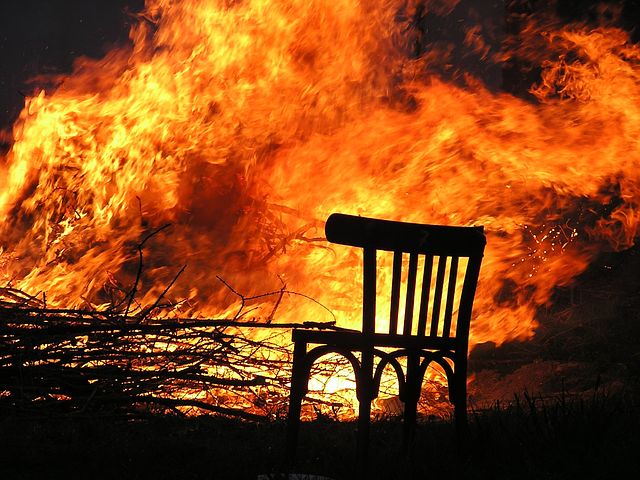
They falter when it comes to sitting in the fire. To do what they know needs to be done, even when the doing pretty much sucks.
The discipline to exchange temporary discomfort for some future benefit.
The commitment to staying on the path you want for yourself even when the terrain becomes difficult.
The courage to tackle something that may lead to failure.
The faith that the pain isn’t as bad as it feels and that it won’t last forever.
The gratitude that you’ve been given this opportunity to test yourself.
And, at least for me on my morning walks, it’s the knowledge that there’s another mug of coffee waiting for me when I get home.
When I left that difficult yoga class the other day, I immediately decided that the efforts were worth it. I was proud in my determination to persist even when child’s pose was calling to me. I felt energized by my perseverance and calmed because my inner critical voice had nothing to criticize.
My students are voicing similar sentiments as they look back at their year. They share how hard it’s been. Remember those moments where they wanted to give up and return to the safety and ease of an easier class. And then satisfaction and self-respect creeps into their countenance as they recount those periods of intense effort and the gains that were made from the achievements.
Kazh the pup has been able to celebrate as well. We’ve put him through the proverbial fire these past few months. We have high expectations for training and behavior and we’ve put lots of time and effort into teaching him how to be in our pack.
And it’s paid off. His first big even, a March of Dimes charity walk for babies, was this past Saturday. Here he is walking a trail filled with people, dogs and strollers without his leash. And he did awesome. It was amazing to watch his face as he settled into the day and into the expected behavior. He was confident. He was proud. He was accustomed to challenge and so he didn’t let it phase him.

You feel at peace with yourself because your values and actions are in alignment.
You gain confidence in your ability to overcome and persevere.
You become stronger with every fire you endure.
You feel honor for keeping your promise to yourself.
And you feel empowered by your ability to make it through.
When I finally pulled out of the driveway this morning to go to work, I was a little more tired than I would have been if I had spent that extra hour sleeping. But I was happier that I didn’t simply hit the snooze button.
Because although I have regretted making excuses, I have never once regretted sitting in the fire.

My school of the last five years is involved in a meiosis of sorts, splitting and dividing into two halves, each pulling some of its identity from the whole. Good schools become families, adults coming together with the shared goal of nurturing and launching children. The restructuring of a school is the break up of a family, with all of the associated heartache and opportunity. And it’s often a break up that nobody wants.
Last night, we celebrated the final day of the existence of the staff as a single entity before the last strands are cut today as we move into our new schools and our new roles.
And it was a wonderful celebration. Equal parts belly laughs and tears. Differences set aside in lieu of gratitude for shared experiences and the unique gifts that each person shared during their tenure.
Yes, it was sad. We traded stories about some of our most challenging – and rewarding – students, realizing as we shared that we may never again be in the company of others who participated in that same memory. We grew a little apprehensive, wondering how in the world we would ever build this kind of connection and camaraderie in our new schools. The task feels daunting, especially when compared to the already-built relationships. We poked fun at each other’s warts without causing distress because we all know it comes from a place of love and acceptence. And we wondered if our new family would be accepting as well.
It was sad. It is sad.
But it’s not only sad.
Last night was a rememberence and celebration of all that had been and the early excitement of what is to come. A perfect blend of memory and anticipation. An acknowledge of the end tempered with gratitude that it existed.
As I listened to two talented teachers lead a inside-joke filled presentation, I thought how wonderful it would be if we could always approach life’s endings in this way.
With equal parts belly laughs and tears.
If there has to be an ending, why not make it a good one?

It’s not just seasons changing in these parts.
The school where I’ve worked for the past five years has become swollen. Overripe and bursting with more kids than the building was designed to hold. And so it’s being cleaved and the excess is being funneled into a new school, opening next fall.
My first reaction when confronted with the reality was that I wanted everything to remain the same.
Because change is hard.
And it’s so much easier to just keep on keeping on.
But that’s not always (or even often) a choice.
So when decision time came, I elected to transfer allegiance to the new school.
And between the additional meetings, the multitude of unknowns, the additional curriculum burdens and the physical sorting and packing, it has not always been easy.
But change never is.
Here are some strategies that I’m using now that help to make this change a little easier:
Accept Change As Inevitable
Even when things stay the course, the course changes, as do the people on it. Some change is obvious, the sudden endings and the hard right turns of life. And other change, most change, is more subtle and slow. The fraction of a millimeter added to a child’s height. The replacement of tall grasses with short trees that eventually grow to shade out the growth below.
When the abrupt changes occur, we often resist, digging our heels in and skidding through the turn as though we can alter reality through an act of sheer stubbornness.
We may as well push down on our children’s heads in an attempt to halt their growth.
Change is normal.
Change is unavoidable.
We may as well get used to it.
Frame Change As an Adventure
How exciting! You get to try something new!
Not feeling it yet? Keep practicing. Watch your words. Rather than speaking negatively about your situation, work to frame it as an adventure. An experience. Yes, there will be trials and tribulations. That’s part of what makes it more exhilarating. Aren’t you lucky to have this opportunity for excitement!
Part of the adventure mindset is to view setbacks as problems to be solved rather than roadblocks in your way. Be creative. Be flexible. And remember to have some fun along the way.
Control What You Can
We all feel better when we have the impression that we are in control of our lives. Unfortunately, life does not always agree. When you’re faced with unwanted change, it’s easy to fall into a victim mindset, taking the approach that all of this is happening to you and that there’s nothing you can do.
It’s true you cannot stop the change. But it’s also true that you’re not completely helpless either. In the midst of upheaval, control what you can, no matter how small or seemingly inconsequential. Simply recognizing that you have choice and acting upon those choices will go a long way to alleviating the fear and frustration that accompanies change.
What If It Is Your Circus and They Are Your Monkeys?
Create a “Worth It Because…” List
If you have chosen this change, you probably already have some idea of how it may benefit you down the road. If this change was thrust upon you, you’re probably drawing a blank as to the potential positives of the unwanted life renovation.
So figure them out. Step outside yourself and brainstorm some of the current and future reasons that this change is/will be worth it. You don’t have to like or agree with the change to uncover some of the positives. Some of these positive side effects may not be automatic. So put in the effort to make them happen.
Piggyback On Your Change
You know that thing you’ve always intended to do but never quite got around to it? Now’s the time. You know that bucket list that has been collecting dust? Brush it off.
Change provides opportunities for more change. It’s harder to come up with excuses to avoid something new when new and different are everywhere you look. View this as a window of opportunity for you to bring to life some of the changes you have dreamt about.
—–
As for me, I am super excited about my upcoming change. It will push me. It will challenge me. Some days it will probably bring tears when overwhelm hits, but I’m confident that the effort will pay dividends. I’m thrilled to be part of building something new.

We’ve all seen the statistics –
A high school drop out earns less money and is more likely to be unemployed.
A high school dropout is more likely to commit crimes and spend time in prison.
A high school dropout has lower physical and mental health.
So we place a great emphasis as a society on encouraging our children to persevere and make it through 12th grade. We tell them it’s worth it. We offer encouragement and celebration when they’re on track and motivation and consequences when they’re not.
Because the lessons learned in school are important. And the consequences of not learning them can be dire.

And then once the diploma is in hand (either high school or higher education), we back off. As though the learning is done.
When in reality, it’s really just beginning.
It starts young and you don’t graduate until your bell rings, hopefully a long, long, long time from now.
Whether you learn the lessons or not.

And life’s lessons are way more important than the quadratic formula or who led the final battle of the Civil War. The consequences of not learning life’s lessons are even more profound.
How do you stop from being a dropout in the school of life?
Take some cues from the characteristics of those that successfully graduate from high school:
Successful students know that they have to be present to learn. They make an effort to be there most days and they understand that a body in the seat while the mind is elsewhere is a waste of time. When they are sick, they allow themselves time to rest but they also understand that time away requires extra effort upon return.
Students of life understand that they need to be fully present and engaged. They don’t hide behind their phones or under the covers for days on end. They don’t call in sick every time there is a difficult task. They take time outs when needed, but don’t leave life on “pause” for any length of time.
Students are constantly presented with material that they cannot yet do. And the successful ones have faith that with enough time, effort and assistance, they will make progress and master the lesson. Before a student can walk across the stage, they have to believe that they can walk across the stage.
Life is the hardest teacher – the tests often come first, showing us what we don’t yet know. And it can be easy to become defeated. To give up. To drop out. It’s okay if you don’t learn it the first time through. There’s a reason summer school exists. You don’t have to be able to do it all at once. Just believe that by tackling increasingly bigger challenges, you’ll get to walk across that stage.

High school graduates are not afraid to ask for help. They’ll go to the guidance counselor for assistance with home issues. They seek out the graduation coach for hep preparing for the SAT. They show up at morning help sessions, ask the media center clerk how to locate information and talk to their coach about how to improve their high jump.
As adults, we don’t have all of that assistance under one roof, but it’s still there for the taking (okay, usually paying!). Students of the school of life acknowledge that sometimes they need support from outside. And they don’t hesitate to ask for a hall pass to the counselor.
In class, strong students are not afraid to get their hands dirty. They are active participants in lecture and small group work. If they didn’t study for a test, they don’t ask surprised when they receive a failing. And they never try to blame the teacher for that F. Graduates accept responsibility for their own learning, starting with the effort they expend.
Life is not a spectator sport. You don’t learn about life only by watching others navigate through its obstacles. Life’s scholars don’t expect others to do the work for them or to sweep in and save them. Those who make As in life put in the effort and take the responsibility for their own happiness and well being.

Graduates are never without an eraser. They know that mistakes are inevitable and are nothing to be ashamed of. Instead of cursing their errors, they embrace them, understanding that the best learning often comes through mistakes. Furthermore, they are willing to start over. And over. Until they get it right.
Mistakes are a sign that you’re learning. Starting over means that you’re applying the lessons. Students of life don’t waste time wallowing in guilt or “shoulds.” Instead, they analyze the mistake, make adjustments and try again. And again.
Every student who has graduated high school has endured a bad class or a bad teacher. They have faced people who single them out, they have dealt with unfair situations and they felt beaten down. The dropouts let that bad moment spread, a ripple effect that influences areas that previously were okay. The graduates understand that bad classes happen. And schedules change.
Life isn’t arranged in classes, but hard terms most definitely exist. Often they’re not fair. Sometimes they are so bad that they threaten to spread into every corner of our existence. Life’s successful students work to find comfort in the belief that hard times don’t last. That fairness isn’t promised on the syllabus. And that a bad week, or month or year does not make a bad life.

Ask any high school graduate and they can name at least one adult in their lives that they look up to. They seek out and observe mentors, people further along the same path that they envision themselves on. They ask. They listen. They learn.
Successful lifers also have mentors, people they emulate and admire. They release the ego that says, “You’ve already learned everything” and they are open to discovering something new.
Those who stay the course through school are able to see the bigger picture. They understand how the little steps add up to a bigger outcome. They may grumble about the often-infuriating details that can interfere with progress, but they accept that sometimes they just have to play the game and jump through the hoops.
In life, successful students also accept that there are some things that they have to do even when they really, really don’t want to. They are able to step back and see how those details, even when pointless, fit into the bigger picture. And they’ll put their head down and make it happen.

Learning gets messy. It gets arduous. It gets downright frustrating sometimes. High school graduates may have moments where they ball up the paper and throw it across the room in exasperation. But after their tantrum, they keep going.
Lifelong learners develop a tolerance for frustration. They feel it and then they let it pass. They learn how to mitigate its effects and how to ignore its squeal. Successful students have grit. True grit.
Very few of those high school students who walk across the stage have nobody cheering them on. Successful students understand the importance of friendships and they prioritize creating and nurturing those relationships. They also recognize that no one friend will fit every need and they work to diversify their friend portfolio.
It may be harder to make and keep friends outside of high school, but it’s no less important. Life is so much better and richer with others by your side. They offer support, reality checks and a laugh when you need it most. Bonus points for slumber parties:)
 Lessons From the End of a Marriage