What We Gain From Reading Fiction

Its a “snow day” in the ATL today. That means that the temperatures may dip below freezing and the cold rain may solidify into ice or snow. In an an abundance of caution (and probably a fear of a cluster this close to the Super Bowl), the local schools have all decided to implement Online Learning Days.

Since my internal alarm clock still woke me up at 4:00 am and my students will likely not begin their online assignments until later this evening, I’ve been granted the much-needed gift of some unexpected time this morning.

I walked the dogs, wrote some quizzes, did my taxes and went to the gym. But my inbox for work was still silent. So I picked up my Kindle, took a trip to the virtual library and spent the last few hours reading a fictional narrative.

The writing was unremarkable. The characters somewhat unlikable. And the story was somehow confusing and tedious at the same time. (I guess that the library gets runs on ebooks just like the grocery store runs out of milk and eggs during a storm).

But even though the book wasn’t great, the experience was. Because reading fiction has benefits that we often fail to recognize.

Fiction Allows for Distance and Distraction

When we’re sad or anxious or just generally unhappy with our current circumstances, it’s natural to seek escape. Some escapes are certainly healthier and more effective than others.

Surrendering your mind to a story is a wonderful way to give it some rest from whatever is troubling it. Because books demand our attention, they are often more immersive than video or other more passive means of mental escape.

Books allow a free (or cheap) vacation with no packing, no preparation and no TSA lines. The trip away can occupy you for a few minutes or several hours. And as with any holiday, you often find yourself restored upon your return to normal life.

Fiction Provides a New Perspective

Most of us live a relatively homogenous life. We live near people that are like us. Then, we go to work alongside those with similar values and goals. On the weekends, we watch the same shows and visit the same shops. So even when we talk to others, it can sometimes feel as though we’re conversing with a reflection.

Fiction provides a break from the monotony and offers the gift of novelty and a fresh set of eyes. You get to experience what Earth is like from Mars or what it’s like to be a strapping man if you’re a diminutive woman. You’re able to experience new worlds, myriad narrators and countless motivations and backstories.

Once the book is set down, the experience of a different perspective often stays with you, allowing you to be more flexible and open in how you perceive things.

Fiction Encourages Empathy

At the start of this school year, we used a study of the book, Wonder, to anchor our social and emotional wellness lessons. My 6th graders still struggle to identify and analyze their own responses to situations, but they could easily put themselves in Auggie’s shoes and discuss how he might be feeling.

Because so much fiction is written from a first-person perspective, it truly gives us the opportunity to occupy the shoes – and thoughts – of somebody else. It’s much harder to judge somebody’s actions when you’re also privy to their internal world.

When you read a lot of fiction, it primes your brain to ask questions about people you encounter in the world before you jump to conclusions about what is behind their actions.

Fiction Subtly Inspires

So many “self-help” style books can come across as critical and preachy. They have a way of declaring that you’re doing it all wrong while the one doling out advice has advantages that the rest of us mere mortals can only dream of. That tone can be a turn-off as the advice falls on deaf ears and the inspiration rings flat.

Fiction is different. Instead of whopping you upside the head with some positive and trite message, it slowly and surreptitiously makes it way into your consciousness. As a result, you don’t rally your defenses. And you just might close the book feeling inspired by the messages woven explicitly throughout the text or the whispered encouragement from the character’s actions.

Fiction Ignites Curiosity

I’ve long held the belief that we should all strive to respond to the world with more curiosity and kindness. Narratives are crafted to make us ask questions. We are driven to turn the page by a desire to know what will happen next. Perhaps we form a conclusion before it’s revealed, but we always hold the door open to possibly being wrong.

Fiction creates wonder. It prompts us to ask, “What if?” Books may take the form of boxes, but they are limitless in their reach once they’re opened.


Fiction Speaks of Broad Stroke Truths

When I was going through my divorce, I read lots of fiction. Lots of dumb fiction since my brain was still sputtering. Yet even though the selections were far from literary masterpieces, the basic storylines all spoke of life truths for all – love, loss, transformation, redemption and overcoming obstacles.

It doesn’t matter if the story is about werewolves or Civil War soldiers, these broad stroke truths are the heart of every tale because they’re the heart of every life. And sometimes it’s good to reminded of that. That no matter the setting, we’re not alone in our experiences.

Are you aware of the power in YOUR story?

The Most Important Lessons From My Divorce

Often the lessons we need most are the ones we are most resistant to. I never wanted to be divorced. In fact, losing my husband, through any means, was my greatest fear in life. So, when I found myself suddenly facing divorce at the age of 32 after being betrayed by my best friend and partner of 16 years, I was lost.

The best lessons can often be found when we are facing unanticipated change and loss. It is a window where we are lost and searching, broken and vulnerable, wanting and open. It is a time when the ego has been forcefully stripped away and we are able to face those challenging lessons that we may usually avoid. In those moments, we learn who we really are and what we are capable of.

The following are some of the lessons I learned on the heels of my divorce:

1) When Gratitude is Your Wrapping Paper, Everything is a Gift

You cannot always change your circumstances, but you can always change your attitude. I wasted time after the divorce being angry and playing victim. Slowly, ever so slowly, I began to soften and to look at the bigger picture. The divorce and its associated trauma happened; I could not alter that reality. I could, however, choose to change my reaction. I have begun to practice radical gratitude – being thankful for the man who deceived and abandoned me. I began by writing a list of ten reasons I am thankful for him and I continue to write a note of gratitude every time I make a payment on the debt he left behind. The situation hasn’t changed, but I now can view my divorce as a springboard for better things.

2) Happiness is Your Choice

I used to tell my husband, “You make me happy.” I meant those words as a compliment, an endearment. I wanted him to know how much he meant to me. When he left, I realized that if he truly made me happy, then he also took my potential well being out the door with him. I also began to see the unfair burden I placed on him by making him the keeper of my happiness. That was not fair to him or to me. I have learned to take responsibility for my own happiness. I can choose to be happy with or happy in spite of. Regardless, it is my responsibility.

3) The Past Doesn’t Stay Buried

My ex husband came from an alcoholic family. He denounced their dynamics and always said that his biggest fear was turning into his father. I took his word for it; I thought he was safe from their destructive patterns since he was aware of them and wanted to make different choices. I underestimated the power of the past. If there is one thing that alcoholic families excel at, it’s keeping secrets. Apparently those lessons of silence and secrets were too embedded for him to overcome. The skill set was just waiting in the wings until the right moment came along. When he began to struggle during our marriage (with money, alcohol, depression, employment…who knows?), his reflexes kicked in and he covered it up. The past is like a vampire – if you try to defeat it solely by burying it, it will come back to bite you.

4) “Knew” is Not the Same as “Know”

I met my husband when I was just 15. I knew his family. I knew everything from the name of his elementary school to his biggest fears and wishes in life. I thought I knew him. I could describe every little nuance of my husband with the utmost confidence. It was misplaced confidence. I didn’t realize that the man I knew was no longer the man in front of me. We are all fluid, changing with age and environment. Getting to know someone never ends.

5) Work Avoidance Goes Both Ways

I have always had a tendency to work. A lot. I always saw that as a positive trait, an asset. It was only more recently that I realized that my drive to work was often out of a fear of what I would see if I slowed down. The divorce acted like a highlighter in my life, illuminating areas that I used to avoid through work. I learned to slow down and to trust in my ability to face the present. I now breathe through discomfort rather than try to hide from it.

6) The Body Often Knows More Than the Mind

For the last couple years of my marriage, I seemed to catch every cold that came through the school where I worked. I had trouble sleeping, often waking in the middle of the night. I sensed a tension coursing through my body – a low level yet ever-present anxiety. Since there were no outward signs of discord in my marriage, I assumed the tension was due to a difficult time at work. I was shocked to realize, after I recovered from the initial trauma of the abandonment, that my body was more relaxed than it had been in years. I now listen to my body’s messages even when they seem unfounded.

7) Wellness is Not Measured in Hours at the Gym

I used to think I was well. I ate a healthy diet, exercised daily and even managed to do a little yoga once in a while. I used to think I was well, but I wasn’t. After the divorce, I had to rebuild my health and this time, I had a much more holistic and balanced approach. I became a math teacher after struggling with the material myself as a child. I was drawn to wellness coaching for a similar reason. It allows me to utilize my teaching skills along with what I have learned about wellness from a balanced standpoint after my own journey.

8) There is a Difference Between Trust and Complacency

My ex husband gained my trust over many years. He held his word and voiced his thoughts. I trusted him completely. I trusted him so much that I became complacent. I assumed the trust would remain and that he would continue to be honest and faithful. I assumed wrong. I have learned to trust again (through the help of my dog!) but I will never again become complacent. My eyes now remain wide open.

9) Life is Not a Waiting Room

I used to be an expert at delaying life. I would prioritize work and promise myself a break in some imagined future. I would squirrel away money, imaging it being saved for some mythical future. When the divorce washed away my life in one destructive wave, I realized that I was waiting rather than living. I still work hard and I’m still frugal natured, but I no longer put life off for the future.

10) Holding is Out of Love; Clinging is Out of Fear

I never would have described myself as clingy with my ex – I was independent (often too much so), not jealous, and was frequently apart from him for long periods while he traveled. It was only afterwards that I saw the tension inherent in clinging and the motivations behind it in a way that echoed familiar. With clinging, you are desperately attached to an outcome, grasping out of fear. Yeah, I get that one. I was clinging in a way and it was holding me still, static, unable to move. I now have healthy desires and passions which encourage investment in the now and the goal, but not in the outcomes that are out of my control. I realize that this describes my current relationship. I am so much more relaxed about the “outcome.” Facing my fears has had a way of diminishing them. I am no less committed to the current relationship, no less in love. But it feels different. I’m not grasping. I’m holding.

With some of these lessons, I am now doing master’s level work. With others, I am repeating the introductory course. Either way, it is okay. The point is not to make an “A,” rather the intention is to be open to new lessons and to persevere through even the most difficult tutorials. I just hope I don’t have to endure such a harsh teacher again!


Are You Writing Your To-Be List?

I would wager that barely a day goes by where you are not at least partially driven by a to-do list. Whether scribbled on a slip of paper, stored neatly in your phone’s database or merely a memorized inventory of all that you need to accomplish, you move from one task to another. As you cross each item off the list – laundry, gym, phone call to the bank – you feel a sense of accomplishment. But all too often, that feeling of achievement is short-lived as you look back down at the ever-growing list of tasks that need attending.


To-do lists are important. They keep us organized and productive. They help to maximize our time and ensure that necessary items are addressed.


To-do lists are important.


But they are not everything.


Because we are so much more than simply the tasks we accomplish. Our value is found more in who we are than in how much we can cross off in a day.


I used to be the self-appointed queen of the to-do list. I had them at work. I had them for home. I even had them for down time. I would hurry through each task so that I could cross it off and start the next. I got quite a bit accomplished in those years. But at quite a cost.


As I was busy with my to-do lists, I neglected the most important matters in life.


I forgot to be.


I was merely hopping from one duty to another without much time to pause or even be present with the task at hand. My body would be engaged in one chore while my mind would be planning the next. I would run myself ragged until at some point, I would simply collapse from exhaustion. It was no way to live.


It took quite a wake-up call to pull me away from the security of my to-do lists – a 16-year marriage that ended with a cold and callous text message. When those few words appeared on my phone’s LCD display, I lost everything that held meaning in my life.


Including the to-do lists. It no longer seemed important to make sure that all of the test papers were graded by the next day. It was no longer critical to wash dishes as soon as they were sullied and a coffee date with a friend took precedence over getting the laundry done.


My priorities shifted from getting through to building relationships and appreciating the moment. I learned to balance the need to “do” with the experience of being.


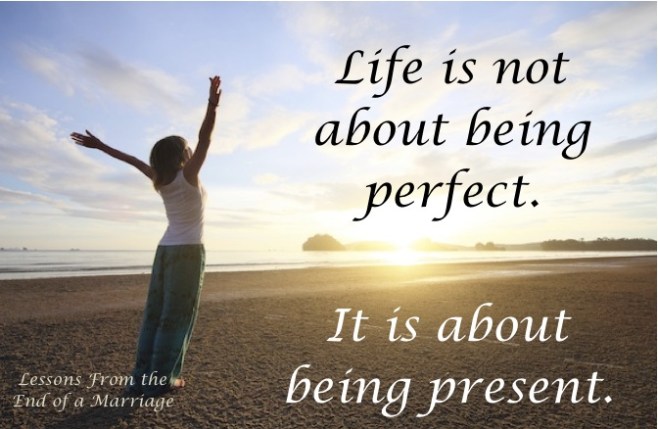
Being present.


Being patient.


Being grateful.


Being peaceful.


Being joyous.


Being loving and being loved.


Being mindful and in the moment.


I crafted a “to-be” list and posted it next to my computer – a reminder of what is truly important in life. It’s a different type of list; the items are never meant to be crossed off and completed. And as long as I accomplish what is listed on my to-be list, it is a good day. Even if there are still dishes in the sink.

presentlife.jpg


When Gratitude is Your Wrapping Paper

gratitude

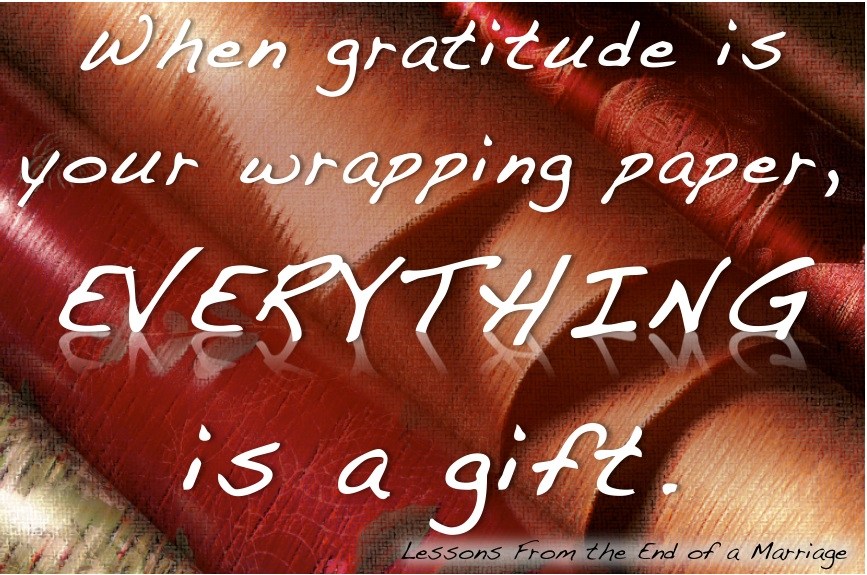
When gratitude is your wrapping paper, everything is a gift.


If someone had told me ten years ago that I would ever be grateful for my tsunami divorce, I would have thought they were ignorant. Or cruel. Or, at the very least, utterly clueless and insensitive.


But, you what?


They would have been right.


My divorce was a doozy: 16 years of what-I-thought-was wedded bliss suddenly amputated with a single text message. This was followed by the discovery of marital fraud and felony bigamy. In one instant, the life I had was gone and it was stolen by the man who had lovingly kissed me goodnight for my entire adult life.


Needless to say, I was angry. Confused. Heartbroken. As the months carried into the first anniversary and beyond, it was difficult not to remain painfully focused on what I had lost. I was actively building a new life and was joyous in it, yet I drew a hard line that kept that same gratification from touching my past.


And that strategy worked for a time, as long as my past knew its proper place. But it never stayed put in the history books for long. Letters would arrive about new debts that I had to somehow pay, triggers would pounce from the most innocuous of events and fears of trusting again became apparent in my new relationship.


It became clear that ordering my past to simply sit and stay like an obedient dog wasn’t an effective approach.


So I did something radical.


I was inspired by the gratitude lists that circulate social media every fall. I love those lists. I enjoy reading how people are thankful for their families, their jobs and their health. I smile when I see their pictures of cooing babies or mischievous puppies. I appreciate the renewed energy that spills from accounting one’s blessings.

Those lists are beautiful.

Heart warming,

But I also think they’re a cop-out.

It’s easy to be thankful for the good things in your life. It’s easy to summon gratitude for the people and situations that bring us joy.

Don’t get me wrong; it’s valuable to take the time to enumerate those things you appreciate.

But it’s even more valuable to find reasons to be thankful for those things that bring us pain or grief or anger.


When gratitude is your wrapping paper, everything is a gift.


Much like an oyster encapsulates an irritating bit of sand with glorious mother of pearl, you can choose to envelop the torments in your life with thankfulness.


And so that’s what I did. Every time I wrote a check to pay for the hidden debts that were left in my lap, I wrote a reason I was grateful for the opportunity. I composed a list of reasons I was thankful for my ex, effectively muffling the pain. I taught myself to recognize the negative emotions and, rather than try to stuff them down or ride them out, I actively wrapped them in gratitude.


And it turns out that gratitude was the key to releasing me from the prison of my past. It happened. It altered me. But it does not control me. You cannot always change your circumstances, but you can always change your response. Gratitude is a choice you can always make.


So, I leave you with a challenge that can turn your greatest sufferings into your greatest gifts.


But it won’t be easy.

I call it radical gratitude for a reason.
Radical because it’s intense.
 Difficult.
 Almost unthinkable.
 But also because it has the chance of being life changing.

Identify the one person or thing or situation in your life that has caused you the most grief. The most pain. The most anger.

Find that dark hole that bleeds you.

That curse.

Maybe it’s an ex. Or an abusive parent. Perhaps it’s your job or lack thereof. Possibly, you face an illness that has stripped your body or had an accident that stole your health in one fell swoop. Maybe it’s not the presence of a person, but the loss of one.

Whatever it is, identify it.

And then be grateful for it. Create a list of ten reasons that you are thankful for your biggest challenge.

You can share it – here or elsewhere – or you can keep it to yourself.

But write it. Believe in it. And then release it.

When gratitude is your wrapping paper, everything is a gift.


wrapping-paper


Six Ways That Dogs Help Us Heal

In so many ways, every dog is a therapy dog.


1 – Dogs Are a Reflection of Our Energetic State

Watch a dog for any length of time and you will learn things about their human companions. Dogs reflect our inner emotional and energetic state. They become a mirror, often giving us a glimpse into ourselves that we struggle to see otherwise.

In order to have a calm and happy dog, you have to learn how to moderate your emotional state and manage your anxieties. They become a living form of biofeedback. As your breathing rate slows and your thoughts become centered, your dog soon settles and becomes ready to listen.

One of my favorite quotes from Cesar Millan (the Dog Whisperer” is, “Dogs tell the truth. People tell a story.” And isn’t that the truth. We claim to fine. But our dogs often reveal otherwise.  We would be well-served by listening.

girl-1160441__480


2 – Dogs Give Us Unbridled Love

There is nothing like being greeted by a dog when you come home. That open mouth that seems to show pure delight. The wagging tail that carries the enthusiasm through the entire body, too big to be contained. And the immediate request for affection and bonding. They don’t care that you screwed up at work or that you accidentally put on two different socks that morning. Dogs default to acceptance rather than criticism. Which is often a welcome change from the rest of the world.

When you’re sad around a dog, you’re never sad alone. They seem to know when we need a snuggle and they’re not afraid of a few tears. No matter how much we worry that we’re not enough, that we’re unlovable or that we’re not a good person, our dogs help to remind us otherwise. Their love is not contingent on anything other than being a part of their pack.

dog-1149964__480 (1)


3 – Dogs Force Us to Step Outside

I can’t tell you how many mornings I step outside into rather unpleasant weather and I’m tempted to give up on my daily pre-work walk. And then I look down at Kazh, whose tail is already wagging in anticipation of the outing despite the weather, and I obligingly lace up my shoes.

Dogs inspire us to step outside – both literally and metaphorically – when we’d often rather hide within ourselves. Their cold, insistent nose nudges us, reminding us that there is life to live and adventures to be had.

They remind us that exercise is important. With their “live in the moment” mindset, they help us to see even the most mundane act as part of a glorious adventure. On walks, they insist on stopping to smell pee upon the roses, a reminder that the journey is as important as the destination.

pug-690566__480


4 – Dogs Encourage Interaction With Others

When I run alone, I rarely talk to people. When I run with a dog, I rarely return home without meeting someone new. Dogs are not only social creatures, they are social lubricant. They force us to interact with others even when we’re in a hibernation and isolation mood.  Not only do they encourage interaction, they encourage positive interaction. It’s hard to be grumpy or judgmental when you’re petting a new dog.

We are also social creatures. Our mental health improves when we are around others. We thrive when have established human – and animal – connections. Dogs help to nurture these relationships when we’re struggling to do on our own.

pit-bull-2047469__480

5 – Dogs Help Us Build Confidence

I love teaching children how to walk my pit bull. At first, they’re hesitant. After all, this is a dog that greatly overpowers them on a physical level. And then I explain how the dog responds to confidence. Walk with your head up. Your shoulders back. Stride with purpose and conviction. The dog will listen if you believe in what you’re doing.

Dogs are experts at sniffing out insecurities. If you’re not sure, they have no reason to pay any attention to what you’re asking them to do. But once you learn to believe in yourself? That dog will do anything you ask. And that’s a great motivator to begin to trust yourself.

fuca-2491995__480.jpg

6 – Dogs Teach Us the Importance of Boundaries

Have you ever entered a home that is ruled by the dog? It tends to be pretty chaotic. Like humans, dogs will try to get away with whatever they can. They will test your boundaries.

Many people struggle with setting and maintaining boundaries. They’re concerned about being liked or being perceived as easy to get along with. And so they let others get away with too much. It’s hard to set boundaries with people. They push back, often painfully, by picking at our biggest fears.

Dogs offer up a wonderful training ground to learn how to set and maintain boundaries. They still test us, but we are much less likely to take it personally when a dog tries to sneak up on the couch than when an addict claims, “You’d help me if you loved me.” Our dogs help us learn how to use boundaries. It’s then up to us to use them with humans.


This post is dedicated to the dogs of lives.