
How We Handle Failure

As I was reacquainting myself with my students last week (yes, we start school WAY too early in the south!), I reminded them of my belief that the math they will learn in my class is important. But the lessons in learning how to handle frustration and failure are even more important. Because, let’s face it, many of these kids may never have to solve a quadratic equation as an adult or explain why an exponential function has an asymptote, but they will certainly face failure. Probably many times.

images-53.jpeg

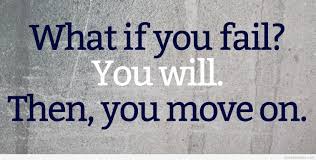
And I’ve to realize how important learning how to handle failure really is. In fact, I would go so far as to say that it is one of the primary forces that shapes who we become. The good news? Even if we have a had a subpar response to defeat in the past, with practice and the right mindset, we can learn to improve our relationship with failure.
images-52.jpeg

Five Negative Responses to Failure

Giving Up

I think all of us have released the words, “I give up!” in frustration when the fifteenth attempt at something still neglects to result in the desired outcome. It’s easy to become fatigued and weary, especially once the thinking brain has expended all of its energy and allows emotions to take the helm.

Internalizing the Message

“I suck,” we mutter to ourselves, confusing the line the action with the person, believing that we ARE a failure instead of a being that failed at something. This response is often ingrained in childhood when perfection (or at least the illusion of it) is expected of you from the adults in your life. You equate failure with rejection.

Avoiding Risk

If you don’t try, you cannot fail. Some respond to failure by refusing to take risk, preferring to practice the perfect and staying safely on known ground. This choice is rationalized as prudent, even wise. Yet the decision is made out of a fear of failure rather than a careful weighing of the potential risks and rewards.

Lashing Out

Some get angry when facing failure, attempting to cover the discomfort and vulnerability inherent in defeat with a veneer of hostility. “It’s not me, it’s you!” the response insists, hoping that by keeping people on the defensive, the failure will be overlooked.

Hiding the Evidence

This response is another that develops when failure is not accepted. When the inevitable happens, it is seen as shameful. And what do we do with that which shames us? We bury it.
images-8.png

Five Positive Responses to Failure

Accepting the Inevitability

Perfection is an illusion. There is no creature on this earth that succeeds in everything it tries. The newborn foal stumbles and falls before it learns how to walk on its shaky and spindly legs. The tree fails to root down deeply enough into the dense soil and almost topples during a storm.

And we are no different. Failure is as much a part of life as breathing. By accepting that, we can remove some of the emotion often associated with it. Rather than being shameful or a sign of weakness, failure is a sign of life.

Viewing Failure as Information

When I was preparing my classroom for the new school year, I had to adjust the legs on several of the student chairs. I glanced at the screws holding the legs together and estimated the proper size of screwdriver needed. On my first attempt, I managed to almost completely strip the screw while failing to loosen it enough to adjust the leg. That failure provided me with information – the screwdriver was the wrong size.

Once we have information, we are able to make adjustments and try a new approach. Without failure, we would never know what modifications are beneficial. Failure is a part of evolution; it steers us towards what works.

Taking Responsibility Within Locus of Control

Those that know how to use failure to their benefit are quick to own their failures, but only the ones within their control. There are two important facets to this response. The first is that once we claim responsibility for something, we give ourselves the power to change it. Secondly, by only accepting responsibility for things within our influence, we refrain from wasting energy trying to change things that we do not have dominion over.

It can be scary to admit that you failed. We don’t want others to see us as weak, as flawed. Yet by taking ownership, you remove the opportunity for others to use your failures against you. And the reality is that much of the time, people respect those that immediately and completely admit their failings as long as they are also making an honest attempt to learn from those defeats.

Reminder to be Open to Learning

Do professional athletes ever outgrow their need for a coach?

Nope.

Yet all too often, we become so comfortable (okay, cocky) within our own areas of expertise that we forget that we should still be learning.

And failure is happy to give us that reminder that there is always room for growth. For improvement. Failure equals humility and humility keeps us open and pliable.

See Failure as Opportunity

And this is what it comes down to.

Every failure is an opportunity.

A chance to try again.

Only now with more experience and knowledge of what doesn’t work.

Every failure is an opportunity.

A change to do better. To respond differently.

Without failure, there is no learning. No growing.

When we see failure as something to avoid, we are robbing ourselves of the opportunity to become the best version of ourselves.

And when we are able to become comfortable with failure, we are able to use it to take the next step. And then the next.

We will stumble. We will fall.

But as long as we get back up, learn from what didn’t work and keep trying?

Well, there’s no stopping us.

images-51.jpeg

Putting the Lessons Into Play

My husband discussed some hard stuff with me the other day. I’m proud of him for his self-awareness and courage and I’m also proud of me. Because my response, both in moment and in the days after, truly reveals how much I’ve grown since my first marriage.


I didn’t overreact, so I could be a safe place for him.

In my first marriage, I would have overreacted to something similar. I would have instantly gone to defcon 1 with my fears leading the charge. And my reaction would have been the furthest thing from a safe space. In fact, it would have announced, “I can’t handle this, so you need to protect me from it.” Ugh.

A few years ago, my insides probably would have thrown a panic party while I worked to maintain a calm exterior. An improvement, for sure, but still not ideal.

But now? I not only responded in a calm manner. I felt calm. I didn’t try to catastrophize or worry about what could, maybe, possibly happen. I just listened. Instead of being in my own fear, I could be with him.


I feel more compassion instead of a need for perfection.

In my first marriage, I was afraid of any potential blemishes. They were threatening, something to be feared. And so I felt a sense of disgust at any sign of imperfection in myself and in my first husband. Of course, since neither one of us could uphold this charge, there was a constant low-lying tension between my expectations and reality.

It’s different now. Which is especially good since my now-husband and I have officially reached the age of mammograms and colonoscopies. It’s hard to maintain that veneer of perfection when a nurse half your age is squishing your boobs against a metal plate.

I have so much more tolerance – and compassion – for the struggles that we all have. I no longer see the struggle as a sign of weakness and I enthusiastically celebrate the courage and discipline evident in those that don’t shy away from their particular battles.


My boundaries are both more forgiving and more robust.

Before, I expected perfection but would put up with a lot as long as I didn’t have to look too closely.

Now, my boundaries are set further back. They allow for mistakes and the opportunity to  be human and messy. But at the same time, they are less tolerant of bullshit and will no longer be consoled with pleasing words that are spoken in place of action.


I have confirmation that I chose MUCH better this time around.

We are not defined by how we handle the easy times. Instead, character is truly revealed in how someone handles the hard stuff.

My first husband’s response to struggle was to hide, lie and act out of shame. After experiencing the brutal conclusion of that approach, I intentionally sought out someone with courage who’s default setting is in revealing rather than concealing.


Yet again, I’m filled with gratitude for what I endured ten years ago. It may have been a conflagration, but it was one that prepared me for the growth that needed to happen.


Forgiving Yourself

I’ve done some dumb things. 

Some things I’m not proud of.

And some that I’m embarrassed about.


I’ve made bad decisions.

Followed by worse ones.

And held tightly to some bad assumptions.


I’ve inadvertently hurt those I’ve loved.

Made others feel badly.

And neglected to own up to my faults.


I could get mad at my former iterations; berate myself for my shortcomings and mistakes. Goodness knows, I did plenty of that when I learned that my ex husband had me completely fooled.


Or, I could see those earlier versions of myself as steps along the way, focusing on making minor adjustments based on previous experiences.


ebcfb434ff1a5351c2fa7c47cc38469e


We had dinner with an old friend the other night. He went through a bad breakup – after a bad relationship – several years ago. He still sees his ex periodically and he mentioned how much these encounters still impact him. Interestingly, the emotional reactions are not due to lingering feelings for her or residual sadness from the breakup.

The negative response is because she reminds him of who he was several years ago. And not only does our friend not like his old self, the fact that he was that person results in anger.

He has forgiven his ex.

He has yet to forgive himself.


IMG_3747


I loved my husband’s response to this proclamation, “Without blue belt Brock, there would be no black belt Brock. I sucked back then. I knew nothing and made stupid mistakes. But if I hadn’t been through that, I wouldn’t have been able to become a black belt.”

Wow. Truth right there.


We are all experiential learners.


No child walks with confidence the first time they stand. Adolescents endure plenty of awkward make-out sessions before they learn how to kiss. Pilots train on virtual planes so that their mistakes have little impact in the real world. Apple had to come out with some pretty clunky versions of computers before they could develop the sleeker machines they are now known for.

We learn by doing, making mistakes and trying again. And getting mad at ourselves for not getting it right the first time is as silly as yelling at a toddler for falling down on their initial attempt at walking.

That past version of you was a necessary step for this current version of you.

If we commit to punishing ourselves for what has happened in the past, we leave little energy for improvement. When we forgive ourselves for our past mistakes, we allow ourselves the opportunity to learn and improve.


Forgive yourself for what you have done. Don’t excuse yourself from doing better.


IMG_3740

Why Refusing to Admit to a Mistake Can Be the Worst Mistake You Make

mistake

My proudest teacher moment this year came in the form of a Christmas note from a student –

“You taught us that it’s okay not to be ‘perfect’ and that is how we learn…from our mistakes.”

I used to have a really hard time admitting that I made a mistake. I would endure the repercussions instead of allowing that I made a poor choice and seeking an alternate. I would quietly jump through hoops to mitigate the consequences of my mistake instead of copping to it and asking for assistance.

I saw my mistakes as personal failings and their consequences as natural punishment. Instead of seeing opportunity in mistakes, I saw shame.

And in that environment, small mistakes can become large ones.

When my marriage imploded publicly and spectacularly, I was forced to come to terms with many mistakes of my own making – I chose to marry this man who obviously had some traits that were incompatible with marriage, I was ignorant of the deceptions and financial transactions that were occurring under my own roof and I further made the error of extending blind trust to another.

And for the first time in my life, rather than feeling shame and shutting down from those mistakes, I allowed myself to see opportunity and feel motivated by them.

And you know what? It was okay.

The world didn’t end because I had made a mistake. My loved ones didn’t turn away in abject horror. The lapses in judgement didn’t define me and the only thing they changed was my conviction to learn how to do better the next time.

And instead of fearing mistakes, I started to accept them. Sometimes even welcome them. (A tip of the hat here to my husband who does so well of admitting mistakes without excuse or defensiveness. I’m still learning from him!)

By admitting to a mistake, you take the first step towards fixing it.

By admitting to a mistake, you allow for other solutions and other perspectives.

By admitting to a mistake, you invite others into the search for resolution.

By admitting to a mistake, you set the stage for learning and create opportunity for growth.

By admitting to a mistake, you silence the shame and normalize the experience of not getting it right every time.

By admitting to a mistake, you give yourself the gift of empathy and understanding.


We ALL make mistakes. It’s what you do with them that matters.


Lessons From the Wake

I’m good at making excuses for my fears.

Damned good.

In fact, the excuses are real. I just choose to ignore the solutions.

But I’m tired of living that way.

So I refuse to anymore.


This past week, I had an opportunity to water ski for the first time.

Let me clarify. It was not the first opportunity in my life to water ski- I’ve had many of those over the last 20 years. It was; however, the first opportunity I chose to accept.


And, like all fears, it seemed so silly after it was faced and the excuses so easy to overcome.


And, like all fears, facing it and mastering it brought an incredible feeling of strength and potential.

My lessons that day are embedded within water skiing, but they apply to facing most any fears.

Surround Yourself With the Right People

The situation on the boat this day was perfect. I had a teacher/driver/guide/coach that I trusted and who was patient and positive. There were other skiers on the boat who had only a few more hours practice than me – watching them showed me it was possible. When you’re with the right people, you feel supported enough to take a risk.

Accept Your Weaknesses

My primary excuse for avoiding water skiing over the years was my fear of losing my (very expensive and very necessary) contact lenses. On this day, I brought a pair of swim goggles. Rather than allow a weakness to hold you back, find a way to work around it.

Learn From Your Failures

On my first attempt, I got up but then immediately fell back into the water. After a quick debriefing, I learned what I did wrong and corrected it on the next try. Failure is a teacher, not an end.

Capitalize on Your Strengths

My form was not ideal on my first, 3-minute run. But I could use my strength (literally, in this case) to make up for my lack of finesse. Your own strengths can help to balance your weaknesses. Let them.

Don’t Compare Yourself to Others

There were some VERY good skiers on the boat. I didn’t compare myself to the woman who grew up on skis. That would be silly, pointless and disheartening. I compared myself to the Lisa who always said, “No, thanks” to the offer to ski. Rather than use others as your benchmark, look to your own progress.

Prepare But Don’t Overthink

I had a boat lesson on the proper form (tight ball with skis up) and most important tip (keep your arms straight) but, once I was in the water, I silenced the brain and let the body tell me what to do. Overthinking tends to make something simple into a complicated mess.

Set Realistic Goals

For some reason, I always had a fear of water skiing. That meant that I had a bigger hurdle to overcome than many on their first attempt. Allow for your fears and create realistic expectations for you.

Celebrate Success

After my three minute ski, I crawled back onto the boat and was greeted with cheers and high fives. Allow yourself to enjoy the feeling that comes from tackling something new. It’s pretty awesome.

And finally,

Allow Yourself to Have Fun

And try not to get too much water up your nose!