Can You “Affair-Proof” Your Marriage?


I was tagged on Twitter yesterday as someone who “owns her ugly.”


It made me smile.
And then it made me reflect.
You see, I didn’t always own my ugly.
In fact, I engaged in all types of mental gymnastics to wall myself off from it and to distract others from looking at it (Hey! Look over here!).
I was afraid that by allowing others to see my ugly, I would give them a reason to leave me.
And abandonment has always been my greatest fear.
But that’s silly, isn’t it? Not the fear of being abandoned. That’s a very real monster. But the thought that I could somehow fool people (and I’m including my ex-husband in this category) that I didn’t have any ugly.
Because we ALL do.
We all experience motivations at time that are ego-driven. We all fail to fully listen to others at times and instead assume what we want to believe. We all can overreact to something in the present when it twinges on a nerve laid down in the past. We all can allow our insecurities to dictate our actions.
We all try. And we all fall short sometimes.
This particular group on Twitter has been brought together through the experience of infidelity. Some were the unfaithful partners and some are the betrayed. It’s easy when you’ve been cheated on to spend your energy pointing fingers at the unfaithful partner. It’s a lot harder to look at yourself, especially when your own ugly seems so minimal when placed next to something so horrific as an affair.
But that doesn’t mean it’s not important.
In fact, it’s critical. At least if you want things to change.
I can identify three different iterations of ugly in myself that surrounded my husband’s infidelity:
In a purely hypothetical, if my ex-husband had come to me and revealed that a friendship with a woman had started to cross some boundaries, I would have screamed at him, cried until my face was purple and swollen and made him feel “less than” for even having an attraction to someone else.
My reaction would have been fear-driven (What if he decides he likes her more than me?), but it would act to intensify my husband’s shame as well as encourage him to hide things from me instead of bringing them out into the open.
Related: The Unintended Consequences of Overreacting
This was at its ugliest right after my husband left. I felt like I had some sort of moral superiority over my ex, yet under that guise of virtue was really a desire to punish and a need to be loved.
When he left, my ex was generous with his criticism of me, painting me as materialistic, negative and unaffectionate (none of which are my brand of ugly). And so I became defensive, needing to prove that he was bad and weak whereas I was good and blameless.
And yes, unlike him, I was faithful in my marriage. I never lied to him or withheld important information. But that doesn’t make me better than him. It just makes me different. For a time, I thought that admitting to my own weaknesses would justify what my ex to me. But that’s not the case. No matter my uglies, he’s still responsible for his choices. That part is all his to own.

“Look what he did to me!” I would cry out to anyone who would listen. “Look at these unjust wounds!” I would exclaim, detailing the exact nature of his betrayals. It felt good in the moment as others would rush to comfort me and condemn his actions.
But it also felt disempowering. As a victim, I was faultless, but I was also impotent, unable to change my situation. It was scary to let go of this guise because it meant taking responsibility for my own healing (It was WAY easier to insist that I needed something from my ex to make it happen).
1 – Nobody can use your ugly against you. Think of it like blackmail. Once it’s in the open, the blackmailer has no power over you.
2 – You are no longer threatened by the ugly in others. You understand that we all have our faults and you respect those that are willing to face and address their own.
3 – Before we own our ugly, we often try to change others. Once you own your ugly, you recognize the power you have in changing yourself.

In hindsight, it’s all so clear.
Unfortunately, we can’t preorder hindsight.

Looking back now, some of my ex’s false stories are absurd. One of my favorite has to do the phone line. Apparently, we were beginning to receive calls from creditors since he had decided that funding a second life was more important than paying the bills. And it wouldn’t do to have me inadvertently pick up one of these calls and learn the truth about our finances.
So he cut the phone line.
But it didn’t end there. Because of course, he couldn’t admit that he disconnected the service (which by the way, also meant the alarm system didn’t work while I was home alone when he was traveling), so he feigned surprise that the phone no longer worked. We went to radio Shack, where he bought a device that is used to diagnose issues in phone lines ($25) and pretended to try to find the problem for the remainder of that afternoon. Now that’s commitment.
My gut said something was off about the entire situation. After all, I had never had a phone line just suddenly stop working. And my ex never followed through with contacting the phone company, which seemed like a logical next step. His reaction was a combination of an initial flurry of action and then…well, nothing.
But I didn’t listen to my gut. I listened to him.
So why do we believe their lies?
If I saw the truth about the phone line, it would mean that I would have to face the reality that everything I thought I knew was a lie. It would mean that my husband was not my protector, that instead he had become my tormentor. That every ounce of security that I thought I had (financial, emotional, etc.) had evaporated and nothing could be trusted.
It was like a domino effect; if I saw through one lie, they all would tumble and reveal the hellish truth behind their facade. And I wasn’t ready to see that.
We believe the lies because we so desperately need them to be true. Because reality is too scary to comprehend.
I thought my ex husband was a good man. A generous man. An honest man. And to admit otherwise meant that I would also have to cop to my own shortcomings in selecting him and then for keeping him on a pedestal.
We believe the lies because we want to think that we made a good choice. Sometimes it’s hard to admit a mistake.
By the time my spidey-sense was trying to get my attention to tell me something was wrong, he had been lying undetected for years. So to see one lie in the present meant that I had to admit to not seeing all of those in the past. It was easier to simply stay in the dark and pretend that everything was okay.
We believe the lies because it’s embarrassing, shameful even, to reveal that we have been fooled. We want to think that we’re smarter than that.
In many of my ex’s stories, he painted himself as the victim of some unfortunate circumstance. He was the underdog, just trying to do the right thing in a world that seemed to be stacked against him. And since I loved him, I wanted to believe him. I wanted to believe IN him.
We believe the lies because we take the side of the one we love and it’s easier to see them as the victim than the perpetrator.
Like many cheaters and addicts, my ex used gaslighting to keep me confused. He would outright deny something that I remembered happening and he would create documents that conflicted with the real ones that I had already seen. All of this uncertainty meant that I always questioned my own perceptions, often even more than I did his excuses.
We believe the lies because we have been conditioned to no longer believe ourselves.
And that’s exactly where healing begins – in learning to trust our own perceptions and instincts again and in believing that we ARE strong enough to handle the truth no matter what it holds.
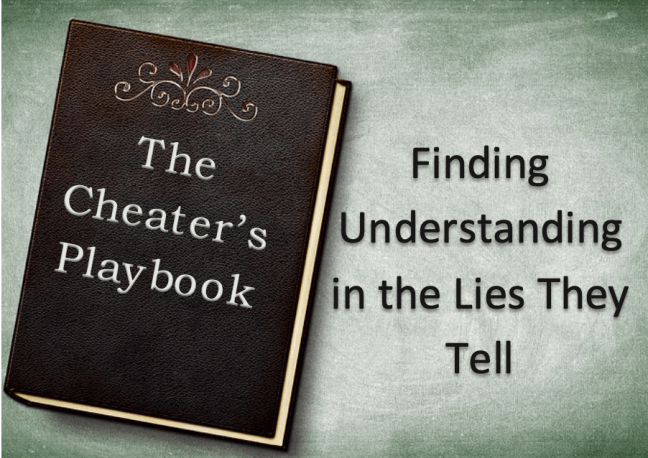

It had only been a couple weeks since I had discovered that my then-husband had been courting others. I sat in the waiting room at the doctor’s office, anticipating the results of the humiliating tests that you have to submit to after finding out that confidence you placed in monogamy was ill-advised. Adding insult to injury, the magazine at the top of the coffee table stack seemed to be taunting me with its headline – “Five Ways to Affair-Proof Your Marriage.” How was it that I was the one who felt shamed and stigmatized when he was the one who cheated?
I have since learned, through hundreds of exchanged with betrayed spouses, that this sense of blame and embarrassment is far from uncommon.
There are many reasons that the betrayed often blame themselves for their partner’s infidelity. First, it’s challenging not to interpret the straying as a personal rejection, especially because it comes from someone who claimed to both know and love you. As you struggle to find some sense of understanding about why this happened, it’s often easier to settle on your own perceived shortcomings than to accept that sometimes answers remain elusive.
It’s a misconception that affairs only occur in bad marriages. Many people who cheat claim that they love their spouse, love their marriage. Yet, either for the thrill, the opportunity or the search for something they’re missing, they elect to stray. And for the one who was betrayed, it’s important to realize that just because it happened toyou, it does not mean that it happened becauseof you. You didn’t make them cheat and, in most cases, you could not have prevented them from cheating. Regardless of their motivations, your spouse’s actions reveal more about them than about you.
In addition to your own sense of fault, you may face accusations from others. The cheating partner often utilizes projection and blame both in attempt to distract from their misdeeds and in order to reduce their own sense of guilt and shame. They may pepper you with statements along the lines of, “If only you would have…” and “I wouldn’t have needed to cheat if you…” These claims not only shift the responsibility of the affair to the betrayed partner, they also frequently minimize any deception that occurred, asserting that the spouse “must have known” what was occurring.
When these allegations bombard you, take a moment to remind yourself of the motivations behind these claims. Your ex is basically acting like the guilty child blaming the dog when the cookies go missing; they will likely point the finger anywhere rather than where it belongs. Rather than allowing their choices to challenge their self-perception of themselves as a “good person,” they will frequently paint their partner as “the bad guy.” Also, consider that you weren’t given the opportunity to respond from a place of full knowledge; you can’t be expected to meet your partner’s needs when they’re burying their desires behind their lies. In some cases, this manipulation began long before the affair(s) even started, using gaslighting to slowly undermine their partner’s sense of reality.
The external blame can also come from those outside the marriage. Assumptions will be made and accusations formulated about how you must have been a sub-par spouse in order for your partner to step out. These assertions, especially when they come from friends and family, are blows upon already bruised skin. These claims, much like the magazine headline that taunted me with my failure to “affair-proof” my marriage, are coming from a need for the world to be a fair and orderly place. People desperately want to believe that if they do good, good will be returned to them. They find it easier to accuse the betrayed spouse than to accept that infidelity could pay a visit to their marital bed.
When you’re trying to find your way after the discovery of infidelity, it’s okay to limit your exposure to those who do not support you. Surround yourself with people who refrain from assigning blame and who empower you to find your truth and rebuild your life.
I remember a strange sense of relief coming over me when I discovered that my then-husband had been leading a secret life. Even as my world collapsed and everything I had was swept away, I felt a sort of serenity building beneath the storm. For years, I had been unknowingly living a lie, an unknowing participant in a made-for-television drama. At some level, I must have been aware of this tension, the constant incongruity between what I thought and what I was living.
And so once the horrific truth came to light, I suddenly felt a sense of power for the first time in years. Now that I knew the facts, I could make choices. Instead of being tossed around by the winds spun by his lies, I was finally able to stand alone and see my life clearly. I had been granted an opportunity to live authentically.
There is often a sense of powerlessness that comes with the discovery of infidelity. You couldn’t prevent them from cheating. You can’t stop them from seeing others. You can’t control how the affair partner responds to the revelation of the infidelity. You can’t pressure your ex to explain their motivations or to address their deep-seated issues. And you can’t force them to apologize or to try to make amends.
We all-too-easily focus on what we can’t control. We obsess over the details of the affair. We desperately search for explanations and meaning in the betrayal. We believe that maybe our ex will again become the person we once thought they were. We convince ourselves that we need an apology.
Yet we don’t need the one that harmed us to be the one to save us.
In fact, everything we need, we already have.
Now that you know the truth, you are able to see yourself as you are, not as you have been led to believe.
The lies have been washed away. Acceptance of those things you cannot change has been reached. And what you’re left with is your truth. You’ve been betrayed. And now you decide what will be revealed.
 Lessons From the End of a Marriage