Til Death Do You Part?

I got into a Twitter conversation yesterday with a man whose view intrigued me. From what I can gather, he is divorced with a couple young kids.

A divorce he didn’t want.

A divorce, that for whatever reason, his wife did.

And even though the vows are now broken, he is still maintaining his promise of fidelity to her until death severs their oath.

I can certainly see why someone would choose not to date while they are focused on raising their children. I can empathize with the decision to avoid the balancing act of blending families. And I can even appreciate someone electing to not reenter the dating world out of fear of additional heartbreak or simply a discovery of contentment with singlehood.

But the piece I can’t seem to wrap my head around is keeping a promise to someone who has made it very clear that your loyalty is not valued.

He offered a clue that the rejection by the one he trusted the most delivered a message that he had no value.

And I think everyone that has faced betrayal and rejection can identify with that sentiment. It’s certainly hard to disentangle your views of yourself with your ex-partner’s (new) views of you.

Yet, even with that, I struggle with the idea of a one-sided pledge of allegiance.

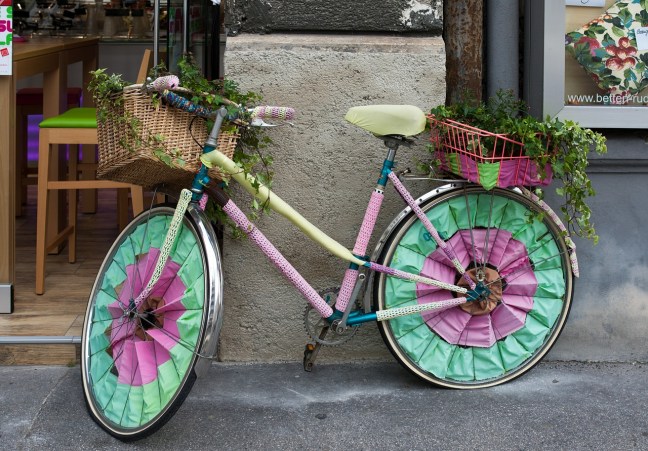
I see the vows as like the wheels on a bicycle. Ideally, both are fully functioning and working in concert. If one tire is a little flat, the other can help support the weight for a time until the tire is re-inflated. If one wheel is bent, the ride may not be over as long as the metal is hammered back into shape. Yet if one wheel is removed, the bicycle is useless no matter how hard the remaining wheel works. And it’s time to either find a new wheel or learn how to ride a unicycle.

That’s my two cents. What’s yours?

How to Change a Man

I met up with a friend the other day. She’s at a crossroads with the man she’s been dating for the past year or so. She wants marriage. Not now, but she wants to move that direction and wants that to be the mutual end goal. At this point, he states he does not want marriage. Now or at any point. They’re in that difficult place where the relationship works, but the objectives of the partnership don’t align.

Having known Brock back in the days when he said he never wanted to be married, she inquired, “How did you get him to change?”

The short answer?

I didn’t.

And I couldn’t. At least not in any meaningful and lasting way.

I didn’t make him change. I didn’t ask him to change. I didn’t expect him to change.

But here’s what I did do:

I Accepted Where We Were

I always knew I wanted to be married (or at least something like it) again. But that didn’t mean I wanted to jump straight into commitment immediately. In fact, Brock was always the forerunner on taking the relationship to the next level.  And we baby-stepped it from one level to the next. And as we slowly integrated our lives and tore down our walls, I simply enjoyed the place where we were.

I Accepted Him

As with any relationship, as the newness wears off and the pedestal lowers, you discover certain traits and characteristics of your partner that drive you a little nuts. Since none of his quirks were red flags or deal breakers, I worked on accepting them. In fact, I’ve even learned to appreciate some of what can easily annoy me.

I Limited Expectations

I knew that our relationship may not progress to marriage. And I was okay with that. I had no expectations of a wedding or a white picket fence. I simply knew that I loved him and loved being with him. And that the time together wasn’t wasted even if it didn’t result in nuptials. Besides, I had learned about the dangers of expectations:)

I Didn’t Push

I never initiated a “where are we going?”talk. In fact, the only relationship-oriented talks we had were about where we were, making sure that we were on the same page along the way. I was patient as he learned how to be in a serious relationship and, later on, learned how to share a home and a life. I gave him time and space to acclimate.

I Worked on Myself

Whenever I found myself frustrated or disappointed by something in the relationship, I made an effort to examine my own responses (which, no surprise, were often overreactions). I learned that by changing my reactions, I could change the dynamics of our interactions.

And over time, the man that never thought he would be married, not only decided that he did, he also became an amazing and dedicated husband.

But the most important part wasn’t what I did.

It’s what we did.

Because everything that I did that compelled him to change, he also did for me. In spades.

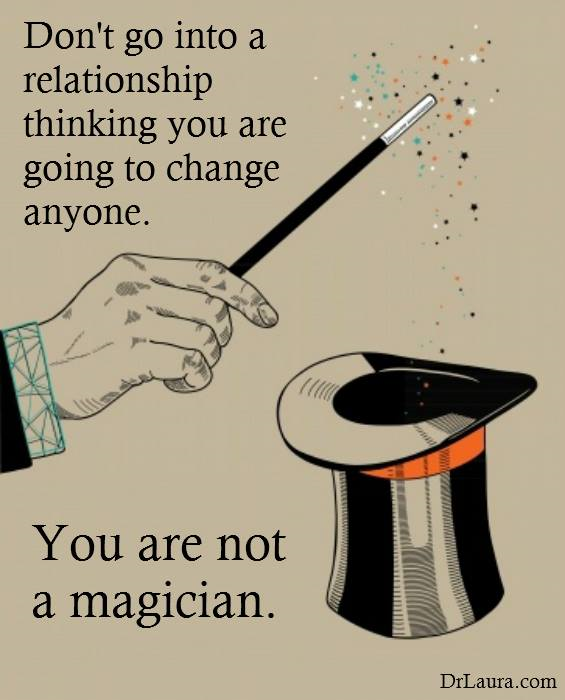
You cannot ever change your partner.

But you can be someone that inspires them to change themselves.

Because ultimately, the only guaranteed way to change a man (or a woman) is to change yourself.

2015/02/img_4385-1.png

Divorce Leaves a Residue

My ex husband’s parents were smokers. Entering their house always felt like walking into a parking garage on a warm and still day, the smoke forming clouds along the ceiling and tendriled wisps climbing the walls. The rooms felt dark as the haze filtered the sunlight and the once-white ceilings felt oppressive with their tar-stained varnish.

My ex used to seal his room from the smoke, employing towels and blankets in an effort to barricade his belongings against the nicotine attack. And, while he was there, we thought it was a successful endeavor. After all, compared to the rest of the house, his room smelled clean and his furniture looked unadulterated.

Until it came time to move. We pulled his sofa, that we had intended to use in our first apartment, into the garage. Hopeful, we peeled off the sheet that had been covering the fabric. We were horrified. Not only did the couch smell like the upholstery in a pool hall, the exposed surfaces were stained brown in contrast with the untanned underbellies of the cushions.

And no matter how hard we scrubbed, the stains and the smell would not fully release. There was a residue left behind.

We left that tarnished sofa behind that day and spent money we didn’t have on an unsullied replica from Montgomery Ward, determined to start our lives together fresh unburdened from the remains of the past.


In a moment of unedited honesty the other day, Brock turned to me and said, “Sometimes I wish you would give up writing about all of this and it wouldn’t be a part of your life anymore.”

And sometimes I wish that too.

That I could have escaped from the past with no residue, as clean and unspoiled as that new sofa. Because the truth is that divorce leaves a residue. A film that no matter how hard you scrub, you can never fully remove. It’s not something that disappears just because you take yourself out of the environment. It resists fading and clings tenaciously to every roughed-over surface.

You can try to cover the damage, hiding it beneath a slipcover of smiling perfection. You can scrub at it until your hands are raw and your the very fabric of your being becomes worn and thin. You can perceive the disfigurement as terminal, and live your life as an abandoned piece of furniture cast off in an unheated garage.

Or, you can see the stains as battle scars. Signs of a life once lived and a love once loved. You can learn how to find peace with the residue, viewing it as the reminder of your past while weaving into the fabric of your future.

Divorce leaves a residue.

And what you do with it is up to you.

Opinion

I realized something last night.

Brock asked for my opinion. It was about something where I have no expertise and that ultimately comes down to his personal decision.

But he still asked for and valued my opinion.

He does this frequently. In fact, often enough that I sometimes get annoyed.

“Why do you want to know what I think? It’s your decision. It comes down to what you want.”

But last night, I realized something.

That him asking for my opinion (even and maybe especially in areas where I have no particular insight) is a sign of respect. Of openness. Of equality.

And the reason that I get annoyed is that I’m not used to that from my husband. At least not the first one.

There were decisions we made together – options that impacted us both. And then there were decisions he made on his own. And he never wanted my input on those one way or another.

I was used to that independent streak, especially because I carry quite a strong one myself. When we weren’t involved in a joint venture (which was often, including the weekly grocery trip), we were usually operating solo.

So that means when I hear, “Lisa, can you come give me your opinion on something?” when I’m in the middle of my own project, I can get a little irritated at the interruption.

Until last night’s realization.

He’s not asking me because he really needs my input; he’s perfectly capable of making decisions on his own (and often better than I am in the midst of a crisis).

He’s not interrupting me because he either doesn’t value my current project or with any intention of annoying (not even remotely part of his character).

He’s asking for my opinion because he cares about my opinion. Even when it’s about something that is his own decision to make.

And that’s worth an interruption any day.

On a related note, I called my mom for her opinion about a project I am working on. She was thrilled:)

The Two Words You Should Never Say

We often utter these two words under the guise of empathy and compassion.

We say them almost automatically when something said triggers a memory in ourselves.

But when we say these words, we are not being empathetic. Or compassionate.

We are being egotistical and worst and narrow-minded at best.

Assuming that we know more and that others’ experiences parallel our own.

“I understand.”

Those two words are dismissive and minimizing.

Rather than provide comfort, they lend an air of superiority that leaves the “understood” one feeling invisible rather than appreciated as it reduces an entire lifetime of experiences and reactions to a mere sketch comprised of conjecture.

“I understand” is built upon a foundation of assumptions.

It assumes that everyone perceives as you do.

Feels as you do.

Responds as you do.

But they don’t.

You can relate. You can identify.

And you can certainly empathize.

But you will never understand.

It’s worse than simply putting words into someone’s mouth.

It’s also putting thoughts into their heads.

And feelings into their hearts.

We feel understood when somebody listens to us, not when they talk at us.

We feel understood when somebody accepts our perceptions rather than when they try to convince us of their own.

We feel understood when somebody honors and respects our differences instead of trying to reduce us to a common denominator.

And paradoxically, we often feel the most understood when somebody admits that they do not understand. And instead of offering words, they give the gifts of presence and kindness.

Because we don’t ever understand what somebody else is experiencing. But we all know what it’s like to be scared or hurting or confused. And we all know how important it is to feel understood and accepted.

So rather than saying you understand their situation, demonstrate that you understand that you cannot fully comprehend their pain yet you can support them just the same.

Be receptive rather than prescriptive.

Ask instead of tell.

And listen more than you speak.

For more on the idea of assuming understanding, read this post on The Good Men Project.