Feels Like I’ve Been Here Before

I keep getting the strange sense of deja vu.

Feeling like I’ve been here before.

Which is crazy on the surface of things. After all, this is a global pandemic, the likes of which have not been seen for 100 years.

None of us have been here before.

Yet, for those of us who have been through one or more of those life-altering moments – the discovery of infidelity, abandonment, sudden and profound loss – this may feel strangely familiar. After all, we know what it’s like to wake one morning to discover that the world we knew, the world which we trusted to ground us, no longer exists.

We are familiar with the grief that sneaks up and tugs at our guts when we’re not paying attention. And we are no longer surprised when we grieve the small things as much as the big ones.

We’ve experienced that strange sense of disbelief, of thinking that somehow this is all just a tragic mistake and that the reality we knew simply needs to be recovered.

We know the fear that comes with the uncertainty and the deep craving to return to a sense of safety. And we know that over time the belief things will return to normal is replaced with an acceptance that a sense of peace only comes once we’ve adapted to the new situation.

We’ve lived through that life turned upside-down, where the normally innocuous things have become threats hidden around every corner.

We’ve endured those long nights wishing things could be different before we dry our tears and pledge to focus on what we can control. And we learn both how small our influence is and also how powerful it can be.

We’ve tried to run away from our pain in the hope that we can distract our way out of it only to find that it cannot be outrun.

We’ve been through those moments of utter defeat when we feel like we’re not strong enough to get through this, only somehow we manage to make it through that day. And then the next.

This may be new. You haven’t been through this challenge yet.

But you’ve made it through others.

You know what to do.

 

When You Can No Longer Rely on Distractions

It’s my first day of spring break.

And I’m struggling.

For the other 18 years of my teaching career, I reached spring break both exhausted and relieved, ready for a break from the relentless and overly-structured schedule of teaching.

But this year?

I’m panicky, only now realizing how much I’ve relied on the need to be online and responsive to my students all day to keep me focused and how much the process of reinventing lessons for the digital realm has kept me occupied.

So now, with the next 9 days stretching out before me with no real purpose and no defined structure, I’m feeling a little crazy. A little unmoored. And a lot anxious.

We all have our preferred form of distraction, that thing we turn to in an excuse to avoid facing that which scares us. Many of us tell ourselves stories about our distractions, convincing ourselves and others that it needs attention, while fervently denying that we’re also trying to escape facing down that which scares us.

Like many of you I’m sure, being busy is my favored distraction. I find a strange comfort in my to-do lists that dictate my days. When I’m on the move, I don’t have too much to pause and just be with my thoughts and my feelings. And when I schedule in those times for mindfulness and reflection, I like knowing that there is a limited amount of time for stillness. I only have to “be” for so long.

Even with the current constraints, I could still manufacture busyness. I could create a rigid and demanding schedule to practice coding or work on writing. I could find some all-consuming household project to eat up all my daytime hours. I could escape for hours on end into books, barely taking the time to look from the page.

Yet even though those things call to me, they don’t quite feel right.

I’m panicky.

Reality is setting in.

And I think I just need to learn to be okay with it.


Thoughts From a World Turned Upside Down

Trying to Think in a Time of Stress

I wrote a blog post over the weekend. Then, after it was published, I went back and reread it. And I noticed something startling. In half a dozen cases, I left out whole words. Not typos. Not the wrong word. Or even a missing letter. Simply no word at all.

And that’s not the all of it.

I’ve spent the last three months teaching myself to code. I’m at the point where I have a reasonable grasp on the basics and now need to put the isolated skills together in longer – and more difficult – projects.

And I just can’t do it.

The languages, which were starting to feel familiar, are now just swirling letters and punctuation on the screen.

I’ve had to take a step back and work on more bite-sized challenges, which luckily my brain seems able to digest. It’s pretty much the equivalent of baby rice cereal for the brain.

It’s been awhile since my brain has felt like this. Ten years to be exact.

My ex left in July 2009. We started school a couple weeks later.

It had been years since I had felt the need to work out problems ahead of time before giving them to the class. So it caught me off guard when I was trying to explain how to decode a word problem at the board and I got stuck.

My brain simply couldn’t handle a multi-step problem. There was limited retention. No attention span. Instead of problem-solving, my brain was simply returning the cognitive equivalent of the “spinning wheel of death.”

For the better part of a year, I had to make accommodations. I made notes to take to the board with me during lessons. Answer keys were prepared well in advance. I went back and re-taught myself things that I had known but was struggling to apply. Instead of reading my normal books, I gravitated towards young adult fiction with its easier-to-understand writing.

I was worried, afraid that this cognitive decline would be permanent.

But it wasn’t. In time, it returned to its original level.

And so I’m currently holding onto hope that the world – and my brain – will return to sanity again.


All over Twitter this week, I’ve seen people timidly admit that they’re struggling to focus. To think. To problem-solve.

They’re worried. That their reaction is abnormal. That they may never be able to think again. That something is wrong with them.

There’s nothing wrong with struggling to think while your brain is busy attending to other (and often scary) things.

Here’s a way to think about it. For the sake of argument, pretend that you’re a skilled knitter. In fact, you can normally knit a scarf automatically and you don’t struggle to follow a complex new pattern.

But now is not a normal time.

Because now, at least as far as your brain is concerned, you’re treading water in an attempt to stay afloat. And knitting has suddenly become a whole lot more difficult.

So if you’re struggling to think right now, know that you are having a perfectly normal response to an abnormal situation.


While you’re waiting for your stress to decline and your cognitive to ramp back up, here are a few tips:


  • Adjust your expectations. Don’t base them on what you can “normally” do. Remember, your brain is treading water right now.
  • Your attention span is shorter. Schedule breaks.
  • Chunk information into smaller pieces.
  • Provide support for your lack of retention. Get used to writing more things down than you had to before.
  • Give yourself opportunities to feel successful. Otherwise, frustration can easily get the best of you.
  • Intentionally reteach yourself things. It may feel silly to go back to 101 when you’re a professor in it, but that sequential feeding of information will help your brain learn how to function again.
  • Pay attention to the basics – sleeping, nutrition, exercise. They’re important.
  • And finally, be patient. You can’t force this.


You’re not broken.

You’re human.


I Want to Know How It Ends

My first marriage was in December 1999, the apex of the collective anxiety around Y2K. At the time, my fiance and I operated from a place of optimism, rationality and faith. Despite the warnings and fears that we were constantly being bombarded with, we decided to move forward with the assumption that everything would work out.

And it did. Well, at least the transition into the new century worked out. (The marriage was something else entirely, but I don’t think I can blame Y2K for that one.) All of that anxiety and fear building up to the new year grew as flat as the leftover champagne while the sun rose on January 1.

Staying calm and present during times of uncertainty is hard. By nature, we are uncomfortable with the unknown. Yet life is not a book, where we can peek at the final chapter before we dig into the narrative. Our lives offer up no synopsis prior to living so that we can prepare ourselves for what is to come.

It’s easy to get swept up in the anxiety of the unknown, to put life on hold while waiting for the conclusion to be revealed and for life to return to normal.

Yet even the idea of an “end” is a falsehood. Consider the current arrangement of the continents. We know they used to exist in one solid mass (Pangea), that has since broken apart and drifted into the familiar patterns we were quizzed on in school. Yet the drifting is not over, the formations are not set. Just because most of the changes are too slow to be perceptible within a human lifespan, does not mean that change is not occurring.

We want to know how it ends so that we can be reassured that we’re making the right decisions. We want to know how it ends so that we can be prepared. We want to know how it ends so that we can adjust our expectations accordingly.

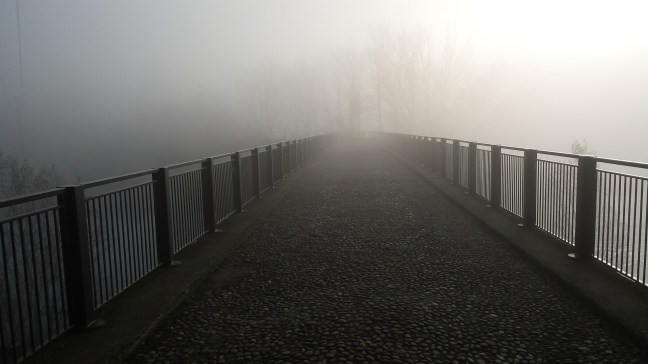
We want to see the end of the bridge, tethered securely to a welcoming shore, before we take the first step.

Yet standing still does not keep the unknown at bay. It simply restricts our lives as the future unfolds. We can’t see the end. We can’t change the end. But we can make the decision not to live in fear of the end.

I have a five-year spiral journal. My entry earlier this week included, “I wonder what we think about the coronavirus one year from today?” And I don’t know what entry might be recorded on that same page next year. The previous entry might remind me of a forgotten fear, the virus and the associated panic a distant memory. Or, life may have changed dramatically to the point of becoming unrecognizable. Most likely, the entry will fall somewhere in between. But in the meantime, I have 364 more entires to record. And I’m going to take them one day at a time.

Because we may never know how it ends, but we can be present while we get there.