When You Remove a Negative

One of the more difficult concepts for middle school students to master is integers. Specifically, adding and subtracting integers. Even when the concept is introduced with concrete and tangible examples, the students still struggle with the often counterintuitive nature of negative numbers.

You see, in elementary school, they are taught that addition always results in more and subtraction, less. But once those numbers become negative, the results are often reversed.

One of the ways I help them remember the rules for adding and subtracting integers in by relating it to relationships:

When a good person comes into your life, it improves the value.

When a good person leaves your life, it reduces the value.

When a bad person comes into your life, it reduces the value.

And the one they have the hardest time understanding…

When a bad person leaves your life, it increases the value.

photo-22

The Words I Hate to Hear

There are two words that I hate to hear more than anything else:

“I can’t.”

I hear them in the classroom. I read them on Facebook or on my Twitter feed. I hear them from coaching clients.

And I even hear them from myself.

And every time I hear those words, I see someone limiting themselves.

Defeating themselves.


“I can’t” doesn’t keep you safe.

It means means you’re afraid to try.

“I can’t” doesn’t mean you are not able.

It means you are uncomfortable.

“I can’t” doesn’t make you happy.

It keeps you from happy.


“I can’t” is often a knee jerk reaction. A plea to keep the status quo and resist change.

We become adept at shoring up our “I can’ts” with excuses disguised as reasons.

It’s a shield.

A security blanket.

A delaying tactic.

That only serves to hold us back.


The biggest lie we tell ourselves is “I can’t.”

Stop lying.

You can.


Let it Go

I’ve been in the classroom for thirteen years. And, in those years, I have accumulated a lot of…stuff. I have games and cards for curriculum I haven’t taught in many years. I have boxes filled with files that speak of units past. I have workbooks and textbooks, long since retired, that no longer correspond to the math that I (or anyone in the state for that matter!) teach. I have hundreds of labeled bags filled with measured out amounts of random items – pennies, pipe cleaners, little foam blocks – all used for math labs that are now curricular dinosaurs.

For years, I’ve carted around more than a dozen file boxes filled with these materials. I held onto them at first because I trusted that the educational pendulum would swing back and I would again be responsible for the teaching of polynomials and imaginary numbers. But with each election and each testing mandate, the chances became more and more slim that those topics would again trickle down to the middle school level.

But even as I let go of the notion of teaching these units again, I still held on to the boxes. Because those boxes held more than just paper and plastic; they contained the years that I considered my best in the classroom.

For a few precious years, I had the perfect storm in education: great curriculum, great class sizes and great students. By holding on to those boxes, I was holding on to the idea that the perfect storm may brew again and I could teach higher-level concepts to small groups of hard working kids. Every time I would move or sort through those boxes, I would grow sad, reminiscing about what was and what was no longer. The newer units didn’t hold the same appeal, not because they were worse but because the older ones were rose-tinted with memory, idealized in time. And with the old taking up permanent residence in my classroom, it was impossible not to compare.

I finally realized this year that keeping those boxes in my classroom is pretty much the equivalent of keeping my old wedding photos on my wall.

Uhh…no thanks.

It’s amazing the mental choreography we will create to attempt to rationalize grasping on to the old. We pretend that we may need it again in some, as yet, unknown future. Anxiety and worry speaking the language of “what ifs” in order to keep us prisoner to the detritus of our pasts. We claim that it serves as a reminder of the good times, even though its presence dulls the new. We allow memory and hope to create value where there is none and, even worse, waste energy and other resources on lugging around the boxes, both real and metaphorical,  from our former lives.

So this morning, I sorted through thirteen years of lessons and saved projects. I filled recycle bins and garbage bags and re-gifted the plastic tubs to a new home.

It’s a little scary.

Letting go always is.

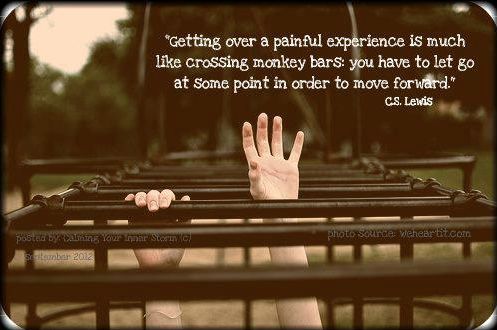
But you can’t reach the next rung until you’re willing to release the last.

And it’s also freeing.

Letting go always is.

Because it’s only in releasing our grasp on the past that we are able to fly towards our future.

8a0001272065287cc7e5c51536b59326

Alert Levels

As a country, we became familiar with alert levels in travel after 9/11. We felt the apprehension of a code red and perhaps even modified our plans. We grew comfortable with the ever-present code orange, understanding that some level of threat is always present, even while dreaming of a day when all airports operate under a code green.

These alert levels were accepted as prudent. It was not a way of assuming culpability for the attacks nor was it lamented that we shouldn’t have to be alert. Rather, it was simply an acknowledgement that we needed to pay attention and respond to any information coming in.

As someone who faced deception and betrayal in her marriage, I became familiar with alert levels in relationships. And I realized and rectified the mistake the  mistake I made in my first marriage.

Relationship Code Red

There are times when all the sirens should be sounding. This is an appropriate alert level if you discover deception or face abuse. In those cases, proceed cautiously and call for back-up. Often, one or both partners is operating in a code red even when there no triggers within the marriage. This can arise from prior relationships or from insecurity, where fear is sounding a false alarm. A healthy relationship cannot exist under prolonged code red conditions. Get help or get out.

Relationship Code Orange

I think this is a healthy alert state for the infancy of a relationship. It can be all too easy to fall with the heart and leave the brain behind. No matter the attraction, it is important to remember that the person is still largely unknown to you. This is a time to question and verify. In an established relationship, a code orange is sounded when there are perceived significant difficulties – a lack of intimacy or connection, a lie, a breaking of a boundary. It is a reminder to be aware of your partner and your circumstances. It may be a minor blip that can be corrected easily or it may require outside assistance. Prolonged code orange isn’t healthy; it leads to a marriage filled with suspicions and doubts. Listen to the alert. It’s telling you to pay attention.

Relationship Code Yellow

A code yellow is not necessarily cause for alarm. It is an appropriate level during times of change – birth of child, new job, a move. All of these place new demands on the relationship and it is smart to be aware of potential complications. It is a reminder to not put your spouse or your marriage on autopilot, to be present in your relationship. Think of it as a nudge. If ignored, the threat level can easily escalate. But just a little attention can put things back on the right track.

Relationship Code Green

This is the ideal state for a healthy, established relationship that is built on trust. The alert system is on, yet it is reporting no threats.

So the mistake I made? After getting to know my ex husband, I turned off the alert system. I trusted him. I trusted him to remain trustworthy. Now, who knows? Even if my alarm system was fully operational, his brilliant deceptions may still have gone unnoticed. And it’s certainly no excuse for his behavior. But that’s no reason for me not to do my part.

So now my relationship alert system is on and fully operational, humming along at code green.

Gravity

Like many other kids, I entertained the notion of becoming an astronaut. On family camping trips, I would gaze up at the stars and imagine what it would be like to travel between them. I thrilled in the images of astronauts unbound by the limits of gravity, every small action becoming a dance through space. The life of a star-walker seemed so free. So captivating. So inviting.

But I didn’t see the big picture yet.

Like many other kids of the 80s, my school went positively hog-wild for the Challenger expedition. We wrote letters to Christa McAuliffe. We carefully selected payloads and supplies from lists, balancing needs against weights, preparing on paper for a trip we hoped we would one day make. We watched videos of the crew aimed at schoolchildren and we learned lessons recommended by NASA. The inflatable planetarium paid a visit and we were taught rudimentary celestial navigation. Our school even built a mock-up of the cockpit of the shuttle out of cardboard and foil where we would take turns running pretend missions.

By the time the actual launch date arrived, there was a thrum of energy vibrating through the school. All of our pseudo-preparations led  us to feel like we were a part of that mission, an integral as the commander. That morning was endless as we waited for the lunch-time launch. TVs were located and rabbit ears adjusted to tune-in to the launch. Regular programming, both on TV and in the school, was suspended for the mission.

I remember the gasp more than the explosion. My teacher’s sharp intake of breath followed shortly by the news anchor’s wail. The kids needed another moment to reach understanding and then our cries began. For most of us, this was the first tragedy on a grand scale that we had ever experienced.

Interestingly, the disaster itself did not dull the allure of space for me. Instead, it drove me to understand more. As I sought out my own information, I realized that the videos and lessons presented to us were sanitized for our protection. We weren’t taught the realities of space travel; we were presented with the shiny happy Disney version.

One picture in one book rendered me speechless. It was an image of the command capsule from a pre-shuttle program splashdown. One astronaut was already on board the rescue boat, collapsed under his own weight. Another was being hauled from the hatch, his muscles unable to provide much assistance. On the next page, was the image that was always presented to the public – the entire crew standing together after the mission with smiles on their faces and hands waving in the air.

Just to take that picture, that little piece of fiction, in the days after landing would have exhausted the crew. Despite their healthy appearances, they could hardly walk. In the absence of gravity, their muscles atrophied. They became weak and unable to meet the demands of their own world.


A life of little resistance seems so tempting. The thought of floating through without struggle and being untethered to any ballast is appealing.

But the reality is not so attractive.

We need resistance to grow sturdy.

We need struggle to become strong.


During my divorce, I felt like I was trying to walk on Jupiter, my 120 lbs magnified by the gaseous giant to a staggering 283 lbs. Every action required immense effort as I struggled to complete even the most arbitrary tasks against the pull of the pain.

But each day, I grew a little stronger. More adapted to my new environment. I became less aware of the increased resistance as I became tougher.

And when it was time for my return to earth, I felt like I was floating.

The strength built for struggle filled normal life with ease.

Star walking on earth.