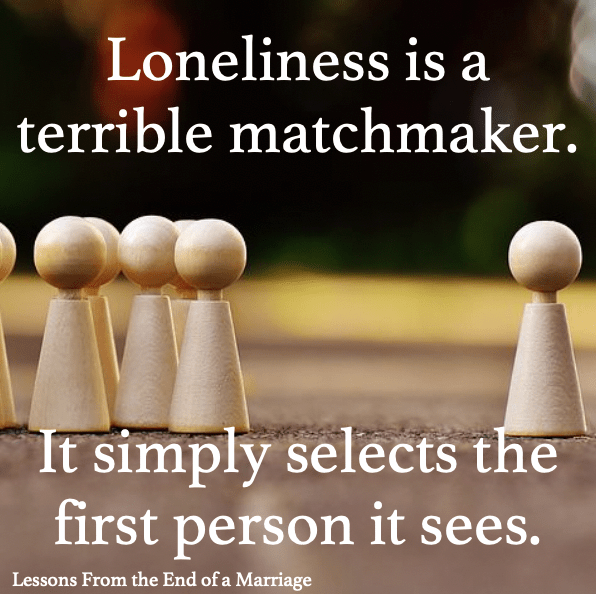
Can You Find Happiness With a New Partner After An Unwanted Divorce?

unwanted divorce

“I can’t imagine being happy with any else but her,” the message in my inbox said. The “her” in question was his ex-wife, who had recently initiated an unwanted divorce. “Do you really believe that it is possible to ever be happy with a new person?”

I asked my journal that same question after my divorce, afraid to voice the query aloud as though that would give my concerns more power. Even while I felt disgust at the realization that I had been sleeping with a stranger, I still fought the connection I had forged with him over sixteen years.

I tried to imagine myself with another man – a generic, faceless one – and I would be instantly snapped back to an image of my ex as though industrial strength bungee cords still tied us together. I thought of how comfortable I was with him and I searched the men in my periphery questioning if I could ever be so vulnerable with any of them. I reflected back on the intensity of the love that I had felt for my ex and I wondered if I would ever experience that again.

I couldn’t imagine ever being happy again with anyone else.

And I’m so grateful that I didn’t allow my imagination to keep me from trying.

___


Here are five truths to consider if you find yourself wondering if you can be happy in a new relationship:


Your happiness is anchored in you.

When you’re with someone for an extended time, the boundaries can begin to blur. Something that makes them happy, makes you happy. And it’s easy to begin to believe that your happiness is dependent upon them.

Yet it’s not and it never was.

True happiness and satisfaction in life comes from living within your own beliefs and values. It is found in living a purpose-driven life where you know who you are and what you have to give. It is in a sense of curiosity and playfulness. And, yes, it is in the relationships you form with others.

Here’s the important part – the root of happiness and the ability to create it is not found in another person or when your external circumstances change. It is in you. Always has been. Always will be.

Believing it only existed with your ex holds you back. Believing that you can find it in someone new leads you astray. Finding containment within will never let you down.


Your marriage wasn’t perfect. 

And it may not have even been good.

I know. Tough pill to swallow. I choked on that one myself for a couple years. But once I accepted it, everything else started to fall into place.

You see, I thought I had a good marriage. A great marriage, even. We never fought. We had great intimacy. We had common goals and values (or so I was led to believe). Much of the responsibility for that illusion lies on his shoulders – he needed for me to believe that things were good so that my suspicions would not be altered. And some of the responsibility falls on me. I needed to believe that the marriage was great because I was too afraid to entertain the alternative.

By allowing myself to see the reality of the relationship, it helped to let it go and by recognizing its imperfections, it also aided my belief that I could be in a happy relationship again.

I used to believe that I had a great first marriage. Now, I believe that its ending was proof that it wasn’t great. And I’m okay with that. I can now look back and smile at the good moments while at the same time accepting that not all was good behind the scenes.

And I’ve taken those hard-won lessons from that relationship and put them to good use in my life now. I’m beyond happy in my current marriage and happier still that it isn’t perfect.


Different can be better.

After an unwanted divorce, all you feel is the loss and all you know is what you had. There’s a tendency to smooth over the rough edges and idealize the person who left. The sense of deprivation causes a panicked grasping, an almost-obsessive need to try to hold on to whatever you can of your former partner. Every ounce of your being is focused on the void you feel and you naturally seek to want to stuff your ex back into that space to fill that hole.

Sometimes this manifests through repeated attempts to win the ex back or a more subtle yet persistent pining for the one who left. Other times it shows up by trying to sift through the single scene looking for a doppelgänger to replace what was lost.

You miss what you know and you don’t know what you haven’t had.

A new relationship will be different than the one you had. And different can be better (especially if you learned from your mistakes).

The grooves you followed in your old relationship will be rough at first, as you trip and stutter over the worn patterns with a new partner. But soon, you’ll find your own music.

The strengths of your ex may not be mirrored in the new partner. Yet they carry their own gifts and you may find they bring out new ones in you.

You won’t relive your early twenties with them, broke and optimistic. Yet you will share more experience and wisdom and the confidence that comes with them.

Happiness in the new relationship is found in recognizing what makes it unique, not in trying to make it a carbon copy.

Rather than see this as a burden, view it as an opportunity. A chance to start again, to start better.


Fear restricts; hope frees.

Fear weaves a web more intricate than any spider. Fear holds you back stronger than any restraints. Fear narrows your vision more than any blinders. And when you’re wondering if you’ll ever be happy with another person again, you’re listening to fear.

And fear lies.

But hope frees.

Fear tells us that the future will be worse than the past. Hope reminds us not to jump to conclusions.

Fear threatens that we’ll always be alone. Hope reminds us that connection is the natural outcome if we’re willing to be open and vulnerable.

Fear warns that we’ll never find happiness again. Hope reminds us that contentment is always present when we know where to find it.


Love doesn’t come with lifetime limits.

I’ve never seen love advertised as, “Limit 1 per customer.”

Yet we often live as though that were true.

Just as parents can find the love for each additional child, you can find the space within you to love again.

Eight years ago, I couldn’t ever imagine being happy with anyone else. And now, I can’t imagine having to go back to who I was with before. Because now, I’m happier than ever.


The Elephant in the Room: How to Talk to Those Experiencing Grief

When bad things happen to good people, we’re often at a loss of how to respond and what to say. The loss becomes the elephant in the room – too unwieldy to discuss yet too big to ignore.

Here are some thoughts on how to talk to people who are dealing with loss or tragedy:


Bringing It Up

Sometimes we hesitate to bring the subject, as though the person has forgotten that their husband has left or their family member has died. You don’t have to worry about saying something that will make them think about something that they’re not already thinking about.

When everybody refuses to acknowledge the loss, it can lead the heartbroken to believe that they are alone in their pain. The mention of it lets them know that they’re not alone in their memories and their suffering.

All that being said, be cognizant about when you bring it up. At work, the person may be doing all they can to hold their grief behind a dam of conviction. And a reminder at that point may breach that wall. Also, be mindful of their response to your words. If they change the subject or shut it down, respect their wishes. If they want to talk, listen.

If you’re the one suffering in silence, let people know if and when it is okay to bring it up.  And if your friends and family cannot talk about it, perhaps it’s time to find a support group of people who can.


Speaking About Your Experiences

It’s natural for you to want to share your similar experiences. And there is quite a lot to be said about the power of “me too.” Yet be careful here not to minimize the experience of someone else by implying (or stating outright) that your situation was worse. Also refrain from claiming that you know exactly how they feel. Even if the circumstances are identical, the responses won’t be. Your experiences may allow you to empathize, but that’s a long way from actually being in their shoes.

If you stick your foot in your mouth by complaining about how bad traffic was on the way to their loved one’s funeral, apologize. And then forgive yourself. When we’re emotional, we often respond with nervous energy and a lack of appropriate filters.

If you’re on the other side and somebody says something ignorant to you, try to let it go. They are either trying to connect and they failed miserably or they haven’t experienced anything in the same universe as what you’re going through and they’re clueless.


Offering Platitudes

“It’s for the best.”

“God doesn’t give you more than you can handle.”

“It was meant to be.”

Just don’t. I am a huge believer in silver linings, yet there is also a hell of a lot of polishing that has to happen before you can see those. And for those in the midst of grief, there’s nothing shiny about what they’re seeing.

Often what people need more than an assurance that it will be okay is reassurance that it’s okay for them to not be okay right now.

Instead of platitude, offer condolences. Offer thoughts. Offer prayers. And offer to just listen, without judgement.

If you receive some of these platitudes, try to remember that they’re coming from a place of love. Those who care about you don’t want to see you hurt and they’re trying to reassure you (and them) that you’ll make it through.


Expecting Them To Be “Over It”

Grief does not speak calendar. They’re not going to be suddenly healed after a month. Or three. Or even a dozen. The pain of loss ebbs and flows, but it is always there like the pools left behind from an outgoing tide.

It’s unfair to expect them to be “back to normal” after a period of time. In fact, their normal may in fact be different now. Be compassionate about where they are in their pain. Accept that they have been changed by their experience and that this is not about making you feel comfortable.

If you’re experiencing people telling you that you should be “over it,” begin by asking yourself if there is any credibility to their claim. It’s easy to become stuck in grief and sometimes this is how others let us know that we need help to keep moving. If this is not the case, read this and try to refrain from punching the person.


Accepting Your Own Triggers

Loss has a strange way of bringing up all past losses. When you look at the faces at a funeral, some are crying for the life being honored on that day, some are crying at the remembrance of past losses and many are weeping for both.

Be mindful of your own triggers when helping someone else through their grief. These can be reminders about your past experiences or even triggered fears about what could happen to you in the future. This is one (of so many) reasons that losing a child is so hard – the other parents cannot bear to fathom that loss themselves and so they often create distance from the impacted family.

Be honest about what you’re feeling. If needed, get support for yourself so that you can be present for your loved one.

If you’re the one facing loss, understand that not everybody will be able to be present for you because of their own struggles. It doesn’t mean they care about you any less, it just means they are also wrestling with their own emotions.


Overall, the most important thing you can do for somebody else is to simply be there. Letting them know that they are not alone.

Three Powerful Lessons About Finding Love From An Unlikely Source

love lessons

Because sometimes the way to learn to do something better is to start with what we already know…

shopping-2411667__480

You know: Never go to the grocery store when hungry.

When you succumb to the grocery store on an empty stomach, you’re possessed by a powerful drive to grab anything in your sight. You have a tendency to zero in on high-calorie items, especially those stocked for maximum visual impact. Your reasoning and planning abilities are sluggish, which may lead to a full cart but an empty pantry as you later realize you forgot the staples.

In contrast, when you navigate the store on a full stomach, you find it easier to stick to your list of needed items and resist those temptations that look good only to leave you feeling bad.

Love lesson: Never date when starving for affection.

When you’re starving for attention and affection, you may enter the dating scene driven by that ravenous and undiscriminating hunger. You’re likely to grab anything that catches your eye with little thought to its long-term impact.

Instead, strive to fill the voids in your life with friends, family, hobbies, passions and purpose before you seek out romantic love. You will make better choices for the long term and be better able to stick to your list of “must haves.” And you’ll also find it easier to pass on those people that make you feel good in the moment only to cause regret in the morning.

You know: Your cart only has so much space.

A grocery cart has finite space and so decisions must be made about what will be chosen to occupy that real estate. Maybe you notice a sale on soda and you’re tempted to fill the basket until the cans pile over the brim. You may justify this decision, claiming that you’re taking advantage of a good deal and that you never know when such a sale may come around again.

But at what expense? Yes, you’ll have soda for months. But you can’t live on pop alone.

Love lesson: Sometimes you have to let go of what makes you feel good in the moment in order to make space for what fulfills you long term.

Once we have allowed someone space in our lives, we tend to justify their place there even when they may not have been the wisest choice. It can be easy to focus on the parts that fit while actively ignoring the reasons why it’s not a good idea.

It’s a version of FOMO (fear of missing out). Because as long as that person is there, you know you have someone. If you let them go, you risk being alone. But there’s only so much space. And sometimes you have to let go of one thing in order to make room for what you need.

You know: Junk food may be quick and easy, but it is detrimental to your health.

So called “food deserts” earned their moniker not from a lack of food, but from a lack of quality food. Processed foods are tempting because they require little investment of time or money. They promise sustenance and indeed provide some feeling of satiety. These “foods” have been carefully engineered to promote maximum consumption and to encourage dependency.

However, in the longer run, these foods can cause starvation even as they widen the waistline since key nutrients have been replaced with fillers and empty calories. Healthy foods take effort, intention and planning as you turn the raw ingredients into something that will both nurture and fortify you.

Love lesson: Healthier relationships take time and energy to prepare.

Quick fixes are tempting in love as well. Those relationships that ignite quickly and fill you with both a surge of temporary well-being and a driving need for more. They can become a drug, leading you to always search for that next spark of interest. Only to leave you empty and lonely once the initial attraction fades.

Healthier relationships are built from the ground up. There is effort. Intention. Sustained energy and shared responsibility. And the pride and ownership that comes from doing something yourself.

Is A Happy Marriage Possible?

happy marriage

The marriage I am in right now, today, is the best marriage I have ever had.

And that’s saying quite a bit because I’ve been in lots of marriages.

“But wait,” I can hear you thinking, “I thought you were with your second husband. That’s not ‘lots’ of marriages.”

But here’s the thing – even though I have only signed two marriage certificates, in fourteen years of total matrimony, I have been in numerous marriages.

Because a marriage, like the people in it, is always changing.

And the one I am in right now is the best one I have ever had.


So I am a firm believer that a happy marriage is absolutely possible. But only if you understand what makes a marriage happy.


A happy marriage is not…


Happy Every Day

Dr. Drew likes to talk about out intolerance as a society for what he deems “ordinary misery,” the normal downs that can be found in a good life. Marriage is no different. Outside of the fairytale that fiction (or Facebook) portrays, no partnership will be all smiles all the time.

In fact, a marriage of any duration will probably go through some hard times. Even some very hard times. But just like you can love your child even in those moments when you you don’t like them very much (maybe like all of middle school!), you can be committed to your marriage even on those days or weeks when you’re not entirely happy with it.

Free From Doubt

It is entirely normal to question your decisions. To consider your options. To wonder if you’ve made the right call and to think about what other paths may have held.

The trick here is to distinguish between ordinary doubt (on par with ordinary misery) and your intuition screaming that you’re making a wrong move. The former is more an exercise in thought whereas the latter (which I experienced towards the end of my first marriage), operates largely at a subconscious level.

A Sole Source of Happiness

A marriage, no matter how awesome, should never be your only source of happiness or purpose. That is simply too great of a burden for it to bear.

A happy marriage is formed when two happy people come together and make the choice to have parts of their lives overlap.

Static

A marriage is a living, breathing entity. The person you say “I do” to will not be entirely the same person you wake up next to five years down the road. And you will grow and change in that time as well. The environment that surrounds the early marriage will change as children come and go, jobs transition and health challenges arise. What works during one phase may longer be effective or feasible in the next.

A Solution

Marriage is not a solution to a problem. If there are issues or insecurities in the relationship, the addition of a certificate and a ring will not alleviate them. In fact, it often has the opposite effect.


sms-861

A happy marriage is…


Challenging

A happy marriage is challenging in the best way possible. It consistently pushes you to become a better version of yourself, requires that you deal with your own issues and makes you confront your assumptions and expectations. I forces you to admit when you’re wrong and stand up for your boundaries even when you’re scared.

It’s not easy. But then again, nothing worthwhile ever is.

Fulfilling

Not in a cupcake kind of way that feels good in the moment only to leave you with regret later, but in a wholesome, home-cooked meal kind of way. A happy marriage helps you feel energized and nourished and makes everything else just a little bit easier.

Evolving

When I interviewed my ninety-eight-year-old grandmother for my recent book, she kept coming back to the idea of adaptability to survive life’s hardships. And that trait, both in the individuals and in the partnership, is key to a happy marriage as well. A happy marriage is one with a growth mindset.

Risky

One of the key elements of any successful relationship is maintaining vulnerability.

And that open state always comes with risk.

One of the reasons that the marriage I’m in right now is the best one I’ve ever been in is that I’m finally willing and able to accept that risk without preemptively closing myself off or entering into a state of unbridled panic. I kinda feel like a deserve a medal for getting to this place:)

Supportive

A happy marriage is one where you feel like your partner has your back. Even when they don’t understand or agree with you.

It’s a safe place, where you can express your thoughts and feelings without ridicule or contempt. Even when your partner doesn’t understand or agree with you.

A happy marriage accepts those differences and accepts both partners as they are.


As I see it, one of the biggest hinderances to a happy marriage is fear. Fear of losing yourself. Fear of being left. Fear of not being loved. Fear of being hurt. Fear of making mistakes. Fear of not being accepted.

As I’ve said before –


We push people away because we are afraid of letting them in and being hurt when they leave.

We grasp on to people that are not good for us because we are afraid of being alone and someone is better than no one.

Pushing and pulling are fear, not love.

Love is holding.

Loosely enough so that each person has the freedom to grow and change.

And firmly enough so that each person knows they are supported.

It is trusting the other person enough that they want to stay even if they have the ability to leave.

And trusting yourself that you will be okay if they do.


16 Widespread Misconceptions About Marriage

misconceptions expectation

If I’m honest with myself, I entered into my first marriage with many of these misconceptions. These beliefs made recognizing and admitting to any cracks in the marriage a proposition too scary to face because any faults would threaten my assumptions.

And I’m not alone in these inflated expectations of marriage. Over time, matrimony has shifted from being an arrangement of mutual practical benefit to carrying the burden of meeting most of our social, emotional and physical needs. Could it be that one of the reasons for the increasing divorce rate is the corresponding rise in our expectations of marriage?

A good marriage begins by understanding what is meant by a “good” marriage, by having a realistic picture of what you can expect from your marriage, your spouse and yourself.

It starts here…

–1–

Idealistic Expectation: Getting to know your spouse happens before marriage.

We are often counseled to wait a specific number of years – usually 2 or 3 – so that we have plenty of time to get to know the person we are about to marry. It is often assumed that once you have seen the person at their best, at their worst and survived a road trip together that there is no mystery left.

Realistic Expectation: Getting to know your spouse is an ongoing process.

In a marriage of any duration, you are effectively married to several people as your spouse changes over time and as you learn more about them. If you believe that you have learned all there is to know about them and you effectively close your eyes and shut your ears to new information, you may just wake one day to discover that you are married to a stranger.

–2–

Idealistic Expectation: I expect my spouse to be my best friend.

I had this expectation of my ex, especially once we moved across the country together. I wanted him to be husband, lover and bestie, all rolled into one neat package.  Expecting your spouse to be best friend is a large burden for them to carry. Furthermore, narrowing your circle of influence is limiting to both you and your partner. It’s one thing to have your partner be a best friend. Something else for them to be your only best friend.

Realistic Expectation: I can expect my spouse to be one of the most important people in my life and to have our relationship occupy a more intimate space than any other relationship. 

It is completely reasonable for you to expect that your spouse is “your person.” They are the one you list as an emergency contact, the first you call with important news and the one you return home to each day. Additionally, it is entirely appropriate for your spouse to be your most emotionally intimate relationship and for there to be more shared with your spouse than anyone else. After all, there is a reason that you cannot be forced to testify against your spouse in court:) That being said, it’s also important to maintain close friendships outside of the marriage.

–3–

Idealistic Expectation: I expect my spouse to never hurt my feelings.

With this expectation, we become primed to take every slight, every cross word, personally. Yet the reality is that ANY two people that spend significant time together will inevitably hurt each other’s feelings. Often unintentionally.

Realistic Expectation: I can expect my spouse to not act out of malice or with an intent to manipulate.

Your marriage should be a safe space, both physically and emotionally. It’s one thing to push your spouse’s buttons at times, and something entirely different to strive to make them feel inferior or rejected. You can enter into marriage with an expectation that your spouse refrains from abusive behavior and that an effort is made to spend more time operating from a place of kindness than of crossness.

–4–

Idealistic Expectation: My spouse should be able to tell when I am upset.

This expectation can lead to a toxic cycle. It begins when one partner becomes upset at the other and responds by actions (for example, withdrawing) rather than words. The initial slight becomes amplified with the belief that the other person should be able to correctly identify the emotional state and even the reason for the reaction.

Realistic Expectation: I can expect that my spouse will take an interest in my general well-being and to make an effort to be observant. 

Your spouse is not a mind reader. It is not fair to expect them to know what you do not say. That being said, it is fair to expect them to care about your emotional and physical state.

–5–

Idealistic Expectation: My spouse and I should have similar interests.

I sometimes get strange looks when I engage in an activity with someone other than my husband. It seems to be assumed that we should accompany each other of any adventure, despite our independent interests. Yet if I dragged my husband to a botanical garden, we would both be miserable. I would rather attend with a plant-minded friend while he tinkers with his Corvette and then we can reunite and share the good feelings that arose independently.

Realistic Expectation: My spouse and I can have similar life goals and beliefs yet achieve those in different ways.

My now-husband and I are both passionate about helping people. I fulfill my altruistic drive by writing; he meets his by teaching people how to fight. On the surface, these activities could not be more different even though they are aligned in their larger meaning. And having separate lives enriches our life toegther.

–6–

Idealistic Expectation: My spouse should be able to meet my needs.

I made the mistake in my first marriage of expecting my husband to help me recenter after a rough day at work. It was effective, but is also handicapped me and my emotional independence. I now find that the more I make sure that my needs for stress reduction and restoration are met apart from my marriage, the better spouse I can be.

Realistic Expectation: I have to take responsibility for making sure my needs are met in an honest and healthy way.

The only time it is appropriate to expect another to meet all of your needs is during infancy. After that, it becomes your responsibility to make sure your requirements are met. It is perfectly reasonable to turn to your spouse for some of your needs. But also ensure that you have other resources that you can turn to.

–7–

Idealistic Expectation: My spouse should never disappoint me.

Disappointments will happen. It doesn’t mean that your partner is evil or doesn’t love you. It means they are human.

Realistic Expectation: Although disappointments are inevitable, I can count on my spouse to not betray me.

There;s a difference between disappointments and betrayals (although sometimes we can treat the minor infractions as major missteps). Betrayals, with their deceptions and intentionality, speak to a lack of integrity.

Continue to read the rest.