5 Simple Rules For Your Online Dating Profile

Building your profile on an online dating site after divorce is a daunting task. You’re going from “off the market” to available and looking, perhaps after your “lifetime guarantee” proved to be a lie. You are no longer the person you were the last time you were dating and you no longer are interested in the same people. Your self-esteem may have tanked along with your self-knowledge, leaving you hesitant and uncertain.

So how in the world do you construct a dating profile that enhances your assets, attracts the kind of person you want and refrains from revealing more than you intend?

Follow these 5 simple rules –

1 Activate Curiosity

It’s easy to try to tell anything and everything in your profile. Resist that urge. Instead, focus on sharing just enough to make somebody want more. After all, that’s what inspires a person to message you. Think about parts of your personality that seem to be in opposition or interests that you have that would usually contradict each other. Capture a potential date’s interest by placing these at the beginning of your profile.

2 Avoid Red Flags

I was amazed at how many profiles I saw when I was dating that waved red flags in my face – diatribes about crazy exes, self-defeating paragraphs about current life status or signs that somebody needed a therapist more than they needed a date. But the most common flags? The subtle ones that either make a person come across as too independent or too needy. The best way to avoid red flags is to have a trusted person read through your profile before you publish and give you honest feedback.

3 Tell the Truth (But Not the Whole Truth)

Divorce isn’t final? Disclose that. Have sole custody of four kids? Put that in. Heavier than you wish you were? Tough; record your honest weight. However…don’t add the details about the divorce drama, the stress of caring for the kids or your conflicted feelings about your weight. Those supporting details are better added later and in person. Overall, be honest – you want somebody who wants you for you and hiding the truth is a sure sabotage.

4 Don’t Try to Please Everybody

You aren’t trying to create a profile that will please everybody. Unless that is, you want to date everybody 🙂 So many profiles are bland, avoiding anything that might offend or alienate. But the result is like the beige wall of internet dating – not a turn off, but also not all that interesting. Be you. Show the weird. You will inspire some people to move on. But that’s okay because they’re not a match.

5 Use Pictures That Show What You Love (Not What You Fear)

Choose your pictures based upon how you felt in the moment they were taken more than how you feel looking at them later. So often, people select photos that unintentionally reveal their insecurities – airbrushed perfection hiding image concerns, action pictures concealing a fear of risk or status symbols belying a fear of not being successful. Instead, find those pictures that make you feel good about you as you are. Not as you wish you were. That confidence and joy will show and speak louder than any Pinterest-perfect pic. I promise.

8 Reasons Relationships Move Too Fast (And Why You Should Slow It Down)

relationship fast

Are you worried that your relationship is moving too fast?

It’s so easy to get carried away when you first meet somebody you’re attracted to. The oxytocin is flowing, the possibilities seem endless and you’ve yet to learn how annoying they can be on a long car ride. And sometimes that early intensity moves quickly into exclusivity, commitment and even cohabitation well before you even know much about your partner’s inner workings.

The following are 8 common reasons why relationships move too fast:

Fear of Being Alone

I see this fear in ever-increasing numbers in my friends as we all move towards middle age and beyond. It often seems as though it is better to have somebody than nobody, and so a new love interest is quickly catapulted into the role of “life partner.” Some people are aware of being motivated by a fear of being alone, while others are not conscious of the reasons behind their drive to be coupled.

It can be isolating when you’re not in a primary relationship and the fear that you will always be alone can solidify into conviction, prompting a ride on the fast track into partnership. But, as you may have experienced, the wrong relationship can be far, far worse than no relationship and there is no greater loneliness than that of feeling alone in a relationship.

Afraid of Losing “The One”

A belief in a soulmate, a perfect-fit partner, can create a desire to grasp onto someone out of a fear of missing out on “the one.” Maybe you’re afraid if you don’t commit soon, they’ll walk away. Or maybe they even presented you with an ultimatum. Regardless, the belief in a soulmate can create a sense of urgency, much like a one-day-sale at a department store encourages you to pull the trigger on a purchase.

I don’t believe in soulmates. There are many people that can be a good fit for you. And “the one” is part found (similar values, right timing, etc.) and part grown (developing intimacy, communication, history). That second part cannot be rushed. Or if it is, you may find later that the relationship is only partially developed.

Confusing Hormones for Love

There’s a reason the beginning of a relationship is so exciting – you’re literally high. Stoned on oxytocin, your body telling you to bond and bond fast. And it’s easy to listen to that siren song of lust, spending every waking moment you can with your new obsession and running into a relationship.

Oxytocin is powerful. But it’s also blinding. Would make a major life decision while you’re drunk? Because if you’re pledging yourself to another while still under the effects of those early hormones, that’s exactly what you’re doing.

Only Know How to be Committed

This was the one that got me when I started dating. When you have been married or in an exclusive relationship for a long time, it is all you know. And so you may approach dates as though they are a date night with your spouse. Not because you intend to move too quickly, but because commitment is what is known and comfortable.

Like anything, dating takes practice. Refrain from seeing only one person if you’re afraid you’ll slip back into commitment like a pair of fuzzy slippers. Learn to navigate through those early “getting to know you” weeks and months before you think about what comes next.

Continue to read the rest.


Biological Reasons Breakups Suck

I think when it comes to the end of a relationship, our physical and chemical bodies are on the side of our ex.

At least it certainly feels that way as they both seem to do everything in their power to make the bad practically unbearable.

The good thing, as with your ex’s behavior, once you begin to understand why your body is doing what it is doing, it’s a little easier to distance yourself from its tantrums and not take them as gospel.

So take a read and then hopefully find some comfort in the scientific reasons that you’re having trouble after the end of a relationship.

Stupid biology: 7 reasons breakups wreak such emotional havoc

Is Living After An Unwanted Divorce Worth It?

unwanted divorce

“Is living after an unwanted divorce worth it?”

That particular search string has been leading people to my blog these past few weeks.

And every time I see it, I feel a pull to reach out to them and a twinge because I cannot.

But if I could somehow identify the struggling soul on the other side of the keyboard, this is what I would say:

Yes! 100%, unequivocably yes! Living after an unwanted divorce is absolutely worth it.

Now, I know you don’t feel that right now and I know you can’t see how, so please just try to keep an open mind right now and let those who have been through it strengthen your faith in your future.

I know you know the pain. The void. The never-ending loss of lives ripped apart.

So I’m not going to go there. You need no guide to the suffering.

Instead, I’m going to start at the beginning.

Because divorce is the end of one life

but the beginning of another.

Trying to compare where you are right now with where you were before the divorce is like trying to equate a lot cleared for a house with a personalized and well lived-in home.

They’re not the same thing.

And here’s the hard part, the part that took me some time to accept –

One is no better or worse than the other. Just different. And this one feels worse because it is new and foreign and unwanted.

It starts with accepting that you’re at a beginning. A blank slate, albeit a tear-stained one.

Your divorce was unwanted. Perhaps you had no say.

Now you do. You may be starting with nothing. From nothing.

But you’re still starting.

You may feel as though your ex has taken everything from you. So, get angry. And use that anger to fuel your conviction that you will not allow your ex to take away your future as well.

That’s your energy pushing you forward.

Now find something to pull you as well.

What do you have to live for? Who do you have to live for?

It’s there. It may be hidden under the cloak of the divorce, but it’s there.

Latch on.

I know the empty wasteland is overwhelming. So don’t look at it in its entirety. Instead, build a picture of what you want your life to look like. No, not what it was. I know that trick. But what you really, really want. Because every marriage, every life, no matter how good we thought it was left some desires unfed. There’s no reason to suppress them now.

Let that image of your desired life be your beacon.

While you simply focus on your next step.

And your next breath.

———-

I can still vividly recall the devastation and utter hopelessness I felt after my ex left me with no warning and no opportunity for discussion. I remember the hollowing, the agony, the blinding fear.

I recollect wondering if life after would be worth it. If I would ever be happy again.

And those feelings now are as far away as joy was then.

Because not only is life after an unwanted divorce worth living, it can be even better.

Accept where you’re beginning.

Summon your motivation.

See where you want to go.

And take one step. And then another.

You are worth it.

———-

I am generally a very independent and headstrong person. In the first few days, I refused any professional intervention. By week two, I learned that I could not do it alone and sought medical and psychiatric assistance. And I could not have done it without them.

If you are experiencing a persistent feeling of hopelessness or prolonged changed in eating or sleeping, please seek help. Remember, you’re at the end of one life and the beginning of another. And we ALL need help at the beginning and end of life.

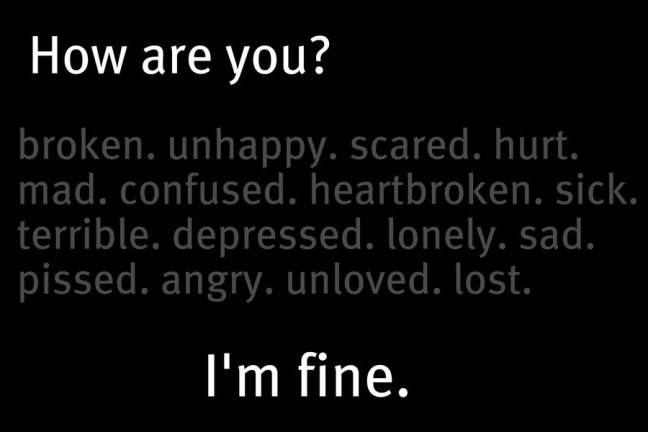
“I’m Fine.” (But What Are You Really?)

I'm fine

“I’m fine.”

How many times have you declared those words?

Hundreds?

Thousands?

Maybe more?

And how many times were those utterances accurate, describing your well-being as exceptional? Thriving? Or, in the more modern use of the term, simply satisfactory?

And how many times were they offered in reflex, in deflection or even as an outright lie?

__________

Here are some of the true feelings that can hide behind “I’m fine.” Do you relate to any of them?

“I’m afraid that if I start talking, I’ll start crying.”

My world is a mess right now and I’m trying to just get through. I may look okay, but I’m really just going through the motions.

“I’m trying very hard to pretend that I’m fine. Please don’t intrude on my delusion.”

If I really paid attention to my intuition, I would probably know that something is not right. But I’m not ready to face it yet so I’m going along with the idea that I’m fine.

“I’m not fine, but I don’t feel safe sharing that with you.”

Things are really hard right now and I wish I could talk about it but I’m afraid that you’ll ridicule me or somehow add to the pain. So I’d rather play it safe and keep my feelings tucked inside.

“I don’t know how I’m doing, to be quite honest with you. I don’t really give it much thought.”

I haven’t allowed myself to slow down enough to be aware of how I’m doing. I stay busy and pretend that as long as I’m doing, I am fine.

“I’m afraid that if I admit to not being fine, you’ll see me as weak.”

I know you see me as the strong one. The one that holds it all together. And I don’t want to be seen as weak or have you think that I can’t be counted on.

“I’m not fine and that’s my problem.”

I don’t want to burden you with my troubles. You have enough on your plate.

“I believe that I should be fine, so I play the part to the world.”

It’s been a long time since the event. I have so much going for me. I have nothing to complain about. I feel guilty for not feeling fine when so many others have it much worse.

“I don’t have the energy to explain my not-fineness to you.”

I’m tired. Defeated. And even just the thought of trying to explain how I feel is exhausting. So I give you the two syllables needed to stop you from probing further.

“I’m frustrated or upset with you, but I don’t want to rock the boat.”

I’m not fine, but I’m afraid that if I tell you how I feel, you’ll be angry or disappointed. And my fear of your reaction is greater than the pain of holding back. For now.

“I was taught that my feelings aren’t valid. So I suppress them.”

My parents taught me that feelings were stupid. I learned that nobody will listen or respect my emotions. So they stay hidden. Even from me.

“I want to be left alone.”

I really just want to crawl into bed and hide under the covers until this fades. Please don’t come in after me.

“I need time to process my feelings and put words to them.”

I want to open up, but I need to do it at my own pace once I wrap my brain around what I’m feeling.

“I need someone who will just listen. Not try to fix things.”

I’m not fine. But I’m also not helpless. I want to be able to share my feelings without you trying to step in and fix everything.

__________

I’m not suggesting that the next time the cashier at the grocery store asks you how you’re doing, you should respond with a truthful unloading of your current worries. Unless you want to be the one they all try to avoid when you walk through the door, that is.

After all, many of our daily interactions are superficial and that’s okay.

But not all of them are.

And when “I’m fine” becomes a habit, a reflex, that we apply to our friends, family, therapists, doctors and even ourselves?

We’re robbing ourselves and our relationships of the vulnerability and connection that comes from the courage to respond with authenticity.

So next time somebody asks how you’re doing, respond consciously.

Here are some words to choose from:

sad  nervous  excited  anxious  lonely  energized  confused  frazzled  aroused  irritated  content  elated  angry  lost  melancholy  fatigued  overwhelmed  engaged  hurt  fabulous  frightened  playful  relieved  embarrassed  awed  vulnerable  relaxed  jealous  unsure  apathetic  curious  grief-stricken  grateful       rough around the edges   better every day      making progress     happy to be here

Or even just fine.