
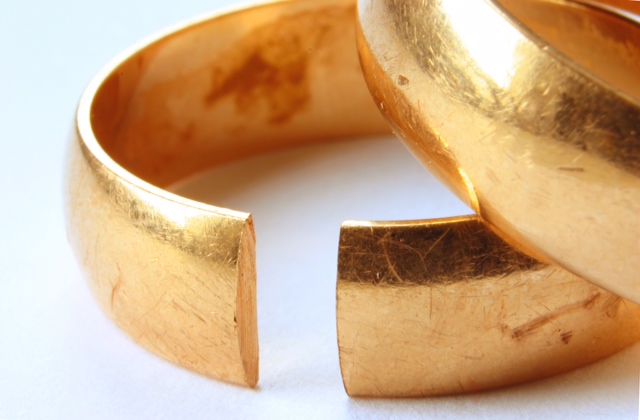
When will my divorce be over?
It seems like such a clear-cut question, doesn’t it? Obviously, the divorce is over when the legal process is finalized and you receive a decree embossed with your local court’s seal.
But that’s only a piece of the puzzle; that’s when the state sees you as divorced. Not necessarily when you do.
Because a divorce, like a marriage, is so much more than a piece of paper.
There are certain benchmarks that you have to meet before you can relax and truly see your divorce as over. These are in no particular order because they may occur at a different point for each person. And the timeline for healing will be different for everyone.
Release of Hope
Before you can view your divorce as final, you have to first accept that your marriage is over. Maybe you’re a fixer and you are still desperately trying to patch things together. Maybe you are still in disbelief and you keep hoping that your soon-to-be-ex will change his or her mind. Or maybe you have weathered many ups and downs over the course of your marriage and you are holding on to the idea that this down will again be followed by an up. It makes sense to hold on to hope as long as possible. After all, you don’t want to discard a marriage that is still salvageable. However, it’s also important to accept that you cannot control your partner’s choices and you cannot save a marriage on your own.
Acceptance of Circumstances
Divorce changes every aspect of your life – from living situation to lifestyle. Maybe you lost money in the deal or were ordered to pay alimony. Or the judge ordered joint custody when you were hoping for full. Perhaps you were made to move out of the marital home and your suburban spread has been replaced with a run down apartment. You may feel like your current situation is not fair, that you are being made to pay for situations beyond your control. And you may be right. Divorce isn’t about fair. It’s about getting through and moving forward. And that begins with accepting where you are.
Completion of Legal Matters
Divorce may be more than a piece of paper, but the acquisition of that paper sure can be a drawn-out and expensive process. And it’s difficult (if not impossible) to feel like the divorce is over while you’re still producing documents and cutting checks to lawyers. I have such empathy for those involved (either by circumstance or state law) in a year+ process (although I didn’t always feel that way). It’s difficult living in that limbo of separation where you’re neither married nor divorced.
Construction of Framework for New Life
It’s difficult to feel a sense of completion when the old chapter may be finished but the next is still a dark void. It’s much easier to feel like the divorce is fully behind you when you have at least the basics for the next steps in your life sketched out. You don’t have to know everything about the life you want to create post-divorce as much will unfold over time, but aim for some insight. Put the energy into laying out the framework for your new life; scaffolding makes moving forward more manageable.
Tempering of Bitterness
Are you still holding on to anger towards your ex or carrying a sense of derision for relationships in general? Even if you aren’t ready to date again (or even ever want to date again), this negativity makes it difficult to put the divorce behind you. Sometimes the residual acrid emotions are our attempt to avoid facing the sadness and loss hidden beneath. Other times, the anger is our shield because we are afraid of being seen as vulnerable and weak. Much of the time anger is simply pain screaming to be heard. So listen and answer.
Easing of Fear
Much like anger, fear can serve as a tether, holding you to your divorce. It’s scary facing the world alone when you’re used to having your spouse by your side. It’s terrifying to start over when you don’t even trust that you can stand. It’s daunting to think about dating again and starting a new relationship from scratch. And it may be even scarier to imagine being alone forever. The only way to lessen fear is to face it. Once you conquer those first few “I can’ts,” you’re confidence will build until you know you can.
Restoration of Balance
There is nothing balanced about life while you’re going through a divorce. Your emotions are running the show and are frequently as well behaved as a toddler on a sugar crash. You may be eating too much or too little or just too much of the wrong stuff. Perhaps you’ve become adept at avoiding reality through alcohol or distractions. Part of regaining your life after divorce is establishing healthy habits and a balanced environment. Re-evaluate what occupies your life and remove what no longer serves you.
Ultimately, your divorce is over when you see it as something that is a part of your story, your past. It no longer defines you or limits you. It speaks of where you’ve been, not where you are going. It’s an ending, yes. But one that allows a new beginning.


 Lessons From the End of a Marriage