Have you ever noticed that children do not understand the concept of a guilty pleasure?
Sunday afternoon found me in the bath tub after the completion of a daunting to-do list. I decided to do this bath right – I had the window open to listen to the rain, a glass of wine and a newly downloaded Kindle book. I had no rush, no worries.
As I lay back into the scented bubbles, enjoying the feeling of my arms floating, cradled by the warm water, I was taken back to my childhood.
I used to spend hours in tubs – both of the hot and bath varieties – savoring the slippery denseness surrounding my buoyant frame. I would stay in the waters until hunger or a completed book drove me out, never feeling guilty for wasted time or feeling pressure to accomplish something more meaningful. On the nights I spent at my dad’s apartment in my childhood, he would knock on the bathroom door to check on me about every 30 minutes. Many nights, he made it to four knocks before I finally emerged from the tub.
I understood the concept of pleasure. But I never thought to associate it with guilt.
So why does that change? Why do I now feel guilty or lazy when I indulge? Why do I judge myself?
Part of it is out of necessity. When we are young, our parents and guardians act as our voice of reason, limiting our overindulgences (“You can only have two cookies”). We do not have to self-limit; it is done for us.
But, at some point, that regulation has to shift to us. We have to learn how to work before play and eat our broccoli before our ice cream. We become the care takers and the needs of others are placed before our own. Without that mental management, we would all be living in our parent’s homes, eating Oreo’s all day and playing video games. Well, except for me. I’d be in a bath tub with a book. And probably broccoli.
The problem is that, at some point, many of us get too good at using that internal voice. Not that we always obey it (Ever had an internal argument about if you should eat that dessert? Yeah, who won?) but that we usually feel guilty when we do not.
We indulge. But we don’t necessarily enjoy.
That dessert tastes much better when you’re not berating yourself for eating it. The hope is that the internal monologue of guilt will keep your willpower in check. That if you feel bad about the behavior, you will avoid it in the future. Reality doesn’t work that way. Rarely does guilt about an indulgence keep us in check. We just act as though it does. The reality is that our cravings for whatever the indulgence are more fully satisfied when we fully give in to the experience.
So what’s the answer? How do we balance our need for self-regulation and yet still enjoy our indulgences without guilt?
I know that I am going to let my parental mind set my guidelines and then turn control over to my inner child to enjoy the experience.
All I can say is that it’s good my Kindle has limited battery power. Otherwise, I may never get out of the bath:)
Christmas can be such a polarizing season. Some people are enraptured by the sights and sounds, while others, lamenting what they have lost or never had, fall into despair. Why is it that a holiday can have so much power to drive our emotions? Why are some okay with their lives from January through November, but then feel despondent about their lot when the month clicks over to 12? Why do others allow stress to accumulate throughout the month, only releasing it with the ribbons on Christmas mornings? How is it that a holiday that emphasizes togetherness creates intense loneliness in so many?
It’s simple, really. There is no other time of the year as fraught with expectations as Christmas. And loneliness, stress, and disappointment hitch a ride on those expectations, sliding into our minds undetected. We can choose not to welcome them. We can use awareness to exorcise the ghosts of Christmas’s past and future, allowing ourselves to embrace the present and whatever gifts it brings.
Ghosts of Christmas Past
When I was young, I spent Christmas with both my parents. As with all families, we had rituals and traditions. I remember my mom making pineapple ham and my dad coming in from a bike ride, the smell of sweat blending with the scent of the pine needles on the tree. I remember the Christmas eve church services, with me squirming between them awaiting the tradition of opening one gift that night upon our return. I can picture our rides through town, viewing the lights in the trees and luminaries that lined the streets.
And then we were two. My parents divorced and my dad moved across the country. It took us some time to find our stride. Those first couple years felt empty; traditions carried out even though a critical member of the team was missing. We tried to keep it the same, fought against the inevitable change. It didn’t work. It never does.
Eventually, we created our own traditions, some carried through and some newly invented. We had a family friend join us for celebrations, her energy completing the triad. We took trips. We celebrated with other families. Sometimes we had money. Often we did not. But it didn’t matter. We let go of Christmases past and, in doing so, created wonderful Christmases in the present.
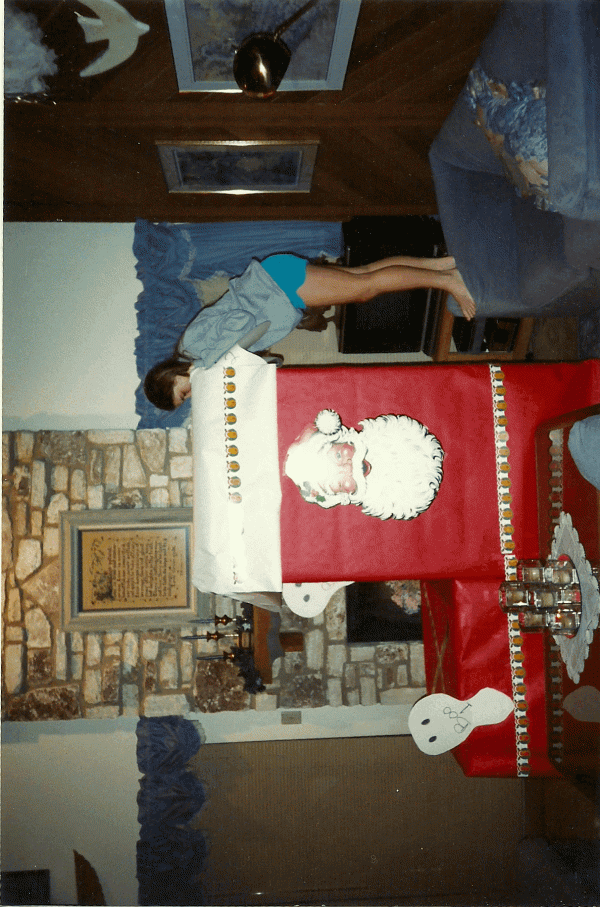
This was one of my favorite Christmases. My mom obtained and wrapped a refrigerator box and a washing machine box and assembled them to make a stocking. I was shocked when I woke up that morning and, at 16, it took a lot to impress me. Our family friend joined us and they both had fun laughing at me as I crawled through the endless “stuffing” that filled the stocking and surrounding wrapped gifts, many of which were inexpensive. This was a great example of how creativity and attitude matters more than money.
I’m thankful for those childhood experiences. They taught me to be flexible and to work within the present reality. As I entered into married life, my husband and I followed a similar model. We were lucky enough to be “adopted” by various families over the years. On some Christmases we traveled, and some we did not. Sometimes we saw family; more often we were devoid of blood relatives. Each year was different. And each year was wonderful in its own way.
At my ex-in law’s on Christmas in 2001.
If you have children, realize that your attitude towards the holiday is more important than any traditions. If your family has changed, it is futile to try to recreate the Christmases of the past. But that doesn’t mean that your Christmas cannot still be wonderful.
Ghosts of Christmas Future
Not everyone is haunted by the past. Some people’s expectations are fixated on the future. It is easy to allow expectations to build. We expect Uncle Bobby to act differently than he usually does and we get stressed when his good behavior fails to manifest. We picture perfect children, gleaming and squealing in glee. We envision a table piled high with delectable goodies worthy of Martha Stewart’s kitchen. We allow our minds to ponder what glorious gifts might lie just beneath the wrappings. We watch movies filled with perfect families and see commercials pushing items, implying that they will make your life perfect as well.
These daydreams may be pleasant, but they have a dark side. Unless you are visiting Martha, the spread will not be perfect. Your kids will inevitably allow grouchiness to overcome them by afternoon. You will probably not find the winning lottery ticket in you stocking. In other words, Christmas will be real. It is easy to become disappointed when we allow our expectations to grow well beyond our realities.
The ghost of Christmas future is often hardest on those who are or feel alone. The divorced parent who does not have custody over the holiday. The single person without family in town. At no time can you feel more alone than during a holiday that celebrates togetherness. But, you are only alone if you allow yourself to be. Let others know you do not have a family to celebrate with; the offers will likely come. Some of my best Christmases were spent with the families of friends or employers. If you’re willing to speak up and be vulnerable, you will find an open home and open hearts. They may not be family, but they are family for the day and sometimes that is enough.
If you prefer not to join another’s celebration, look for volunteer opportunities through church or Meetup.com. Helping others is a surefire way to get your mind off your own troubles. It may feel as though the whole world is paired up or celebrating with family, but that’s just the message, not the reality. You have choice in the matter. You can choose to suffer or you can choose to smile.
The Gift of Christmas Present
This year, my home will be full of family, yet none of them are related to my fiance or me. There is no tree in our living room, nor lights on our house. I will be serving a vegetarian spread with nary a ham hock to be found. The kitchen will be messy and the plates will be mismatched (and chipped!). But there will be laughter and games. Friendship and smiles.
It won’t be like the Christmases of the past nor will it be a celebration in an imagined future. Rather, it will be the Christmas of now. Exactly as it should be. Let go of the ghosts lamenting the past and brush of those whispering of an imagined future and be with the Christmas of the present.
I wish you and your loved ones a happy (and real) holiday:)





 Lessons From the End of a Marriage