Let it Go

I’ve been in the classroom for thirteen years. And, in those years, I have accumulated a lot of…stuff. I have games and cards for curriculum I haven’t taught in many years. I have boxes filled with files that speak of units past. I have workbooks and textbooks, long since retired, that no longer correspond to the math that I (or anyone in the state for that matter!) teach. I have hundreds of labeled bags filled with measured out amounts of random items – pennies, pipe cleaners, little foam blocks – all used for math labs that are now curricular dinosaurs.

For years, I’ve carted around more than a dozen file boxes filled with these materials. I held onto them at first because I trusted that the educational pendulum would swing back and I would again be responsible for the teaching of polynomials and imaginary numbers. But with each election and each testing mandate, the chances became more and more slim that those topics would again trickle down to the middle school level.

But even as I let go of the notion of teaching these units again, I still held on to the boxes. Because those boxes held more than just paper and plastic; they contained the years that I considered my best in the classroom.

For a few precious years, I had the perfect storm in education: great curriculum, great class sizes and great students. By holding on to those boxes, I was holding on to the idea that the perfect storm may brew again and I could teach higher-level concepts to small groups of hard working kids. Every time I would move or sort through those boxes, I would grow sad, reminiscing about what was and what was no longer. The newer units didn’t hold the same appeal, not because they were worse but because the older ones were rose-tinted with memory, idealized in time. And with the old taking up permanent residence in my classroom, it was impossible not to compare.

I finally realized this year that keeping those boxes in my classroom is pretty much the equivalent of keeping my old wedding photos on my wall.

Uhh…no thanks.

It’s amazing the mental choreography we will create to attempt to rationalize grasping on to the old. We pretend that we may need it again in some, as yet, unknown future. Anxiety and worry speaking the language of “what ifs” in order to keep us prisoner to the detritus of our pasts. We claim that it serves as a reminder of the good times, even though its presence dulls the new. We allow memory and hope to create value where there is none and, even worse, waste energy and other resources on lugging around the boxes, both real and metaphorical,  from our former lives.

So this morning, I sorted through thirteen years of lessons and saved projects. I filled recycle bins and garbage bags and re-gifted the plastic tubs to a new home.

It’s a little scary.

Letting go always is.

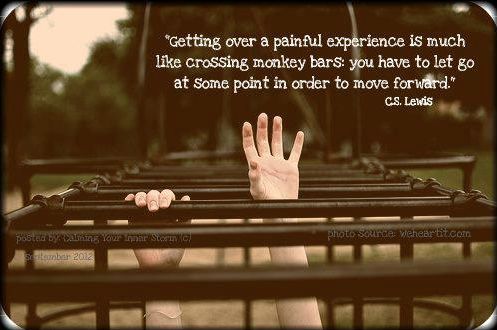
But you can’t reach the next rung until you’re willing to release the last.

And it’s also freeing.

Letting go always is.

Because it’s only in releasing our grasp on the past that we are able to fly towards our future.

8a0001272065287cc7e5c51536b59326

Forest Fire

Smokey the Bear tells us that only we can prevent forest fires.

But that’s not really true.

I mean we can avoid throwing lit cigarettes on top of dry pine needles and we can faithfully cover our campfires with dirt before retiring for the night. But those measures won’t stop the errant spark from catching a ride on a gust of wind. They won’t redirect the lightening’s path away from the dead wood that riddles a mature forest. Even the professionals, with their fire breaks and controlled burns can’t really stop forest fires. They can only hope to mitigate their damage.

Because forest fires are an inevitable part of nature and nature always has its way.

We tend to focus on the destructive properties of the fire. And certainly, when fire and civilization intersect, the results can be devastating. The loss is apparent in every charred stump, the once verdant forest transformed into an alien wasteland.

We focus on the loss because it is what we feel acutely. It is sudden and catastrophic. We cannot help but contrast the blackened skeletons with their once proud and rich forms.

But the fire is more than an ending. It is a beginning.

The conflagration clears away the dead and dying trees, making room for the seeds protected just below the soil to begin their journey to the sun. The blackened trunks enrich the soil, replacing nutrients that had been leached for centuries. Any illness that may have gripped the forest is extinguished with the flames, allowing an opportunity for new and healthy growth to emerge.

I’ve begun to see my divorce as a forest fire. Devastating. Destructive. Inevitable. Yet also cleansing, burning away all that was dead or dying or diseased. Leaving behind richer soil and brighter sun to nourish even better growth. And I’ve now gone from wandering lost through the charred stumps of the old growth to reveling in the beauty of the new.

So even though Smokey is wrong and we cannot prevent every forest fire, we can do our part and when they do happen, we can strive to see the potential hidden just beneath the newly exposed earth.

grow

When Gratitude is Your Wrapping Paper

If someone had told me five years ago that I would ever be grateful for my tsunami divorce, I would have thought they were ignorant. Or cruel. Or, at the very least, utterly clueless and insensitive.

But, you know what?

They would have been right.

My divorce was a doozy: 16 years of what-I-thought-was wedded bliss suddenly amputated with a single text message. This was followed by the discovery of marital fraud and felony bigamy. In one instant, the life I had was gone and it was stolen by the man who had lovingly kissed me goodnight for my entire adult life.

Read the rest of the post here. 


6 Reasons You’re Struggling to Move On After Divorce

You say that you want to move on, putting the divorce behind you and getting on with your life. You claim that you want to feel better, to stop crying and start living. Perhaps you even pronounce that you’re over your ex and that you’re ready to start looking for someone new.

Yet that desired progress isn’t happening.

The life you envision isn’t unfolding and instead, you find yourself stuck. Anchored in the muck and mire of the divorce. Not a member of your old life, yet not yet fully living in your new one.

It’s easy to make excuses for why you can’t seem to move on. You’re angry, and rightfully so, that your life plan turned out to written in disappearing ink. Maybe your ex cheated, stealing your ability to trust along with your imagined future. Perhaps your bank account is anemic and all of your energy has to go to replenishing its stores. You might have endured horrible court battles that wounded you and your children. You may be adjusting to life as a single parent or a sole breadwinner.

But those are all excuses, bindings that keep you lashed to the past. After all, it’s easier to say, “I can’t move on because of (insert favorite excuse here)” rather than shouldering the responsibility of moving on by yourself.

So, here is your metaphorical slap across the face. This is the advice you’ve needed to hear, but your friends and family are too nice to say it. But I’m not your friend. I’m someone who has been there, done that and now makes the T-shirts. I am okay with making you a little angry if it helps to make you better.

I’m also not going to tell you to “get over it.” I find that phrase insulting and shortsighted, only uttered by people who have never felt a certain depth of pain or who prefer to bury it rather than address it. But even though there are some things you don’t just “get over,” you don’t have to let them hold you back.

If you’re having trouble moving on, you’re probably doing at least one of these things wrong.

Forgiveness

My response to people encouraging me to forgive was one of indignation. How could I be expected to forgive? He deserved all of the wrath I could send his way and then some. How dare someone tell me I should let that go?

But they were right. By refusing to forgive, I wasn’t hurting him. I was hurting me. I was allowing myself to be a prisoner to his actions and allowing them to dictate my feelings. Forgiving him was a gift of peace to myself.

Forgiveness isn’t a pardon. It acknowledges the wrongs and then wraps them in compassion and acceptance. Forgiveness is an inside job, quietly accepting the apology you never received.

Forgiveness is a difficult road. But you’re worth it.

Grasping

When we lose everything, it is human nature to grasp onto whatever remains. And, often in the case of divorce, what is left is the pain. And so we hold onto that pain, claim it. Own it. Defend it. Even feed it.

That pain can become our identity. I remember how I would receive care and kindness when I was hurting, yet would be comparatively ignored when I was not. It’s tempting to stay in pain, to allow others to continuously nurture our wounded hearts.

But is that really what you want? To be the hurt one? The weak one? To be so determined to lay claim to your pain that you do allow anything or anyone else in? Releasing that pain is strangely scary. It’s willingly loosening your grip on your past and trusting that you’ll land safely.

Let go. It’s worth it.

Associations

Do you have triggers that are like a time warp to the past, pulling you back to moments of agony and anxiety? I do. In fact, I would say this has been my greatest challenge — learning to respond from the present and not from the past.

Even though some healing is passive, slowly softening with the passage of time, triggers are often more resistant. They take repeated attention and deliberate action to remediate. Triggers and associations are not inevitable; you can retrain your brain.

It takes work. But you’re worth it.

Continue to read the rest.


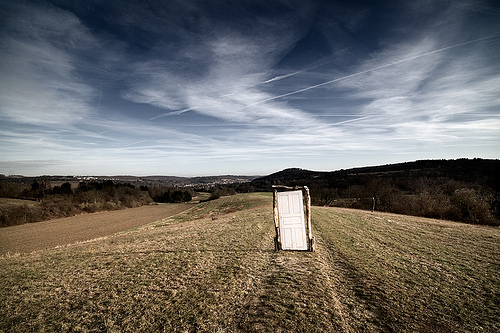
Closed

I used to be obsessed with finding closure.

I pursued it with the intensity of Tiger chasing a tennis ball, convinced that it contained the peace I so desperately needed. I yearned for it at night and awoke frustrated when it hadn’t been gifted to me in my slumbers. I kept searching for the one thought, the one idea, the one fact that would seal my past away behind an air-tight door. I feared that closure would not be possible within the limitations my circumstances provided. I worried that I was dependent upon him to create that closure. I was concerned that I needed an apology or at least an answer to form that seal against the pain. An answer and apology that I knew I would never receive.

I started to believe that my closure would forever be incomplete, a door ajar allowing the whispers of the past to carry through.

And that thought scared the hell out of me. So I used that fear to drive my search for the elusive closure. I had to be creative since I had few answers and even fewer signs of remorse.

Closure is closely linked with understanding. If we know why something happened, it’s easier to accept its occurrence. But sometimes circumstances don’t allow us to sift out the truth from the past. But you can create your understanding even when you don’t have all the answers.

I started my search for understanding by learning about and systematically affixing labels to him: sociopath, narcissist, addict, etc. None seemed to truly fit, but they allowed an anchor for understanding. Next, I assembled pieces of the past like a giant puzzle, looking for patterns and ideas that fit. Slowly, an image began to emerge of a man that carried a dark passenger, a man that was defeated by his shame and his secrets. My conclusions may be accurate or they may be entirely woven of fiction. But it doesn’t really matter where understanding comes from; it brings relief regardless of its origins.

I had hoped that understanding was enough to bring closure. It was not. It answered the “why” but still did not alleviate the pain. My anguish was still a doorstop propping open the door to the past. So I focused on being thankful, using gratitude to soften the sorrow. Allowing the perspective of the bigger picture to bring purpose to the pain. And it helped. But closure was still hiding. I felt like there was still some unanswered question that kept me from being able to reach a conclusion.

Eventually, I tired of the search. I stopped looking for what I couldn’t seem to find.

I figured closure would remain a dream for me.

But then I drove by my old house last Friday and felt nothing but gratitude. And I realized that I had finally had it. My search for closure is now closed.

Sometimes the best way to find something is to stop looking for it.

Sometimes you have to trust that doors will continue to open before you can close the one you came in through.

And sometimes dreams do come true.