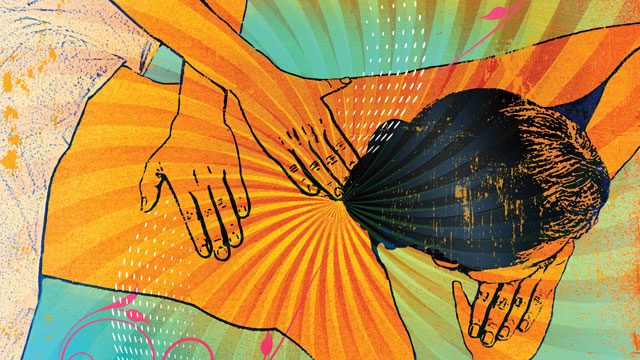
When you are facing the loss of a primary relationship, your body is also in mourning for the loss of touch. One of the primary ways that we give and receive comfort is through physical contact; it lowers blood pressure, lowers anxiety, and helps to alleviate depression. Unfortunately, with divorce, when you need touch the most, it is often the most absent. This is a time when regular massage is not a luxury; it is a critical component of healing your body and mind.
What is the difference between mental rehearsal of an event and creating expectations for the event?
Image via Wikipedia
There has been quite a bit of research and discourse in the last few years about the nature and benefits of mental rehearsal for athletes and others in positions that require a demanding and skilled physical performance. They are trained to visualized their body working efficiently, picture themselves executing each move perfectly, and feel their mind and body in perfect harmony.
These visualization techniques have since been applied to other areas, demonstrating that mental rehearsal can be a powerful tool for success. Cancer patients picture their T-cells squashing the invading cancer. Surgeons mentally rehearse each step of a complicated procedure countless times before even touching the scalpel. Public speakers view themselves giving their presentation, calm and confident.
For those undergoing a major life transition, visualization can help to calm anxiety and provide hope for the future. You can mentally rehearse for your time in court, visualize yourself becoming whole and happy, see yourself in a new relationship. All of this mental energy can help you on your path to healing.
In all cases, the most important aspect of visualization as a technique to improve performance or outcomes, is that is effectiveness depends upon one’s ability to be self-aware and monitor one’s responses to stimuli.
It is important to note, that in all of these examples, the strategy of mental rehearsal focuses on the individual’s performance, not the behaviors of those around him or her. That is the primary distinction between mental rehearsal and expectations; the former depends upon actions that are largely under your control, whereas the latter is subject to the behaviors of others not under your jurisdiction.
It is all too easy to spend our mental energies building expectations. This strategy will only lead to disappointment; however, as others can never live up to their fantasy counterparts. Many times, our happiest moments are those that caught us unaware, before any expectations had a chance to take root.
Choose where you want to spend your mental energy: building expectations that can be dashed by others or rehearsing you being the best you possible. I know where I try to focus my energies; in fact, I am seeing myself running an effortless ten miler this morning even though it’s frigid outside. Now, let’s see if that image holds once I get that first blast of wind!
Divorce is a major reboot of your life. Control-Alt-Del of all that is familiar. The process can vary, some may have time to save and safely exit their open files. For others, applications are subdued with repeated clicks of the “force quit” button. Divorce causes damage to the system, errors and gaps. For most of us, we have to start our lives over again in safe mode.
Safe mode is a troubleshooting option for Windows that starts your computer in a limited state. Only the basic files and drivers necessary to run Windows are started. The words “Safe Mode” appear in the corners of the display to identify which Windows mode you are using. If an existing problem does not reappear when you start in safe mode, you can eliminate the default settings and basic device drivers as possible causes.
After a divorce, safe mode means that your life is powered up again in a limited state. Only the necessary applications for living are in place; it is survival mode. There is nothing wrong with this state; in fact, it is often required to be able to function at all. However, just as a computer in safe mode is not truly operational, a life in safe mode is not truly living. Safe mode is a time, a space, a tool that should be used to diagnose and treat any maladaptive hardware or software issues so that a full reboot can occur.
Look at your own life. Are you in safe mode? Does this state still serve you, or is time to complete the repairs and perform a full reboot of your life?
When my husband first left me with a text message, I was outraged. I felt impotent, my voice stolen from me just when I had so much to say to him. How could he leave me and give me no answers? How could he disappear and not let me talk? For months, I sought solace in the thought that I would be able to take the stand in the felony bigamy trial against him and again in the civil divorce case. I held tight to the thought that he would have to face me then. Then I would have my say. Then I could have closure.
As events unfolded, I learned the bigamy would be settled with a diversion and no trial would be forthcoming. The divorce ended much the same way; I saw him, but was not allowed to speak to him.
So, there I was. Eight months had passed since the fateful day. The two opportunities I saw for closure had come and gone. I was at a crossroads; I could either come to terms with never having closure, or I could seek closure within myself. I chose the latter.
The problem was, even though I had committed to a path, I had no idea how to move forward. I thought about what would need to be true for me to not be stuck in the past, mired in the muck created by the whole experience. First, I realized that I would need to find a way to reframe the experience in a positive light. That naturally paired with the wellness journey that I was on and that I help to guide others along as well. I would need to have a clear picture of who I was in the marriage and what I could learn from going forward. I knew that I would need to take back my voice, not to talk to him, but to share my story in a way that could help others. Finally, and most importantly, I realized I needed to soften towards him, replacing some of the anger with compassion. That last part was the hardest (and sometimes still is).
As I worked on these goals, I found that I began to develop a peace about what happened. It gave me ownership and took me out of victimhood. It shifted the power to me and I no longer needed him to find closure and move forward. I found closure within.
Pain is inescapable and inevitable, but it does not have to become a way of being. Recognize the pain, embrace it even, and see what it can teach you. Much as physical pain is often our body’s way of alerting us that something is wrong and needs addressing, emotional pain is the mind’s way of letting you know that there are shifts to be made. Your pain does not have to be your torturer; it can be your teacher.




 Lessons From the End of a Marriage