And for my fellow introverts, here’s an open letter to share with the extroverts in your life.



I watch friendships form every day. I see the new kids slink through the halls and into the classrooms on their first day, both wanting to be invisible and also yearning for recognition and acceptance. Their first interactions with the other kids are often uncomfortable, but within the span of a week, most of the new students no longer stand out as different.
It’s easy to make friends in childhood. School provides both the structure and freedom needed for relationships to develop. Classes and lunch schedules allow for repeated exposure to the same people so that familiarity easily builds. The down time in the halls and the lunch room provides an easy opening for exploration and banter, often centered on the shared experience of school.
It’s not as easy to make friends as an adult.
Especially as an introverted one.
Introverts can easily underestimate the importance of friendships. After all, we don’t feel the same intense pull towards others that our more extroverted brethren experience. Our social groups are smaller, our interactions fewer. The need for time alone is often more pressing than the need for connection.
And yet, we need friends just as much as the gregarious. Loneliness and a lack of human connection has been associated with both lower mental and physical well-being. We introverted ones may treat friendships as a nicety, but they are really a necessity.
Introverts tend to be adept at maintaining already established friendships, especially with people that are understanding of their periodic need for hibernation. But when life circumstances remove those familiar relationships, introverts can stall in the quest to create – and build – new friendships.
So how can introverts make friends in adulthood?
Adult life doesn’t easily provide the nutrient-rich agar that friendships feed off of. We may encounter others sporadically or only with a task-oriented goal in mind. There are no teachers or counselors to intervene on our behalf, requesting that others extend a hand.
By the time we’re old enough to rent a car, we have become quite comfortable with the room within our own minds and, as independent beings, have the opportunity to curl up and stay there. This natural introversion can come across as cold or uncaring, leading to further isolation.
But with just a few tweaks and adjustments, even the most introverted can find and nurture new friendships.
Accept that you will be uncomfortable sometimes.
Like most introverts, I am comfortable in my own home. My own room. My own head.
But that’s not where potential friends reside. In order to meet people, you will have to leave your comfort zone. You will be in environments that may feel overwhelming. You will be asked to stretch beyond your unusual routine. Learn to distinguish between ordinary discomfort and your intuition telling you that something is amiss. Refuse to pander to the former and what was once unsettling will become easier to navigate.
1 – Seek out one-to-one or (very) small group interactions.
Play to your strengths. You likely find large groups of people draining and even isolating. While an extrovert may throw a party to meet new people, you’ll be better served by inviting an acquaintance to coffee.
Recognize the numerical tipping point where you go from. “I like this” to “This is too much” and strive to keep your social interactions within that limit. When you do find yourself in a big group, try to find or create a smaller, more intimate gathering within (or just beyond) the masses.
2 – Say yes.
I know your book is calling. I know that you crave the solitude of your bed after a crazy day. It’s easy to make excuses to those invites that find there way to you. To beg off those intrusions on your peace.
Make a promise to yourself to say “Yes” to a certain number of invitations every month. The gathering may not exactly be your cup of tea (again, you will be uncomfortable sometimes), but you’re opening the door to allowing someone in. And you never know, they just might become a friend.
3 – Plan for buffer zones.
If Maslow had written a hierarchy of needs for the introvert, alone time would certainly be on the lower rungs. In order to both maintain your sanity and to ensure that you’re at your best in social situations, plan for some down time both before and after any taxing interactions.
You may be surprised how minimal these need to be in order to be effective. Try wearing headphones to block out others on your daily commute or diving into a book for five minutes in the parking lot before you exit your car.
4 – Strive for repeated and frequent exposure.
Familiarity breeds friendships. You cannot make a friend in just one encounter. If you meet someone and they pique your interest, look for a way to see them again soon. If you’re trying to meet others, seek out environments where you encounter the same (manageable-sized) group on a frequent basis.
Repetition is especially important in the beginning of a friendship. You may need to have more contact than you usually prefer in the early stages in order to get the relationship off the ground.
5 – Practice extending invites.
I’m good about saying “Yes” to invites, but not as good at initiating them. And since I have a lot of introverted friends, we can easily go quite a long time without contact.
Look for opportunities to extend an invitation. Instead of falling to your default position of doing things alone, see if somebody wants to join. It may feel awkward at first to ask, but often that effort is needed to create the frequency of contact needed for friendship.
6 – Use technology wisely.
On the one hand, the internet and texting technology has been a boon for introverts. After all, we can now “talk” to others without ever leaving our home. On the other hand, it can easily provide an excuse to not have meaningful connections with others as we hide behind our screens.
Use technology as an assist, not an excuse. Send an invite through text. Find potential friends through an online interest group. And then put the phone down and talk to the person. In person.
7 – Find your niche.
If you find small talk awkward and annoying, you may find it easier to meet potential friends that already share an interest of yours.
Introverts often have passions and hobbies that are largely solo activities – writing, model-building, gaming, etc. Since you may not meet others simply by engaging in your interests, it will take some extra effort to find others that share your enthusiasm.
8 – Look outside your familiars.
When we’re in school, our friends largely mirror us. They tend to be of a similar age, background and social class. As adults, we are not limited by the factors that guide childhood friendships.
We find it easier to identify with and bond with those that are superficially like us, but sometimes the best friendships can be formed with apparent opposites.
9 – Identify and manage any social anxiety.
Introversion and social anxiety are no the same thing (the former deals with how you recharge your energy and the latter comes from a fear of “what ifs”), but they can go hand-in-hand.
Recognize if you have any signs of social anxiety that are making it more difficult for you to make friends. Anxiety can be managed and inaction often serves to only allow it to grow.
10 – Communicate your needs.
Your budding friends may not recognize you as an introvert or may be unfamiliar with the needs of the more introspective set. Be upfront with your need for alone time and be clear that it has nothing to do with your like – or dislike – of another.
People are going to respond much more favorably to an explanation of a need for solitude than to constant brush-offs or unanswered texts. Additionally, if you sometimes need a nudge to get you out of the house, let that be known as well.
11 – Maintain your intention.
As an introvert, you need your time alone. Yet you also need meaningful human connection. Once you determine how much you require of each in order to be happy and healthy, make maintaining that balance a priority.
Related – An Open Letter to Extroverts: What the Introverts in Your Life Want You to Know

I’ve always been drawn to small, enclosed spaces. As a child, I would play (and sleep) in appliance boxes that I decorated and filled with blankets and pillows.
I’ve felt very over-taxed and over-stimulated this school year and could tell that I needed to get serious about my self-care. I have a dormer in my home office that has been my meditation nook for a few years, but with its view of my workspace, I tended to be distracted by what I needed to get done.
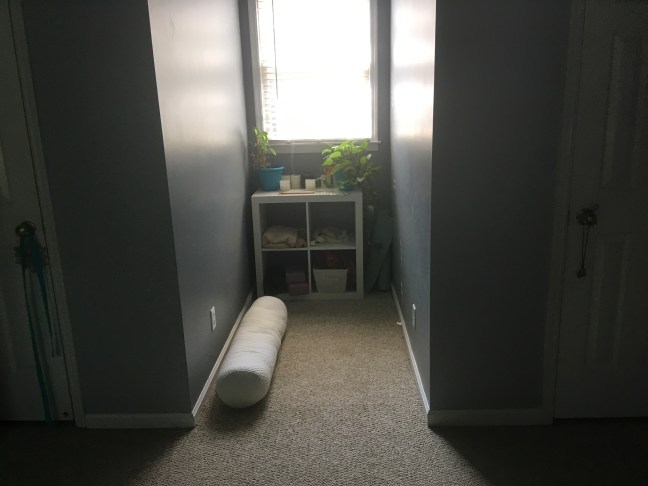
So, last weekend, I added some curtains (to block the view of the computer) and stocked up on T.J.Maxx pillows to make the floor inviting. The combination of soft light, fluffy pillows and incense is like a dose of instant calm.

Now, if I could just figure out a way to have one of these in my classroom 🙂

I’m not an extrovert, but I play one in real life.
Most people would probably be shocked to discover than I am a true introvert – that social situations and crowds exhaust me and I seek balance by being alone. After all, I have chosen to be a teacher. I am outspoken in meetings and not shy to speak in front of a group. On top of that, I have intentionally cultivated a large group of friends and I enjoy spending time with them and having them in my space. I have developed countless online relationships and enjoy time with my online family. Surprisingly, I can be loud. I rarely slow down. And I once rocked a shirt that said, “Sweet Talker in Action” as a kid because I never shut up.

But behind all of that is a woman who feels most at home in her office, a “safe” space of solitude. A woman who would be more comfortable in solitary confinement than in a cell with multiple roommates (not that I ever intend to try out either!). I need my alone time in order to be the public me. In a way, I put on an act every day. It’s still me, but it’s the “on” me. It’s the real me with a booster rocket of extroversion. And if I play the role too long, the tank runs dry.
I was looking for a concise article that would explain characteristics of introverts for my very extroverted husband after feeling overwhelmed by the demands of the beginning of the school year.
I drew a blank.
So I decided to write it instead.
Not all of these characteristics will apply to every introvert. After all, that is simply one label and we are all represented by more than a single word. But I think many introverts will recognize themselves here and I hope that extroverts will find some compassion and understanding for their more reserved brethren.
I envy you sometimes. The way you seem at ease in a crowd. How you seem to know how to initiate and carry on a conversation with no apparent effort. When I’m at the periphery of a crowd, I see you in its center, pulling energy from those around you, like some kind of emotional fusion reactor. And I’m jealous as I feel my own energy waning as the event progresses.
But then, when I’m tucked away in a quiet nook or nose-deep in my latest book, I’m at ease with myself and pleased with my nature. You see, it’s not always easy living as an introvert in an extrovert’s world. We must learn to adapt. To play-act. Or run the risk of being overlooked.
There are more of us out here then you may imagine (usually thought to be somewhere between 25-33% of the population). Some, at the extreme, are obvious – they rarely talk, have a few select friends and work at jobs where the interactions are minimal. But the rest of us? We can be found anywhere – in classrooms and boardrooms, in media and marketing and even in your own home. You see, we’re good at blending in. But sometimes we pay a price.
The following characteristics can help you identify and support the introverts in your life:
I used to be shy. Painfully so. But that’s a learned response and can be changed. Introversion is a character trait found in shy and more outgoing people. You can learn to work with it but it is a fundamental piece of who you are. Many introverts have no problem approaching new people. And then they will retreat to recharge.
The stereotypical introvert is quiet. Bookish. Reserved. Yes, that person is probably an introvert but they are not the only ones. Although I prefer to express my ideas in writing, I frequently find I am the leader and spokesperson for groups. I talk fast and often. I gravitate towards heavy metal and intensity in my activities. Only those close to me know about my need for quiet and solitude. Introversion isn’t worn on my sleeve; it’s carried inside.

I’ve always known I was introvert. My “safe” space has always been a quiet nook with a book. I recharge through time in nature and carefully plan downtimes between social events.
I’ve always known I was an introvert.
But I’ve just now made a connection.
The beginning of the school year is hard on everyone – parents, students and teachers. But I’ve always seemed to find it more difficult than some. Yes, my feet are tired at the end of the long days and my voice cracks from overuse.
But I also inevitably feel drained for the duration of August.
Fragile and bit raw.
Now, sure, I’m not sleeping enough and overwork is a given at the beginning of the year.
But there’s more to it than that.
I have 120 new people that fill my days, filing into my room in groups of 30 every 54 minutes. I have dozens of new coworkers to get to know and hundreds of parents with whom to work. I have no moments of solitude once I enter the school, simply times of noisy and less noisy. In front of the class, I’m animated. Acting a role for the sake of connection and the lesson. In the halls, I act and interact.
I’m good at all of this – the teaching, the managing, the multi-tasking.
But it comes at an expense.
Because for any introvert, being social takes energy.
And navigating new social situations requires even more.
Looking around my classroom on Friday, I could see the effects of the sustained efforts on my students that seem to be of an introverted nature. Like me, they were drained from the energy required to be in an always-on environment. Like me, their nervous systems were on overload and were demanding some quiet and alone time.
I just made this connection between August and exhaustion yesterday while teaching. This morning, I tried (emphasis on tried) to explain it to my very extroverted husband. He just didn’t get it. He wants to be able to fix things and gets frustrated when it’s not an easy fix and, even worse, one he can’t understand.
Like always, I’ll adjust and learn to find the balance in an extroverted world. But for now, I’m just reminding myself that August doesn’t last forever and I will be recharged again soon.
But first, it’s time for some Motley Crue tonight! Hey, no one ever said that introverts can’t be headbangers:)
 Lessons From the End of a Marriage