An Open Letter to Those Who Have Been Ghosted by a Partner

ghosted

I see you.

I know that right now you’re feeling insignificant and discarded. I see you standing there in utter shock, struggling to process how everything changed in an instant. The “before” and “after” alternately body slamming you with the brutal reality. I see you because I was you.

I hear you.

I know that you’re frustrated that your voice, your very right to speak, has been taken from you. I hear your silent screams into the void, the endless question of “why” echoing through the fog. I hear your voice because it follows my own.

I understand you.

I know that you’re questioning everything, running every detail through your mind, worrying each strand of memory like a loose thread. I understand the doubts that are starting to creep in, that you’re wondering what clues you may have missed or even believing that you somehow deserved this on some level. I understand you because I was in that same place several years ago.

The pain and confusion you’re experiencing are totally normal reactions to such a complete and total blow and betrayal.

Being abruptly abandoned without explanation is one of the more painful experiences that life can deliver.

And the first thing you need to understand is that leaving in that manner is a reflection of your ex’s character. Not yours. Some may remind you that relationships take two. And this is true. Yet ending it on this jarring note was a decision made without your cooperation. You may experience judgement from others. Try to be patient with them as they truly don’t understand what it’s like. Even loved ones may seem to blame you. This is often because they cannot bear to imagine this happening to them and so they need to try to make some sense of why this happened to you.

Ghosting is cowardly. Instead of having the difficult conversations and potentially seeing you hurt, they chose to run and hide. That is not healthy adult behavior, especially with a relationship of significant depth and duration. It’s not fair to end a relationship this way. It robs you of any opportunity to ask questions, much less eliminates any chance you may have had to fight for the relationship.

After being ghosted, you are haunted by the unknowns. Those endless questions can drive you crazy. Again, I’ve been there and I took that ride for a time. You may get some answers. It could be that they were seeing someone on the side or that they had amassed secrets that they wanted to keep hidden. I know the temptation to hunt for information is strong; however, I encourage you to keep this urge on a leash. Too much obsession over the reasons for their actions will only serve to bring you more misery. They gave you important information about themselves by leaving this way. Ultimately, that matters more than any details.

Are you desperately looking for closure?

If you’re finding yourself stuck by not knowing what happened like an unfinished puzzle with a lost piece, use what you know to fill in the gaps. Craft a story from the facts you have and your knowledge of your ex. You may not get it right. But it doesn’t matter. Our minds fixate on what is missing. Once you fill in those holes, it gives the brain permission to rest. Here are some more ideas on how you can find closure without your ex’s cooperation.

Perhaps the most cruel part of being ghosted is that the residual doubt and uncertainty lingers and follows you into new relationships. You can easily become anxious, desperate not to be blindsided again. And this worry can easily poison your new relationship if you allow it to simmer. It’s important to learn to trust yourself again. It’s possible that you didn’t signs in your other relationship because you were afraid of what they would mean. Trust that you can not only recognize brewing problems but that you can also face whatever may come.

I’m probably getting a little ahead of myself. Right now, you just want to know how to make the pain end. I wish I could wave a magic wand for you and release the anguish you feel. But I can’t. No one can. Not even your ex.

They are gone.

The way they went about it is cowardly and shitty. Yet the end result is the same. They are gone.

They had all the power in how they chose to end things. You have all the power now in how you choose to move forward.

I’m going to interrupt to share with you a little story about ghosts –

When I was six years old, my parents took me to Disney World. I insisted on waiting in the two-hour line for the haunted mansion ride. They indulged me (yes, I am an only child.) As we approached the front of the line, the details of the house and the spooky sounds playing over the speakers began to frighten me. Panicked, I refused to step inside the attraction.

A short time later, I gathered up my courage and decided that I wanted to brave the ride again. My parents again indulged me, only with some well-deserved grumbles this time.

It turned out that I had built those ghosts up to be way bigger and way more powerful than they were. The fear was within me. The story that they would harm me was one that I was telling myself. And when I walked back out into that Florida sunshine, I felt proud of myself that I had faced those ghosts and made it out the other side.

I know this ghost is different. They have hurt you. Deeply. Yet now they are like a projection in that haunted house – the real danger is over. What’s left is the apparition in your mind. And even that will fade as you again walk back into the light.

You will never forget “the one who ran away.” But don’t waste your life chasing after them. They are not worth your time.

Your love and loyalty and energy are better spent on those that deserve it.

And that includes you.

I see you.

I hear you.

I understand you.

And I believe in you.

Lisa


Want to learn more about my story when I was abruptly abandoned by my husband after sixteen years?


Are you looking for help recovering from being ghosted? 


Separation Anxiety: Understanding Why Rejection Hurts

rejection hurt

Our new pup apparently has some issues with separation anxiety.

So far, he has destroyed every bed that has been secured with him in his crate and tried to eat through a window when he was allowed to roam free (He was wearing the cone of shame when this happened. I would love to see video of how he managed to get his teeth to the window frame!).

Once we realized what were dealing with, my husband immediately researched Cesar Millan’s recommendations for mitigating separation anxiety.

In one video, Cesar highlights the origination of the behavior and why it can be so pervasive.


“Dogs are pack animals. And to be left behind from the rest of the pack is the most painful thing ever.”


Wow.

Now, I know it’s dangerous to equate human emotions to dogs. But when I heard this, I immediately thoughts of the excruciating pain of a sudden break up. After all, our human packs may look different, but social bonds are just as important to us. And to be rejected from the rest of the pack is the most painful thing ever.

In our ancestral past, to be rejected could easily become a death sentence. Without the protection and pooled resources of the tribe, the outcast immediately has to enter into a battle for sheer survival.


It’s no wonder then that rejection registers the same as physical pain on fMRI scans. To be rejected can feel like a literal death sentence. 


This framework also helps to understand why people respond to romantic rejection the way that they do. Especially when the break up is sudden and complete or the withdrawal unexplained and painfully cold.

Some choose to fight, channeling their distress into relentless anger targeted at the people they see as responsible for their dismissal. They may paint their ex as a malicious monster or demonize the other man or woman. Rejection can prompt an offensive attack  or it can lead to a fight to hold on to the rejector. This grasping may manifest physically as stalking behavior or it may exist only the rejected’s mind in the form of obsessive and persistent thoughts.

Others, powered by the fear of being alone, choose to flee, hoping that if they can only run fast enough, they can outpace the pain. They may seek to distract themselves from the rejection or find temporary acceptance from hollow interactions. Maybe they convince themselves that they prefer being isolated and they build walls to ensure that others cannot approach (thus eliminating the chances of further rejection).

And some choose to freeze. Becoming stuck, anchored in their isolation. They turn inward, perhaps blaming themselves for not being enough. As they internalize the experience, they shift from seeing rejection as something that happened to them to wearing it as an identity and projecting this idea that they are not to be desired.


At its most basic, rejection triggers fear. Fear of being alone. Fear of being unwanted. Fear of insignificance. 


At home, we’re working with Kazh to help him understand that being alone isn’t something to fear. He’s learning how to stay calm even as his humans walk away and to trust that the solitude is transitory. We’re building his confidence in himself so that he becomes more comfortable when his pack leaves him behind. And, as the healing leg allows, we’re exercising the body so that it is less likely to send the mind signals of panic.

And it’s not really so different for us. We can practice staying calm in times of rejection, reminding ourselves that isolation is often fleeting. We can refrain from exaggerating the magnitude of the rejection, understanding that feeling like you’re dying doesn’t mean that death is truly imminent. We can focus on building our confidence so that being alone doesn’t equate to feeling helpless. And we can use the body to help to train the mind.

But we, unlike many of our canine companions, can also find a new pack when we’re pushed out of the existing one. A rejection from one person does not equate to a rejection from all.  Instead of seeing rejection as a sign that you’re not good enough, chose to view it as an indication that you’re not the right fit.


When you view rejection as information, it empowers you to find a more fitting situation. Better to know that you’re not a good fit than to spend your life trying to be a square peg in a round hole.


And if you’re still feeling the sting of rejection, play with a dog. They’re good at making you feel wanted. Especially if you have treats:)

Lisa Arends divorce
Obligatory puppy photo.


Lessons From the Sudden End of Marriage

I really enjoyed doing this interview. Susanne asked some great questions that led me to talk about parts of my story that I rarely reflect on. Additionally, I also give some advice for people who are facing a tsunami divorce.


https://www.youtube.com/watch?v=Gb62VHYJN04&feature=youtu.be

Why Love Is About Learning to Sit With Uncomfortable Emotions

What feelings come to mind when you think about love?

Is it the overwhelming tenderness you feel for the child nestled in your arms? Or the passion and desire you feel for a lover? Maybe its the quiet comfort of a shared smile or the intimacy and attachment you feel with a lifelong friend.

When we think about love, we focus on the pleasant sensations, the feelings of seen, being understood, being accepted. Love is the warm hug, the kind words, the desiring glance.

And yes, love is all of those things. It is perhaps our most powerful motivator, our greatest need. All that we do ultimately comes down to being done for love or out of a desire for love.

So if a need for love is universal, why do we struggle so much with finding it, feeling it and expressing it?

Because love is not only about the good feelings.

It’s about learning to sit with the uncomfortable ones.

Because that overwhelming affection is paired with the fear of losing the person that brings you such joy. Love lives alongside of loss. Of rejection. Of abandonment.

Just as love says, “I’m with you,” fear whispers, “But you could end up alone.”

When we focus too much on the fears, by pretending that they are not there, playing mind games to mitigate them or allowing their words to limit us, we inadvertently close the door to love.

Because in order to have love, you have to accept its potential loss. In order to have attachment, you have to risk rejection.

We struggle with love, not because we have difficulty with the positive emotions, but because we try to avoid the uncomfortable ones.

But that’s where love is found.

Sitting right next to fear.

And for you to find it, you have to be willing to find your place between them.


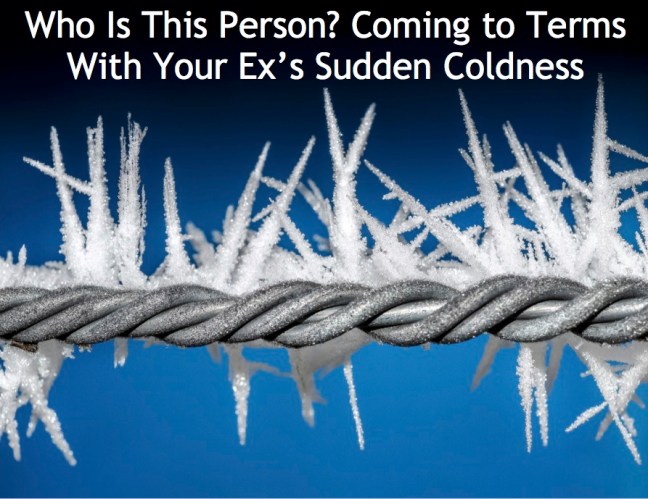
Who Is This Person? Coming to Terms With Your Ex’s Sudden Coldness

sudden coldness

We stood in front of the security line of the Atlanta airport. I felt so loved, so safe in the familiar space created between his chest and his arms, listening to his heart beat through his shirt. I teared up a little as I turned away, already missing my husband of sixteen years as soon as the physical contact was broken.

It was supposed to be goodbye for a week.

It turned out to be goodbye forever.

By the next time I saw him, eight months later in the courtroom, he had become a stranger. A forbidding stranger.

In an instant, this man had gone from my protector to my persecutor. My ally to my greatest threat. And instead of professing love, he was waging war.

It was as though a switch had been flipped.

I just couldn’t wrap my head around the seemingly abrupt transformation. Had this malicious man been hiding in my marital bed the entire time? Did he somehow wake up one morning a different person? Or was he always this way and I was finally able to see the truth?

The reality is probably a little bit of all of those.

Self-protection is at the root of behavior.

To begin with, it’s important to remember that at its core, all behaviors are self-protecting. To that end, it made sense for him to play the part of a loving husband while he chose to remain in the picture. This act allowed him to avoid my rage, sadness and disappointment over the reality of his actions.

Once he left, the distance and coldness again protected him from feeling my pain. In essence, by acting as though he didn’t care, he could begin to believe it. A barrier of disassociation. In this view, the switch was flipped more in an effort to prevent pain than in an effort to inflict damage.

For my part, believing in his good-husband routine insulated me from the painful truth during our marriage. I didn’t want to see the deception he was capable of, so I chose to believe in the best of him. And then once he left, a switch was flipped in me. I couldn’t understand how someone I loved (and who I thought loved me) could do those things, so I chose to see him as all-bad. This view, and the distance it provided, served to protect me from further damage to an open heart.

Cognitive dissonance is a powerful force.

Cognitive dissonance happens when somebody’s beliefs about themselves and their behaviors are not in alignment. It is a very uncomfortable position, and so we often strive to change either our actions or our beliefs so that they again line up.

One of the ways that my ex minimized his cognitive dissonance between the conflicting belief of seeing himself as a good person and the action of committing bigamy is by justifying his choices. Over time (and without my knowledge), he had demonized me, both in his mind and to others.This belief then allowed him to act in a cruel and hateful manner towards me while still maintaining his internal integrity.

My own cognitive dissonance was amplified towards the end of the marriage as the belief that my husband was an amazing guy was beginning to be challenged by the cracks in his facade. And then upon the receipt of the text that ended it, the wool was brutally ripped away from my eyes.

And for the first time, I saw him as he was, not as he wanted to be seen.

You can’t see the big picture until all of the pieces have been assembled.

I now believe that the man I married was not the same man I divorced many years later. He changed, significantly and detrimentally, most likely from a combination of addiction and unaddressed childhood trauma.

Yet, even though he was not the cold and calculating man when we wed, that potential was within him. I saw some of the signs and yet I chose to discount them, brush them off as inconsequential.

And it was only later, once he removed his mask and I began to assemble all of the clues, that I could see how it all fit together. Even though the change felt abrupt, it was more a matter of the final piece being slid into place.

Hate is not the opposite of love.

And then there’s this – the opposite of love is not hate. It’s indifference. When we truly don’t care about someone, we don’t expend the energy to make them miserable. When an ex is trying to make your life difficult or attempting to manipulate you, it’s a sign they have not yet let go. And it can also be an indication – albeit an agonizing one – of their own pain.

When you’re facing the brunt of your ex’s coldness and distance, it’s hard to respond with anything but shock, hurt and indignation. Maybe this will help.