How to End a Marriage

end a marriage

How to end a marriage…

The end of a relationship is excruciating whether you are initiating the breakup or you are on the receiving end of the news. Those who are in the position of being the one to announce the end face the additional pressures of being secure in their decision and they shoulder the stress of deciding how and when to end it.

This flowchart gives you a guideline for how to end a relationship. Obviously, not all possibilities are included, but it can serve as a framework for your own situation.

how to end a relationshipA – Use Your Words (How to Have the Difficult Conversations)

BShould You Divorce? 12 Questions to Consider

CHow to Save a Marriage in Ten Steps

Notice what is absent from this chart – ghosting, abandonment, manipulation and withdrawal. Remember you once loved this person. No matter the circumstances, there is no reason to be cruel.


Feel Like A Man

One of the moments when I loved my now-husband the most is when I witnessed him slide a BB gun into a man’s hands, propping the barrel on the porch railing where it was aimed for some cans.

Although no words were spoken, I understood his motivation.

He wanted his friend, weak and shaky from a degenerative neurological condition, to again feel like a man. And that was an importance I was only just beginning to understand.

My now-husband is a man’s man. He wears his masculinity on his sleeve and is both astute at identifying the characteristics of manhood and at communicating them.

And from him, I’m starting to understand the importance of feeling like a man. And how damaging it can be when that feeling is taken away.

Feeling like a man means that you feel powerful in your own domain. It means that you have control over many aspects of your life and that you receive respect and recognition for your strengths.

Feeling like a man means that you are able to take care of your family. Most often this is financially motivated, but it can also manifest in creating and maintaining a home.

Feeling like a man means that you take seriously the charge of protecting your family. It means that if harm befalls one of your own, you interpret it as a personal failing.

Feeling like a man means trying to find a balance between the very real and powerful emotions that arise within and the cultural message that “big boys don’t cry.”

We ask a lot of our men.

And they ask a lot of themselves.

And sometimes life doesn’t cooperate, stealing away the very things that allow a man to feel like a man.

Health crises rob the body of its strength. Turning a once-strong man into a weak and dependent form. The one whose broad shoulders used to carry others is now reduced to the one being carried.

Jobs are lost and with them, the confidence that comes from respect for position and knowledge. Lost as well is the knowledge that the family is being provided for.

Appreciation and recognition is withheld, perhaps replaced with nagging for what is not done instead of seeing what is done.

Someone in the family is harmed or is unhappy and the situation is internalized, a personal short-coming even when the cause is outside of anyone’s control.

Vulnerability is encouraged, yet that very trait can be turned against him when he is seen as weak or incapable.

I’m learning that all men, not just the alpha, masculinity-on-the-sleeve types, have these basic needs. These primal motivations.

And when a man doesn’t feel like a man, it is all too easy for him to feel like a failure. Depression seeps in, displacing any remaining confidence. He is prone to withdrawal as he questions his value. Addiction can become a welcoming refuge from the shame. It’s a vicious cycle – the less he feels like a man, the less he engages in the actions that make him feel like a man. And that’s the very cycle that consumed my first husband. Only I didn’t see it at the time.

As I watch my husband with his ever-weakening friend, I am grateful for the insight into what it mean to feel like a man.

And I’m careful to not take that feeling away.

How to Save a Marriage In 10 Steps

1) See the Marriage You Have

Before you have any chance of saving your marriage, you have to see your marriage. Not the marriage you think you have or the marriage you want to have or even the marriage you used to have, but the marriage that sits in front of you today. See the pitfalls and see the potential.

Should You Divorce? 12 Questions to Consider

Assuming that at least one person want to make the relationship work (after all, you are reading “How to Save a Marriage,”), a marriage that is in trouble can fall into one of four categories based upon the intent and effort of the other spouse.
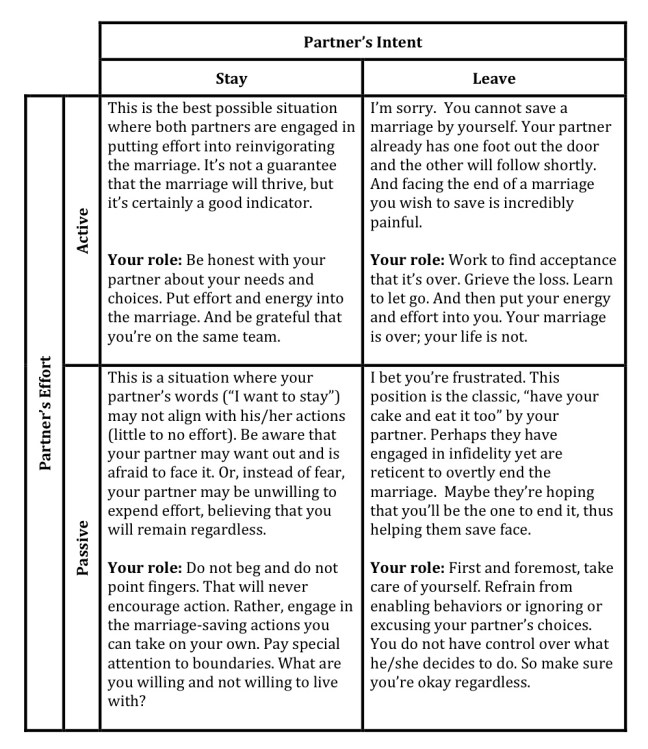
Partner’s Intent

Before you attempt to administer CPR to your marriage, make sure you understand which category you’re working with and what your role is in the situation. After all, trying to breathe life into something that is already expired only steals your breath away.

Finding Happiness After an Unwanted Divorce

2) Establish Boundaries

Take some time to solidify your thoughts about the marriage you want. What are your non-negotiables? Have they changed over the duration of the marriage? How long are you willing to live in limbo while the marriage is being worked on? Does that change if you’re the only one expending effort?

Til Death Do You Part?

There are no right or wrong answers here, but you have to be honest with yourself. And then with your partner. Be careful with your wording. Ultimatums rarely work (i.e. “If you don’t start doing X by next Tuesday, I’m done.”). Instead, frame it as a proposal (i.e. “I’ve realized I really need a marriage that has X. I’m willing to give us three months to see if we can make that happen. Is this something you can agree to?”).

You have the right to feel safe within your marriage. You have the right to be treated with respect. What you allow is what will continue. Of course, that also means that you have to be willing to walk away.

Stuck In a Bad Marriage? These Are Your Three Choices

3) Put On Your Gloves

Put on your gloves; it’s gonna get dirty. No, not the boxing gloves. The work gloves. Staying with the status quo is easy. Change is difficult. And change when it deals with emotions and ego and fear and family? Yeah.

Part of saving a marriage is being willing to do the dirty work. It’s facing the truth about your own hang-ups and fears. And it’s being willing to face your partner’s independent thoughts and intentions. There’s no room for deflection or defensiveness. You will get muddy. Just accept it. Because the only way to change something is to meet it head-on.

START NOW

4) Apply Your Own Oxygen Mask

At the end of the day, your choices and actions are the only ones that you can control. So make sure they’re adaptive ones.

Dig into your own triggers and unresolved issues. Get help if you need it. If life has become stagnant, re-engage in your passions and interests. Put yourself on your to-do list and take responsibility for ensuring that your needs are met.

It is not your spouse’s job to make you happy. Or safe. Or fulfilled. That’s on you. A marriage is only healthy if both of the individuals are healthy.

What Do You Owe Your Spouse?

5) Replace Blame With Appreciation

Who would you rather spend time with – somebody who consistently accuses you of wrongdoing or somebody who recognizes your efforts and attributes? It’s easy to point out someone’s shortcomings in the hope that they will change. But that only backfires. Instead, nurture the good in your partner. Let them know that you see and appreciate their assets.

Now, your partner may have been behaving badly. Perhaps very badly. Avoiding blame does not mean that you excuse their choices (see boundaries). It just means that you don’t rub their noses in it. Because if your only goal is to make them feel badly, why are you wanting to save the marriage?

The Four Agreements In Marriage

6) Be Intentional

Think of saving a marriage like applying for a business loan. Before issuing a check, the bank would want to know your overall business goals, the steps you’re going to take to reach them, the tools and support you will need and your plans for various setbacks.

A marriage will not improve if you don’t put effort into it. In fact, part of the reason you may be in this position is that you (and/or your partner) may not have been intentional in your actions and your marriage slowly came to a stop without the added push.

This is your life. Steer, don’t drift.

Why I Don’t Want a Perfect Marriage

vow

7) Introduce Novelty

One of the most common utterances from people who have had affairs is that it “makes them feel alive.” And that’s no accident. We all adapt to our surroundings and no longer notice what is always there. And that even holds true for spouses.

Now, luckily, you don’t need to seek out a different bed to spice things up. Break out of your routine. Engage in a new activity and allow yourself to see your spouse in a different light. Don’t worry about what you “should” do. Let go and embrace the curiosity and wonder of a child.

Passionate Protection

8) Re-Imagine Your Marriage

The marriage you have isn’t working. Maybe it’s time to change how it looks. In order to survive, a marriage has to be adaptable.

Life always changes. Kids come and go. Careers shift. Demands come and go. And the marriage that worked at one life stage may not work in another. If you want to save your marriage, you may need to reinvent your marriage.

Have a conversation (or more!) about what role you want marriage to play in your life. What needs do you want it to meet? Where are you inflexible and where are you willing to change?

There’s More Than One Way to Wear a Wedding Ring

9) Refrain From Grasping

It’s natural to grip tightly when you’re afraid that something is slipping away from you. The problem with grasping is twofold: First, it serves to smother your partner, encouraging him or her to escape in order to breathe. Secondly, grasping is based in fear and that fear will blind you to reality.

Work to self-soothe. Manage your anxieties. Surround yourself with support. Build your confidence.

You will be okay no matter what happens with your marriage. And trusting that you can be okay alone is critical to being okay in a relationship.

10) Make the Marriage Your Priority

Sometimes, we get so fixated on our spouse that we lose focus on the bigger picture. If you want to save the marriage, make the marriage your priority. Even in those moments when you’re mad at your spouse, stay committed to the relationship.

Make sure your words and actions align with your goal. Set your ego to the side; it will be bruised. But it can take it. Face your fears. I know it’s scary. The first step always is. But then the second step is easier.

Ultimately, you alone cannot save your marriage. The mathematics of marriage state that 1+1=2, yet 2-1=0. In other words, it takes two to make a marriage work and only one to destroy it.

If your partner does not want to make the marriage work, you cannot support it alone. But that doesn’t mean you’re powerless. Work on making you better. Whether that better you is married or not.

Don’t Believe In Divorce? Sadly, It May Not Matter

Mad At Your Partner? Try These 12 Ideas Before You Explode!

It happens to all of us. One day you find yourself looking at your partner in disbelief, the first flush of anger crawling up your neck like the mercury in a summer thermometer.

How can you do/say/think that?

Why did I ever decide to be with you? What in the world was I thinking?

You’re so aggravating/frustrating/self-centered/stupid/annoying.

It’s normal. Two imperfect and different people will collide sometimes.

Why I Don’t Want a Perfect Marriage

And learning how to handle your frustrations towards your partner is one of the most important aspects of a relationship.

And, no. That doesn’t mean that he or she should change to match your expectations.

It means you learn how to manage your expectations and your reactions. That you accept that your anger has as much (if not more) to do with you as it does with your partner. And that you shift from blame, which only escalates anger, to responsibility, which can mitigate ire. These strategies can help release your anger and can also help to reset the dynamic in the relationship.

Here are some ideas to get you started:

IMG_5706

Write Him/Her a Note of Appreciation

When we’re angry, we have a tendency to demonize our partner, seeing only the negative and assuming the worst. Help to restore emotional and cognitive balance by making the effort to write a note of appreciation to your partner describing something that he or she does that you are grateful for. You don’t have to deliver the note immediately, although it would nice to hand it over at some point. After all, silent appreciation isn’t really appreciation at all.

IMG_5704

Release the Energy

Anger has an energy to it. It demands action. And if we don’t release it physically, the anger tends to come out in our words. So give in to its demands. Strap on your walking or running shoes and get moving. A tired brain is a more rational brain.

IMG_5703

Increase Your Efforts

I love the idea that in a good relationship, both partners strive to give just a little more than their partner. So make the commitment to put in 10% more than your partner. Not out of spite or martyrdom, but out of a true desire to feed the relationship. Now, this is difficult to do when you’re already angry because you’re feeling taken advantage of or under-appreciated. And that’s also when it’s most important, as long as you’re truly doing it because you want to see the relationship thrive.

IMG_5702

Talk Yourself Down

One of the first skills taught to infants is the ability to self-soothe. Revisit those lessons and talk yourself back from the edge. When cortisol and adrenaline are coursing through your body, you are literally unable to process and problem solve effectively. Recognize your (over)reactions and calm them.

IMG_5700

Engage in Life

When the situation becomes more chronic, we have a tendency to become stuck in anger. Allow life to be a distraction and a passion. Just like you don’t have to wait to live until you are healed, you don’t have to wait to live until the anger is gone. Jump head-first into things that bring you fulfillment and excitement. Besides, sometimes anger at our partner is really misplaced anger because we are not living our own lives fully.

IMG_5699

Refrain From Grasping

Sometimes, especially in those of us with abandonment issues, anger walks hand-in-hand with panic. It can lead to a crazy push-pull dance of “leave me alone, but don’t leave me.” Recognize if this is your response and learn to calm your anxiety before it controls you.

IMG_5698

Give Space, Not Distance

When anger sparks, the flames jump from one body to the next when they are in proximity. As a result, it can be helpful to give (and receive) space when anger is present. Be careful, however. There is a difference between space and distance. Space says, “I’m still here with you and for you. I may not be by your side physically, but we are still in this together.” In contrast, distance declares, “I’m out. I’m done.” Space gives both people room to breathe, whereas distance sucks the life out of the relationship. 

IMG_5697

Explore Your Triggers

Often what we’re angry at is not what we think we are angry at. Take the time to explore your triggers with an open mind. Follow the threads of the anger and see where they lead. Their roots are often in the past and often not related to the current partner. Make sure that you’re not blasting the current relationship with flames from an old one.

IMG_5696

Burn the Scorecard

Nothing fuels a fight (or degrades a relationship) like scorekeeping. It pits you against each other instead of for the marriage. Burn (metaphorically, I assume) any used scorecards and refuse to partake in any future scorekeeping. Use strategies to evict any thoughts of tit for tat from your mind. Because if you keep score, it’s your relationship that loses.

IMG_5701

Sleep

We’re often told to “never go to bed angry.” Yet sometimes sleep is exactly what we need to provide rest and perspective. So, sleep. And count to ten while you’re counting sheep.

IMG_5695

Assume the Best

When we’re angry, we often jump to conclusions and anticipate responses before we hear them. We construct a narrative that feeds the anger and assumes the worst. Turn it around. Instead of assuming the the worst, try assuming the best. It’s still based on your expectations (and so may be false), but it primes the pump for a better experience.

7 Reasons People Withdraw in Relationships

IMG_5705

Assume He/She Wants the Best For You

And while you’re busy assuming, go ahead and assume that your partner wants what’s best for you. Even if he/she isn’t always great at showing or expressing it. After all, wouldn’t you want them to do the same for you?

Stuck In a Bad Marriage? These Are Your Three Choices

bad marriage

I had someone come to me last week for advice. His relationship with a woman – a married woman – recently ended and he was reeling from the breakup and associated revelations.

“I don’t understand,” he wrote, “How can she tell me her marriage is so bad and then choose to stay in it?”

I groaned. I couldn’t help it. I have never heard from anyone who had a relationship with a married partner who was not told that the marriage was bad. In fact, I think that pronouncement is a prerequisite for infidelity.

And it drives me crazy.

First, I see this as an excuse. It’s a convenient way to lessen guilt and shift blame to the unsuspecting spouse. It’s basically saying, “I’m not cheating because I’m a bad person; I’m cheating because you’re a bad person.” By painting the marriage as bad, regardless of the veracity of the claim, the actions become justified.

I also read these statements as a cry of insecurity. In essence, “My husband/wife never appreciates me so I need you to fill in the void.” But when we seek validation outside of ourselves, it’s never enough.

The assertion of a bad marriage to an affair partner is also manipulative. It’s a sob story that can used to spur rescuing behavior. “I’ve tried so hard to be a good spouse but I’m a victim of my spouse’s actions.”

Ugh. Just no.

If you’re on the receiving end of these stories, listen between the claims. Watch actions, not words. Think about what this person has to gain by telling you about their bad marriage.

And realize that reality may be very different than the picture they are trying to paint. After all, most people that have affairs claim that they are happy in their marriages.

Yet they say otherwise.

Now of course, marriages can go bad. Some had signs of mold from their inception while others slowly rot over time. If you’re in a souring marriage, you have three choices:

Fix It

Not by changing your spouse. But by changing yourself and your reactions. Instead of blaming your responses on your partner’s actions, dig deeper to uncover why you are upset. What is being triggered? Address that.

How To Release Your Triggers

Accept It

Your spouse isn’t perfect. And neither are you. Marriages have seasons of growth and periods of drought. Are you looking to your spouse to fill a void within yourself? Are you expecting your marriage to magically heal your childhood wounds? Are you assuming that your partner should meet all of your needs?

Why I Don’t Want a Perfect Marriage

End It

And if the defects are fatal? End it. There’s no reason to keep a marriage on life support forever.

12 Things to Consider Before Ending Your Marriage

Choosing to stay in the marriage while complaining about it is a form of passive acceptance. Yet it’s an acceptance that will keep you (and your marriage) miserable.

7 Reasons People Withdraw in Relationships

It’s really that simple.

Three choices – fix it, accept it or end it.

Make one.