It’s been raining in Atlanta for…well, ever. At least it certainly feels like it. And so I’ve spent a good amount of time catching up on some reading. Here are some relevant and quality articles that may be of interest. Curl up out of the rain, make a mug of tea and get your read on:)
I can never get enough of this stuff. Life. Changing.
I’m also finishing up a great book (Deep Survival) that explores why some people survive physical ordeals (lost at sea, 9/11, etc.) while others succumb. I see so many parallels with the traits and mindset that allow people to triumph over physical situations and emotional ones. Lots to think about.
Enjoy the rest of your weekend and if you’re on a rain dance kick, please stop it:) I’m ready to dry out!
Some milestones in divorce are clear – the day the decree is final, the day you establish your own home and the day you go on your first date.
But the most important milestone? The one that anyone who has ever been through divorce eagerly awaits?
That one is more subtle.
So how do you know when you have moved on after your divorce?
The Memories Lack Emotional Punch
When I first used to share with others that I had been left by my partner of sixteen years, I felt as though I had come down with some super-bug. My limbs would shake, my temperature would rise and I felt as though my stomach was trying to run away (perhaps to catch my runaway husband).
Over time, these physical symptoms dissipated – the stomach would twinge rather than threaten to expel its contents, the shaking was reduced to a slight tremble in the hands and the internal thermostat was regulated.
And then one day, when I had to tell my story, I realized I had no physical – and no emotional – reaction. It just was. The events had become fact. Not feeling.
When you can remember bits of your past and share your story without feeling like you’ve been punched in the gut, it’s a sign you’ve moved on.
In the beginning, I could not accept any good in my former marriage or my former husband. I had to make it all-bad so that I could make it all-okay. Because when an unwanted divorce arrives on your doorstep, the best way to accept it is to pretend that you wanted it.
In time, good memories starting sneaking in through the cracks in my hastily-built wall. I remembered the goofy, gangly kid that I fell in love with, the unsure but determined young man that accepted a move across the country and a chance at a real career and the confident (seeming, at least) guy that accepted accolades in his work. The moments we shared started to bubble up to the surface and with them, smiles.
The beginning and the middle became separate from the end. And I grew to appreciate what was good without either overanalyzing it looking for cracks or following the tracks to its demise.
When you can treasure what was good in your marriage without dwelling on why it is gone, it is a sign that you have moved on.
I had someone ask me earlier if I had any resources on kids during divorce. My first reaction was to say that, although I’m a child of divorce, I don’t really have any experience as the adult in that situation.
But then I asked what grade the kid in question was in.
And once I received the answer of 8th, I realized that I do have some insight. Even though they’re not my kids and it’s not my divorce impacting them, I have 15 years of witnessing the ways that teenagers deal with their parents’ divorce.
It is so difficult to tease out any acting out caused by the divorce from normal teenage behaviors. Well, as normal as they can be when their prefrontal cortex is not completely formed.
Teenagers are not in their right minds. Literally.
But I do see patterns of behavior that often signal that a divorce has occurred or is in process. Many of these patterns are more common in one gender than the other, although the gender lines are by no means firm. In some ways, divorce can amplify the normal teenage behaviors and other times it completely alters them.
The behaviors are usually the most extreme when the parents are in the middle of the legal process (especially if the kid is being used as bait) but can also appear well after a divorce that occurred in elementary, where the child seemed fine at the time. They can be brief and mild or longer lasting and more severe.
Here are the top behaviors I see in teenagers having trouble trying to process divorce:
The boys are…
Oppositional
The boys can get angry. Very angry. Sometimes it’s directed at a particular person (especially if they see one parent as being at fault), but often it is scattered and nondiscriminatory. They get into fights. They challenge authority at school. Often, when I am able to get them to open up, they are feeling pressure to be the “man of the house” and are trying to toughen up before their time.
These kids need a safe outlet for their anger (martial arts comes to mind), a safe place to be vulnerable, consequences for their misbehavior and reassurance that they are still kids and not responsible for the household.
Withdrawal
Instead of acting out, some boys draw in. Their hair becomes longer and rarely washed. They seem to curl inside themselves at their desks. Their schoolwork suffers as they fail to complete and turn in assignments. Some turn to cutting or other self-harming behaviors. Many turn to video games as an escape. Sometimes I learn of a diagnosis of depression.
These kids need patience, persistence and intervention. If you’re at all concerned about their mental health, seek help sooner rather than later. And try to engage them in life outside the screen.
Using
I can usually tell which of my students drink or use drugs on a regular basis. And many of those are boys with divorcing parents. Some see it as an escape. Some take advantage of a distracted single parent. Some are trying on adulthood. And some are just lost.
These kids need tough love. And soon. Don’t try to handle this one alone. Call on the professionals, for you and your kid.
The girls are…
Perfectionists
These are the ones that often slip under the radar. They’re pleasant. They perform well in school. You may think you have lucked into the perfect teenager, even after going through the breakup of a family. Yet under the guide of perfection is an overwhelming anxiety; some of these girls are trying to do it all out of a fear that they must be perfect to be lovable and accepted. And at some point, they will burn out.
These kids need consistency, reassurance and a way to build confidence (martial arts comes to mind here as well). Encourage play and discourage excessive time on schoolwork. Refrain from associating value with performance.
Mean
The anger in the girls usually presents differently than the boys. They are more covert. Manipulative, perhaps out of a desire to try to exert control when they feel they have none. Their anger is more pointed, either at classmates or at a parent (or often at a new boyfriend or girlfriend of a parent). They develop this “nobody else will ever hurt me” armor and they attack with their words and actions.
These kids need boundaries and they need to face the natural consequences when they’re crossed. The key to softening the armor is usually a relationship with a trusted, non-parent adult – a teacher, a family member, a counselor, who can help them face the pain under the anger.
Acting Out Sexually
Most teenage girls are boy (or girl) -crazy. But most are doing more talking than anything else. For girls going through a family divorce, especially when the father is absent, some start dating older boys and acting on that talk. They want to know they are pretty, special and desired. And they’ll take it any way they can get it. Some of these girls feel abandoned. Others neglected. And some just feel ignored.
These kids need structure to limit their unsupervised access to technology and a watchful eye on their interactions. They also need attention, so strive to provide the attention in positive areas. Most of all, they need love. They are still kids regardless of what behaviors they’re engaged in.
And all teenagers of divorce are…
All of the kids I see with divorce in their story are working through trust issues; they’re often slow to establish bonds. Most look for attention, some by being the “teacher’s pet” and others by being the “class clown.” They’re often a little more on the extremes of the “needy” to “leave-me-alone” curve.
And they’re teenagers. 100-pound hormonal two-year-olds, as I affectionately call them. They’re still learning who they are, how the world works and figuring out their place in it.
Love on them even when they’re irritable. Uphold the rules no matter how many times they’re broken. Give them support when they need it and let them struggle when they don’t. And see them as they are and help them see who they will become.
And be thankful that they’re not teenagers forever.
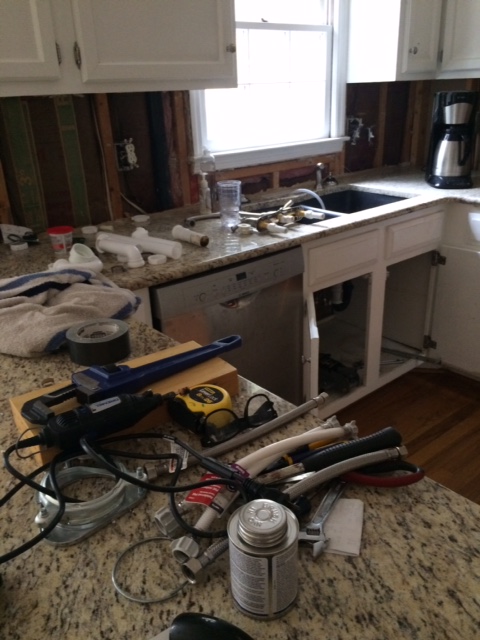
Of course if I was a plumber, I would a) be getting paid to deal with this BS and b) it wouldn’t be my kitchen going on four days without water.
Beautiful new counters underneath a pile of not-the-right-size plumbing parts.
I’m convinced that plumbing is the most contemptible of all of the home improvement projects. It’s not complicated – connect this to that in such a way that fluid flows freely and leaks are eliminated. The problem comes when apparent malevolent spirits installed the original pipework (glued PVC connector on the drain pipe? Really?) and plumbing manufactures seem to find glee in both creating an infinite number of connector styles and failing to design (or, in the case of the big boxes, stock) products that meet customer’s needs.
I’ve only given in once and hired a plumber. And that was after 5 hours in the freezing dark with my then-husband trying to attach a new water line to the house after the blue poly finally gave up the ghost in the dead of winter. It’s such a difficult expense to justify when the elusive part is always promised at the next trip to the hardware store.
Which always seems to result in one more item then needing to be returned.
As well as one more test for your marriage.
Any decently-sized home improvement project has the ability to challenge your marriage in the following ways. Even if you break down and hire a plumber.
1 – Money, Money, Money Down the Drain (Assuming You Have One Installed!)
I think we’ve managed to spend $100 a day at Home Depot over the past week. And that’s just on the little bits and pieces that make the big-ticket stuff work. Add to that the increased cost of prepared foods or eating out and of course, the cost of the cabinet refacing and counter top and it gets scary. Hey, maybe I can turn my kitchen into a haunted house and charge entry – it may not scare the kids, but I bet the parents will be petrified 🙂
Spending money while stretching a budget can be stressful. And that can become even more difficult when you have one partner with champagne tastes while the other is carefully watching the wine cooler budget.
But even, as in our case, when you agree on the decisions, watching the money wash away is stressful. It’s important to communicate fully about your fears and work together to decide how far the budget can be stretched. It’s a lot easier to tolerate the expense when you’re working as a team.
2 – Managing Frustration Without Biting Off Your Spouse’s Head
Home improvement projects are always a roller coaster. They begin with hope and the tantalizing freebies of sample swatches and Pintrest pictures. Then comes the first reality check when you begin to associate a budget and a timeline with your desires.
And then there are the inevitable and numerous setbacks. I can’t even begin to tell you how many times Brock has had to say, “I have bad news” over the last week.
And the project is still in its early stages.
It’s impossible to not be affected by the bad news, but it is so important to work to manage that frustration without gearing up for a fight with your partner. The fact that the bolt they’re trying to attach doesn’t fit is not a personal failing. Don’t treat it as one.
And the best way to deal with frustration? Humor.
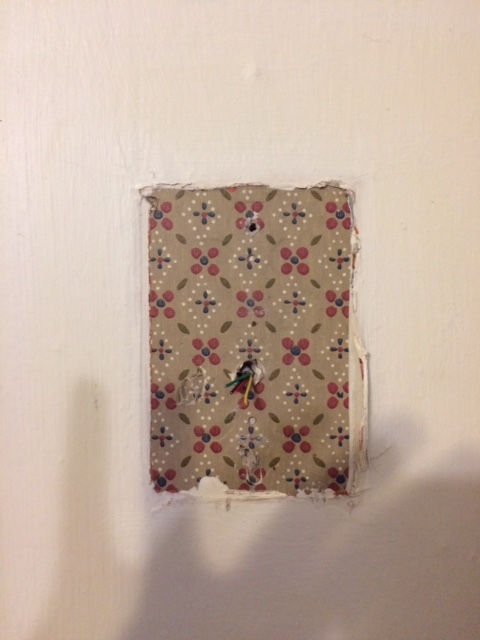
A hint of kitchen past once hidden behind a phone jack. We joked about removing all the paint and restoring the wallpaper to its old glory:)
3 – Flexibility Demands Even Greater Than Those Required by Yoga
It’s funny how you much you can learn about someone by watching how they handle disorder. Once I emptied the bottom cabinets, I declared the kitchen pretty much closed until the implements were returned.
Brock, on the other hand, simply dug through the kitchen items in the other rooms, found what he needed and set to making spaghetti.
Proof positive that he is the more flexible one when it comes to home environment.
I’m still learning:)
4 – Coping With Change and a Dearth Of Coffee
I’m used to moving through my early morning routine driven by pure muscle memory and habit. I can make the coffee and my breakfast with no thought and little attention.
But now all of that has changed. Making coffee now requires a trip to the bathroom and a small cup to use as an intermediary to fill the pot. In order to dispose of the old grounds, I have to first find the small compost bucket, which seems to enjoy playing hide and seek with the other items we are constantly looking for. And for now, the used mugs are sitting unwashed while we work on getting the water running again.
Ugh.
Change is hard. And change in your home with your spouse is harder still. Be patient with each other as you’re working through new patterns and new habits. It will smooth out. Eventually.
5 – Lack of Personal Space or Please Get Your Elbow Out of My Ear
Our home is not small but the available footprint has decidedly shrunk now that the kitchen cupboards have vomited their contents into the dining and living rooms. And the kitchen itself? It’s like playing hopscotch on a moving ship.
And it’s not only the intrusion of stuff where it doesn’t belong that lends to a sense of claustrophobia. It’s also the close – very close – proximity you have to be in with your spouse while engaged in exasperating or tedious labor that seems to strive to reach Twister proportions.
I’m pretty sure my elbow did end up in my husband’s ear last night as we were both crammed under the kitchen sink. Tiger sat nearby, looking upset that he wasn’t invited to what he saw as a cuddle party.
Anytime space is at a premium, tempers can more easily flare. Douse them with good music, good laughter and a favorite home improvement beverage.
6 – Learning Your Partner’s “Home Improvement” Language
Love language, smudge language. We all know what is really important in a marriage is learning your partner’s home improvement language.
“Can you hand me that wrench thingie over there?”
I glance over there and see a total of five wrench thingies, none of which seem appropriate for the task at hand.
“The one that looks kind of like the old channel locks but newer.”
Turning my gaze, I spotted the needed implement at a different over there.
Part of learning you partner’s home improvement language is learning their vocabulary.
But that’s only the beginning.
In order to be fluent, you also have to know their strengths and weaknesses. Their skills and when it is best to pretend that the power tools aren’t working.
It’s pretty cool that on this project, Brock and I were able to divvy up tasks by strengths with little conversation. We both know that he is going to be the one to deal with the contractors and make sure that stuff gets done even when there are hiccups and I’ll be the one to paint the ceilings and find the new storage items. You know, the ones that go over there.
7 – Admittance of Wrongdoing and Acceptance That Watching HGTV Does Not Make You An Expert
“I need help with this one. I just can’t seem to get these screws in,” I said, passing the pieces of the new bar stool over to Brock. He managed to line them up and tighten them down, only to look up from his work and realize that I had attached the seat on upside down.
Oops.
When undertaking a project of any magnitude and tackling projects with a skill set that doesn’t get exercised enough to go pro, mistakes will happen. I have quite a bit of knowledge about home repair (more thanks to my ex than television, but I do have to admit to some HGTV viewing), but I have been the assistant more than the surgeon on these operations. So sometimes often my results leave something to be desired.
And it turns out the screws went in much easier once the seat was turned around the right way. Who knew?
8 – Biting of the Tongue And the Avoidance of “I Told You So”
Brock never made me feel stupid or inept because of my bar stool debacle. And I happily returned the favor a couple days later. When working on the home, you and your spouse are a team. And tearing one member down only serves to lower the performance of the entire team.
It can be tempting to call out mistakes, especially when they compound frustration by adding to the time or money needed for a project, but it is a temptation best avoided.
Because once the scolding begins, it rarely stops.
9 – Compromise And Learning to Love (or at least tolerate) Your Partner’s Taste
I wanted to simply swap out existing trashcans and relocate the kitchen one to a corner by the fridge. Brock balked, expressing a distaste for my chosen location.
And once I realized that his desire to not have the can there was greater than my desire to use the spot, I spent a couple hours locating a new can that can fit in a location that we can both live with.
Home improvement is one of those times when you have to let go of always getting your way. Stand up for what is important and compromise or even give in on the rest.
At the end of the day, your spouse’s happiness is way more important than where you choose to throw away your trash.
10 – Getting It On (When All You Want to Do Is Go to Bed)
These are the kind of sexy texts we’re sending to each other right now. Don’t be afraid to scroll down; it’s entirely SFW:)
Is this the one we need?
Unless you’ve always harbored a fantasy about carpenters or electricians, there’s really nothing about home repair that will get your engines revving. In fact, it can easily have the opposite effect when you’re both tired, grumpy, sweaty and probably covered in some sort of very unsexy goo.
The truth is that sometimes you have to wash the plumber’s putty out of your hair (or scrub the adhesive off your hands!) and take a bedroom break. The kitchen sink will wait (and Home Depot is open late).
11 – Dealing With the Unexpected Without a Breakdown
When the trip to Home Depot on Saturday was a dud and we discovered the needed part couldn’t be delivered until Tuesday (why can Amazon ship me shoes on the same day but shank extenders for my faucet take four days????), I almost lost it. This means we’re not only looking at several more days of a waterless kitchen, but it also means that we may have another date night under the kitchen sink on a work day. I prefer my cupboard snuggles on the weekend.
And then we looked at each other, shared looks of despair, frustration and finally resolve.
We’ll get through this. Together.
And Why It’s Worth It –
There is nothing like the celebration of reaching a shared vision through joint effort and teamwork.
Assuming you’re still on speaking terms, of course.
Scan any list about the most important elements of a happy marriage and effective communication will be somewhere between “shared values” and “physical intimacy.” Its ubiquitous inclusion is not because relationship writers are lazy. It’s because communication truly is key in any relationship. Especially one where you face each other every day prior to morning coffee, tackle everything from kitchen remodels to retirement plans and expose your greatest vulnerabilities and dreams.
The reason that communication can become a point of contention in a relationship is that while talking is easy,
Listening is hard.
And taking responsibility for our own emotions and responses is harder still.
But that doesn’t mean that everything to do with improving your communication has to be hard. Here are ten easy hacks to start improving the communication in your marriage beginning today:
Use Figurative Language
Feeling misunderstood is extremely frustrating. And it’s easy to get caught up in blaming your partner for refusing to listen. But maybe they’re listening and simply not relating. Not because they don’t want to. But because they don’t have anything to latch on to.
So instead of getting irritated, try getting creative. Reach back in your mental archives and pull up those metaphors and similes from your school days. Instead of explaining what it is, try painting a picture of what it’s like. You’re not trying to replicate every detail or match every trait. You’re just working to establish an anchor point for understanding. You can fill in the gaps later.
Follow the Percent Rule
I am a huge fan of the 80/20 rule – do the “right” thing 80% of the time and cut yourself some slack the other 20% of the time. Although this is most often applied to nutrition, it works with communication as well.
Share 80% of the positive thoughts you have about your partner or your relationship. (Yes, it would be nice to aim for 100%, but life, you know? So strive for 80%.) This means every time you admire your partner’s butt as he or she walks away, each time you notice that the garbage has been taken out and whenever you see him or her tackle something with ease, you speak up. Or write a note. Or send a text.
And the 20%? Share only 20% of your negative thoughts. This means you may have to choose them wisely. Don’t waste those words on a gripe about the scattered socks unless that’s really something that you to express and you want addressed. These words should be reserved for problems that can be solved together, not complaints for the sake of grumbling.
Pay Attention to Physical Comfort
One of the worst grades I ever made on a college exam was on a chemistry test that was administered in a frigid room while I sat on a cold, unforgiving metal stool. My body was in such discomfort that my mind wasn’t operating anywhere near its best.
Conversations operate the same way. There’s a hierarchy of needs and a full stomach, a rested body and an acceptable environment come before listening and responding effectively.
So by all means, go to bed angry if you need to. Staying up and staying engaged in the discussion will only backfire.
Ask More Questions
Do you find yourself responding defensively or getting angry after a statement by your partner? The instinct is to respond with a sledgehammer, shutting down that line of discussion completely and utterly.
Instead of smashing the claim (and you partner) into smithereens, try increasing the amount of questions that you’re asking. This strategy has a two-pronged benefit – it helps give you added information to aid in your understanding and it validates to your partner that you’re listening to them.
Use a Candle
Do you or your spouse have trouble initiating difficult or complex conversations? Try this simple idea.
Tell Stories of Your Shared Past
One of the ways that researchers are able to predict divorce in a couple is the relationship origination story that they tell. Happy couple tell happy stories, making light of or brushing over any rough patches on the way to the alter. Do they tell happy stories because they are happy or does the mere retelling of a happy story cultivate additional happiness?
I would wager it goes both ways.
Make a habit of telling favorable tales about your shared relationship history. You’re making deposits in the marital bank and reinforcing your bond.
Write It Out Before Talking It Out
Have you ever uttered, “You make me feel…?” No shame. I’m guilty too. We say that because it’s easy, skimming the surface – you did this, I felt this – instead of digging deeper – you did this, it reminded me of that, and I felt this.
One of the biggest things you owe your spouse is to take responsibility for your own stuff. And that starts by being aware of your stuff. The connections between your present and the luggage you brought with you from your past.
So talk to your journal before you talk to your partner.
Because writing your thoughts is a great way for you to see those connections between what was done and how you feel. Because nobody else can make you feel a certain way.
Engage In a Shared Task
The body tells our minds how to feel. If you clench your fists, you will respond more aggressively in conversation. If you roll your shoulders back, you not only appear more confident, you speak more confidently.
So when you want to communicate to establish a connection, begin with a physical association through a shared activity. This doesn’t need to be complicated – washing the dishes, taking a walk, shopping for groceries all count as joint tasks.
Just another reminder that you’re in this thing together.
Use Texting Wisely
In a marriage, texting should only have two uses: 1) Planning or 2) Play.
Logistics comprise a significant portion of any relationship. And texting is a great way to work out the details of shared lives in real time.
But a marriage that only shares plans isn’t much of a marriage.
And phones are great for sharing more than just reminders and schedules.
Flirt. Seduce. Banter. Joke. Play.
And ban anything negative or complicated from your texting vocabulary. Some things are better addressed in person.
And the number one hack you can utilize to improve your communication?
Release Expectations
So often the reason that a conversation heads south is that we react to what we expect to hear instead of what is said. We construct a response before we even hear our partner out.
In other words, the battle is really within ourselves.
The single most important change you can make in your communication is to approach with curiosity instead of conclusions.
Listen.
And you just might learn something new about your partner.










 Lessons From the End of a Marriage