How to Learn When the Test Comes Before the Lesson

I love the quote about life being a cruel teacher, administering the test before the lesson (which I believe is from Oscar Wilde originally and is now being attributed to Drake??).

snip20161217_22

And it’s true, isn’t it? We’re presented with challenges that we don’t yet have the tools to overcome. We face situations with which we are unfamiliar and unpracticed. Somehow, we muddle through and make it through, only to look back later and finally reach a level of understanding.

My now-husband once made a statement about I handled my divorce gracefully. I laughed at the absurdity of that statement, remembering my early (and rather ugly) emails to my ex and my hours spent trying to learn everything I could about his other wife and his other life. I made poor decisions. I was reactive instead of proactive, since I was making it up as I went along.

My now-husband then clarified, “No, I mean after the early emotional stuff. You didn’t try to punish him and you used the experience to make yourself and others better.”

And that’s how life’s lessons are:

Hard.

Messy.

And only understood after you’ve survived the test.

Read more about my own test in this new piece over at DivorceForce. 

All I Want For Christmas is a ThunderShirt

For those of you unaware of this remarkarkable item, this is a ThunderShirt.

snip20161213_18

They provide compression that helps to alleviate canine anxiety. The name comes from their intended use during thunderstorms.

And I want one.

Not for Tiger. He’s chill.

But for me. Because I’m not.

And no, I’m afraid of thunder.

Let me explain.

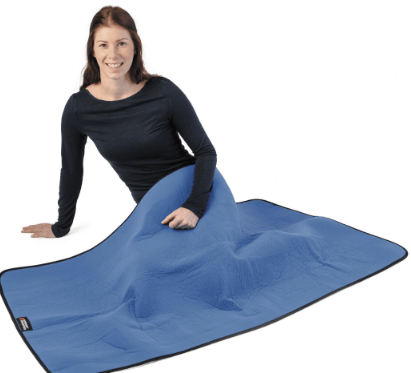
Brock got me a weighted blanket a few days ago. There quite commonly used for people (especially kids) with sensory issues. The extra pressure help to calm anxiety and quiet the agitated mind.

snip20161213_20
It’s a lot heavier than it looks.

Well, I’m not a kid and I don’t have sensory issues. But I most definitely have anxiety and an agitated mind.

And in three short nights of sleeping with this blanket folded in thirds across from chest, the difference has been amazing. Night and day, you might even say.

I fall asleep faster with less mental busyness. I sleep deeper. And I can even fall back asleep when I am awaken during the night.

And once I’m up in the morning? My body is calmer, with less of the jumpiness I usually experience and my mind doesn’t fall so eality into overwhelm.

All because of a blanket.

I’ve threatened to wear it to work like some super hero cape. Or, at the very least, keep if folded behind my desk for emergency use.

Can you just picture the students’ reactions when I lay on the floor with a leaden blanket draped over me? 🙂

So see, that’s why I need a ThunderShirt. Stylish (well, for a dog) and portable.

And for the really rough days…

snip20161213_19


7 Subtle Signs You Have a Backseat Driver in Your Life

For a long time (okay, even now), when my now-husband would vocalize his opinion about something that he thought would be good for me, I recoiled. It felt almost invasive.

Smothering.

Controlling.

Not because of what he was saying, but because of what I have been through.

My now-husband is direct, expressing his thoughts and feelings overtly and directly (a trait I very consciously looked for the second time around). Sometime I chafe, but I love the fact that it’s all on the table. And even though it’s not always comfortable, I love that he challenges me to defend my decisions and actions because it serves to help make me better.

My former husband was covert, passive aggressive and manipulative in his approach. Unflinchingly supportive on the surface of any thought or action I undertook, while silently steering me in the direction he wanted. He never questioned me, never told me what to do (except to relax while he tackled some chore on his own). His control was subtle, which is exactly why it was so powerful. My defenses were never triggered until it was too late.

The following strategies are commonly used by people who are passively controlling. Those who, rather than overtly take over the wheel of your life, cunningly influence how you turn the wheel. All of these signs can have multiple meanings; on their own they do not indicate control. But when more than one show up along with a sense that boundaries are being crossed, it warrants a closer look.

The tears may be real, but the emotion is not. This trick is learned in infancy, as babies realize how tears can halt punishment and bring attention. Some never abandon this trick and persist in using tears to manipulate those around them. Look out for waterworks that only come when something is desired and seem to halt as soon as the goal is obtained.

Affection and attention are doled out as a distraction and a pacifier. This was my ex’s favored ploy. It sounds crazy to complain about an attentive husband, but when I look back, the affection was increasingly used whenever I came dangerously close to the truth. His great big bear hugs felt protective at the time, now they seem more like a martial arts-style submission.

Decisions are held back. Waiting to make and/or communicate a choice is a particularly crazy-making form of covert control. Everybody else is held in limbo, their own lives and decisions delayed. Doing nothing can carry with a great deal of power when others are depending upon you.

Money is used as a mode of communication. Sometimes finances are used in overt control, such as when one spouse makes all of the financial decisions and doles out an allowance to the other. But it can also be more indirect, such as when purchases are kept hidden or the partner with the higher income feels entitled to make decisions for everyone.

Judgement is passed. This can be direct, “You look like you’re trying too hard when you wear that skirt,” or indirect, pronouncing something unacceptable in someone else. My ex took it a step further and frequently renounced choices and behaviors in others that he was guilty of himself.

The favors and gifts are given with some sort of reciprocity in mind. The stereotypical idea of a wife using sex to get her husband to do things comes to mind here, but it’s by no means the only modality used. Handouts can be used with great efficacy to shape behaviors. After all, there’s a reason we train animals that way.

They accuse you of being controlling. Projection and gaslighting at its finest.


In a healthy relationship, each partner challenges the other and accepts influence from the other. It flows both ways, balanced.

When there is controlling behavior present, the interchange is not equal. One holds more power than the other.

And when there is a backseat driver, a more passive controller, this imbalance can be difficult to pinpoint.

Control thrives when you’re too close to it, too afraid to see it and unwilling to erect and maintain boundaries.

Take a step back, trust in yourself and practice making decisions by yourself and for yourself.


Related:

I Hate Mums

I Reject Your Reality and Substitute My Own

Subtle Signs You’re Being Manipulated By a Covert Abuser

The Misuse Of Affection

How Being Cheated On Impacts Your Next Relationship

I wish I could say that my first husband’s infidelity has had no impact on my second marriage.

But the unfortunate reality is that, even though my ex has long since been excised from my life, his choices still have an impact. On me and on my marriage.

By understanding how being cheating on impacts your next relationship, you can help to maximize the positive effects and minimize the negative ones. Learn more here.

Bad to the Bone: Is Infidelity a Character Flaw?


We know infidelity is bad.

But what about the people that commit it?

Do they have some ingrained and persistent defect in their character? Or, are they inherently good people who made a bad choice?

Support For Infidelity As a Character Flaw

It is a selfish decision. Cheating happens because somebody is incapable of considering – or caring about – the impact on another. There is a distinct lack of empathy and consideration.

Deception and manipulation are employed. The ends justify the means and in order to maintain their affair, cheaters knowingly and coldly lie and control others for their gain.

There is a distinct lack of grit and perseverance. When the going gets tough, the cheater gets going into the arms of another. Hard work and effort is traded in for the fast appeal of a new model.

They are cowards. Instead of summoning the courage for the difficult conversations, they express their unhappiness and dissatisfaction from afar.

Integrity is absent. There is no moral compass, no ethical code guiding their behavior. Words may say one thing, but the actions speak something entirely different.


Support For Infidelity As a Faulty Decision

A slippery slope led to a catastrophe. A bad choice was made for something that seemed minor. But then the effects compounded like falling dominos after reaching a critical point.

There is a lack of self-awareness. Discontentment wasn’t brought up because it wasn’t realized. Instead, attention was focused on work or others, leaving a gap for an affair to slide in.

Maturity is lacking. And with it, an understanding of personal responsibility or cause and effect. Immaturity also contributes to a desire for instant gratification over sustained effort.

Loneliness and disconnection cloud the thinking. A sense of perceived rejection or being unappreciated contributes to more primal and basic instincts as it plays upon the need for social ties and acceptance.

There is a deficit of coping mechanisms. They never learned how to be in a relationship and how to navigate both inter- and intra-personal conflicts. And this leads to a poor choice.

So what do you think? Is infidelity a sign of an enduring character flaw or is it a consequence of a fallible, yet overall good, person?