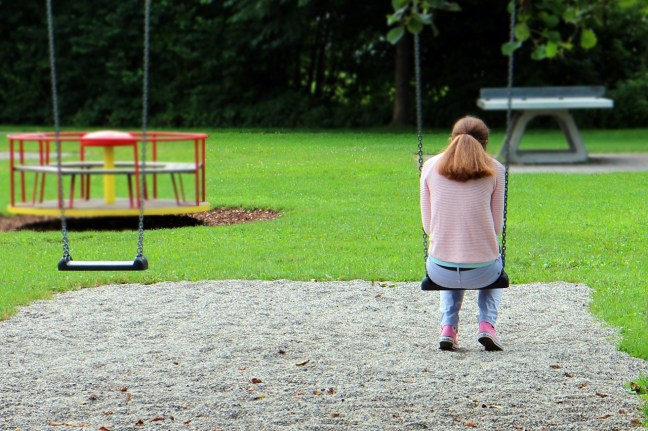
I’m Not Strong Enough

Every year I have some kids who break my heart.

It happens as soon as I task them with completing some assignment and they whisper to me with down-turned eyes, “I’m not smart enough.”

And my heart breaks for the broken spirit of the child.

Because the truth is, there are very few kids that are truly not smart enough to understand the math I teach and those are never even in my class.

But I can see how some may conclude they are not smart enough. After all, they see some of their classmates tearing through assignments like a kid at Disney World. They hear others volunteer answers before they have even processed the question. They feel their struggle while they see others’ successes.

But the problem is not that they aren’t smart enough.

Maybe they are not skilled enough, having missed earlier important concepts.

Maybe they are not present enough, excessive absences interfering with their ability to comprehend the material.

Maybe they are not supported enough, missing out on the help needed at home or at school.

Maybe they are not focused enough, allowing in outside distractions that make it difficult to think clearly.

Maybe they are not disciplined enough, forgoing homework for the call of video games and not participating in the needed practice.

Maybe they are not understanding enough, ignorant of their own ways of learning and demonstrating knowledge.

Or maybe they are not confident enough, perceiving themselves as lacking in some fundamental way that is fixed and rigid.

None of those things have anything to do with smart.

And all of those things can be addressed.

And overcome.

To expose the smart kid that was there all along.

Hiding behind those limiting beliefs.

———-

With adults, I rarely hear, “I’m not smart enough.” Yet I often hear, “I’m not strong enough.”

And it breaks my heart to hear the broken spirit.

Because the truth is, there are very few adults that are truly not strong enough to overcome the challenges that fall into their path.

But I can see how some may conclude they are not strong enough. After all, they see others speak and write and sing about their own journey and the conquering of it. They see others reach the finish line of their trauma before they have even finished processing their own. And they feel their struggle while they see others’ successes.

But the problem is not that they aren’t strong enough.

Maybe they are not skilled enough, having missed earlier opportunities to practice struggle and the overcoming of it.

Maybe they are not present enough, not able to put the time into healing that it requires because of other demands.

Maybe they are not supported enough, lacking the buttressing effect of family, friends and professionals.

Maybe they are not focused enough, allowing in outside distractions that make it difficult to think clearly.

Maybe they are not disciplined enough, electing to avoid the pain rather than face it and move through it.

Maybe they are not understanding enough, unaware of their own needs and what tools are effective for them.

Or maybe they are not confident enough, judging themselves as broken and somehow less than others.

None of those things have anything to do with strong.

And all of those things can be addressed.

And overcome.

To expose the strong person that was there all along.

Hiding behind those limiting beliefs.

———-

In the classroom, I work to help figure out what needs each kid has and then we work together to discover what methods and tools best meet those needs. I act as a cheerleader when they’re discouraged and a butt-kicker when they’re trying to avoid. I reveal my own struggles to them and help them to see their own strengths. I give them opportunities to shine when the quick-to-get-it kids often falter and I praise the effort that moves them forward. I highlight their progress, comparing them to themselves rather than to anybody else.

We talk about how everybody has some things that come easy and some things that don’t. And how often those that struggle become the better for it. They laugh when I tell them that math was my worst subject and that I almost failed Algebra II. They laugh, and then they smile because it gives them hope.

In the adult world, I do much of the same. I help people figure out their own needs and what tools will best match those needs. I encourage when the spirit is down and kick some butt when it is dragging. I share my own struggles (and the struggles that others have made public) and I help them to see their own strength. I look for opportunities for them to shine when maybe the quick-to-heal folks still stumble. I highlight their progress, comparing them to their earlier version rather than to somebody else.

We talk about how some people seem to move through trauma easier than others due to a blessing of biology, support, environment or prior experience. And that some may have to struggle more to get there.

And that struggle can make you better.

I had one client that had a life relatively free of trauma until a big one that sent her to me. She knew that it was harder for her to deal with the situation than others because as she was processing the pain, she was also doing the hard work of identifying her own strengths, weaknesses, needs and tools of best fit.

And she appreciated that effort even as it wore at her.

“I know this won’t be the only thing I have to go through in my life. If I do it well, it will serve me going forward and if I don’t do it well, it will become the thing that holds me back.”

And she’s right.

At the beginning, she wasn’t strong enough to reach the summit.

But she was strong enough to take the first step.

And then the next.

And each step built her strength.

Her confidence.

Her resolve.

YOU are strong enough.

I see it.

I want you to see it too.

And you don’t have to do it alone. Learn more.
7 Areas to Upsize During Divorce

upsize

Divorce is a pruning of your life. Limbs are removed and the whole is pared back, perhaps to its base, leaving only the bare minimum needed to sustain life. There are many areas where it is prudent to downsize to simplify and remove excess stressors, focusing only on the most critical needs.

But divorce is more than the removal of a life; it is the beginning of a new life. It is the intersection of loss and opportunity. And even though there are some areas where contraction makes sense, there are other areas where you can expand and grow.

The following are 7 areas you may want to consider upsizing during divorce:

Passions

We all start out life passionate about something. And then, over time and with increasing responsibilities, that passion is often relegated to the dusty shelves as it is replaced by more practical affairs. Now is the time to dust them off. Your passions help to reunite you with your core self, reminding you of who you were before the marriage. They provide welcome relief from the pain as you enter into a state of flow, acting as both distraction and sustenance for the soul.

Pick up that untuned instrument. Unearth your old paints. Sign up for a softball team. Brew your own beer. It doesn’t matter what it is, just that it is something that you truly love to do. So leave the excuses and just do it.

“Me Time”

Divorce is draining and exhausting. Maybe you normally balance taking care of kids, pets, coworkers and aging parents with barely a blink. It’s okay to take a break. To ask for help. To allow others to carry part of the load. So that you can take time for yourself. No guilt allowed. Until your oxygen mask is firmly affixed and you are breathing deeply, you can’t do much for others. So, carve out time for yourself and then take it.

Investments

Divorce can make the future a scary place. The well-laid plans were washed away by tears and the new blueprints have not yet been drawn up. That’s okay. There’s no rush. Yet even when you don’t know where you’re going, you can still start making some investments in your future. These may be financial, seeding your own savings or retirement. The investments may be in the form of education, starting a new degree or certification program that will open up new doors. Maybe it’s taking the first steps towards completing your first triathlon. Or even something as small as planting a tree that will shade your favorite spot on the patio. You will have a full life after divorce. Start funding it now.

Friends

This is an area that may need both upsizing and downsizing. While you may use this time to remove friends that no longer fit, divorce is also a great time to make new friends. I know it may feel overwhelming, especially if you are of a more introverted nature. But the effort is worth it. New friends introduce novelty and excitement. They give you an opportunity to try on your new persona and shed the skin of “the divorcing one.” The making of and keeping of friends require that you remain engaged in life. They encourage you to get out of your house and out of your comfort zone. Some of these friendships may be lasting and others may come and go. That’s okay. Let your friendships evolve as you do.

Exercise

There is a positive association between movement and mood. It’s easy to feel depressed when fully couch-locked. It’s much harder when peddling for your life in a spin class, shaking your booty in Zumba or power-walking through the park. If you had an exercise habit before the divorce, take this opportunity to upgrade it. Give yourself a new challenge. Try a variation or increase your mileage. If you normally go at it alone, see what a group class is like. If you gravitate towards the crowd, experiment with a solo venture.

If you haven’t been exercising, this is your chance to start. Here are some ideas to help you make movement a habit and create lasting change. And, if you’re unsure where to start, this list can give you some pointers about which type of exercise may be best for you.

Confidence

Feeling low? You just need to supersize your confidence. I know it’s hard to do when you feel like you’ve been kicked and then kicked again. The good news? – Just the process of divorce serves to build your confidence. And in the meantime, here are 21 ways, both large and small, that can boost your confidence. Everything starts with conviction. And that faith comes from trusting and believing in yourself. You’re awesome. You can do this.

Dreams

Life is a series of choices. And each decision we make eliminates the possibility of other paths. Divorce is a do-over in many ways. Some of those dreams that were sacrificed for earlier choices may be on the table again. See your dreams as a type of brainstorming. Allow them to flow without judgement or censorship. Explore the possibilities and alternates. Don’t rush into making decisions; enjoy the fantasies for a time. Expand your potential. And then act on it.

Heart Break – Heart Attacks After Divorce

A recent study has shown that people who have been divorced are at a higher risk of having a heart attack at some point. Interestingly, the risks are higher for women then men and remarriage has more of a protective effect on men than women.

The study’s authors propose that perhaps divorce is more stressful on women and that women often face a greater economic impact from divorce. Data backs up the second claim, but the first is more tenuous. After all, men are discouraged from showing pain and weakness and are less likely to seek and receive help post-divorce. So, is it perceived as harder on women only because women are more likely to talk about it?

There was one factor that seemed to be a glaring omission from the study – the impact of children. Was there a correlation between the number, ages and custody of the kids and an elevated risk of a heart attack? It certainly seems plausible that the stress of being a primary caregiver for the kids could be a contributing factor to heart disease.

I’m glad to see research such as this carried out. It illustrates the impact of divorce and speaks to the importance of self-care after a stressful life change. And the more we understand, the more we can address. Perhaps making divorce just a little less painful.

Did You Miss These?

My newly planted plants managed to survive the freeze with only cosmetic damage. It’s funny, similar damage used to devastate me. Now? I just shrug it off. I know that the wilted and damaged tissue will fall off of its own accord in a matter of days and that in a few weeks, there will hardly be a scar.

And now that the weather is in agreement with the calendar again, I’ve returned to yard to tend and water and plant some more.

With my hands busy in the garden, they have been idle at the keyboard.

The following are some posts that, according to the numbers, there’s a good chance you missed. Why not check out one that piques your interest?

Rewriting the End of a Relationship We often underestimate the power we have. Learn to embrace it.

Bust a Rut Sometimes life doesn’t allow us to change at our own pace.

Sacrifice Surprise – this can be a reason marriages end.

Growth Mindset in Marriage There’s a reason this trait is prioritized by job interviews.

The Anti-Victim Use these strategies to empower someone else. Or maybe even yourself.

Debridement Hard to read. But powerful lessons to learn.

Progressive Resistance It doesn’t get easier. You get stronger.

The Faux Commute Some take it literally. Others stick to metaphor. But we all have something to learn on this drive,

Outsourcing You can’t outsource healing. You have to do it yourself.

You Are Not Your Divorce Sometimes we need a reminder and a little perspective.

Confirmation Bias in Marriage Strive to see with your eyes rather than your assumptions.

Understanding and Addressing Loneliness After Divorce

It has been postulated that loneliness is one of the primary epidemics of our age. Loneliness is much more complex then it may seem; the single person living alone may not be lonely while the married person constantly surrounded with others might be. Teenagers today, never far from their countless social media feeds, report feeling lonelier than generations past. Loneliness comes not from the quantity of our social connections, but from the quality.

Loneliness is so much more than the ache of being isolated. It is associated with a greater risk of depression and an increased chance of death though all means. We are a social species; like Maslow’s young monkeys proved, we have evolved to form relationships. And we only thrive when those relationships thrive.

Understanding Loneliness After Divorce

Your spouse probably knew you better than anybody. Even if the final years of the marriage were filled with conflict, just the fact that he or she knew exactly how to push those buttons is a sign that you were known. And then at some point, either before or after the split is made official, you became persona non grata in his or her eyes. And that’s the door sliding shut on your solitary confinement.

If you do not have children or your children spend time visiting their other parent, you are facing the haunting echoes of an empty home. The barren space mirroring the chasm in your heart. It’s a strange feeling, being alone, when you’re used to another person being there. Even if your spouse traveled frequently leaving you home, you may find that the finality to this emptiness gives it more weight.

The end of a marriage is the end of so much more. Like the ripples from a stone thrust rudely into the waters, the impact of the divorce carries far and wide. You may lose friends. And many of the friendships will certainly change. It’s a cruel joke – when you need connections the most, they fall apart.

Some of loneliness after divorce is inevitable. There is a void that takes time to fill. There are changes to adapt to and a curve to learn.

But you don’t have to sit idly by. You may feel as though you’re in solitary confinement, but the only locks on that door are the ones you secured yourself.

Addressing Loneliness After Divorce

The first step in combating loneliness is understanding your social and relationship needs. Are you an introvert that thrives on alone time and only needs a few close connections? Or, are you happier when you are surrounded by people? It’s an important distinction. The introvert can feel lonely and stressed if in the center of the action, whereas an extrovert can feel painfully isolated even in the company of a single close companion. Know thyself. And create a world that matches your needs.

So many rebound relationships are entered into in an attempt to patch that intimacy void left by a departing spouse. It never works, at least at first. It takes time to form connection; a new relationship, no matter how exciting, does not yet have that vulnerability and intimacy of an established one. Instead of looking to new partners to fill that gap, turn to existing relationships. This is a great time to nurture that bond with a close family member or your best friend. Those relationships tend to take a back seat when you’re married. Invite them to sit shotgun.

In divorce, you lose people. So go find more. Invite a coworker to lunch. Accept the invitation to a party. Join Meetup.com and sign up for a group that interests you. Get to know your local grocery clerks; a smile and some brief chatter from a friendly face can change your entire day.

Cultivate your passions. What did you used to enjoy doing as a child or young adult that you no longer do? This is your opportunity. Pick up that paintbrush again. Brush the dust off that guitar. Sign up for the soccer league. When you’re engaged in what you love, you don’t feel lonely. Even if you’re the only one in the room.

One of the most devastating elements of loneliness is the feeling that you don’t matter. That you could exit the world today and no one would even notice. So make an impact. Join a volunteer organization. Become a Big Brother or Big Sister. Spend time with the elderly at a retirement home and gain wisdom from their stories. Or, register to rock newborns in the nursery and gain hope from their innocent eyes.

Ultimately, loneliness is a choice. And inaction is choosing to remain isolated.

So if you’re feeling lonely, do something.

Reach out.

Nurture connections.

And get busy.

Divorce can make you lonely.

But you don’t have to stay there.