
Are You Finding Your Hero or Faking Your Hero?

I love listening to kids talk about what influence they want to have on the world. Unconstrained by reality, they are not afraid to dream big and reach beyond.

When these children share their aspirations, they are voicing their inner hero – the champion that we all seek within ourselves.

And when we’re children, that hero self lies close to the surface. We openly spoke of our grand dreams and plans without a hint of embarrassment. During childhood play, we embodied roles that showcased our hero selves.

And then at some point around middle school, the doubt starts to drift in, carried in on the currents of our ever-expanding awareness. The yearning of the hero suddenly seems silly. Impractical and out of reach.

And so we begin to push away our hero self, packing away the lofty goals along with the capes and masks of our youth.

But the voice of the hero isn’t silenced, only suppressed. And even when we’re not aware, we’re listening to its pleas.


I read an interview recently of a man who, by most people’s standards, had a successful life. He was married with a child, worked as a teacher and had a home. But he spoke about his dissatisfaction with that life because it fell far short of the hero dreams he incubated as a child.

That malaise eventually translated into a type of gambling addition. While placing and managing his bets, he felt powerful and in control. He was drawn to the potential of winning big and in doing so, altering his family’s life for the better. Even though the lurid reality had him furtively tapping away on his phone while hiding in the bathroom, he saw it as a sacrifice for the greater good.

Of course, it all came crashing down. He lost too much money to continue the playacting that he would come out on top. The potential losses of his family, his home and his job became too big to ignore.

And he had to face the reality that he wasn’t finding his inner hero, he was faking it.

This man later went on to write a book about his experience (Which I would share if I could remember his name or the title!) and summoned the courage to tell his wife the truth about his hidden compulsions. My guess is that now that earlier restlessness has been somewhat quieted. Because now he’s found his inner hero and has authentically achieved some of that influence he yearned for as a child.


The enthusiasm for heroes is ingrained in us. From Achilles in the Iliad to the latest Wonder Woman (even extending to the real-life Gal Gadot), we seek and aspire to be champions.

This drive can be constructive and encouraging when it is accepted that struggle and failure are part of training of hero.

But when, instead, we feel ashamed for not achieving some mythical status and maybe we attempt to shortcut the process, we end up even further away from our hero voice.

Your inner hero isn’t afraid of doing the hard work. Failure is not seen as an endpoint; it is a turning point. Your hero wants to heard, yes. But even more, your hero wants you to be powerful in your life. To vanquish your own demons. And to be true to yourself.

In contrast, the faked hero may look good to the outside, strong and important. Yet the feelings on the inside do not align with the appearance. And that discord between who we want to be and who we are is a breeding ground for dishonor and discontent.

Take a moment and reflect on what your inner hero whispered to you as a child. That voice spoke of your potential, unsullied by the doubts of the world and unconcerned with the idea of taking risks. Let go of the belief (and any accompanying shame) that you should already embody that hero persona. And instead, see yourself as in training. Taking the steps and getting closer to your idealized self.

And don’t worry so much about looking the part. Forget faking your hero, it’s time to go back and find your hero.
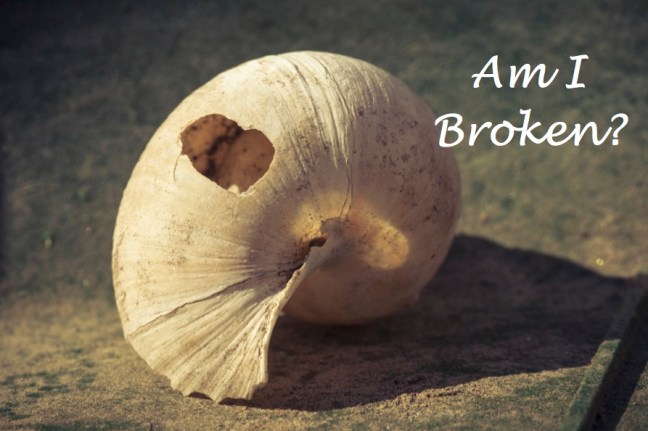


Am I Broken?

​​​​​I’m working on writing a couple of books this summer (yes, two because I’m crazy!) and as a result, I’m finding that my body and brain are resistant to spending time crafting blog posts. And since my new phone now has enough memory to operate (more than I do right now, to be honest), I’ll be sharing some videos through the summer. I don’t have the time (or computer power) to edit these, so they’ll be raw. Please forgive:)

This first one is in response those who are feeling broken after divorce, a sentiment I have been encountering quite a bit recently.

​​

Twenty Tiny Tweaks to Help You Through Divorce

For those days when the big changes feel overwhelming and yet you’re still wanting to feel better –

Here are twenty small and easy things you can do to help make your life through divorce just a little bit easier.

Staying With the The Devil You Know

devil you know

Is it better to stay with the devil you know?

The Monty Hall problem is a famous puzzle in mathematics. In this dilemma, a contestant on a gameshow is attempting to correctly choose the one door out of of three that hides a prize. The contestant selects door and does not open it. The host then opens door three, revealing that there is no prize. The player is then given the option to stick with their initial choice or switch to the second door.

Most people intuitively feel that remaining with the initial choice of door one is advantageous or that the contestant now has an equal chance with either door one or two. Mathematically, however, the player has a better opportunity of winning (67% chance) if they change their selection.

When this solution was first published, the outcry was enormous, well beyond what would be expected for a math-related article. So why were people so resistant to the idea of letting go and taking their chances on something new?

Once people make a decision or arrive at a solution, they take on a sense of ownership of that idea. And once they possess it, they become wary of letting it go. In a sense, releasing the choice becomes a loss. And we often act to avoid loss.

The first choice for the contestant is knee-jerk. At that point, all of the doors have an equal chance of containing the prize. But once the second choice is offered, the situation has changed. Inaction is tempting both because it needs no overcoming of inertia and accepting a loss due to a failure to act is easier than accepting a loss that arises directly from an action.

And then of course, there’s ego that has a difficult time admitting that maybe the first choice wasn’t the right pick after all.

And all of this simply to avoid leaving behind a door that may not even contain a prize.

We face a version of this dilemma in life. Except then, we know what is behind the door. And yet sometimes we struggle to choose another option even when we know that what lies behind the door we picked is certainly no prize.

I think we’ve all chosen the devil we know at times. Maybe you stayed in a job too long that wasn’t a good fit. Perhaps you tolerated an abusive situation after the pattern became clear. Or possibly you have clung to a self-narrative long past its expiration date.

We justify our decision to stay with the status quo –

“At least I know what to expect.”

“I know how to navigate this situation and I don’t now how to do the other.”

“Maybe this is the best I can do.”

“I still have hope that this situation can change.”

It;s scary to leave what you know. It’s hard to admit that maybe your first choice wasn’t such a good one. It’s so hard to let go of one selection when you don’t yet know where the other will lead.

But if you know that the door you chose isn’t right for you, maybe it’s time to select another. After all, that one might just hide the prize you’ve been looking for.

The Perks and Problems of Being an Only Child

I just saw a former student from a few years back.

“How are you?” I inquired, looking at the almost-adult in front of me.

“Great,” she replied, “I just got my license today!”

“Awesome! That’s got to be a little freaky to have your first day driving on such a stormy day.”

“That’s why I brought my [younger] brother with me. That way, if I got into a wreck, I wouldn’t be alone.”


I am an only child. It’s a status that never gave me much thought as a child and when it was worthy of consideration, my attitude was generally one of gratitude as I encountered my friends’ obnoxious younger siblings. I was also a deliberate only child, raised by parents who were well-versed in the stereotypes and generalizations of solo offspring.

So it came as somewhat of a surprise to me the other day when I realized an undeniable adverse impact that being an only child had on me. But before I get to the downsides of being siblingless, let me begin with the positives. Because there is a LOT to be grateful for.

Only children…

Are comfortable with adults. In larger families, there is a divide between the children and the adults. They occupy two separate spheres. As the only child, my world intersected the adult arena more often and, as a result, I grew comfortable talking to and interacting with adults. As a teacher, this is often the first clue I have about the size of my student’s families.

Learn to be assertive. I didn’t have a sibling to look out for me on the schoolyard or to help me navigate uncomfortable situations. I had to learn to do it myself (I didn’t find it an easy lesson). I had to reach out to have friends accompany me since I had no built-in peer group. Only children have to learn to speak for themselves.

Have a flexible view of family. Without siblings, children have a tendency to find and build familial relationships with others. Family is defined by the relationships formed between the people rather than the mandates of the DNA. This is a lesson that has served me well in adulthood as my tribe has morphed over time and location.

Independence. Without an older one to pave the way or a younger one to assume the blame, only children have to learn to stand on their own and take responsibility for their actions. I learned how to take care of myself, entertain myself and go out by myself. All good skills to have as an adult.

Of course, there were downsides too. As Brock and I watched two brothers tussle on screen in a series we’re watching, he mentioned how he and his siblings used to do similar all the time. And it suddenly clicked.

Only children…

Don’t learn how to fight. And not just physically, as in the case on the show, but verbally as well. Most siblings are constantly battling for attention and resources. They antagonize each other and engage in frequent arguments and altercations. And unlike with a friend that you can discard, you have to return home to your sibling so navigating the discord is essential. Sibling squabbles teach kids that disagreements are natural and that you can love one another even when you’re fighting.

Have nobody to verify their experience. Only children do not have somebody else to talk to about their experiences with their parents. I was lucky, I only had the normal childhood parental gripes. But for those with parents who are toxic, abusive or narcissistic, the lack of a sounding board can be devastating and extremely isolating.

Limited lessons in learning to compromise and share. Yeah, kindergarten did a good job here, but it was still limited. After all, my room and my things at home were still my domain with nobody to challenge that status. Perhaps that’s one of the reasons I became a teacher – it’s MY room! 🙂

Don’t have as much struggle for individuation. It’s always interesting to me how siblings assume family labels from a young age – “the athletic one,” “the smart one,” “the smart aleck one.” The kids have to find and fight for their individual identity from the beginning. And if they attend the same schools, it’s a struggle that follows them their entire childhood. As an only child, I never had to try to set myself apart from anyone.

I’m grateful for the recent ah-ha moment in my difficulty with interpersonal conflict and disagreement. It’s one of those areas where simply having an awareness pays dividends.

And as for Tiger, my current only canine child, we’re planning on getting him a sibling this fall in the hopes that he can pass on some of his awesomeness to the next doggy generation.