10 Ways to Survive at Work When You’re Divorcing

Wouldn’t it be nice if we could just push a pause button on life while we’re trying to get it together during divorce? Unfortunately, such a button has yet to be invented. And so we are stuck trying to keep up with our responsibilities at work while our emotions and personal lives are pulling us down.

And it’s not easy.

Here are 10 easy things you can do to help make it a little less tough that don’t require calling in sick for the next year:)

10 Ways to Survive at Work When You’re Divorcing


Life doesn’t stop when your marriage does. Here are some ideas on how to hold it together at work while your life is falling apart –


1 – Appoint a Point Person


Depending upon your nature and the culture of your workplace, you may decide to be open and transparent about your current situation or you may decide to keep it under wraps. Regardless of your position, I encourage you to confide in at least one person at work. Choose wisely – you’re looking for somebody who will be supportive rather than a busybody and will be understanding and helpful even if only provided with the barest of details.

Divorce can be very isolating and when you spend the majority of your day around people who don’t know about your situation, it can feel as though you’re in quarantine. Having a point person at work gives you a release valve. A friendly face and an encouraging word go a long way when you feel completely discouraged.


2 – Find a Safe Place


No matter how accepting your workplace is, you probably want to try to avoid tears at your desk or screams of profanity over the phone in the break room. Take a moment to scout out a safe place, a secluded spot inside or outside your work where you can retreat when you need a moment to get yourself together.


3 – Develop an Elevator Speech


Even if you decide not to reveal the unraveling of your marriage, people will notice that something is different. And being questioned when you’re raw can strip away any semblance of sanity and togetherness you are projecting.

So write your elevator speech, a canned and brief response that can be uttered in response to any probing questions. One that I often used – “I’m in the middle of a major life renovation.” Once you write your speech, practice it until you can say it without emotion.


4 – Clear Your Head


Institute an emotional purging ritual that you engage in before you begin your work day. I used a timer set for 8 minutes and a journal where I would write out all of the negativity and fears that arose during the night.

Follow your purge with a few moments of mindfulness. This can be as simple as ten deep breaths with intention and focus. This combination of release and awareness will help to keep your emotions in check throughout the work day.


5 – Block Messages


Divorce has a way of being intrusive. And whether it’s a call from your lawyer about another needed document or a text from your ex about custody, those messages can completely derail your work day. Most of these messages demand attention, but are not emergencies. So block them for the duration or part of your work day and set aside time each day to read, listen and respond to divorce-related news. Just by attending to the information on your own schedule will go a long way to making you feel in control of your emotions.

6 – Get Up and Move

A still body fosters a restless mind. If your job is mainly sedentary or keeps you in one primary location, make an effort to take movement breaks. If you can, strive to move with enough energy to elevate your heart rate, as the corresponding release of neurotransmitters will help to calm your mind and reset your mental state for work.


7 – Schedule Strategically


Some bad days seem to come out of nowhere. But others can be anticipated. If you have an upcoming day that you suspect will be rough – a court appearance, an anniversary, a birthday – use your schedule strategically. Need a day off work? Maybe it’s a good time for a doctor’s appointment. Need something to look forward to after a bum day? Schedule a vacation. Also, if you have control over your workload, you can intentionally ramp it up as a distraction or lighten the load if you need a break.


8 – Find a Centering Focus


Place something in your workspace that acts as a center, a prompt to take a deep breath. A sign that it will eventually be okay. A reminder of what is really important. It can be a picture, a quote or even an object. Think of it as your mascot or slogan for your new life.


9 – Stock Up on Sticky Notes


Your brain won’t work right for a period of time. It’s suffering from a TLI (Traumatic Life Injury) and it’s processing and memory capabilities will be reduced. I used to make fun of my mom for her abundance of sticky notes. And then I went through divorce and papered my own surroundings!

Don’t try to keep everything in your working memory; devise and implement some sort of note-taking strategy. Think of it as an external hard drive for your overtaxed brain.


10 – Get Into the Flow


Work can be a blessing during divorce. Allow yourself to become immersed in your responsibilities. Seek to enter a state of flow, where the outside world fades away and time seems to suspend. Let your work remind you of your strengths and your value.

Above all, be kind to yourself during this time. You’re facing some major changes and it’s only natural that the impact will bleed into your work. And the more you learn to accept and work with the reverberations, the less they will rattle you.


The Importance of Rituals

We mark life’s important milestones with rituals – words and actions, often shared with others, that become a signpost that one stage has ended and another has begun. After death, we gather to pay our respects and to remember the life that blessed us with its presence. We use graduations ceremonies to delineate the end of childhood and the beginning of a new, more independent stage. Birth announcements are sent so that the larger community can share in the joy of a birth. Celebration dinners are held to acknowledge birthdays or promotions and flowers are sent in solitary to those in grief.

Rituals provide a shared language, a way to both announce the transition and to allow others to share in its experience. In ritual, we acknowledge the importance of any loss or any new gains. There is comfort in the action, especially when it suggests a next step when your vision is clouded over with emotion. Rituals both honor the past and allow for change; they are the spiritual linkage between what was and what will be.

Rituals provide a pause.

A collective breath. A rare moment to simply be in the between. An opportunity to connect through shared memories and possibly shared tears.

Some rituals are more private – the silent prayer, the daily scribbles in a journal, or the annual review of important photographs on an anniversary. Yet even these provide a sense of connection, providing a feeling of being part of something greater than ourselves.

Without hours of returning to alien and vacuous house after my husband abandoned me, I engaged in spontaneous rituals of my own. I burned love notes that I had written to him in the outdoor fire pit that we had recently bought together. Each pledge of love fed to the flame brought a new wave of fresh tears and each charred fleck of paper that escaped towards the sky brought with it a new sense of hope for rebirth.

Later that night, possessed with restless energy and filled with grief that alternated between rage and sadness, I gathered up his things, hauling trash bag after trash bag to the garage. I needed to finalize his exit by the removal of the evidence of his existence.

Over time, the rituals became less frenetic and more purposeful. I committed to daily entries in my journal, many of which were a way to say goodbye. I took one last walk through my garden, touching each plant as I passed. The tangible detritus of our marriage in the form of photos and letters was packed away until I could decide what to do with it. And the night my divorce was finalized was a strange parody of a birthday dinner, attended by friends and family.

Divorce is the end of one life and the beginning of another.

And unlike most life transitions, divorce does not come with a socially-constructed instruction manual that suggests pre-approved rituals. So we have to construct our own way to mark the occasion, both remembering and honoring what was and making space for what will come.

Ten Unexpected Episodes That Left Me Feeling Triggered

triggered

After my former life imploded with a tsunami divorce, there were some situations that I knew would be difficult to face. In order to avoid being triggered, I drove the long way to avoid seeing my former neighborhood with the entrance sign that my husband fabricated the letters for. I was cautious not to go to “our” restaurant alone or when I was feeling low. Looking ahead, I knew that I would struggle with any hints of abandonment. And I studiously avoided any media that dealt with the subject of affairs or fraud.

But then there were the unexpected triggers. Those seemingly innocent events or circumstances that sucker-punched me to my knees, my head swirling with flashbacks instead of cartoon birds. In hindsight, these seem innocuous. Silly, even. Yet they were anything but at the time they occurred.

In chronological order, these were the ten unexpected episodes that left me feeling triggered:

A Tap on the Shoulder

It was just an innocent and perfectly acceptable tap. A student needed my attention while the class was testing. Not wanting to make any noise and coming up from behind me, she simply tapped me on my shoulder. Three months earlier, it would have been a non-event. But that day?

Oh, it was an event.

You see, my ex and I had this little game where we would tap the other on the shoulder at random times as a way to request a kiss. So when that student tapped my shoulder, I felt my stomach take an express elevator down as I again realized the enormity of what I had lost.

The Words, “Dear Reader”

My ex used to write creative fiction when he was in high school and he often shared these stories with me. He had this habit of occasionally addressing the reader directly which always got under my skin (although I never said anything).

Years later, after he abandoned me, was arrested and released on bail, he attempted suicide after emailing my mom and his other wife a suicide note. The tone reminded me of those youthful stories with its undercurrent of “dear reader,” as though he was doing us a favor.

I made it several months before I encountered those words in a book written by some completely innocent author. The text was flung across the room before it found its way back to the library.

A Traffic Jam

Years ago, I read a scientific article about how traffic jams are actually related to fluid dynamics and how understanding the latter has led to unique strategies in major cities. Excited about this information, I shared the study with my husband. He laughed at me and soon “fluid dynamics” became a joke whenever we were stranded in Atlanta traffic.

Since I stayed close to home after the tsunami divorce, months passed before I was impacted by traffic. As my car came to a stop behind miles of red brake lights, I automatically said the words, “damned fluid dynamics” as tears poured down my face. I would never again have someone to share that joke with.

Getting Picked Up at the Airport

I knew to steal myself for the hazardous materials sign at the entrance to security since that was the last place I ever saw my husband while he was still my husband. But I didn’t expect to have a panic attack on the other end of the trip.

My now-husband, then-boyfriend promised to pick me up after a visit back to Texas. As I stood at the curb waiting for him to arrive, I realized that I half expected him to not show, which is what I believe my ex husband had originally planned before concern for the dogs changed his approach.

When my boyfriend’s car pulled up as promised, I shook with both relief and release of stored trauma.

Small Lies of No Consequence

I teach middle school. And middle schooler lie. Often. About stupid things.

In the past, I could laugh off these stupid lies even as I made it clear that I wasn’t going to fall for it. After all, I knew that these fibs weren’t personal. They were just the excuses offered up by teenagers with partially-formed brains and a desire to avoid consequences.

But something changed after I learned that I had been living a lie crafted by my ex. An allergy of sorts. Any exposure to falsehoods and I would have a severe reaction. For the first time in my entire career, I would have to excuse myself so that I could calm down before responding to a kid.

The Air Blower at the Entrance to Home Depot

I walked through the entrance of Home Depot, the rush of air drowning out all of my senses. When I came to on the other side of the blast, I found myself transported to the past.

Money Moved From One Account to Another

This was a silly one. My now-husband and I had a gift account from our wedding and we had agreed to move the money to our joint savings account. But apparently my emotions didn’t remember this agreement.

I’m proud of how I handled this one.

A Basement Theater

I’m not so proud of how I handled this one. My ex husband built himself an office in the basement. In reality, it was command central for his other life. Needless to say, I developed a bit of an aversion to basements after this.

So when my now-husband wanted to build a theater downstairs, I responded in a pretty poor manner, letting fear do the talking for me.

Ugh. I’d like to forget that particular outburst.

Mums

This one was a surprise. After all, they’re just flowers. But when I saw them – and appreciated them – I suddenly realized how much I had allowed my ex to be my voice.

Winning Teacher of the Year

I received the honor of Teacher of the Year towards the end of my first marriage. My husband was gone at the time (allegedly on a work assignment) yet he had flowers delivered to my classroom before he even knew that I won. Months later, he attended the awards ceremony with me. The professional photos from that night were the last we had taken of us as a couple.

Exactly ten years later, I won again. My husband was out of town.

Gulp.

I had to remind myself that I married a very different man this time. Which soon became evident. My ex sent expensive flowers to my work where they would be sure to be admired by others. My now-husband made an immediate Facebook post talking about how proud he was of his wife. The flowers came, but to the house. They weren’t meant for public adoration.

The triggers came fast and furious in the beginning. Over time, they lessened in both intensity and frequency. It’s been over a year-and-a-half since I was last triggered. I’d like to say that I’m done with them, but I also know that life likes to keep us on our toes. Luckily, I trust now that the feelings will fade and the event will lose its power to impact me.

The best things about triggers is that once they are defused, they are harmless.

When New Information Comes to Light

I became conditioned to be afraid of the mail. And the ringing phone. Even email had the ability to send my stomach plummeting down towards my feet. Because each intrusion had the potential of bringing new information about my ex husband to light.

In retrospect, the pattern was quite clear:

Stage 1 – Status Quo of Healing

Doing okay despite the major upheaval of my life. Possess a sense of confidence that I was going to be okay and that this tsunami divorce was not going to remain the defining factor of my existence. Feeling like I could handle whatever emotions my mind decided to deliver.

Stage 2 – Body Slammed

“Who was I kidding? I’m far from okay,” I would think as I learned some tidbit of new information from the external world. It could be anything from a blog post from the other wife mentioning a sweet gesture to a bill from the utility company in his name. Instantly, I travelled back to the shock and dread of the initial discovery, my mind convincing me that this new information changed something vital about my ability to heal and move on.

Stage 3 – Processing and Assimilating

After obsessively turning over the new information in my mind for several days, it began to feel less foreign and less threatening. Often, I discovered that it wasn’t really new after all, only another piece of data simply confirming what I already knew. Finally, I would file this recently learned fact alongside its brethren and start to find a sense of status quo again.

Well, that is, until the next piece of new information dropped unannounced into my lap. At which time, the cycle would begin all over again.

Healing is not linear. As new information comes to light, we have to mourn, accept and adjust all over again.

It is completely normal to experience setbacks in healing after divorce when you receive new information. Each discovery pierces the newly-formed healing skin and threatens to bring new blood to the surface. It’s a new pain upon a known wound.

Be patient with yourself and your reactions around these events. You may seem to be overreacting, but that is because you are responding to so much more than simply this one piece of information. You’re struggling to process an entire pile of garbage and the addition of one more piece can feel overwhelming and ominous.

Whenever possible, limit your exposure to new information while you’re still feeling raw. You may be curious to know what your ex is up to, but you’re often better off remaining in the dark. Set boundaries, both digital and with people in your life, to filter what information makes it through to you.

Finally, give it time. In the beginning, every new piece of data is like shot coal burning you as you take it in. In time, the coals turn to ash, still not palatable, but no longer so painful or damaging. Additionally, your confidence grows with each new exposure as you learn to trust in your ability to handle it.

And that’s what it really comes down to. We fear new information because we worry that we can’t deal with its reality. Then, we struggle with the knowledge because it feels so heavy and oppressive. Once we learn how to take only the parts we need and to discard the rest, we can remain calm and confident no matter what new information comes our way.

You got this.

Marriage is Not a Test

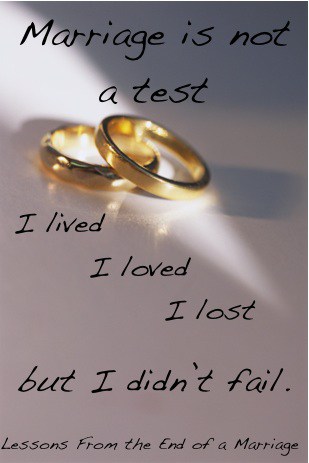
Marriage is not a test.
I lived.
I loved.
I lost.
But I didn’t fail.

Society makes assumptions about those who are divorced. Maybe we lack the fortitude to persist through difficulties. Perhaps we possess some great fatal flaw that makes us unable to sustain matrimony. Or, possibility we are flighty, given to jump in without thought and give up just as easily.
There is often shame inherent in admitting that one is divorced, like some scarlet letter “D” is forever branded upon your character if your “ever after” ended sooner than expected. It’s as though you failed at one of the biggest assessments you face as an adult.

In the strictest sense, my marriage did fail. After all, it ceased to exist upon the receipt of the horrific text: “I’m sorry to be such a coward leaving you this way but I’m leaving you and leaving the state.” Furthermore, my husband failed me through his betrayal and abandonment. I failed him by not seeing that he needed help and I failed myself by not being aware of his actions and the signs of a crumbling marriage. Yet, even with all that defeat, I refuse to look at my marriage as a failure. That label undermines our years together with all its shared memories and joys; the shared life and experiences are negated with that single word. Although I did feel as though I failed in some ways, I was adamant that I was not going to let my divorce define me as a failure.

Failure is an act, not a person. I’m divorced. Not defective.

As I grappled with the end of my marriage, I found comfort in the words of others. Others who had faced their own challenges and were determined to learn from and grow from their mistakes and unrealized goals.
There’s always failure. And there’s always disappointment. And there’s always loss. But the secret is learning from the loss, and realizing that none of those holes are vacuums. Michael J. Fox


When the marriage died, I felt like I expired right along with it. As though my respirator had been yanked from my face and I was struggling to find the strength and will to breathe on my own. I felt unanchored and unable to escape from the pull of the dying marriage. Failures are not vacuums; we can summon the strength to move beyond them. The realization that I could choose to redefine my divorce was powerful; it gave me the motivation and momentum to continue.
I’ve come to believe that all my past failure and frustration were actually laying the foundation for the understandings that have created the new level of living I now enjoy. Tony Robbins


I am often asked if I would have married him if I could turn back the years. I would. Yes, the divorce and associated suffering have been the most painful experience of my life. Yet, I could not imagine my life without having endured that pain. Without that failure, I would not have the perspective that allows so much gratitude and acceptance in my life today. Acceptance that extends to forgiveness for my ex and myself for the conditions that led to the end of the marriage.
It is impossible to live without failing at something, unless you live so cautiously that you might as well not have lived at all, in which case you have failed by default. J. K. Rowling


I used to be too fear adverse in my old life; I would engage it what I call “practicing the perfect,” which is a way to feed the ego at the expense of the soul. I would try things only if I believed that I had a good chance of success. Interestingly, the cataclysmic end of the marriage released me from that fear of failing. I learned that it’s rarely fatal and that security is only an illusion. You’ll never know what you can do unless you try.
A failure is not always a mistake, it may simply be the best one can do under the circumstances. The real mistake is to stop trying. B. F. Skinner


The tendency is to respond to failure in one of two ways — blame others or internalize the mistake. That’s the ego talking again. It’s helpful to realize that most people in most situations are doing the best they can. I used this to help soften towards my ex. I realized that he didn’t do these things to me; I was simply collateral damage in his decisions. I also let up on the self-flagellation for not recognizing any red flags.
Success is not a good teacher, failure makes you humble. Shahrukh Khan


Our egos are a bit like young meatheads in a gym. Flexing in the mirror, wanting to appear strong and capable amongst the others. This means that sometimes we will try to lift more than we can without asking for assistance. And, just like in the weight room, this can only lead to disaster. When we fail at something, we can either give up or ask for help. Allow yourself to be humble, ask for a spotter and you’ll not only gain the respect of those around you, but you will also be able to lift more than you ever thought possible.
I don’t believe in failure. It is not failure if you enjoyed the process. Oprah Winfrey


My biggest issue with labeling my marriage as a failure is that it focuses on the end and ignores the 16 years together. The 16 good years. Those still count. I still think back and smile. I may not love the man but I still love the memories. I think this thought is especially poignant for those with children from the union. It’s important for the kids not to think that you see the marriage that created them as a waste, a mistake. In some way and for some amount of time, it was successful.
Failure should be our teacher, not our undertaker. Failure is delay, not defeat. It is a temporary detour, not a dead end. Denis Waitley


Divorce is a powerful teacher if you listen to its lessons. Its methods may be harsh but its messages are life changing. A failed marriage does not make you a failure. The only true failure is failing to live and love, even if that means that sometimes you may lose.
Related:  What Makes a Marriage Successful (and Why Divorce Does Not Mean Failure)
test