What Makes People Susceptible to Gaslighting?

It’s so hard for me now to understand how I fell for my ex-husband’s BS. From where I stand now, his gaslighting and manipulation tactics seems transparent and absurd.

But that certainly wasn’t the case while I was living it.

In fact, I was more likely to accept that I was crazy than to accuse him of madness.

Why was that? What conditions existed in myself, my marriage and in my life that made me susceptible to gaslighting?

Psychology reassures me that I’m not alone. In 1951, the Asch Conformity Experiment sought to garner information on if people will begin to go along with the assertions of others even when that conclusion is contradicted by their own senses.

In the experiment, a group of people were seated around a table and asked to select the card that matched a given image – displaying either one or three lines. In the control group, all of the subjects were authentic participants and people easily selected the correct card.

In the experimental group, only one person at the table was an actual subject; the others were part of the experiment and were directed to chose the incorrect card. In this situation, the subject went along with the majority about one third of the time and selected the incorrect card. The pressure to be accepted was greater than the confidence in their own instinct.

When interviewed later, some admitted that they made the selection even though they knew it was wrong.

And some confided that they truly believed that they were seeing something that wasn’t there.

Why is it that some people are relatively impervious to this kind of influence and others are more easily influenced?


Opportunity in Vulnerability

The early years with my ex-husband were marked by tragedy as thirteen of my friends and mentors died over a few years. During that period, my then-boyfriend became my rock. My center. I anchored to him because it felt like everything was being washed away.

I was needy. Uncertain. I looked to him for guidance, not because he had any more wisdom, but because I was lost myself.

When we’re broken open, we are more susceptible to being controlled by outside forces. In times of increased vulnerability, we are more likely to look for guidance from people intent on misleading us down a path of their choosing.


Fear of Rejection

I went into the relationship with my ex-husband carrying a substantial fear of abandonment. Within this fear, I confused a rejection of my ideas as a rejection of me. And so I too-willingly agreed. Because to disagree meant risking that I would be discarded.

It somehow seemed better to abandon my truth than to be abandoned myself.

The fear of rejection is powerful. In our core selves, we understand that in terms of survival, rejection equals death. And sometimes we’re willing to do the unthinkable to stay alive.


Trusting and Kind-Hearted Nature

Before the discovery that I was married to con man, I had little exposure to people trying to harm me. In my experiences, people were generally kind with good intentions and so I assumed a default position of trust.

We all have a tendency to see people as we are. So those that are susceptible to gaslighting are likely to be trustworthy and trusting. They struggle to accept that somebody – especially somebody who claims to love them – would intentionally manipulate and destroy them from the inside.


Open-Mindedness

As a curious and creative kid, I was always asking questions and considering possibilities. I learned to be wary of knee-jerk conclusions and long-carried assumptions. This open-mindedness served me well in academics. It didn’t prove so beneficial in relationships because I could be led into questioning my own conclusions. And that’s a problem when the one carrying the lead has nefarious intentions.

Open-mindedness is one of the key psychological traits that exist on a continuum. Those that exist on the more extreme end of the spectrum are likely more impressionable to outside influence.


Self-Doubt

Like many people, I sometimes struggle with an internal voice that questions my worth and my perceptions. My ex-husband knew this and would skillfully both reassure me and plant new seeds of doubt deep within the recesses of my mind.

Self-doubt is gold to a gaslighter; they’re drawn to it for the opportunity it provides and they are experts at utilizing it to their advantage. As a result, people are more vulnerable to gaslighting when they are in periods of transition that result in a greater self-doubt.


Isolation

In real terms, I wasn’t isolated during my marriage. I had a full-time job as a teacher, I tutored on the side and I talked with friends and family on a frequent basis.

Yet the reality was that I was isolated when it came to my marriage. Not only did I have tendency to spend too much time within my own head, I also refrained from talking about my husband or my marriage in any real way to those around me.

I never gave myself the opportunity for a reality check.

Gaslighting proliferates when there are no other sources of light. When there are a multitude of external influences, it is more difficult to be persuaded by a single source.


It’s easy for me to beat myself up over falling for his manipulations. But mostly, when I look back with perspective, I feel compassion for the woman I was. Yes, she made the mistake of trusting too much and loving too easily. And in the mix, she forgot how to trust herself. But she also showed how strong she was and in the end, she found the courage to find her truth.

 

When Your Pedestal is Too High

When I first met my ex-husband, my focus was on getting to know him. I asked questions without assuming the answers and I listened to his responses without any prior assumptions blocking the way like a clog in a drain.

And then, much like what happens when you become familiar with a character in a book, I began to construct my own view of him, assembled from his words and actions over many months.

And that view was quite favorable.

I thought this was a good viewpoint to have; I had often heard the adage that one of the keys to a happy marriage was to see your spouse through rose-colored glasses. So I minimized his faults and glorified his strengths.

My error was in not recognizing (and appreciating) the distinction between a rose-colored tint and an opaque coating of naive confidence.

I had mistakenly placed him on a pedestal and that pedestal was ultimately too high.


When you place your partner on a pedestal…


You set forth unattainable expectations. 

We become disappointed not by other’s actions, but when their actions don’t match our expectations. When you have an inflated sense of your partner’s character, abilities or intentions, you are laying the groundwork for expectations set well beyond reach. Additionally, you may begin to hold yourself up to unreachable goals as your goals become more out of touch with reality.


You provide no allowance for mistakes.

When you perceive someone as “perfect,” you provide them with no permission to make any errors. If they are aware of the pedestal they stand upon, this can lead to a denial and concealment of any mistakes. And if you become aware of any signs that they are flawed, you can overreact because it calls into question your assumptions.


You discount any signs that don’t align.

We are all subject to confirmation bias. We pay more attention to those things that confirm our beliefs than to those that threaten our assumptions. And if you happen to believe that your partner is “too good to be true,” you may well miss the signs that this is indeed the case. This threat is especially concerning if you happen to be with somebody that willingly exploits your trust.


You create a situation where a fall from grace is inevitable.

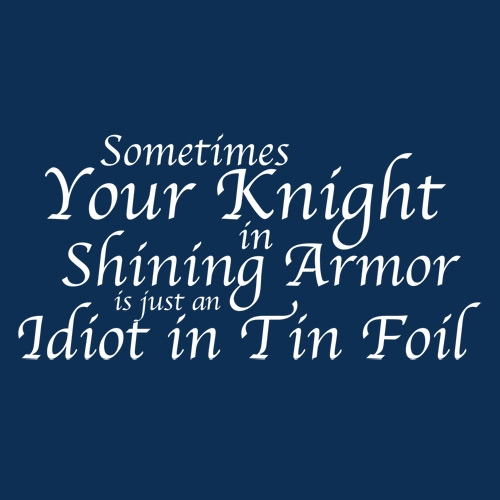
It’s impossible for anybody to stay perched on a pedestal forever. The fall from perfection will happen and the shockwaves can be catastrophic. This is especially acute when you feel as though your partner has “rescued” you from your past or some difficult situation. At some point, you’re going to realize that the shining armor is merely tinfoil.


IMG_1840

The mistake I made in my first marriage was to only view the good in my ex husband. As a result, it was difficult for me to be aware of his deceptions and manipulations. Any slip-ups that I knew of were magnified beyond their scope because they threatened to destroy my image of him. When the truth was finally revealed, I went from seeing him as all-good to all-bad, as though he was some malevolent monster. The reality of it is that he always had elements of both.


I’ve learned from my earlier mistakes. Now, with my current husband, I choose to see the truth of him (that he is both awesome and human) and focus on the best. It’s a good balance. I emphasize (and hopefully magnify) his strengths while at the same time being realistic and open-minded.

IMG_1809


Subtle Signs You’re Being Manipulated By a Covert Abuser

Covert abuse is sneaky.

It doesn’t leave a bruise on your cheek.

Or cut you down with scathing words.

Or even obviously isolate you from others.

Instead, it wisps in slowly through tiny cracks. Velvet-trimmed lies whispered into trusting ears. The smoke builds until you no longer remember what it is like to see clearly and your head is filled more with the thoughts of your abuser than with your own.

It’s often only possible to identify covert abuse once you have escaped its clutches (and even then, it usually takes a period of months or years to fully grasp what happened). It’s like a domestic form of Stockholm Syndrome, the persecutor masquerading as a protector.

The following are the subtle signs that were present in my ex husband. Small dots of data that when connected, paint a crimson flag of warning. If you see a preponderance of similar signs in your relationship, it warrants further investigation. If you recognize these traits in your former relationship, it can give you some information that can aid in the healing process.

These signs are subtle and can have many causes and manifestations. Just because someone fits these descriptors, it does not mean they are covert abusers or narcissists. But it does mean that you should look twice. Especially before you leap into marriage with them.

Continue to read the rest.

Overcompensation

I know I was shocked when I first heard the news.

I’ll bet you were too.

We trusted him. We respected him.

We felt like we knew him.

And then when the stories about his impropriety began to surface, we started to question.

Not only his authenticity, but also our own judgment.

Like so many that lead lives of misconduct, Bill Cosby hid behind an illusion of perfection. He played the father we all wished we had, and his off-screen demeanor paralleled his on screen performance. He always seemed kind. And patient. Making us laugh and making us learn.

And also making us look away from his behavior behind the scenes.

Causing those that heard of his behavior to question the veracity of the claims.

And perhaps even making those subject to his offenses question their own memories.

Because in so many ways, he was so good.

Too good to be true.

I never realized that my ex was also too good to be true in many ways.  I thought I was lucky to have a husband that I got along with so well that we never seemed to have areas of friction. I felt blessed that he was so patient with me and would strive to temper any anxiety I felt. I was in awe of his ability to solve any problem and I delighted at the fact that he always had an answer.

I trusted him. I respected him.

I felt like we knew him.

And then when the stories about his impropriety began to surface, I started to question.

Not only his authenticity, but also my own judgment.

And all too often, that’s how it is. Sometimes the wolves walk among us unshielded. But much of the time, the wolves are dressed in the finest wool, revered as the ideal lamb.

And who suspects a lamb?

Watch out for those who overcompensate. Those who seem too good to be true. Be wary when tensions never rise and irritation rarely shows. Be cautious around people who never sweat and never seem fazed.

Because all of us are a blend of both wolf and sheep.

And those who pretend otherwise are hiding something.

Related: Covert Abuse