Not Every Day Is a Good Day. Show Up Anyway.

bad day

Having a bad day?

My hairdresser is usually an upbeat and positive woman. Her energy pulls me into the moment and her “bright side” approach helps me forget the fact that I seem to have a little more grey to cover every time.

Yesterday was different. Tears teased the corners of her eyes as she detailed all that had happened to her recently. She was valiantly trying to hold it together, but it was like her emotions were winning at tug-of-war, pulling her over the edge.

Finally, as she applied the last of my color, she wiped the corner of her left eye, picked up a curling iron and exclaimed,

“Damn it. I am going to be beautiful today.” 

And she was. I watched as her hair – and her face – transformed while we waited for my color to set. As each new ringlet was formed, her eyes became a little more determined and her expression became a little more hopeful.


It is a fact of life for all of us – bad days will happen.

Some bad days are of the, “I overslept and my car was rear ended on the way to work.” Other bad days fall into the, “I just buried my best friend” category. And in between those, there will be plenty of the, “I’m just not feeling it today” variety.

On those bad days, there is the temptation to crawl back under the covers and wait for the next sunrise to signal a do-over. Our minds feel pulled towards what’s not going right, thinking about it even past the point where thinking is needed. The plummet of our emotions seems as inevitable as a raft in whitewater poised at the top of a waterfall. We yearn to avoid the discomfort and so we try to distract with food, a drink or busyness. And the idea that things can be better is nothing but a distant possibility, so hazy that it seems like the false hope of a mirage.

Not every day is a good day.

Yet even if the chips are down and the tears are frequent, it is still YOUR day.

You can make the decision to show up anyway.

To proclaim, “Damn it. I am going to be present. I am going to persist. I am going to be positive.”

My husband likes to say that loyalty isn’t about being there when things are good; it is about being there when things are bad.

Be faithful to yourself.

Even on the bad days, show up.

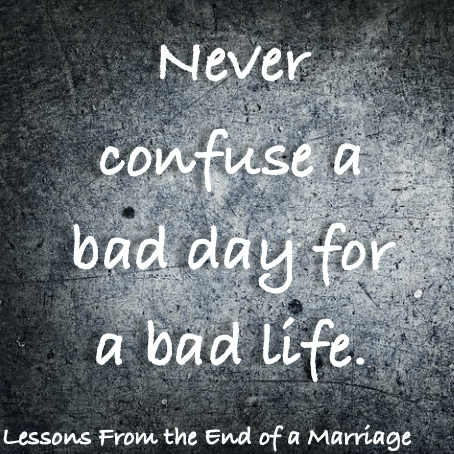
And never confuse a bad day for a bad life.


Why Do We Fall in Love With People That Are Bad For Us?

When I first started dating, I sought out boys that were the opposite of my father.  My logic went like this – my parents divorced, therefor my father didn’t make a good husband, so I would be better off avoiding guys that mirrored my dad.  And I soon fell in love with the man that would eventually become my husband.

It was only years later that I learned that by studiously avoiding certain characteristics. I inadvertently agreed upon other traits that were most decidedly unhealthy at best and criminal at worst. Traits that I was completely blind to at the time.

He was “Husband of the Year” to my face and a lying, cheating, stealing bigamist behind my back.

I’m not alone in giving my heart to someone who would ultimately be detrimental to me.

Why is it that even the most educated and emotionally intelligent people fall in love with people that are bad for them?

Habit– We all have a tendency to do what we have done. Mirror what we have seen. If you grew up in an abusive household, you are more likely to find yourself partnered to an abuser. If you were parented by an alcoholic, you will be drawn to the same. If you have a propensity for the lost boys, you will continue to blindly seek them out until you make an effort to break the habit. Overcoming a habit takes mindful attention; before you can change your patterns, you must become aware of your patterns.

Sunk Cost Fallacy– Just because you have put time and energy into nurturing a relationship, does not mean that the relationship should last. Sometimes, by the time the early infatuation has faded and we realize that somebody is a mistake for us, we feel like we have already invested too much into the relationship to bring it to an end.  This is often compounded by a reluctance to admit to ourselves or others that we chose poorly. It’s better to be embarrassed for a moment than treated poorly for a lifetime.

Are You Falling For the Sunk Cost Fallacy in Your Relationship?

Sliding In– You meet somebody. You’re attracted to them and you have a good time together. So you agree to a second date.  And then a third. Before you know it, you’ve moved in together after justifying that it makes sense to save on rent. And then marriage just seems like the next inevitable step, even if neither one of you have actually given it much thought. The person that made for a great first date may not necessarily be one that makes for a great partner.

Low Self – Esteem  – Maybe you feel like you’re not good enough and that you deserve someone who treats you poorly. Or you find your worth through helping others and so you’re drawn to those that need fixing or enabling. When our self-esteem is low, we inadvertently project it, attracting people that are also lacking in confidence or, even worse, pulling in people that prey upon the weak. A vicious cycle can begin where the person with low self-esteem is drawn to people that use manipulation and emotional abuse to further lower self-worth. How people treat you really does start with how you treat yourself. You must create a healthy relationship with yourself before you can entertain one with someone else.

The Love You Find When You Struggle to Love Yourself

Feeling Lonely – The distress of being alone is one of the great universal human fears. And we will go to great lengths to avoid it. Even as far as getting with and staying with somebody that isn’t right for us with the belief that somebody is better than nobody. The great irony here is that feeling isolated and misunderstood within a relationship is infinitely more painful than actually being alone.

Potential – We often fall in love with a person’s potential rather than their reality. We see their inherent gifts and believe that if they simply made some basic changes, that they would be better. Both for them, and for us. Of course, the reality is that you can never change another person, only your response to them.

Are You in Love With the Person or With Their Potential?

Rationalize – Their behavior will change once we get married/have a child/change jobs/move to the new house. They may treat me badly sometimes, but they are a great parent/provider/respected community member. I know they’re not good for me, but I need to stay because I can’t be alone/handle my own finances/find anybody else. Consistently defending somebody’s behavior (whether your own or your partner’s) is a sign that something is amiss and you are not yet willing to face it.

How can we move on from the damaging relationships and learn to give our hearts to those who deserve it?

  1. Focus less on what made your former partner bad and more on why you were drawn to them.
  1. Look for patterns in your past relationships – are you replaying roles from your childhood or consistently picking the same kind of ill-suited partner?
  1. Are you putting up with consistently poor treatment? Work at setting and maintaining boundaries.
  1. Spend time with people who celebrate your gifts and cherish you as you are. Let their love help you develop your own sense of worth.
  1. Forgive yourself for the poor choices you have made. Rather than beat yourself up, strive to learn from your mistakes.
  1. Understand that just because you made a poor choice, you can still make better choices.

During my own divorce, I was able to reconnect with my father. And I discovered that he is an amazing man with many traits that I would love to have in a partner. And so the second time around, I sought out a husband that had those characteristics and who treats me well not only to my face, but also behind my back.  A man that challenges me to become better while celebrating my strengths. This time, I fell in love with somebody who is good for me.

And I have faith that you can do the same.

Not Every Day Is a Good Day. Show Up Anyway.

bad day

My hairdresser is usually an upbeat and positive woman. Her energy pulls me into the moment and her “bright side” approach helps me forget the fact that I seem to have a little more grey to cover every time.

Yesterday was different. Tears teased the corners of her eyes as she detailed all that had happened to her recently. She was valiantly trying to hold it together, but it was like her emotions were winning at tug-of-war, pulling her over the edge.

Finally, as she applied the last of my color, she wiped the corner of her left eye, picked up a curling iron and exclaimed,

“Damn it. I am going to be beautiful today.” 

And she was. I watched as her hair – and her face – transformed while we waited for my color to set. As each new ringlet was formed, her eyes became a little more determined and her expression became a little more hopeful.


It is a fact of life for all of us – bad days will happen.

Some bad days are of the, “I overslept and my car was rear ended on the way to work.” Other bad days fall into the, “I just buried my best friend” category. And in between those, there will be plenty of the, “I’m just not feeling it today” variety.

On those bad days, there is the temptation to crawl back under the covers and wait for the next sunrise to signal a do-over. Our minds feel pulled towards what’s not going right, thinking about it even past the point where thinking is needed. The plummet of our emotions seems as inevitable as a raft in whitewater poised at the top of a waterfall. We yearn to avoid the discomfort and so we try to distract with food, a drink or busyness. And the idea that things can be better is nothing but a distant possibility, so hazy that it seems like the false hope of a mirage.

Not every day is a good day.

Yet even if the chips are down and the tears are frequent, it is still YOUR day.

You can make the decision to show up anyway.

To proclaim, “Damn it. I am going to be present. I am going to persist. I am going to be positive.”


My husband likes to say that loyalty isn’t about being there when things are good; it is about being there when things are bad.

Be faithful to yourself.

Even on the bad days, show up.

And never confuse a bad day for a bad life.


Why Do We Fall in Love With People That Are Bad For Us?

Have you ever fallen for someone that turned out to be bad for you? Who left you worse off than you were before? Who perhaps used you or abused you?

My hand is sure is sure raised.

And I know I’m not alone in this.

So why is it that we fall so easily for those who treat us badly? And what can we do to keep it from happening again? Learn more here.

Stuck In a Bad Marriage? These Are Your Three Choices

bad marriage

I had someone come to me last week for advice. His relationship with a woman – a married woman – recently ended and he was reeling from the breakup and associated revelations.

“I don’t understand,” he wrote, “How can she tell me her marriage is so bad and then choose to stay in it?”

I groaned. I couldn’t help it. I have never heard from anyone who had a relationship with a married partner who was not told that the marriage was bad. In fact, I think that pronouncement is a prerequisite for infidelity.

And it drives me crazy.

First, I see this as an excuse. It’s a convenient way to lessen guilt and shift blame to the unsuspecting spouse. It’s basically saying, “I’m not cheating because I’m a bad person; I’m cheating because you’re a bad person.” By painting the marriage as bad, regardless of the veracity of the claim, the actions become justified.

I also read these statements as a cry of insecurity. In essence, “My husband/wife never appreciates me so I need you to fill in the void.” But when we seek validation outside of ourselves, it’s never enough.

The assertion of a bad marriage to an affair partner is also manipulative. It’s a sob story that can used to spur rescuing behavior. “I’ve tried so hard to be a good spouse but I’m a victim of my spouse’s actions.”

Ugh. Just no.

If you’re on the receiving end of these stories, listen between the claims. Watch actions, not words. Think about what this person has to gain by telling you about their bad marriage.

And realize that reality may be very different than the picture they are trying to paint. After all, most people that have affairs claim that they are happy in their marriages.

Yet they say otherwise.

Now of course, marriages can go bad. Some had signs of mold from their inception while others slowly rot over time. If you’re in a souring marriage, you have three choices:

Fix It

Not by changing your spouse. But by changing yourself and your reactions. Instead of blaming your responses on your partner’s actions, dig deeper to uncover why you are upset. What is being triggered? Address that.

How To Release Your Triggers

Accept It

Your spouse isn’t perfect. And neither are you. Marriages have seasons of growth and periods of drought. Are you looking to your spouse to fill a void within yourself? Are you expecting your marriage to magically heal your childhood wounds? Are you assuming that your partner should meet all of your needs?

Why I Don’t Want a Perfect Marriage

End It

And if the defects are fatal? End it. There’s no reason to keep a marriage on life support forever.

12 Things to Consider Before Ending Your Marriage

Choosing to stay in the marriage while complaining about it is a form of passive acceptance. Yet it’s an acceptance that will keep you (and your marriage) miserable.

7 Reasons People Withdraw in Relationships

It’s really that simple.

Three choices – fix it, accept it or end it.

Make one.