Edit Your Personal Narrative

Did you ever have one of your English papers passed back filled with red marks; edits and deletions shaping your original script into something more cohesive and descriptive? If you’re at all like me, you first reacted with a bit of defensiveness tinged with embarrassment – “I thought the paper was good.” But then, upon reading the revised essay, you begrudging admit that the revised version is better. Maybe even much better.

The external hand wielding the marking pen gives you the gift of perspective, allowing you to see the patterns in your writing and the fall-back phrases that are too often used.  The editing process removes what doesn’t better the whole and selects the best choice of similar words to express an idea.


Have you ever paid attention to your internal narrative, the story you tell to and about yourself? Have you ever noticed a pattern in the words you select and the phrases you repeat?

Often we unwittingly craft a negative internal narrative, repeating past injuries and berating ourselves. Spinning yarns into straightjackets that keep us bound and gagged, prisoners of ours pasts and our beliefs. We excuse others while we abuse ourselves, framing our choices as worse than they are.


The words we choose to say to others have influence.

The words we choose to say to ourselves have power.


When we repeatedly hear the same words about ourselves, we begin to believe them. Even if they aren’t true.

Pay attention to the words you use to describe yourself. Are you selecting the best term? For example, feel the difference between “depressed” and “sad.” Sure, they are technically synonyms but the connotation is vastly different. Depressed is heavy, permanent. A condition. Whereas sad says, “I feel badly right now.” It’s a mood. Ephemeral. Even if you are depressed, try renaming it as sadness in your script. Keep repeating it and you’ll start to believe it.


Look to see what other words or phrases you can replace –

I shouldn’t feel that way” becomes “I feel this way right now and that’s okay.”

“I’m lonely” turns into “I’m feeling separated from others right now.”

“I’m stupid” is replaced with “I made the best decision I could in the moment and I’m learning.”

“I’m rehashing” is exchanged for “I’m processing.”

“I’m broke” is retired and “That doesn’t fit in to my personal wealth goal” is brought in to fill its place.

“I’ll never find love again” is crossed out and “I am open to receiving love again” is written in above.

“My life sucks” is modified with the phrase “right now.”


Edit your personal narrative to create a story of compassion. A script of forgiveness and learning and hope.

The words you choose have power.

Use that power to shape the life you want.

You’re worth it.


You’re Not Special

You’re not special.

That realization was the  hardest pill for me to swallow post-divorce.

I would read or listen about the depths of pain others experienced through divorce and silently believe that my pain had to be different.

Special.

And I had plenty of evidence to back up my belief. After all, how many 16 year relationships end with a text, fraud and bigamy?

It was a great excuse to delay the real work of healing for a time; by focusing on the sordid details, I gave myself a reason to ignore the collective wisdom from the universal experience of love and loss. On the surface, I would graciously accept guidance and advice while tacitly believing that it didn’t apply to me.

Because I thought that my situation, my experience, my pain was special.

I focused on what set me apart rather than what bound me to the common.

I thought I was special. And that belief was both affirming and alienating, giving blessing to the pain and isolating me from others. It’s a lonely place, sorted into a group of one by the particulars of your story. The blessings of excuses soon wear out their welcome and the focus on the details begins to feel like an un-welcomed quarantine.

My unexpected guide out of the isolation chamber of my perceived specialness came in the form of books. Fiction, mostly, and in many cases, not even particularly good fiction. As has always been my habit, I made a weekly library trip and loaded up on whatever was available – mystery, thriller, historical and even some that could be classified as chic lit.

And I read.

And, as is to be expected, my own recent experiences altered the lens I used to view these fictitious worlds; I related to characters who were facing some unimaginable trauma and were suddenly tasked with the seemingly impossible assignment of rebuilding their lives.

And I learned that when it comes to pain, the details don’t matter.

I empathized with characters facing illness, losing loved ones in myriad ways, dealing with natural and manmade disasters and even with those experiencing what would be classified by most as a minor loss. I related to the antagonists and protagonists, men and women, children and elderly and even the occasional non-human. In almost every story, I found elements shared with my own.

My focus blurred, editing out the details and seeing instead the ever-present themes of love and loss, of fear and shame and of hope and persistence.

I wasn’t special.

And I welcomed that realization.

It meant I wasn’t alone. That others had faced similar and thrived. That even though this was a new path to me, it was well-worn and well-marked.

Pain isn’t a solitary experience and healing is not a solo journey.

And even though you are unique and awesome in your own way, when it comes to suffering, you’re not special.

Rather than focus on what sets your pain and experience apart, find comfort in what binds you to others.

You’re not special. And you’re also not alone.

Group hug?:)


The Best is Yet to Come

I had a conversation the other day where I challenged someone to describe the good that came from a recent and devastating break-up (I know, you’re shocked, right?).

Part of her response-

I love knowing that my best and happiest love is yet to come. I have that to look forward to.

She actually made me speechless with that assessment. In all my years of dissecting out every little scrap of good from my horrific divorce, this was one benefit I never unearthed. And yet, as soon as I heard it, I felt it.

And she’s right.


It’s so easy to grasp onto what was rather than hold hope for what can be.

It’s so easy to view the past through a rose tint and imagine that no future can ever measure up.

It’s so easy to focus on what has been lost rather than what can be gained.

It’s so easy to fill up on sadness and not leave room for smiles.


We zero in on what we know and what we know is the past, the pain.

Try making the belief that the best is yet to come at the center of your heart and aim your thoughts that way.


What I love about her words is that they focus on hope. They build excitement and anticipation. They speak of an assurance that our hearts are capable of love even after heartbreak.

The best is yet to come.

Are you ready for it?


Prepare For the Worst, Expect the Best and Live For Today

The people of Alaska absolutely captivated me.

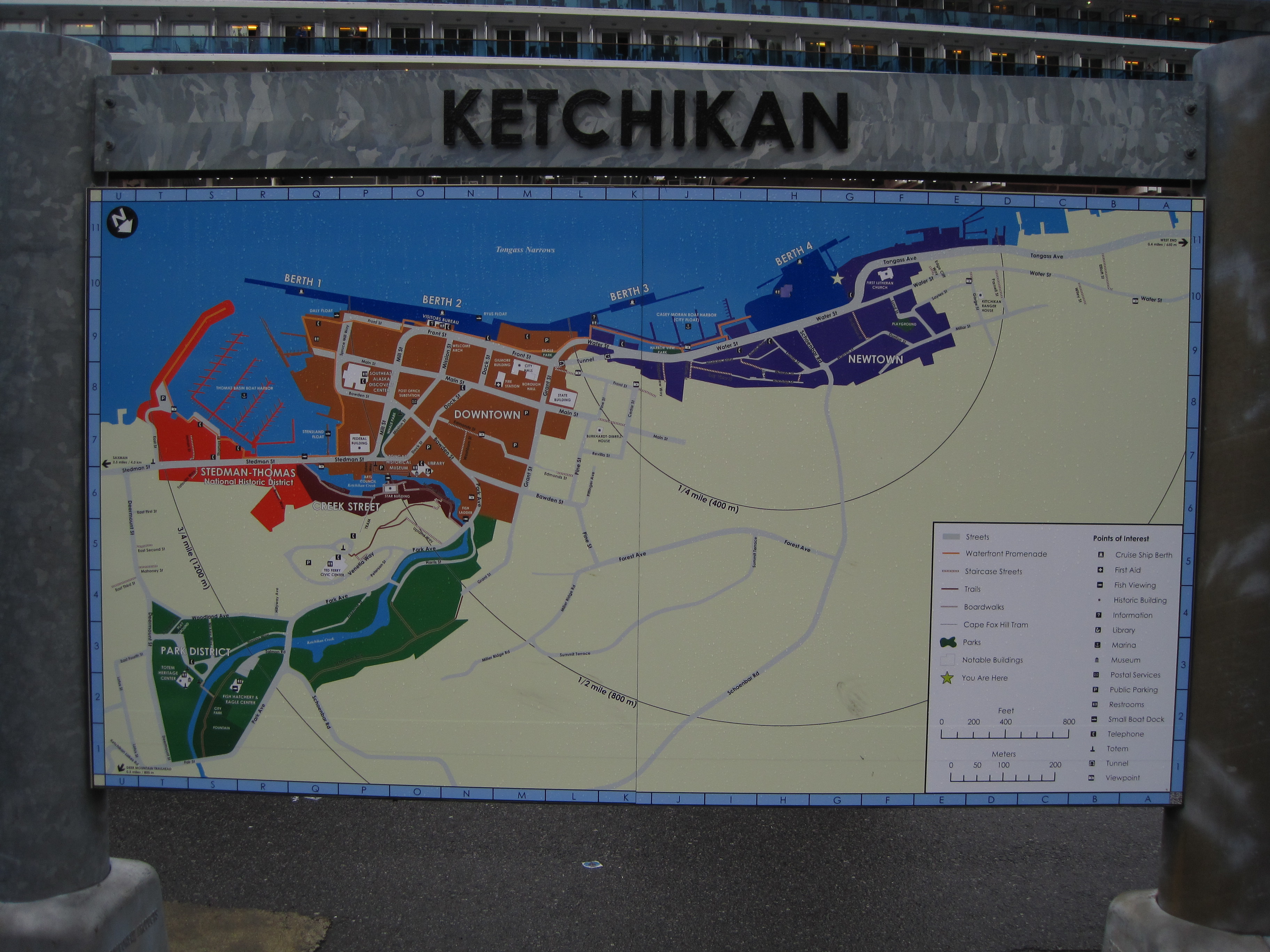
And nowhere was this more true than in Ketchikan, a town of around 8,000 people pressed between the towering mountains of the Tongass Forest on one side and the frigid waters of the Tongass Narrows on the other. Like many Alaskan cities, Ketchikan is only accessible by plane or boat. There are no airports in the actual city of Ketchikan; you must either utilize one of the countless floatplanes or land on Gravina Island and take a ferry across the inside passage into town (this is the site of the proposed “Bridge to Nowhere“).

Our first glimpse of the city from the ship.

At first glance, Ketchikan may resemble many other quaint coastal towns that survive off fishing and tourism.

Pretty small!
Pretty small!

But this isn’t any quaint coastal town. Although the temperate rainforest location helps to moderate the temperatures, this is no pleasure island; an everyday stroll can turn into a fight for survival at any moment. The winds fly through nearby Nichols Passage at hurricane forces through much of the winter months, forcing residents to hunker down and stranding them from any potential way out. The sun never stays long and is usually only visible through the ever-shifting layers of clouds. The forest is untamed and the wildlife is not safely tucked away in some zoo.

Survival is a way of life here.

But it’s not a way of living.

One of the benefits of taking this trip with my extroverted husband is that he engaged in conversation with everybody. We learned that one of the employees for Ketchikan Outdoors was brought there by her mom in middle school and now, as a college student in the lower forty-eight, returns to Alaska in the summer for work. She told us about the transition from a middle school with 1,000 students to one with 200 and the need to take a ferry for any interscholastic sports competitions. We met the owner of the excursion company, who first saw the city on a cruise and made the decision to move there after a second visit where he fell in love with a woman as well as the town. Our guide decided to call Ketchikan home after experiencing its raw and powerful beauty. And our server that afternoon was born and raised in the small town and, after a brief stint away, felt called back home.

Creek Street
Creek Street

Each of these residents spoke in glowing terms about their community. Yet they also remained firmly anchored in reality; life in Ketchikan can be hard.

So they prepare for the worst.

Every 7th grader is required to undergo survival training and complete a survival hike. The 8th graders have to demonstrate their survival skills with an overnight island stay with minimal supplies. Residents carry survival gear in the colder months for even a short trip into town, realizing that the weather turns on a quarter dime in SE Alaska. Nothing is taken for granted as winter approaches, supplies and food gathered and stored.

Full survival gear. Hard to believe I was in a bikini the day before!

Yet they expect the best.

It would be easy to become fatalistic about death here; it takes far too many before their time. Yet even though tragedy is a constant threat, the people of Ketchikan possess a limitless spirit of hope and teamwork. We heard one story of a small fishing boat crashing within sight of the city. The stranded boaters immediately went into survival mode and one was spotted in a tree by a little British lady on her Zodiac excursion. The weather may have bested them, but they had faith in themselves and their community.

The rocks were covered with seals and eagles.

And they live for today.

I think I understand what is so captivating about Ketchikan – it is a place of acceptance and living in the moment. The shifting clouds change the views from each second to the next. The eagles swoop past in a flash and the whales peek through the waves. It’s a place that refuses to be tamed, to be controlled and molded into some imagined ideal.

A bald eagle grabbing a fish just feet in front of us!

Because it is perfect just as it is.

Although I think I’ll limit my visits to the summer months:)

If you ever find yourself in Ketchikan (and I hope you do!), I strongly recommend the Zodiac boat tours by Ketchikan Outdoors. They are a great group of people who run a great operation. We were the envy of our cruise ship!


Asphalt

curious

“Mommy, what’s asshole?”

Or at least that’s what my mom’s friend thought she heard her three-year-old ask. Believing that age-appropropriate honesty is the best policy, she replied with a brief description of the literal meaning followed by  the fact that it’s used in a derogatory way. “You shouldn’t call people that,” she finished up, feeling satisfied with her response.

“Oh,” her son replied, looking puzzled. “Johnny said it was the stuff they put on the road.”


We hear what we expect to hear.

We see what we expect to see.


We reach conclusions before the end and we compose responses before we listen.


But you can change your approach. As with anything, practice makes better.


So, today, practice being curious.

See with your eyes rather than your assumptions.

Listen with your ears rather than your judgements.

Practice being comfortable with unfinished stories and responses unsaid.


Be inquisitive.

Be attentive.

Be receptive.

And be ready to be surprised.

Things are often not as we perceive them to be.

eyes