When Are You Safe In Marriage?

Imagine stepping onto a baseball field and up to bat. You connect with the ball and begin your run around the bases.

So when would you be safe? When could you relax a little, knowing that the umpire couldn’t declare you out? When could you be assured that the run would be completed and you would make it all the way home?

After first base? Second?

If marriage was a baseball field, first base would signal the completion of 10 years, second base would be 20, third, 30 and circling around to home plate again would represent a lifetime of wedded (hopefully) bliss.

When are you safe in your marriage? When can you breathe easy knowing that your spouse wouldn’t suddenly decide to throw you out? When could you be assured that the marriage will last a lifetime?

After ten years? Twenty?

A friend commented on a local radio personality’s somewhat public and ongoing divorce from his wife. They have been married for twenty years. My friend was shocked, having the assumption that a marriage that has lasted twenty years will last for the remaining decades.

But that’s not necessarily the case, is it?

In a marriage, you can celebrate making it to second base. But you can’t relax.

Some of the hardest years can certainly be the early ones, as negotiations are compromised and compromises are negotiated. You are still learning who your partner is in a variety of situations and learning how to be with them. It can be a time filled with complexity and flexibility as you find your stride.

And if nothing ever changes, perhaps you can relax at that point, resting easy knowing that you’ve worked through all of the kinks in the marital knot.

But something always changes.

Kids come and go. Promotions are gained and jobs are lost. Some selves are actualized and some are minimized. Someone may fall ill or someone may fall in love.

Something always changes.

And when change comes, the marriage must change with it if it is going to survive. (And especially if it is going to survive happily because what’s the point of a long marriage if you’re miserable the entire time!)

Even if it’s been twenty years.

Because in a marriage, there’s no such thing as safe at the plate.

And although that may seem a little scary, it also makes the game exciting. Because how can a marriage between two ever-changing people in a always-shifting environment ever become stagnant or boring?

You have to always keep your eye on the ball and your intention on the journey.

And if you get called out, don’t be afraid to get back in the game:)

After the Affair: Are You Focusing in the Wrong Direction?

You discovered your partner is cheating.

Driven by a mixed fuel of rage and pain, you begin a background check on the affair partner that would do the FBI proud.

Who are they? Why was my spouse drawn to them? What do they have to offer that I do not?

We’re looking for information that would protect our bruised and battered egos. That would support the rejection and lessen its agony.

But even if you discover that your partner’s dalliances were with Angelina Jolie or Brad Pitt (both seemingly the epitome of good looks, good character and good standing and well out of the realm of mere mortals like the rest of us), you will still feel the dismissal just as strongly.

Because the pain isn’t about the affair partner.

It’s about the rejection by your partner.

You’re focusing in the wrong direction.

I know. I did it too. My situation was different than many in the fact that the other wife didn’t know he has married (although I have to assume that the other “other women” did); she was conned as much as I was. Still, I grew obsessed with dissecting her, trying to understand the pull, as though she was some super magnet that emitted a force too powerful to resist that sucked him out of the marriage.

But that’s not the case, is it? If someone doesn’t want to be pulled from a marriage, nobody can have that power of attraction over them.

I was focusing in the wrong direction.

(For the sake of brevity and fairness (and my personal aversion to the repeated use of the term “affair partner”), I am going to refer to the other man/woman as the mister(ess). Because there isn’t an equivalent male-gendered term. Yet.)

I can hear you already. But in my case, the mister(ess)…

My reply?

It. Doesn’t. Matter.

I’ll prove it to you.

The situation with a spouse and another can be broken down into four main categories based upon the intention for reconciliation between the partners and if the mister(ess) is known to the betrayed spouse.

No Reconciliation; Unknown Mister(ess)

You and/or your spouse have decided that reconciliation isn’t possible. You’re grieving the loss of your marriage and harboring anger over how it collapsed. It’s easy to place the blame of mister(ess). Safe. It means you can avoid the painful realization that your partner was not the person you thought and it keeps you distracted from the very difficult responsibility of healing yourself.

The other person does not matter. The marriage is over. The “how” and “why” can provide some useful learning. But the “who”? The “who” is just noise.

I often compare the drive to know more about the mister(ess) to the obsession with scratching a scab. It can an all-consuming itch. A need that builds until you fill it. And then once scratched, the drive fades until it begins to build again. As long as you keep scratching that itch, the wound remains open. Leave it, and with time it will heal.

So unless you want the affair partner to be a part of your life moving forward, shift your focus to your future.

If you have kids, the situation is obviously more complicated if and when the mister(ess) becomes part of their lives.

It increases the pain for the betrayed spouse because it’s easy to feel usurped as both a partner and a parent. And often, that pain comes out in an attack on the mister(ess), sometimes even using the kids as weapons.

It’s a nuclear warhead of emotions, which makes it nearly impossible to be pragmatic.

So I offer you a litmus test.

Over the years, your kids have had (or will have) a handful of teachers that they do not bond with. If you run crying to the principal every time your child mutters, “The teacher doesn’t like me,” you’re doing your kid a disservice. If, however, the teacher is truly abusive and inappropriate, if you do not step in and protect your child, you’re doing your kid a disservice.

And it’s the same with the mister(ess) (or, in fact, anyone your ex is seeing). If your kids are in emotional or physical danger, do everything you can to save them. Otherwise, back off.

Refrain from badmouthing the mister(ess) to your children. If he/she is a bad person or has selfish motivations, your kids will figure it out on their own and will withdraw from the person (and grow some grit in the process). Good.

And if your kids happen to bond with the mister(ess)?

Well that’s good too.

The more people a kid has in his or her corner, the better. No matter how they came to stand there.

No Reconciliation; Known Mister(ess)

It is a much more difficult situation when you know the mister(ess). In fact, that is one of the criteria for compound-complex infidelity. The affair partner may be a friend of yours, an acquaintance, or even family. You’re betrayal is twofold – from your spouse and from your friend/family member.

They are two distinct betrayals.

Treat them as such.

You’re not reconciling with your spouse, so the advice above still applies.

And as for the other?

That’s up to you.

If you want to try to keep him or her in your life, you will have to move past the anger and work towards forgiveness. If you always see them as the mister(ess), they can never again be your friend.

If you decide the betrayal is too great to maintain the relationship, you will have to move past the anger and work towards forgiveness. If you carry that venom, it will only serve to poison your future.

Either way, releasing the fixation on the mister(ess) is key to your freedom.

photo 2-108

Reconciliation; Unknown Mister(ess)

So you and your partner have decided to try to make the marriage work. Yet you’re still consumed by thoughts and questions about the mister(ess).

You would surely be upset if your partner was focused on the mister(ess) after an intention of reconciliation had been agreed upon (and if that is your case, are you sure they really want reconciliation?). Why is it any different for you to focus on the other person? If you are holding on to the ruminations about the mister(ess), you are holding the marriage back.

Whatever you nurture, grows. If you want to save your marriage, that’s where your focus must lie. Not on what helped tear it apart.

Reconciliation; Known Mister(ess)

Hat’s off to you. You’re in perhaps the most difficult position of all. Remember, you have decided to try to salvage and repair your marriage. Focus on restoration rather than the storm.

It’s natural after an affair to want to blame. It’s natural to want to paint the mister(ess) as a vile, evil homewrecker intentionally alienating your innocent (or at least naive) spouse. It’s natural after an affair to become consumed by the questions, driven to uncover the sordid details of what happened behind our backs.

But all of that energy is focused in the wrong direction.

It’s turned to what hurt us rather than what can help us move forward. 

The mister(ess) only matters if you make them matter.

Detachment Styles

Much has been written about attachment styles, starting with ways that infants bond with their caregivers and then extrapolated to how people respond in their romantic relationships.

Here is a summary I made of the four primary attachment styles (information from Psychology Today):

attachment stylesIf you are not familiar with attachment theory, it’s worth a look. It’s amazing how much of how we respond in relationships can be described within this matrix.

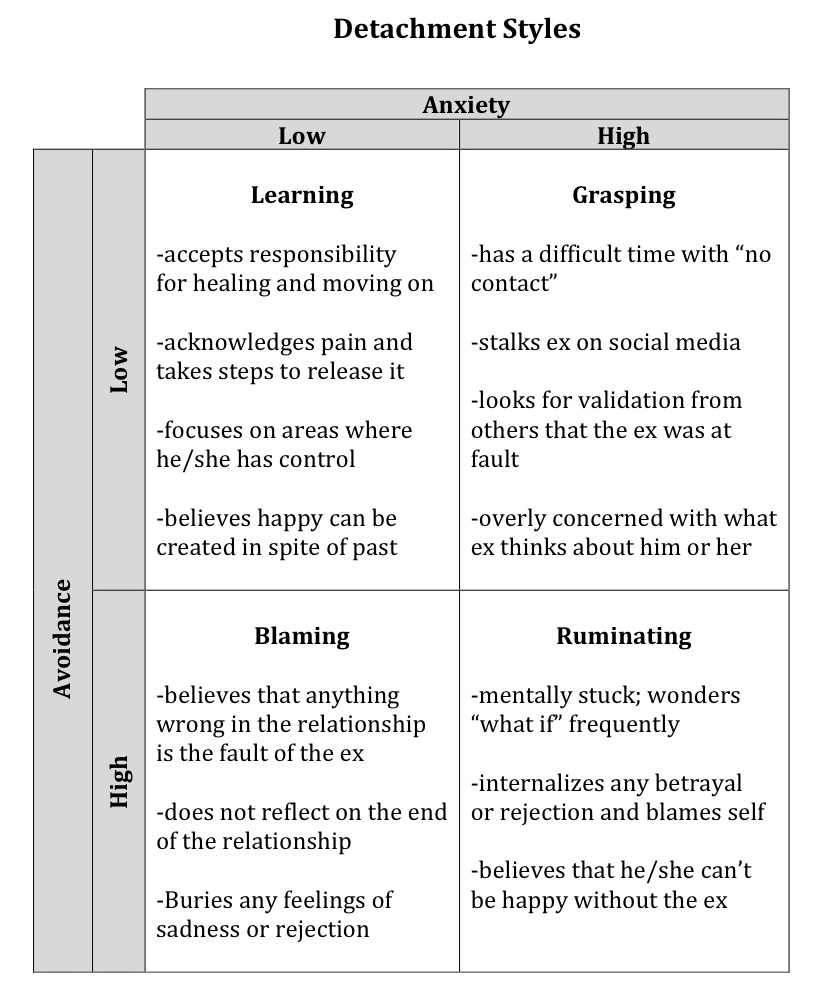
Of course, the way we respond at the end of a relationship also depends upon our personal makeup and early experiences. I created a chart of detachment styles based upon the same criteria.

detachment stylesAs with with attachment styles, you will likely recognize yourself in more than one category or realize that you have moved from one box to another over time. These are not fixed traits; you can change your position with intention and effort.

Breaking up happens. How do you want to detach?

The Faux Commute

In the book I’m reading right now, the main character continues her weekday commute into London months after she was terminated from her job. Part of her motivation seemed to be habit and a lack of purpose and direction. But the main reason she continued the act is because she was too ashamed to tell her landlord/flatmate that she was no longer employed.

When I drove to work Friday morning, the book fresh on my mind, I peered at my fellow commuters, wondering if any of them were burning fuel and hours on a faux commute to a job that no longer existed. If any of them were keeping up the pretense while using up the savings. I pondered spouses back home, blindly secure in the belief that their partner was gainfully employed and unaware of the daily play-act.

It seems like something meant for fiction.

But it’s not.

My ex husband did it too.

He was too ashamed to concede that he could not find work. So he pretended that he could.
For years, he simulated a job. He invented clients and projects. He manufactured payments from lines of credit. I’m pretty sure he even falsified an award. Apparently, he was the best at his pretend job.

And he’s not the only one.

A friend’s first husband pretended to be enrolled in school full time while spending time in bars.

A coworker’s husband fabricated a start-up business while engaging in an affair.

And there’s a woman in my periphery who spent her time shopping while maintaining the facade of employment.

Here is a related piece I wrote for The Good Men Project that explores how this shame around employment can grow and spread through families.

But the problem isn’t just that the secret is kept from the partners.

Often the person can’t even admit it to themselves.

Continuing the faux commute and maintaining pretense even for themselves.

Now obviously most of us will never hold down a pretend job and engage in a daily trip of make-believe.

But that doesn’t mean we don’t engage in our own faux commutes.

That there aren’t truths we’d rather not face and so we keep us the pretense, even for ourselves.

That we don’t catch a ride going nowhere because we’re afraid to admit that it’s a dead-end run.

That we don’t pretend that something is still working for even when we no longer work for it.

So take an honest look at your life.

And make sure all of your commutes are authentic.

The book is called The Girl on the Train and it is a great thriller, especially for anyone who has experienced gaslighting.

One Marriage, Two Lives

Brock and I watched American Sniper last weekend.

We both walked out in tears.

It’s a powerful movie.

And one that highlights many uncomfortable truths.

I’m not going to get into the story. Or the controversy.

But I do want to address one common issue the movie emphasizes.

That people who share one marriage often lead very different lives.

In one poignant scene, the sniper is riding in the back of an armored vehicle through the streets in Iraq. He’s on the phone with his new wife, who was walking out of the doctor’s office where she had just learned the sex of their new baby. On his side, shots are fired. The phone falls and is trampled as soldiers respond to the immediate threat. On her side, she wails as she hears the shots fired across the world. She screams for her husband while clutching her unborn child.

One marriage, two lives.

A military marriage with one spouse deployed is an extreme example of spouses living in different worlds. One occupies the domestic world where daily concerns are often limited to the mundane while the other is living on the edge of hell. The one left behind is desperate to connect, wanting to know about the experiences. Whereas the one who has returned has witnessed scenes that no one should ever see and works to shield his or her spouse from what they saw. It’s no wonder that military spouses often have trouble relating once they are reunited.

This phenomenon is not limited to military marriages.

Lives diverge when distance separates partners for protracted periods of time. Whenever one spouse has job that reveals the darker side of humanity, they may be more likely to erect a screen, safeguarding their partner from reality. When one partner assumes most or all of the parenting duties or when one is fully responsible for securing a living, they have to make a continued effort to maintain a connection between their worlds. And even a couple that shares much of daily life risks growing apart if they fail to check in with the other.

In every marriage, there are two distinct people with two distinct lives.

In every successful marriage, there are two people who actively work to build and maintain a bridge between those two existences.

So that rather than one marriage splitting into two lives, it’s two lives joining into one marriage.