

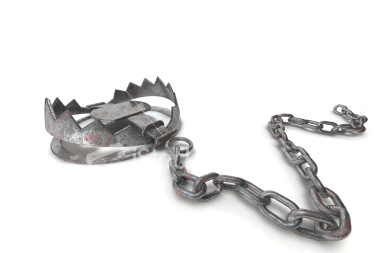
The journey back to life after divorce is a tricky one. You’re depleted and overwhelmed and simply ready for things to hurry up and get back to normal already. It’s easy to feel stuck, trapped between your life and the life you wish to create. When you become aware of these snares, you are better able to disengage and find the freedom to move forward.
The following are common traps that can hold you back after divorce:
Sadness
Divorce is the end of the life you had. It is the death of the marriage and of the shared dreams. It may mean significant changes in family and in lifestyle. It’s natural to mourn. To grieve. You have suffered a major loss.
Sadness becomes a trap when you try to avoid it. When you sense the oncoming tears and instead of letting them flow, you turn away and try to deny their existence. The sorrow only builds when you ignore it, the weight of it holding you down. The only way to relieve sadness is to feel it, acknowledge it and let it flow through you.
Guilt
Remorsefulness comes in many forms after divorce. You may feel guilty for not maintaining your vows, letting your spouse down or not providing the life you had envisioned for your children. Or maybe you even feel guilty because you let yourself down, staying in a situation you swore you would never tolerate.
Guilt has a productive purpose; it guides our actions and acts as a warning light for unethical choices. But sometimes there’s a short in the system, the alarm sounding even when no intentional wrongs have been committed. Consider your actions truthfully. If you owe any apologies, deliver them with sincerity (don’t forget to send one to yourself) and then let the guilt go, as it has served its purpose.
Why
Even when the world responds otherwise, we often possess an innate sense of fairness. Of balance between our intentions and our experiences. When divorce happens, especially if it is a particularly brutal divorce that leaves you feeling victimized and battered, it is natural to question “why?”
At first, exploring the “why” feels like an escape. It distracts from the pain and activates a more rational and aware part of the brain. But “why” is a deceptively sneaky trap. We convince ourselves that once we understand, we will be okay. But no amount of information can relieve the pain. At some point, you have to accept that you won’t know everything and that you can move on regardless.
Vengeance
When we are in pain, we often want to last out. When others harm us, we want them to experience the same suffering. We hold onto our anger like a shield, the sheer power of it enough to protect our delicate selves beneath. We want our perceived persecutor to face consequences. After all, it’s only fair.
The need for revenge is a brutal trap. While your attention is filled with negative thoughts about your ex, you neglect to care for yourself. When you are filled with rage, you end up being singed. And when you base your well-being on someone else’s downfall? Well, that’s just not good karma.
Here’s the truth: You can move on even if justice as you see it is never served. Besides while you’re waiting for the desired punishment to be meted out, who is really the one held in prison?
Loneliness
If you have lost a spouse that you shared many years and many memories with, the forfeiture of the shared history is ruthless. The sudden void is cavernous, the shock of the missing person all-encompassing like the cold air on your goose-pimpled flesh as the water drains out of the bath.
It’s a scary place to be, where two split back into ones. You may feel rejected. Isolated from your former life. Alone against the world. It hurts. But at some point loneliness is a choice. It is up to you to fill your life back up with friends and memories. You have to get up and get out to be connected.
Permanence
We have this way of believing that the way things are now is the way they will always be. But everything changes. Even suffering. The way you feel now is not the way you will feel next year. Or next week. Or even tomorrow.
Divorce is a time when you have to rewrite your life’s plans. But it’s the start of a new chapter, not the end of the story. New beginnings are brimming with possibilities. See them.
Worthiness
When we have been rejected, we often internalize the message, assuming that if it happened to us, it must have happened because of us. We may see ourselves as broken, and either seek out rescuers and fixers or conclude that we are unworthy of love and compassion. We may view our mistakes as fatal character flaws that render us useless.
Divorce is an enormous blow to our self-image and confidence. And it can also help to build us back up as we complete steps we never thought we were capable of. Be mindful of the thoughts you allow about yourself and be deliberate with your personal narrative. After all, the words we say to others have influence. But the words we say to ourselves have power. You are worthy. Say it. Believe it. Live it.
Fear
While some may respond to the fear of divorce by fighting, others may freeze in place, scared that if they move, they will be targeted yet again. Still others may run, seeking to avoid facing the truth of the end of the marriage and the carnage left behind.
When we allow fear to drive our lives, we are limiting ourselves. It may feel like living, but it is only a facsimile bounded by self-imposed rules and boundaries. It’s scary taking that leap of faith from what you knew into the abyss of possibility. But that risk may be preferable to the limitations imposed by apprehension. Don’t let fear be your chauffeur; drive your own life.
Super-Parent
If you are in the position of assuming primary (or only) care for the children, it is all too easy to feel great pressure to mitigate the impact of the divorce by being a super-parent. I see parents who feel guilty for the effects of the divorce and overcompensate by being too permissive with their kids. I see parents who feel guilty about the void created by divorce who strove to fill it by any means necessary.
But most of all I see parents who are overwhelmed and overworked, assuming the entirety of the burden of childcare and decision-making. They become all-mom or all-dad and lose themselves in the process as they place their children’s needs first. This is a tricky trap. Your kids need you. But they also need you to be you. Wholly you.
Give yourself permission to be a good enough parent rather than a perfect parent. Focus on what matters and be willing to release the details that really don’t. Seek out support and guidance from others. And make sure to take care of yourself too.
Preservation
This is the trap of “I will never let myself be hurt again,” the walls that prevent any weaknesses from showing. That protect any vulnerabilities. This trap is often rife with justifications of why it is better to be alone than to risk being hurt.
Consider this: If you are focused on preserving, how much are you enjoying? If you only think about protection, do you ever experience enjoyment? Life is meant to be lived, not secured under glass.
What If
This trap ensnares you with thought tendrils that wind around your brain, whispering about possible actions and outcomes whose time has already passed. The “what if” trap is a maze with no exit, a circuitous path that never ends.
When you spend your energy wondering about what could have happened, you give the past power to rob the future of its potential. Instead of “what if,” try “what now” and focus on what is yet to come.
 Lessons From the End of a Marriage