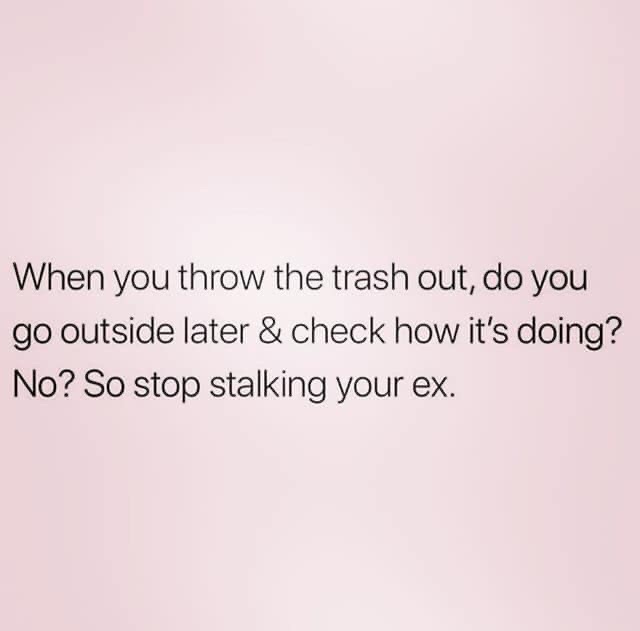
The Increased Urge to Check Up on Your Ex During Times of Crisis

I’ve had several people reach out to me recently stating that they’re struggling to stay away from contacting or virtually checking up on their ex.

It makes sense.

After all, when are we most tempted to reach out to the person that once was a source of comfort and stability? When we’re lonely, anxious or bored. And right now, I think everybody is feeling some combination of those things.

Sometimes it starts with an innocent-sounding thought. “I just need to check up on them,” you say to yourself. “I need to make sure they’re okay.”

Yet, as with so many thoughts when it comes to our exes, this one isn’t rational when examined further. After all, you ex isn’t alone. They have family, friends, maybe even a new significant other to look after their well-being. That’s a job you either quit or were fired from. So why are you still trying to carry out its responsibilities? Furthermore, you’ve gone for some time now without knowing how they are doing. And until the crisis, you managed this state of not-knowing just fine. Why do you need information now? Besides, they’re probably stuck at home just like the rest of us.

Maybe you’re curious if they’re thinking about you, wondering if this increase in thoughts of mortality and the importance of loved ones has made them miss you. After all, it seems like the plot of some 2022 romantic comedy – exes meet up again through Zoom while in quarantine and rekindle their relationship from a distance. And then once the country receives the “all-clear,” they reunite and its happily ever after. Except that’s Hollywood, not real life. In the real world, you broke up for a reason and even though some distance flirting seems harmless, it may be disastrous for your expectations.

Perhaps you’re in a situation like I was in post-divorce, where there was no contact and I looked him up online hoping to find evidence that he wasn’t happy with his other wife. After all, if you’re going to signs of discord in their current relationship, the stress of a pandemic seems like a good time. Yet, at least as far as my social media feeds are concerned, the accepted rules of curating and filtering your life into perfection before sharing still seem to hold true. In other words, don’t expect to see much truth there.

Many of you are feeling lonely right now. Isolated. And so you reach out hoping for a connection with somebody that has a shared history with you. Yet all so often, reaching out to an ex only leaves you feeling more alone as you sense the growing distance between you as your lives continue to diverge. Remember there’s a difference between missing them and missing the memory of them. No matter how many times you reach out, you won’t be able to connect with the past.

You may have been keeping it together before the pandemic, but now with so many of your normal coping strategies banned, you may be finding it harder to cope.

It makes sense.

Every emotion is amplified right now. Everybody has less bandwidth to cope. It’s normal that your willpower is reduced and you’re trying to keep your impulses restrained.

However, that doesn’t mean that it makes sense to check up on your ex. Unless you want to feel worse, that is.

I don’t have any magical advice for those of you struggling to maintain your distance. Nobody does. But I can tell you that you’ll do better if you mitigate your loneliness by staying in routine contact with friends and family. Anything you can do to interrupt the steps between the urge and the initiation of contact will be beneficial (ex. If you tend to look at their Instagram at night before you go to sleep, lock your phone in your car overnight.). Write down reminders why you don’t want to make contact or search them up (How does it make you feel afterwards?). Exercise within the current allowed parameters to work off some of the excess anxiety. And finally, find something that you can dive into that will occupy your brain space and fight off boredom.

In each moment, you have the choice to reach out or to resist the urge. Be honest with yourself which one will make you better, not just for the moment, but the long run. You may scratch the itch, but at what cost?

Breathe.

This too shall pass.


Thoughts From the Edge of a Pandemic

It’s a strange time right now, isn’t it? The entire globe is facing an imminent threat, the first since technology has us so connected and plugged in all the time. It’s a pressure cooker for human behavior, amplifying our usual responses and coping mechanisms.

As of this moment, we don’t know what is overreaction and what is blind complacency. All we can do is try to sort out the valid information from the noise and make the best decisions we can from what we know.

It’s evident that we need to strive to understand this virus, its treatment and its prevention. Yet also critical is that we make an effort to understand the reactions within ourselves and within those around us. Because no matter what the next few months bring, we need to work together and not allow this to further divide us.


Fear Manifests in a Multitude of Ways

Right now, you have two opposing camps – those that are voicing their fears and those that are ridiculing the people that are expressing fear. Yet the truth? Both groups – and those in between that are staying silent – are experiencing some anxiety.

Fear can often express itself in some unexpected ways – covering from anger to humor to distraction. It’s easy to miss the signs in others or even in ourselves. Learn more about how fear manifests: 15 Ways Fear Hides in Plain Sight.


We Have a Need for Action

It’s easy to laugh at the people who have been stockpiling toilet paper. Yet I understand the urge. When we feel out of control, we have a drive to do something – anything – to try to mitigate the outcome. So, yes, filling your home with endless rolls of tissue is a nonsensical response to a respiratory virus, yet it is a tangible action that people feel like they can undertake. It’s not unlike the midwives of old ordering the men to bring hot towels. Purpose and action help to temper panic. Learn more: On the Need For Action


Denial is a Protective Stance

It can be frustrating when people refuse to admit what seems obvious to others. Yet to them, that denial is what is keeping them safe. It’s confirmation bias in action; we actively discard information that doesn’t match our beliefs while seeking out points of view that conform that we are correct. And confirmation bias is extremely resistant to change. Learn more: Jumping to Conclusions.


All Loss Brings Grief

At this point, the actual number of deaths in low from a global standpoint. Most of us are still untouched by the actual illness. Yet we are all grieving. Trips have been canceled or postponed indefinitely. Sporting events shuttered. Planned gatherings dissolved. School events removed from the calendar.

Yes, in the scheme of things, these things are minor. Yet, every loss brings grief as expectations are dashed and a new reality is accepted. And just like with everything, people respond to grief in myriad ways.


Shame is Used as Self-Protection

From racist remarks and actions towards the Chinese to memes implying that those who become ill are filthy and don’t have basic hygiene mastered, there is quite a bit of “us” vs “them” going around. Where whatever commonality that the “them” group shares is absent in the “us” group, thus providing a sense of invincibility. We want to believe that we have control and sometimes this is used as an excuse to hurt others.


When Stressed, We Think in Absolutes

Our stressed brains are not our best brains. The ability to reason and consider multiple perspectives is reduced and we have a tendency to revert to all-or-none thinking. This makes dialog more challenging, as it feels more like a battle for the “win” than an exchange of ideas.


A Plea For Patience

By all accounts, we’re in for a challenging few months, regardless of the trajectory of the virus. Lives have been upended (at least in the short run), financial futures are uncertain, and emotions are running high. Now more than ever, be kind to one another. Seek to understand the motivation behind the words or actions that seem out-of-place. Consider that people can have different approaches to the same problem and different responses to the same situations.

Remember that we’re all in this together.

Why It’s Time to Stop Googling Your Ex!

Googling your ex

I am a recovering Google addict.

For eight months, typing the names of my ex or his other wife into that tempting little search bar was my drug of choice.


I was Googling my ex, but what I really wanted to find was respite from the pain. 


Of course, what I was hoping to find was a full-page ad taken out in the New York Times where he proclaimed that I was the best wife ever and that he made in the biggest mistake in the history of the world when he decided to cheat on and abandon me. I would have also been rewarded by the news that his new wife stole all of his money and abandoned him with a hastily-written sticky note.

Or, at the very least, the news that he had contracted rabies from the monkeys he was showering with in Uganda.

But none of that ever happened.

I mean, the showering with monkeys part happened. Thanks to my sleuthing, I was gifted with the pictures from his other wife’s blog. But as far as I know, there was no rabies, no sticky note and no full-page spread in the New York Times.

And from my perspective now, I realize that even if I had found evidence that he was miserable or regretful, it really wouldn’t have changed anything. Sure, I might have felt a little “zing” of pleasure at his misfortune (probably immediately followed by a jolt of guilt for feeling that way), but then I would have been set on a path of looking for more evidence of his struggle. Like a little breadcrumb trail feeding shots of dopamine to distract from my own pain. As you can imagine, that’s a path that is destined to lead to nowhere good.


Maybe you feel as though your ex took your happiness. So why are you gifting them your attention?


When you’re Googling your ex, you’re basically going to come across one of three things –


You discover that they’re doing great.

And, in turn, you feel like shit. Their endless pictures of smiling faces only serve to make you feel more alone. The upbeat nature of their posts makes it seem like they moved on from you without hesitation.

Intellectually, you know that you’re comparing your reality to their carefully curated presentation, but your heart doesn’t listen. For every good thing in their life, you find a negative counterpoint in your own.

Yet you can’t stop watching. It’s like a train wreck of happiness. It is unbearable to look, but you can’t look away.


You learn that they’re miserable.

Which is what you secretly want, right? You want them to feel the pain you’re experiencing. You want validation that you were important to them and that your loss has impacted them negatively. Maybe this urge is coming from a need for things to feel “fair” or perhaps you’re desperate for them to understand what they’ve put you through.

But the result is the same.

You learn about their misfortune and indeed, you may feel a little pleasure at the news of their pain. But then, you feel a little dirty. After all, that’s not like you, to want others to hurt. And, as you soon realize, that their pain doesn’t actually eliminate yours at all.


You are bombarded with pictures and information that show that they’re human, with both good days and bad.

This is the most likely result of your internet sleuthing. You see some utopian pictures of your ex with a new partner and later learn of a loss that they’ve experienced. Your brain thrives on these intermittent rewards, which are just as addictive as a slot machine in Vegas. You feel an intoxicating mixture of highs and lows depending upon the nature of what the day’s search reveals.

It’s a distraction from your own life, as you convince yourself that you need to know what they’re up to. Much like reading a daily horoscope, you allow this information to shape your day and shift your perspective.

Your ex let you go, but you’re still holding on. Tying your happiness to theirs.


Ask yourself this – How does your ex’s life REALLY matter to yours?


It’s not as though there are a limited number of “happiness tokens” available and you and your ex are fighting over the same cache.

Nor are you playing some sort of sport where one person is deemed the “winner” and the other has to accept the moniker of “loser.”

And, there is ultimately nothing that you can discover that will make your pain disappear or undo the past.


It’s time. Time to stop directing your attention into the endless chasm of Googling your ex. And time to start spending your time and energy on something far more valuable –

you.

9 Ways Comparison Steals Your Joy (And How to Take It Back)

comparison

Comparison. We all do it.

We see our friends’ vacation pictures on Facebook and suddenly feel worse about our own travels. Instead of celebrating our promotion, we focus on how we still don’t make as much as the guy down the street. We enjoy our home renovation until we enter a more upscale home, at which point we become aware of all the areas where ours is lacking. We find confidence in our new athletic achievement until we happen to catch a glimpse of someone in the mirror who just happens to be a little stronger, a little leaner, a little younger.

Why is it that comparison has such a propensity for bringing us down?

1 – Comparison Takes You Out of the Moment

Somebody walks up to you and unexpectedly hands you a check for $1,000. After a few moments of confusion and disbelief, the excitement sets in and you begin daydreaming about how you might spend your windfall. And then you notice that the stranger next to you also received a surprise check. For $5,000.

Instantly, you’re pulled from your fantasies. Your pleasant daydreams are replaced with irritation at receiving the lesser amount. Instead of thinking about your gains, you’re focusing on your (entirely imaginary) “loss” of $4,000.

2 – Comparison Can Lead to Demotivation

You vow to get in shape this year. You start by creating a Pinterest “motivational” fitness boards that universally feature people in the top 1% of physiques. You intend for it to inspire you to diet just a little more and to run just a little further.

Instead, the effect is the opposite. When, after months of dedicated diet and exercise, you feel defeated when the reflection in the mirror is still light years away from that of the fitness model. Believing you’ll never get there, you give up.

3 – Comparison Compares Internal to External

You’re alone on a Friday evening. Even though the thought of dining alone in public horrifies you, you summon the nerve to go out because you’re craving your favorite dish at the restaurant down the street. While eating your dinner, you spot another solo diner. Only this one appears confident and at ease with being alone.

“Why can’t I be confident by myself like that person?” you ask yourself, feeling even more awkward than before. Meanwhile, the solo diner has spotted you and is simultaneously envying your outward poise in dining alone.


4 – Comparison Leads to False Beliefs Based on Incomplete Information

Your friends seem to lead the perfect lives. According to the pictures they share on social media, their homes are always organized, their kids are always smiling, the vacations are epic and the marriages are perfect.

Behind the scenes, there’s a different story. The camera only comes out when the house is clean and the angles of the shots are carefully selected. For every one picture of smiling kids, ten more – with frowns, screams and frustrated expressions – have been deleted. The vacations had their idyllic moments and those are the ones selected to share. And the marriage, like all marriages, has its good moments and its hard ones.

5 – Comparison Prompts Cross Examination of Decisions

When it came to selecting a career, you left no stone unturned. You carefully inventoried your skills and interests. You calculated the income you needed to support the lifestyle you wanted and analyzed the demands of the job compared to the role you wanted it to play in your life.

And by all accounts, you made a good decision. You’re successful, you’re happy and you’re able to afford the life you want. And then you make a new friend who works in an entirely different – and to you, exotic, field. And you start to wonder if you made the right choice all those years ago.

6 – Comparison Lowers Satisfaction

You’ve been studying really hard the entire semester. When you see the “A” printed on the top of your test, you think, “Finally, all that hard work has paid off.” You’re feeling good about your effort, your progress and your standing in the class.

And then you happen to see the “A+” on the paper handed back to the person next to you. “I’m so stupid,” you think. “I shouldn’t even be in this program.”

7 – Comparison Contributes to F.O.M.O. (Fear of Missing Out)

It’s finally happening. You’ve scrimped and saved for two years to afford this trip to Hawaii and you’re on your way. Once you settle in to your hotel, you fire up the Wi Fi and see that your friends are having brunch together.

Suddenly, you question your decision. Hawaii is great, but what might you be missing back home. For the next week, you find that thoughts of what you may be missing out on keep intruding on your vacation.

8 – Comparison Contributes to Anxiety

Your partner got a new coworker recently. An opposite sex coworker. At first, you didn’t think much of it. And then you happened to see a picture. And then you heard about some of the new hire’s accomplishments.

And now you’re worried as you line your traits up against theirs and you find yourself lacking. You begin to question what your partner sees in you and you begin to question their interactions with their workmate.

9 – Comparison Increases Loneliness

You’re having a good day and decide to continue it by treating yourself to a rare pricey latte. While waiting for your drink, you engage in a little harmless people watching.

Only it turns out to not be so harmless. As your eye roves the patrons, you subconsciously compare something that you’re insecure about (your hair, your weight, your wardrobe) to that of another person. And as you tabulate these juxtapositions, you begin to feel as though you no longer belong.

If comparison makes us feel worse, why do we do it?

I tease my students about not being the “slowest zebra” to encourage them to stay focused on their work. And it’s effective. They don’t want to be the outlier, the one left behind and in danger of being eaten by the watchful lion.

We have evolved to constantly question and gauge our status. We want and even need to know where we fit within the group.

When humans lived in smaller social groups, this comparison was relatively harmless. Maybe you’re the worst in the village at collecting water but you can feel confident in being the best hunter.

Yet in the modern world, there is no limit to the number of people we can compare ourselves to. And not just in an abstract, yeah I know Billy makes more money than me way, but in an in-your-face with never-ending pictures and video way on our devices.

And here’s where biology has become cruel. We are rewarded with a little squirt of dopamine for each image we view or each status we read. Even though we feel worse after our social media survey.

We are literally rewarded for doing something that makes us feel worse.

Is comparison ever advantageous?

I teach accelerated math. As in the smart kids that are working a couple grade levels ahead of the average student. Throughout the year, they are only able to compare themselves to other students in their class. And so they can easily become down on themselves when they struggle on an Algebra II assignment. In 7th grade.

In preparation for the state tests, I lowered the rigor and brought in on-level materials. I loved seeing my “struggling” students light up when they realized how easy the grade level math was. By comparing themselves to the larger group, they realized where they really stand.

The opposite can also hold true. When you’re the big fish in a small pond, it’s easy to feel over-confident. And once you’re introduced to larger waters, the shock can be overwhelming. In my mind, this is one of the (few) benefits of large-scale standardized testing – you get an idea of where you (or your children) stand.

Comparison can also serve to highlight gaps or areas of need in your own life. I often pay attention to when feelings of envy rear their ugly head. Then I dig into the underlying reasons. And then I do something about it.

For example, I realized that I was having major jealousy when I saw or read about vacation trips. And once I made the down payment for my fall trip to Costa Rica, the need to compare and the bitter feelings around it disappeared.

Comparison, when approached carefully and mindfully, can also lead to motivation. Rather than seeking out those who are so far from you as to be in another category altogether, look for mentors that are a few steps ahead.

How can I keep comparison from stealing my joy?

Think of comparison like desert, not like the vegetables. It’s best to indulge only occasionally and consciously.

When comparing yourself to others, ensure that you’re only comparing your external to their external. When we compare our internal dialogue to what we can see in someone else, we are using a false metric.

Rather than look to those who are at the pinnacle of where you want to be, look for those whose story you can identify with. It’s a more realistic comparison and one that can give you useful information.

Remember that when the pool is large enough, there will always be those who are better than you in some way. When you’re feel despondent about your rank on one characteristic, make the effort to note an area where you excel.

And finally, be wary of the comparison rabbit-hole of social media. Pay attention to your mood before and after time spent online. If you’re feeling worse, comparison (even if it’s done subconsicously) may be the root cause.

Take a breather. Take a step back.

Remember that others don’t change who you are.

And take back your joy.


The Ex Purge: How to Break Up in the Digital Age

From the moment I came home to my husband’s cleaned-out office and a typed letter on the kitchen island, I became a certified professional level cyber stalker. I used Google Earth to get a bird’s eye view of the home he was staying in with his other wife. I learned her school and employment history. I discovered where she grew up and I even found her sister’s name. I compulsively read her blog, where I found pictures of her and mentions of my, I mean our, husband. I even had to endure a description of them showering with monkeys on a trip to Uganda shortly before the court date for the divorce. As I read about their seemingly happy travels, I couldn’t help but wish they encountered monkeys throwing poo.

Fifty years ago, if a spouse disappeared, they disappeared. There were no options for information short of hiring a private investigator. But today, we can all be P.I.s with nothing more than a phone. It’s a bit scary when so much information is available so easily.

I was obsessed. Driven. Once I started looking, I couldn’t stop. Each new image or tidbit of information made me feel ill.

But the sad part? The part that kept me going? It also gave me a thrill. Not in a good way, but in an addiction-feeding way. It was like an itch I couldn’t scratch. Chasing the dragon of information into a rabbit’s hole of social media. With each click, I felt worse and yet somehow I expected the next click to make me feel better.

But it never did.

Instead, all it did was drive my addiction for information.

I felt like I needed to know what he was doing and where he was. Part of it was learning to let go of him; for 16 years, I always knew (or at least thought I knew) where he was. It took time to adjust to no longer needing to know about his life. Part of it was driven by the divorce process; evidence of his whereabouts and activities were fed to the lawyers to bolster the case and refute his outrageous claims. And part of it was that I hoping to find some sign that he was not happy. That he regretted his decision. I wanted some sign that he missed me.

And I never did.

I knew that this obsession wasn’t healthy. I could feel the itch growing stronger with each scratch, worrying the wounds open and allowing them to fester. In the weeks leading up to court date, the behavior grew along with my anxiety about the possibility of seeing him again and of the outcome of the court’s decisions. I was consumed and it was eating me alive.

So I decided to fight back. I set a date – March 12, the day after the court appearance – as the last time I would ever look for information on him again. On that morning, still riding high from the relief of the conclusion of the legal process, I checked the wife’s blog one more time. She didn’t mention her husband’s divorce. I wasn’t surprised. I closed the window, cleared the search memory on my computer and packed away all of the papers around my desk that held the results of my searches. It felt a little scary, cutting that last tie. But I felt in control again.

I was done; I would never look again.

And I stuck to it, resisting the urge even when I learned information from a television producer that made it sound as though he had new charges pending. I didn’t dig when Jeff Probst informed me about the felony warrant. And I didn’t even think about talking to Google when I saw him two years ago at a local festival.

It was a complete and total ban. A self-imposed safe-search filter that has no work-around.

Want to institute a similar ban yourself? Here are some suggestions:

Be Firm

This is no time for moderation. Facebook posts are not like food; you can survive without them. This is all or none. Commit to none.

Put It In Writing

Write down your conviction. It helps to make it more real and makes it a little more difficult for your brain to try to justify “just one click.” In the beginning, make sure a written version of your ban is visible. You can even change your wallpaper on your devices to a reminder to stay safely away from that rabbit hole.

Dig Into the Why

Explore, preferably in writing, why you feel the need to view these pictures and read this information. What do you gain from it? How does it make you feel?

Enlist Others

It’s difficult not to turn to your preferred search engine when you hear a tantalizing piece of gossip from somebody about your ex. So, ask them to help you stay clean. Explain what you’re doing (and maybe add a dash of why you’re doing it) and request that they not pass along any information to you.

Watch the Precursors

Be mindful of the times and/or situations that make you more prone to initiating a search. Is it when you’re lonely? Bored? Facing an anniversary? Prepare a change of venue or activity ahead of time that can be implemented during those dangerous times. For example, I knew that I was more inclined to look when I was feeling anxious. So, I would go for a run (sans phone) whenever my nerves were singing.

Understand the Limitations

Social media is a Photoshopped version of real life. You’re seeing what people want you to see; not the reality of the totality of their lives. When you are concluding that your ex is over the moon because of a particularly sappy photo, you’re doing the same thing as a teenage girl comparing herself to an edited supermodel. It’s not real. Don’t spend your days contrasting your real life with a fantasy.

Verbalize Your Urges

When you feel the urge to look, say it out loud. Yes, you’ll feel silly. That’s partly the point. When you verbalize your drive, you are pulling it into your conscious mind where you have more control over what you do with it.

Remove the Triggers

Clear your history. Unfriend as needed. Remove associated reminders from your surroundings. Do everything you can to avoid seeing anything that opens that door.

Plan Alternatives

Sometimes the drive to look becomes so powerful that it demands action. So have an alternative lined up. What will you do when the pull becomes too great to resist?

Use Technology

There are countless apps and programs that deny you access to your social media accounts for a set period of time. These can be useful when you’re feeling particularly vulnerable.

Create a Virtual Hug

Surround yourself with images from your life that make you feel happy and hopeful.

Prepare for Slip-Ups

You may fall off the wagon. That’s okay. Plan ahead to make sure you don’t stay off. If you start looking, set a timer. When it goes off, you’re done. After a cyber-stalking binge, go on a technology diet, restricting your access until you feel at peace again. Have a “sponsor” at the ready, a friend who knows of your plan and is supportive. Reach out when you need to borrow somebody else’s will power.

Like with anything, removing your ex from your digital life becomes easier with time. And as the urges fade, it’s replaced with peace. You no longer what he or she is up to. And you no longer care.

Because you’re too busy creating your life.

Related: What Happens to the Ones Who Leave?

farewell-20196_1280