Rerouting

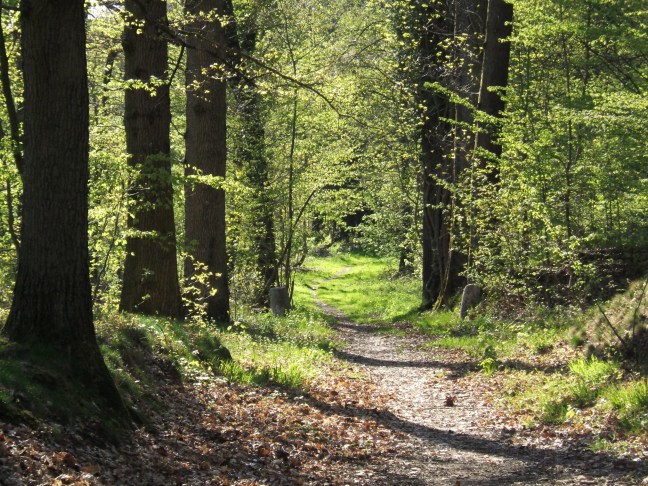
Almost four years ago, I moved to an area across the street from a park that had a four mile trail along the Chattahoochee. I walked or ran that trail several times a week for the year and a half I lived there, often with Tiger or Brock (or both) in tow. I knew its every twist, anticipated its every turn. I could anticipate the areas that would become impassable with rain and the sections that would crack and split in the heat of the summer. I was one with the rhythm of that trail, every step metered to match its demands. I could traverse its terrain almost subconsciously, as its topography was etched into my brain.

Once we moved, my almost-daily visits to this particular trail trickled to once every couple months. On one visit, not too long after the relocation, I stopped short on a particular section of the path. The trail used to continue straight ahead, dipping down into a creek where you had to cross over carefully placed stones, before climbing again on the other side. On this day, the trail in front had been disguised, tree limbs and stones dragged onto its packed soil to dissuade use while a new trail, still rough and somewhat undefined, veered off to the right and wound around the peak, meeting up with the old trail on the other side of the creek.

I resisted the urge to blaze ahead through the old, familiar trail. Instead, I tentatively took the new route. It was narrow, even treacherous in places, as it had yet to carry many feet along its virgin soil. It felt awkward traversing this new path within a known hike. Alien. It forced my brain out of its subconscious attention into a more focused space. I had not learned where every root or every rock lie in wait to catch an unsuspecting foot. I didn’t know which rocks across the water were secure and which only offered the illusion of a firm foothold. I felt myself slow as I paid attention to every detail until I was back on familiar ground.

With each visit, that new section of trail became more worn and more defined as the old trail slowly disappeared into the woods. Today, I realized that the old trail was indistinguishable from the surrounding woods; the only way it exists now is in the memory of those who have walked its path. And the new trail is now wide and firm, secure where it was treacherous and explicit where it was was subtle.

It’s uncomfortable when our paths are rerouted. It’s natural to resist the change. Walk it enough, however, and what was new and uncomfortable simply becomes the norm.


The Types of Friends You Need During Divorce

It is normal for your marriage to be at the center of your social life. You have a built-in activity partner. You share friends. The “plus one” is expected when you receive an invitation.

And then the marriage dies.

Your go-to is gone. The mutual friends may be divvied up like a bag of Skittles, or they may simply scatter as though the bag of candy was dropped to the floor.

It is tempting to hide. To hibernate. You may want to pull the covers over your head and not come out until the debris field has been cleared. It’s tempting, but it won’t help you heal. Think of the skin under a bandage that has been left on too long. Is that what you want your heart to look like?  Click here to read the rest.

Spring Bouquet

I am practically jumping out of my skin. As soon as the morning rush hour dies down (assuming I can be patient that long), I’m driving across town to my favorite discount plant nursery. This place and the planting that followed used to be a spring break ritual for me. I eagerly anticipated the trip, making lists and amending them as their availability page updated. I would fill my car with a hundred small plants (what? they’re cheap!), carefully stacking and wedging pots. The day would be spent planting – the soil my canvas and the plants, my paint.

After the divorce and the subsequent loss of the house, I missed my spring ritual. I mourned the loss of my garden and my daily walks within its walls. I ached for the sight of the new growth pushing through the soil every spring. I wondered how my plants, carefully tended from small starters, were faring under their new owners. My spirit felt the empty hole left by the removal of my garden.

I substituted a membership to the botanical gardens for my own, finding some connection to the soil and nature’s rhythm in that public space.

But it was never the same.

And I wondered if it would ever be.

bulb-care-daff

We moved into this house in September. One of the reasons we chose the house was its outdoor space. It was full of potential. While waiting for the house to close, I brainstormed a list of plants I wanted to acquire that would complement the space. I started painting the garden in my mind, filling the space with blooms and greenery.

Yet I resisted actually getting my hands dirty.

Some of it was practical.

I was busy painting and moving and setting up the interior space. It was a cold and wet fall, not ideal for planting. And, as the yard and I had just been introduced, I felt like I needed to get to know it a bit better before I went sinking my hands into its depths.

But some of it was emotional.

I poured a lot of my soul into my old garden. And its loss was painful. So painful, that I wasn’t sure I ever wanted to start again. I had become accustomed to being mobile. Setting down literal roots is a commitment. And I wasn’t sure I could handle that risk.

I planned to do some planting this spring, but I didn’t have my old excitement, my old drive, about it. It was matter-of-fact.

Until I pulled up the plant availability page at my favorite nursery two weeks ago.

And then I got giddy. Alive with excitement and possibility.

So now, here I am. My fingers are twitching in anticipation of the trowel. A tarp lies in wait in my trunk, ready to accept its verdant cargo. The beds have been weeded and the trees trimmed. The compost and fertilizer are staged at the side of the yard. All I need are the plants. And some patience:)

I have a garden again.

Colorful_spring_garden


In honor of the re-establishment of my spring ritual, here is a bouquet of spring garden themed posts.They are partly about literal gardens. But they are also are metaphorical, highlighting the similarities between nature’s rhythms and our own. All have pictures that remind us that beauty follows even the harshest of winters and words that remind us not to be afraid to bloom.


The Garden

In my old life I had a garden.

When we first moved into our home, the 1 acre yard was a motley medley of scraggly grass and tenacious weeds; too wet to mow and too shady for grass to thrive. It was a blank canvas. Slowly, I began to paint, using the medium of small starter plants, tree seedlings obtained from the forestry department, and cuttings and divisions nurtured from friends and neighbors. Click to read the rest.


The Beauty of an Early Spring Garden is in the Details

At first glance, the early spring garden is barren. There are few leaves, few flowers, no raucous plants fighting for attention. It is a different garden.

The beauty of an early spring garden is in the details, subtle interplay of color and texture, and the bright green of new growth tentatively poking its head though the soil. In order to see the beauty, the quiet spectacle that is the wakening garden, one must be patient and in tune with the rhythm of life. Click to read the rest.


Awakening From Hibernation

Ahh, February. It’s not quite spring but we are well over winter. In the south, the trees and flowers are jut beginning to stir. The first signs of the cherry blossoms have appeared. The daffodils are letting their yellow undercoats peek out at the tepid sun. Tree branches are rounded with the soft buds of the new leaves. The stirrings are not limited to the plants. Joggers are beginning to fill the trails, especially on those days between cold and rain fronts. The squirrels are out in force, digging up the acorns they buried months ago. The birds have lifted their self-imposed ban on song and their chirps and warbles fill the mornings once again.

It’s natural to hibernate when the world outside becomes too harsh to bear. It’s instinctive to curl up and tuck in, settling into a protective stasis. We do it annually to some extent as we follow the natural rhythms of shorter days and colder nights. We tend to narrow our worlds in the winter, paring back and slowing down. It is a time of restoration. Click to read the rest.


When Will I Feel Better?

“When will I feel better?”

This is perhaps the question I hear the most often.

And it is also the most difficult question to answer.

Because there is no single answer.

Healing does not speak calendar.

Feeling better has nothing to do with lunar cycles or landmark anniversaries.

It operates on a different timeline for everybody, depending upon the circumstances, prior experiences, coping skills and support systems. Some may feel better in weeks, while others take years. One person may appear to be healed while holding in the pain while another wears the pain until it wears off. Feeling better is not linear. It is more the slow decrease of bad moments intermixed with the increase of good than a step by step progression.

Feeling better depends upon perspective. You have to remember how bad bad could be to realize that it’s not so bad anymore. Healing is often subtle. The pain may have come in a great crashing wave, but it recedes like the tide, slowly and often leaving pools behind.

Your progress should not be measure against the progress of others, only against the way you felt in the past. There are no shoulds, no benchmarks to meet. As long as you are making progress, you are okay. You can accept where you are in the moment while still striving to do better.

Some of healing is passive, simply standing by and letting time wash your wounds. But if that is your only approach, you will be limited. In order to truly feel better, you have to take an active role in the process. Fuel yourself with quality food, good sleep, exercise and social connections. Seek out therapy or participate in therapeutic writing.Learn to calm your mind through meditation or yoga or time in nature. Have mantras and goals and scheduled smiles.

The biggest lie we often tell others is, “I’m fine.”

It’s okay to not be fine at all times. It okay to need help or a hug.

The biggest lie we tell ourselves is, “I can’t.”

But you can.

You can feel better.

It may not happen when you want it to.

But it will happen when you need it to.

The way you feel right now is not the way you will feel tomorrow. Or next week.

Find peace in the process and inspiration in the intention.

And you’ll feel better.


Make It Better

I had no idea.

I had no idea when I started blogging that it would change the way I look at, well, everything.

I am a numbers gal. I like data and graphs, empirical evidence of cause and effect. But I’m also a relationship person. I like to build and nurture connections with people.

And blogging is interesting that way. The input in is words and the output is in relationships and data. And the data holds clues to building relationships.


Behind the scenes on any website, you get information about traffic and views. You can track visits over time and analyze the impact of certain posts or links. And for a numbers gal like me, that data is intoxicating. It’s like a full-time science experiment with little restraint, “Let’s see what happens if I try this.”

After a few months blogging, I noticed an interesting pattern. From day to day, week to week and month to month, all of my data takes a cyclical pattern, growing and shrinking in a predictable wave.

wavelength

Simply the recognition of that pattern was comforting. In those early days, those troughs caused me to question, well, everything. It was easy to conclude that the downward slide would continue until my site was obsolete. Remember that I didn’t see myself as a writer. Just a math teacher who happened to have a story. But every time, with no clear reason, the pendulum would shift and the readers would come again. I learned to find comfort in the pattern, secure in the belief that the pattern would continue.

But that wasn’t enough. After all, a science experience where you simply observe is no fun at all. So I started to increase my efforts every time the numbers would fall. I would post more frequently, seek out new readers and new platforms and generally market like crazy. My goal was to raise the troughs to the level of the crests.

The interesting part? It didn’t work.

I mean, the numbers would increase again, but only in the same pattern as before. Yet I would be exhausted for the efforts. Perhaps because efforts during ebbs are often driven by fear and frustration. And they’re lousy drivers.

So I changed tactics. When the numbers indicated a trough, I stayed steady. But when a crest approached, I got busy. I realized it was easier to build at the top. I was excited and my energy was contagious. Leads seemed to come from everywhere and links would pour in. The good mojo would feed my creativity and the words would flow from my fingers.

And you know what?

It worked.

The amplitude increased, each crest a little higher than the one before. And those dips? Well, they also stepped up and weren’t quite as dippy.

And I wasn’t exhausted after the cycle of increased effort. In fact, I felt energized.

When something is good, it is easy to make it better.

As a numbers gal, I see patterns everywhere. And, as I learned to recognize and work with this cyclical pattern in blogging, I began to see it in other areas of my life.

My students’ progress ebbs and flows throughout the year.

My fitness seems to build only to fall again due to injury or illness.

My writing inspiration comes in waves (usually with ill-timing!).

Money comes and goes.

Social events arrive in waves.

And, most interestingly, my relationships seem to be on a similar wavelength, with periods of greater intimacy and connection followed by times of more detachment.

And that was eye-opening.

As someone who has been betrayed and abandoned, it is all too easy to interpret that downward trend as an inevitable slide towards the death of a relationship.

When in reality, it’s just part of a normal pattern.

Periods of growth are often followed by periods of rest.

Just look around you.

After my experiments on the blog proved successful, I decided to try them on my marriage.

I put my efforts into making the good times even better. To build even greater intimacy and connection at those times when everything seemed to just flow. And when I feel more distance, I don’t without effort, but I also don’t expend extra. I just recognize it as a period of rest before the next wave.

And you know what?

It works.

The crests get higher, pulling the troughs up as well. Every effort is magnified. The good feelings are multiplied.

Just like the best way to build yourself up is to help build up those around you.

And the best part?

Energy spent making the good even better isn’t draining. It’s rewarding.

Look around your life.

Do you see cycles?

Periods of ebb and flow.

You can fight the ebb.

You can go with the flow.

Or you can can work to amplify each pinnacle, reaching new heights with every period of growth.

Making the good even better.

There’s no limit to what you can reach.