Opportunity

According to Cesar Millan, every bad moment is an opportunity for rehabilitation.

He doesn’t panic when a dog lunges.

He doesn’t get angry when they try to bite.

He doesn’t give up when the dog snaps.

He simply sees the moment as an opportunity.

A moment to show the dog another choice. A different way of responding. A different way of being.

I could have used Cesar the other day.

No, I didn’t try to bite anyone.

But my past tried to bite me.

Brock and I signed up for a house fund registry which meant that a significant portion of our wedding gifts were in the form of money in a joint Paypal account.  We had the agreement that all funds gifted would be applied towards the house with joint decisions. All good.

And then, one morning when I checked my email between classes, I see that $500 had been withdrawn from the account. The email didn’t tell me where the money went or what the intent was behind the transfer.

It just told me that money had been taken.

It just triggered panic in my gut.

I had to endure the entire day before I would have time to log in to Paypal to see the intended destination of the funds or to ask Brock about the transfer.

My past tried to tell me that this was a nefarious move on some level – either trying to hide money or deciding to move forward on a purchase without discussion.

My past made it a bad moment.

My present recognized it as an opportunity for rehabilitation.

In my former life, I would have a) found a way to call my husband right away and demand to know what was going on (see Assumptions) or b) let my panic and anger build through the day as I imagined all of the potential scenarios that could be unraveling.

But this was an opportunity to make a choice.

This was a chance to respond differently.

I started by relaxing. Telling myself repeatedly to take deep breaths to calm the panic in the gut (that would make a good band name:) ). I reminded myself that my response was from the past, triggered by my fears of being betrayed again. My reaction had nothing to do with Brock or the actual situation at hand. I decided to believe that everything was okay. But I also made the decision to check once I got home. Not with Brock, since it was really my problem, but with Paypal.

Trust but verify.

By the time I arrived home, I wasn’t panicked. I wasn’t angry.

I didn’t even run to my computer to log in to Paypal.

But I also didn’t avoid it either.

When I finally did look at the account, I was calm. Rational. Thinking with my present mind rather than with the alarmed mind of the past. I could see clearly and interpret the numbers.

The $500? It was moved into our joint savings account. The amount was set by Paypal’s limits.

I walked down the hall to where Brock was sitting at his computer, wrapped my arms around his shoulders.

“Thank you for starting to move the money into our savings.”

I never told him about my panic. That’s not his responsibility.

I’m the one who has to whisper my own life and see opportunity for rehabilitation in every bad moment.

Lesson learned:)


(Ass)umptions

I read a post this morning by Matt on You Must Be This Tall to Ride that got me thinking about assumptions. Assumptions, both intentional and otherwise, have played a major role in my healing and my view on relationships.

We make assumptions to fill in gaps in information. Our brains hate these voids and they seek to fill them with what makes sense to us and aligns with our views of ourselves and the world (related: How to Apply Labels).  At the end of a relationship, these assumptions can take three main forms: Self Blame, Other Blame and Compassion.

Self Blame

This is often where the depression after a breakup can come into play. You see yourself as broken, defective. You assume that bad things happen to you because you are somehow bad. Or weak. Or unlovable.

In my case, I went through periods where I assumed he left because I was too horrible to be with. I believed that I must have done something so terrible that he had to lie and leave. These beliefs were fed by others who asked what I did to cause him to respond in such a way and, most painfully, these assumptions were reinforced by the suicide (attempted) email he sent my mom and his other wife. He wanted me to assume full blame and, for a time, I did. I believed I was unlovable.

Self blame is a slippery slope. Others often encourage it. The more you look for it, the more it is reinforced. It can have an element of martyrdom, “I sacrificed myself…” Taking responsibility is good; assuming all culpability, however, retards healing.

Other Blame

These are the assumptions that hold us in the victim role. This is where we assume that the intent of the other is to inflict harm and that every action has a malignant motivation.

I was an expert in this one. I assumed he carefully crafted his deceptions solely to harm me. I pictured him calculating the most painful responses, the most hurtful actions and then carrying them out while delighting in my pain. I assumed that he must have some sort of personality disorder and that he was incapable of empathy or pain of his own. I believed that he never loved me and that he was simply a puppet master for 16 years.

It’s interesting and upsetting for me to realize that I even acted this way at times within the marriage. If he did something “wrong” (like forgetting to let the dogs out), I assumed it was intentional. I held both of us to such standards that mistakes were not allowed. Ouch.

Other blame is comfortable. It preserves our own self worth while avoiding any responsibility. It’s a self-feeding cycle that can be difficult to break. But just like assuming all responsibility does not allow healing, avoiding it also keeps you stuck.

Compassion

Assumptions are made when we lack knowledge or understanding. As information comes in, it is important to release or readjust the assumptions. At the end of a relationship, it is easy to picture your ex as your adversary, attacking with a sharpened blade. That blade is often double-edged, harming each partner in its own way.

In my case, I have never had a conversation with my ex to hear his side. I don’t expect I ever will. I have had to fill in the gaps, acquire the information on my own, in order to try to adjust my maladaptive assumptions. (related: Forgiveness 101)

Instead of talking to him, I have listened to the stories of others. Asked questions. And listened to responses.

With each new piece, I adjusted my assumptions.

I now assume that his troubles were rooted in childhood and triggered by the loss of a job and subsequent earning potential.

I now assume that he struggled with addiction in some form that possibly started with the job loss or even before.

I now assume that he did love me. But now I know that love for another is not enough.

I now assume that he was in pain. Lost. Scared. It doesn’t excuse his choices, but it helps me to understand them.

None of those may be true. But it doesn’t really matter. Rather than place blame, they bring compassion. Peace. Understanding.

If I find out more information, I will adjust them again. However, for now, those assumptions are fine. Balanced. Rooted in understanding rather than blame.

I have also softened quite a bit in my new marriage. When I make assumptions of intent, I err on the side of compassion. If Brock forgets something, I first inquire about stress at work or worry about a friend. It’s not always on point, but it does no harm to assume the positive while you’re gathering information.

The saying is that assumptions make an ass out of you and me. They certainly can. But only if you are as stubborn as an ass and refuse to alter your assumptions with time and knowledge.

What’s more important to you – holding on to your assumptions or finding peace?

I thought so:)

On My Terms

My cat has always been affectionate.

But she has only recently become wise.

For most of her 17 years, she would only allow affection on her terms. If she was picked up, she would squirm out while uttering an irritated yowl. If she was caressed, she would walk away, only to return later to demand attention when she was ready.

When she was the affection instigator, she would stay still for hours, soaking up the strokes and vibrating the air with her purrs.

She loved to be loved. But only on her terms.

At some point in her advancing years, she must have calculated that by accepting affection only on her terms, she was limiting the amount of attention she would receive. Perhaps she learned this from watching the dogs, who were always willing to accept care, even if it interrupted their important activities.

She still approaches and asks for affection when she wants it. But now she accepts it when it is offered. Instead of jumping out of encircling embraces, she snuggles in and closes her eyes in feline ecstasy. Instead of running away from an approaching hand, she now meets it halfway, stroking herself along her head.

She learned to accept love. Even if is wasn’t on her terms.

And I learned from watching her.

I suppose you could say that my ex was fluent in my love languages; he knew how to express affection and love to me in a way that I understood.

When Brock and I first started dating, I was much like my cat in her younger days. I wanted affection on my terms: at a time when I wanted it and in a method I preferred. When it was offered at a different time or in a different format, I would turn away.

Around the same time, I read The Five Love Languages by Gary Chapman. It opened my eyes in two ways, one which Chapman intended. And another that he did not.

First, the book helped me to realize how Brock expressed affection. Some things that I found silly or irritating (when they interrupted my flow) were actually his way of expressing love. Just recognizing that changed my response to those actions. I approached rather than turn away.

The book advocates sharing your love language with your partner and then helping him or her learn how to speak your language.

This is where I disagree.

I am not going to travel to Italy and expect them to learn English.

Nor am I going to enter into a relationship and demand that he learn to speak my love language.

That’s accepting love only on my terms.

And, as my cat learned, that’s limiting.

My cat still teaches us how she likes to be petted, guiding hands to her favorites spots. But she still enjoys the attention even when we miss the mark.

You can teach your partner how you like to receive love. But accept his or her gifts even when they are in a different form.

Instead of expecting your partner to convert to your language, try learning to recognize and accept theirs. You may be surprised at how much love is there when you are receptive instead of critical.

And, as the cat has learned, purrs are better than yowls any day.

My Husband Walked Into a Bar

My husband was out of town for business this past week.

As I’m winding down for the evening, I receive the following text:

Sitting at the bar of the steak house that I am at and there is a woman in her 70s who is cracking me up.

My response?

That’s the kind of woman I want you to pick up in bars:)

He chatted with this lady through the evening, sharing pieces of their conversation with me.

She was in her mid 70s and was recently widowed after being married for 50 years.

50 years.

With the same person.

And then they’re gone.

Wow.

I remember how alien it was to be alone after 16 years.

But that’s a drop in the bucket.

My husband was drawn to this woman’s energy. She had made the decision to fully embrace this next chapter of her life, even though it wasn’t asked for.

She got a tattoo. On her butt.

She dates younger men. Plural. Her pick line? “Do you have life alert? I’ve fallen for you and can’t get up.”

She is going ziplining this week and told stories of her other adventures.

She didn’t use the excuse, “I’m too old.” She didn’t live in the past, although she didn’t forget it either.

She shared a bit of marital advice with my husband.

Write notes. Lots of them.

She went on to talk about how her husband left her notes on an almost daily basis. She laughed about it at the time since their frequency made them not-so-special.

But then he became ill. And he died.

And now she looks back at the notes and smiles, remembering the relationship.

And now she realizes that even if each note may not have seemed special at the time, the accumulation of them is priceless because it speaks of the affection and bond held through the years.

I understand.

Brock and I are note writers. It’s amazing the power of a few simple words or a smily face can have on your mood and outlook. I have a folder filled with the ones I have received from him over the years. I hope I’ll need a box to hold them before the end.

I enjoyed my by proxy evening with the this woman – a reminder that you are never too old, that you can fully embrace life after unwanted change and to never take yourself too seriously.

I think I’ll hold off on that gluteal tattoo, however:)

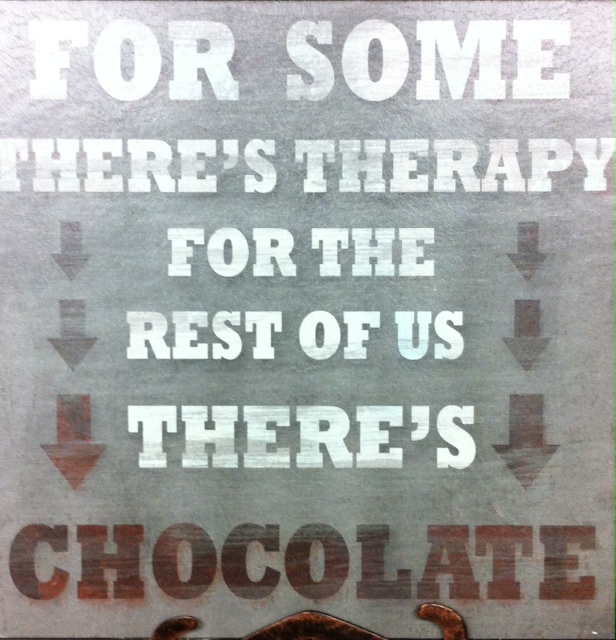
Wrapped in Words

It’s been a rough few weeks at work. I took the time today to read the signs that are posted throughout the school. They helped bring a smile to my face and gave me a renewed sense of energy and purpose (and a few giggles).

I hope they can do the same for you:)

photo-306 photo-307 photo-309 photo-310 photo-311 photo-312 photo-313 photo-314 photo-315 photo-316 photo-317 photo-318 photo-320